Before founding his own structure, Jim Valentino wrote and drew a series of space superheroes for several years for a major house, and this is not the team that the films made famous. The title is the same, the cast is entirely different: the one from 1990 takes place in the thirty-first century with other characters. The market takes this into account. As of August 29, 2026, crude oil shows $6.98 median asking out of 179 advertisements, with numbers at $0.99.
It is the longest continuing work of this author, the least associated with his name, and the one which suffers the most from identity confusion.
This article draws the distinction from the films team, explains what the reading shows, explains a research bias that distorts comparisons, and advises what to buy.
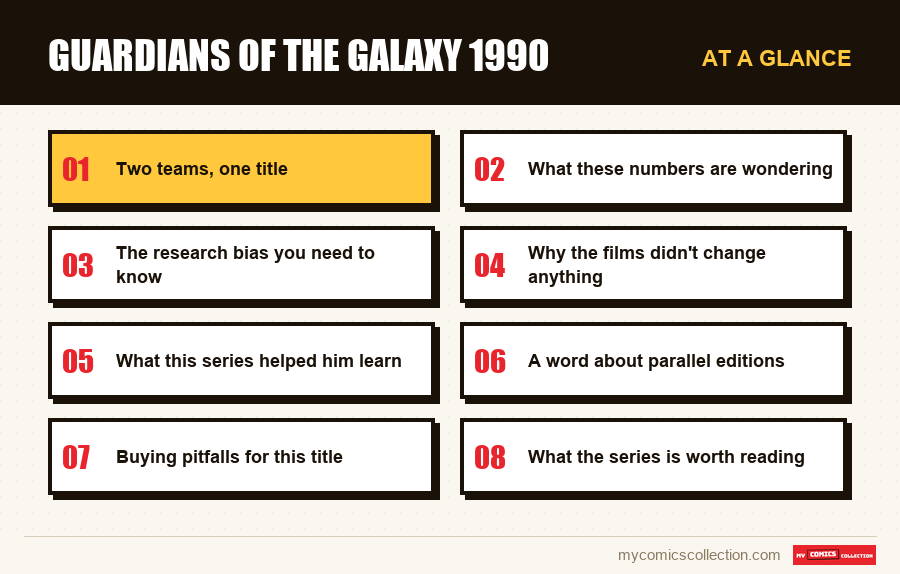
Two teams, one title
This is the founding distinction, and it alone resolves the majority of misunderstandings about this series.
The series written and drawn by this author from 1990 features a team located in the thirty-first century: characters from a distant future, in a ravaged universe, with their own history and their own issues.
The team that the general public today associates with this title appeared much later, in a later series with no direct continuity link. These are two different groups with the same collective name, separated by almost twenty years.
The consequence is immediate for a buyer: the 1990 issues do not contain any of the characters seen on screen. A reader who comes via the films will find nothing of what they are looking for, and this is the first cause of disappointment with this title.
What these numbers are wondering
The following is from fixed price listings taken on August 29, 2026, with raw and certified copies counted separately. An asking price is what a seller hopes for, not what a buyer paid.
The body of the series
179 ads raw, of 0.99 to $229.99 requested, median $6.98. Several mid-series issues at $1.00.
A considerable abundance for a series of three decades.
The certified side
7 ads, of $32.50 to $199.99 requested, median $80.00. Few in number compared to the gross supply.
The ratio is approximately one certified ad for every twenty-five raws.
A second, wider measurement
A search for title and year without mentioning the author returns 162 ads raw, median $14.99, And 14 ads certified, median $100.00.
A gap that questions
Two raw medians for the same series: 6.98 et $14.99. The gap does not describe an evolution but a difference in the population surveyed.
The research bias you need to know
This discrepancy is worth explaining, because it traps anyone who compares readings without looking at how they were obtained.
The two measurements relate to the same series but do not report the same announcements. Mentioning the author's name in a search selects sellers who have written it in their title, and these are mainly sellers of current numbers, who fill their ad title with all the words available.
Sellers of wanted numbers proceed differently: they highlight the character, the rank of the number, or the event it contains. The name of the designer appears less often, because it is not the selling point.
Result: the search by author preferentially goes to the bottom of the distribution, and the search by title covers the whole. The $6.98 describes the series background, the $14.99 the set with its notable numbers.
The lesson goes beyond this case: a market figure means nothing without the query that produced it. Two readings from the same day on the same series can differ by a factor of two without any being false.
What this gap does not prove. It would be tempting to read that the issues signed by this author are worth less than the other issues of the series: which would make no sense, since he signed almost all of them.
Both measures describe samples, not actual subsets. This is exactly the type of confusion that produces false claims about author ratings.
Why the films didn't change anything
A series of blockbuster films have had the same title for a decade, and the market for these numbers bears no visible trace of it. The explanation is straightforward.
The characters don't match. A spectator who seeks the origins of what he has seen is directed towards a much later series. The 1990 numbers are not in his career.
The circulation was considerable. This period printed massively, and the supply remains overabundant thirty years later - 179 advertisements for a single title bear witness to this.
No number in the series attracts attention. Without a cult first issue or a major appearance identified, there is no reference on which a request could be based.
These three causes reinforce each other. An adaptation only values what it designates, and this designates something other than these numbers.
What this series helped him learn
Replaced in his journey, this period takes on a meaning that reading in isolation does not give.
Writing and drawing a monthly series alone for several years, at a large house, with a schedule from which we do not deviate, constitutes training of a particular kind. We learn to maintain a rhythm, to finish what we start, and to manage a team of characters over time.
This is exactly what an author needs when he is about to found his own structure and publish his own series there. The production discipline acquired here is what made the sequel possible, much more than the notoriety that is generally attributed to him.
We can check this by reading in order: the space series first, the vigilante series then. The division habits, the way of distributing information over several issues, the treatment of supporting roles: all this is already in place before the change of publisher.
What changes next is not the know-how but the freedom of subject. The profession was learned here, at the rate of one issue per month.
A word about parallel editions
A particularity of the period deserves an explanation, because it appears in the ad titles without always being understood.
The publications of these years circulated through two distinct circuits (general points of sale on one side, specialized shops on the other) and the copies intended for each sometimes bore different mentions on the cover.
These variants have nothing to do with modern alternative covers: the content is identical and the difference lies in the circuitry. Their interest is in conservation rather than rarity: the copies passed through specialized stores were generally better handled and better stored than those lying around on a supermarket display.
The survey does not recognize any systematic premium on them, which is consistent with the general abundance of the period. In the same condition and at the same price, the mention nevertheless remains a useful clue to the probable history of the copy.
Collecting this series?
Track what you own, what you are missing and what your collection is worth. 7 day trial.
Start my trial →Buying pitfalls for this title
The wrong team expected
A buyer coming through the films will not find any of the screen characters in these issues.
Homogeneous series
Several series bear this title decades apart, each numbered starting from one.
Incomparable readings
Two searches on the same series give a median of $6.98 and $14.99. Comparing without checking the query is misleading.
Parallel editions
The period distinguished several sales channels, mention sometimes made on the cover, sometimes not.
What the series is worth reading
A direct assessment is necessary, because the two reputations that weigh on this title are misleading.
The first is that of the period: mass production, rapid execution, calibrated stories. The second is that of the implicit comparison with what the title subsequently became.
Neither does justice to what is there. It is a long-term space adventure series, written and drawn by the same person for several years, which was already unusual in this editorial framework: the norm being the division of labor between several contributors.
This unity of hand is visible. The tone remains constant, the secondary characters return with consistency, and the threads started find continuations: benefits of a single author that no rotating team obtains.
What it doesn't have: formal ambition. It is a genre series, produced within the constraints of its time, which does not seek to go beyond them. At $1.00 per issue, the requirement can reasonably be adjusted.
What to buy
The recommendation is simple and results from the prices recorded.
Buy a mid-series set. The $0.99 and $1.00 issues are numerous and give an exact idea of what the series is, without going through a first issue which has nothing to indicate that it is better.
Don't look for a certified copy. Seven listings for the set, at $80.00 median: the report with one-dollar raw numbers prohibits any justification other than the taste of the sealed item.
Group from the same seller. At these prices, shipping completely dominates the cost, and it's the only parameter a buyer has any real control over here.
What to record
On this title, the decisive field designates the team and not the number, otherwise the sheet mixes unrelated series.
The generation of characters contained in the issue. Several series carry this title decades apart with entirely different casts, all numbered starting from one. Noting “team of the thirty-first century” or its equivalent is what keeps a collection from becoming a pileup of indistinguishable number ones.
It's also what allows us to answer, in front of a baccalaureate, the only question that matters: is it the series that I follow, or its namesake?
The original distribution circuit when it is mentioned on the cover, this period having distinguished several circuits whose print runs and conservation differ significantly.
These two fields deal with an ambiguity that the title maintains and that the number aggravates: a situation where the inventory does a job that no physical classification can do in its place.
Frequently asked questions
No, and that's the first thing to know. The 1990 series features a team set in the thirty-first century, with its own characters and its own story. That of the general public appeared almost twenty years later in a subsequent series. No characters seen on screen appear in these issues.
Because the two searches do not return the same advertisements. Mentioning the author selects sellers who write it in their title: especially sellers of current issues. Searching by title covers everything. The $6.98 describes the series background, the $14.99 the set with its notable numbers.
Nothing indicates it. Three causes combine: the characters do not correspond, the circulation of the period was considerable, and no issue of this series attracts attention due to the lack of a major appearance identified. An adaptation only values what it designates.
By any of the mid series, available at $0.99 or $1.00. There's no indication that the first issue is better, and a lot gives a much more accurate idea of what the series is like: knowing that at these prices shipping dominates the cost, group from the same seller.
It's his longest continuous work, and the unity of the hand shows: constant tone, coherent secondary characters, threads that find sequels: benefits that a rotating team does not obtain. What she doesn't have is the formal ambition of her 1980s parody, which remains her most personal work.
Which team, which generation?
Several series bear this title, all numbered starting from one.