In short
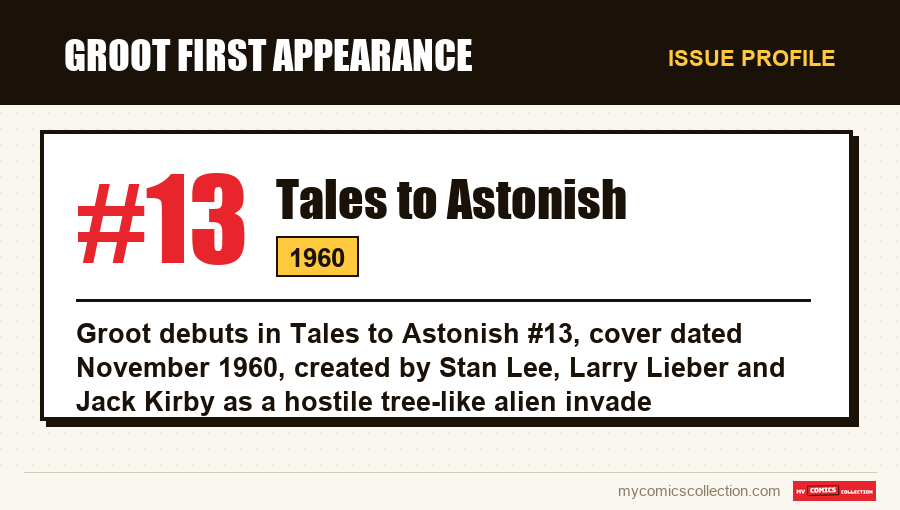
The tree-like invader Groot debuts in Tales to Astonish #13 (cover date November 1960), in a story titled "I Challenged... Groot! The Monster from Planet X!" Credited creators: Stan Lee, Larry Lieber, Jack Kirby, with Dick Ayers on inks. In this issue Groot is a tree-like alien invader who intends to capture humans for experimentation. He is not the gentle Guardian of the Galaxy that readers know from 2008 and the 2014 film.
Some key issues earn their reputation slowly, through decades of collector talk. Tales to Astonish #13 earned its reputation in a different way: a monster story from the fall of 1960 sat in an anthology comic for almost half a century, then a revived character with the same name gave it a second life. This guide treats the number itself, what it contains, who made it, and what a careful buyer should look at before paying for a copy.
Before writing, we confirmed the November 1960 date, the three-name credit, the story title, and each later appearance listed near the end. The synopsis stays short on purpose, and the section on why the issue matters is plain collecting logic, with no market figure behind it.
Cover date, series volume, and the three-name credit
Tales to Astonish #13 carries a cover date of November 1960. The comic sits in volume one of a title that launched with a January 1959 cover date, and the Atlas banner covers issues #1 through #34. The Marvel imprint name appears on the series from issue #21, which is dated July 1961, so number 13 falls squarely in the earlier, pre-superhero stretch of the run.
The credited creators of Groot are Stan Lee, Larry Lieber, and Jack Kirby. When you write the credit line for a collection record, the safest form is "Lee, Lieber, Kirby" with the character noted as the first appearance of Groot. Dick Ayers inked the story. The headline story is titled "I Challenged... Groot! The Monster from Planet X!", and that title tells you most of what you need to know about the genre: a challenge, a creature from another world, an exclamation mark at the end of every phrase.
This is a point worth stating plainly for anyone who searches for "Groot first appearance" and expects a cosmic adventure. The 1960 issue belongs with the monster and science-fiction anthology stories of those years: a short tale built around a single idea, and Groot is the idea.
How Groot is introduced in the story
In the 1960 story, Groot arrives as an alien, tree-like invader. His purpose is to capture human beings for experimentation. That single line of plot is what the issue contributes to the character, and it is a long way from the creature who later speaks three words and protects a raccoon.
The story's resolution has an unexpected, almost comic edge. Groot is apparently destroyed by termites released by a human character named Leslie Evans. The termite ending is the detail that collectors remember, because it shows how the Atlas-era monster stories often worked: a menacing creature, a clever human response, and a final page that closes the case quickly. The word "apparently" is deliberate: the creature is only apparently destroyed, and the character did return decades later.
It is useful to separate three things when you read or describe this issue. First, Groot's species and origin in 1960: an extraterrestrial plant-like being from a distant world, called the Monster from Planet X in the title. Second, Groot's intentions: hostile, and aimed at human subjects. Third, Groot's appearance: tree-like, which is the visual idea that survives into every later version. Anything beyond those three points, including the character's later size, speech, and loyalty, belongs to later writers and artists.
Who made it, and the editorial setting of 1960
Three names share the creator credit: Stan Lee, Larry Lieber, and Jack Kirby. Kirby penciled this story, and Dick Ayers inked it, so four people in all put their hands on the pages a reader sees.
A three-name credit does not tell us who contributed which beat of this specific story, so a collector should treat the credit as shared and not assign Groot's design to one name. The safest record keeps all three creators together, with the inker noted separately.
The anthology format is the other piece of context. In 1960, a comic like Tales to Astonish sold on the strength of its covers and its mix of short, self-contained stories, not on a continuing hero. Characters appeared once, were defeated on the last page, and were not expected to come back. The superhero line that changed the publisher's fortunes was still ahead: Hank Pym, for instance, first appears in this same series in issue #27, dated January 1962, and becomes Ant-Man in issue #35, dated September 1962.
For deeper background on collecting comics from this publisher's pre-superhero years, the guide to Atlas-era comics explains how those anthology titles are graded, stored, and priced in relative terms. For the artist, the Jack Kirby profile places this assignment in the larger arc of his work for the company.
Why this number is a key issue
A first appearance becomes a key issue when two conditions meet: the character matters later, and the original issue is hard to find in good condition. Tales to Astonish #13 meets both, but in an unusual order. For most of its life the issue was a curiosity, a monster story with a cover date from the early Atlas years. The character's later prominence is what turned the curiosity into a target.
The turn came in the mid-2000s. Groot returned in the six-issue limited series Nick Fury's Howling Commandos in 2006, then in Annihilation: Conquest and Annihilation: Conquest: Star-Lord. The character was reintroduced in 2006 as a heroic, noble being, which is the opposite of the 1960 invader. Groot then joined the Guardians of the Galaxy series that ran until its cancellation with issue #25 in 2010, and remained a fixture of that team. In 2014, Vin Diesel voiced Groot in the film Guardians of the Galaxy, which brought the character to a general audience.
That sequence explains the logic of the key-issue status. Collectors who meet Groot through the film or the team book search for "Groot first appearance," and the answer is a 1960 anthology comic with a monster on the cover. The demand comes from the character, but the object is an anthology comic from 1960, so copies in high grade are naturally hard to find.
There is also a conceptual reason collectors value it. The 1960 Groot and the 2008 Groot share a name, a tree-like body, and a place in the publisher's history, yet they serve opposite narrative roles. A first appearance with that much distance from the modern character is a conversation piece. It is easy to explain to another collector in one sentence: the monster who became a Guardian.
A caution follows from this. Do not describe the 1960 issue as the debut of the Guardians member, because the Guardians version is a later reinvention. In a catalog entry, "first appearance of Groot" is accurate. "First appearance of Groot of the Guardians of the Galaxy" is not, and it would invite correction from an informed buyer.
For the character's whole path through the decades, the guide on Groot's comics story follows the long gap between the Atlas-era debut and the cosmic revival. This page keeps its focus on the debut issue.
Do you collect this series?
Track what you own, what you are missing and what your collection is worth. 7-day trial.
Start my trial →
Reprints, collected editions, and issues often confused with it
A collector who wants to read the story without buying the 1960 comic has a clear option. Material from Tales to Astonish #13 is included in Rocket Raccoon & Groot: The Complete Collection, released on April 10, 2013. That volume gives you the story in a modern binding. It is a reading copy, and it does not replace the original comic in a collection of key issues.
Several other issues get mixed up with the debut in listings and in casual conversation, so it helps to name them. The first is The Incredible Hulk volume 2 Annual #5, dated October 1976, in which Groot appears alongside five other monsters drawn from the publisher's horror and science-fiction anthologies of the 1950s and 1960s. It is a real later appearance and a fair companion piece, but it is not the debut.
The second is The Sensational Spider-Man #-1, dated July 1997, where Groot appears in a nightmare of a young Peter Parker. That is a cameo in a flashback-themed issue, useful for a completist and unrelated to the debut story.
The third source of confusion is the 2008 Guardians of the Galaxy series. Because this is where Groot becomes a team member, some listings treat issues of that run as if they were the "Groot first appearance." They are not. They are the first issues of the modern Guardians roster, which is a different collecting question.
When you search an auction or a marketplace, the wording of the listing deserves a close read. The exact phrases to look for are the series title, the issue number 13, and the 1960 date. A listing that says "Tales to Astonish" without a number, or one that shows a different number in the photographs, is a different book. If the number on the cover and the date in the indicia do not agree with this guide, keep looking.
Inspecting a 1960 copy before paying
The following points are method, not price guidance. They apply to most comics from this period, and they matter more for number 13 because demand outpaces supply.
Confirm the identity first. Check the series title, the volume, the issue number, and the November 1960 cover date. Compare the cover design against the images in a trusted catalog. A coverless or incomplete copy sold as a reading copy is a legitimate category, but it should be labeled as such.
Look for restoration. Books from 1960 often show color touch, glued tears, replaced spine pieces, or cleaned stains. Restoration is not a defect in itself, but it must be disclosed, and it changes the category in which the copy belongs. A seller who cannot say whether a book is restored has not examined it carefully enough.
Read the label on a graded copy. If the comic is encapsulated, confirm that the label's title, issue number, and date match the book. Check whether the label notes a restoration or a page-quality remark. Compare the certification number with the service's own registry before you pay. For a loose copy, ask for photographs of the spine, corners, staples, and the interior of the back cover.
Inspect the staples and the spine. Rust at the staples, spine splits, and spine stress lines are the most common condition issues on a 1960 anthology comic. Ask for a close photograph of the spine and of the area around each staple.
Check page quality and completeness. Pages of this era are made of a paper that tans and becomes brittle over time. Ask whether the pages are off-white, tan, or brown, and whether the issue is complete, with every page and the full cover.
The guides on buying secondhand comics and on fakes and reprints turn these points into a checklist you can reuse across a collection.
Appearances that follow and are worth knowing
After the 1960 debut, Groot's publication history goes quiet for a long time. The list below is short on purpose, and each entry has been checked.
- The Incredible Hulk volume 2 Annual #5 (October 1976). Groot appears with five other monsters from Marvel's 1950s and 1960s horror anthologies. It is the earliest later appearance on this list and the natural second purchase for a collector tracing the character.
- The Sensational Spider-Man #-1 (July 1997). A nightmare appearance in the mind of a young Peter Parker.
- Nick Fury's Howling Commandos (2006). A six-issue limited series in which Groot reappears. The reintroduced Groot of 2006 is a heroic, noble being.
- Annihilation: Conquest and Annihilation: Conquest: Star-Lord. The cosmic setting where the modern Groot takes shape. The guide on Guardians of the Galaxy runs picks up the story from here.
- Guardians of the Galaxy (2008). The series in which Groot joins the team, a fixture until cancellation with issue #25 in 2010.
Frequently asked questions
The answer is Tales to Astonish #13, dated November 1960. The story is titled "I Challenged... Groot! The Monster from Planet X!" and is credited to Stan Lee, Larry Lieber, and Jack Kirby. In it, Groot is a tree-like alien invader who intends to capture humans for experimentation.
They share a name and a tree-like body, but they play opposite roles. The 1960 Groot is a hostile invader, while the version that appears from 2006 onward is portrayed as heroic and noble, and joins the Guardians of the Galaxy series in 2008. The 1960 issue is the original debut of the name.
Material from Tales to Astonish #13 is included in Rocket Raccoon & Groot: The Complete Collection, released on April 10, 2013. It is a modern collected edition, suitable for reading. It does not replace the 1960 comic in a collection of original key issues, but it presents the story in full.
Confirm the title, issue number 13, and the November 1960 date. Then look for restoration, rust at the staples, spine splits, and brittle or missing pages. On a graded copy, match the label to the book and check the certification number with the grading service. Ask for photographs of the actual copy.
A natural second step is The Incredible Hulk volume 2 Annual #5, dated October 1976, where Groot appears with five other monsters from the publisher's anthologies. After that, the cosmic revival begins with Nick Fury's Howling Commandos in 2006 and the 2008 Guardians of the Galaxy series.
Holding a copy of Tales to Astonish #13 or another Atlas-era anthology and unsure where it stands?
Estimate my comic