In short
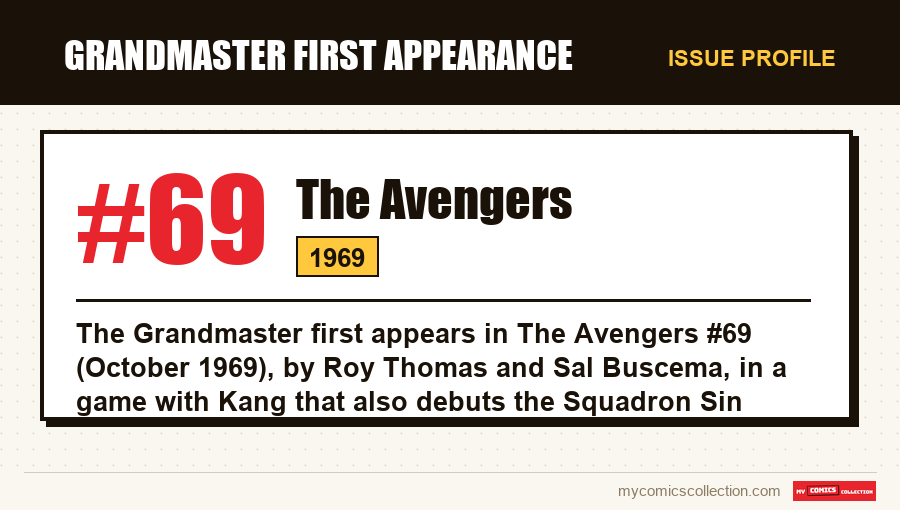
The Grandmaster first appears in The Avengers #69, cover-dated October 1969, written by Roy Thomas and drawn by Sal Buscema. He is En Dwi Gast, an Elder of the Universe, a cosmic gamemaster who treats conflict as a contest. In a story that opens here and runs through #71, he plays a game against Kang the Conqueror and uses the Avengers and a new team, the Squadron Sinister, as his pieces. That team makes its debut in the final panel of #69.
Marvel's Silver Age is full of villains who want power. The Grandmaster wants a game, and that difference is what makes the October 1969 issue of The Avengers unusual: the heroes are not fighting for their lives so much as being moved around a board by an immortal who cares about the outcome only as a result.
Credits, cover dates and the plot points below come from published publication histories of the Grandmaster, the Squadron Sinister and the Elders of the Universe; the notes on condition, grading and buying are analysis, and no market values are given.
The issue at a glance: The Avengers #69
Issue 69 of the original Avengers series is dated October 1969 on its cover. Roy Thomas is the writer and Sal Buscema the artist. Those are the two creators of the Grandmaster, and they are the credits to rely on. No inker, colorist or letterer is named here for this issue.
That restraint is worth copying when you read dealer descriptions. A 1969 listing that lists a complete credit chain may be filling gaps from memory, and a collector who wants a clean record should check the credits printed on the story's first page and keep the rest blank.
The number is also easy to blur with its neighbors. Volume one of The Avengers reached the 60s in 1969, and a sequence of covers from the same months can look alike in a thumbnail. Confirm the number 69 and the October 1969 date on the cover itself before assuming a listing is correct.
How the Grandmaster is introduced
The setup is a contest that runs across issues 69 to 71, dated October to December 1969. The Grandmaster plays a game against Kang the Conqueror, and the stakes are the power to resurrect Ravonna or to destroy Kang's planet. Each side fields pieces: the Avengers, chosen as Kang's champions, and a freshly created team of villains, the Squadron Sinister, assembled by the Grandmaster to oppose them.
The Squadron's four members are Doctor Spectrum, Hyperion, Nighthawk and the Whizzer. They were created to face Iron Man, Thor, Captain America and Goliath, who at that point was Clint Barton. The team is described as a pastiche of DC's Justice League, and Roy Thomas and Jerry Bails said in interviews that it was based on the Justice League of America. A collector who knows DC's roster will see the parallel immediately.
The Squadron makes its first appearance in the final panel of the issue, and that detail has a practical consequence. The Grandmaster's debut and the Squadron's debut share a cover date, and a buyer interested in either is looking at the same book. There is no need to hunt for a second number to obtain both.
The outcome is worth noting for how it differs from a standard superhero win. By the end of the arc in #71, the Black Knight has intervened, so the Avengers did not technically win their fight. The match, in other words, ends in a way neither side planned.
Who created him, and why he looks the way he does
Roy Thomas was the writer of The Avengers at this point, and Sal Buscema supplied the artwork. The Grandmaster belongs to a family of characters, the Elders of the Universe, and that family has a layered history of its own. The Collector, another Elder, was created earlier by Stan Lee and Don Heck and first appeared in The Avengers #28, cover-dated May 1966. The Elders as a named group came later, in The Avengers #174 in August 1978.
That chronology is one of the more important facts for a collector. The Grandmaster, in 1969, is a gamemaster with no stated membership in a larger group. The Elders label was attached afterward, and the group's roster was filled in by later writers. When a seller markets issue 69 as "the debut of the Elders", the claim overreaches; the Elders concept appears nearly a decade after this issue.
The name En Dwi Gast belongs to the character as he is described today. A collector reading the 1969 story should expect to meet him as the Grandmaster, a figure defined by his games, and treat the fuller biography as later development.
For the artist behind the issue, read the profile of Sal Buscema; for the neighboring numbers of the era, the Silver Age Avengers key issues list is the better map.
Why #69 is a key issue
There are three layers of demand. The first is the Grandmaster himself, a character who goes on to appear across decades of Marvel stories. The second is the Squadron Sinister, whose debut in the final panel opens a line of stories that would later be revisited. The third is the Silver Age Avengers run itself, a sequence that collectors pursue regardless of any debut.
The Grandmaster's later record supports the label. He challenges Death to a strategy game in Marvel Super Hero Contest of Champions #1 to #3 in 1982, with the Collector's resurrection as the prize. He returns in The Avengers Annual #16 in October 1987, and he appears in Silver Surfer volume three, issues 4, 10 and 17, between 1987 and 1988, in the storyline where the Elders conspire against Galactus. In JLA/Avengers #1 to #4, from September 2003 to February 2004, he sets the two teams against each other in a scavenger hunt.
Later still, he recreates the Squadron Sinister in Thunderbolts #106 in November 2006, and in Hulk volume two #10 in April 2009 he promises the Hulk the return of Jarella if the Hulk wins a fight to the death; in #12 of that series he is apparently killed by Red Hulk. More recently, in The Avengers #675 in March 2018, he forms a version of the Lethal Legion, and The Avengers #684 in May 2018 reveals that Voyager is his daughter. That is a long span of appearances for a character introduced in a three-issue game.
Keep the label proportionate. Treat it as a Silver Age team book with a clever game at its center; demand rests on a returning character and a team launch. It is not a landmark like the debut of the Avengers themselves, and it is best valued as a solid mid-tier key within the run.
Do you collect this series?
Track what you own, what you are missing and what your collection is worth. 7-day trial.
Start my trial →
Reprints and numbers that get confused with it
The first confusion is the Collector. Because the Collector and the Grandmaster are both Elders, some listings blur them together. The Collector debuted in The Avengers #28 in 1966, three years before this issue, and the two books are unrelated in their credits. Do not accept a listing that attaches one character's debut to the other's number.
The second confusion is with Contest of Champions. The 1982 limited series is the Grandmaster's best-known showcase, and it is easy to assume that it contains his debut. It does not. It is a later story in which he is a central figure, and it is a different purchase from the 1969 issue.
On reprints, collected editions of Silver Age Avengers exist, and they reproduce the story for reading. They are not a substitute for the periodical if you want the first appearance. A reprint changes the paper and the cover treatment, so classify it separately in your records. If a description says "reprint", "facsimile" or "later printing", ask for a cover scan and the indicia, and do not file the book as the original. Our guide to Avengers fakes and reprints covers the checks in more detail.
What to check before you buy
Start with identification. The cover should read The Avengers, number 69, October 1969. Lay it next to a trusted scan, and check the masthead and layout; most errors surface right there.
Next, examine the structure. On a late-1960s Marvel comic the usual weak points are a loose or detached cover, a split along the spine, centerfold separation and discoloration around the staples. Request photos of the staples and spine as well as the front, and ask for a clear image of the back cover, where toning and creases tend to show first.
Then consider restoration. Pressing, touched-up color, sealed tears and cleaning can transform a Silver Age book. A worked copy is its own category, and a label carrying a restoration note spells out what was done. Be cautious with an unlabeled copy that looks unusually bright for its age.
For a slab, read every line of the label. Title, issue, grade and notes appear together, and the serial number can be verified with the company that sealed the book. Our Avengers grading guide walks through how to read a label.
When you compare prices, look at completed sales over time and compare like grades against like grades. One listing shows a seller's hope, while a run of completed sales shows a market. Own one already? The estimate form below works from its condition.
Handling a copy from 1969
Marvel books of this period were printed on newsprint-grade stock that yellows and becomes brittle with age. Even a well-kept copy of an October 1969 issue shows some toning, and grading notes pay close attention to paper quality for that reason. Store the book in an acid-free bag and board, keep it away from heat and humidity, and avoid basements and attics.
If you buy a raw copy, do not open the staples, do not flatten a rolled spine, and do not try to clean the cover. Any of those steps can convert an unrestored book into a restored one. When you want a cleaner copy, buy one rather than altering the one you have.
Where to go after the debut
The natural next step is the Grandmaster's major showcase, Marvel Super Hero Contest of Champions #1 to #3 from 1982, in which he challenges Death to a strategy game for the power to resurrect the Collector, wins, and then sacrifices himself when he learns that the resurrection requires another life. It is a different kind of book from the 1969 issue, a limited series about a contest among many heroes, and it is the story that fixed his reputation for many readers.
After that, the Elders storylines tie into the Infinity Gems. In Thanos Quest #1 and #2 in 1990, the Grandmaster is one of five Elders who hold Gems, and Thanos targets them in turn, which links the character to the cosmic line covered on our Thanos page. The Silver Surfer volume three issues from 1987 and 1988 belong to the same cosmic strand, with the Elders plotting against Galactus.
For readers who want the Kang side of the debut, the story in issue 69 pits the Grandmaster against a villain with a long history of his own. Our guide to Kang's debut in The Avengers #8 places that rivalry in context, and the Black Knight, whose intervention clouds the result of the game, has his own reading guide in best Black Knight comics.
A practical path for a collector is to secure issue 69 in a condition you can live with, add the 1982 limited series as a reading set, and then pick up the later appearances according to interest. That order keeps the debut at the center of the set and treats the rest as supporting material.
Frequently asked questions
The Grandmaster debuts in The Avengers #69, cover-dated October 1969, in the first volume of the series. Roy Thomas wrote it and Sal Buscema drew it. He plays a game against Kang the Conqueror, using the Avengers and the Squadron Sinister as his pieces.
Yes. The Squadron Sinister first appears in the final panel of the same issue. The Grandmaster created Doctor Spectrum, Hyperion, Nighthawk and the Whizzer to face Iron Man, Thor, Captain America and Goliath. The team is a pastiche of DC's Justice League, so one issue covers both debuts.
No. The Grandmaster appears in 1969 as a gamemaster, but the Elders as a named group arrive in The Avengers #174 in August 1978. The Collector, another Elder, debuted earlier in The Avengers #28 in May 1966, so the issue is not the origin of the group.
No. Marvel Super Hero Contest of Champions #1 to #3 was published in 1982, thirteen years after his debut. In that limited series he challenges Death to a strategy game, with the Collector's resurrection as the prize. It is his best-known showcase, but the debut is The Avengers #69.
Verify number 69 and the October 1969 date on the cover, then ask for clear shots of the spine, the staples, the centerfold and the rear cover. A split spine, recolored areas or repaired tears deserve a second look. For a slab, read the notes and verify its serial.
Own the issue that introduced the Grandmaster and the Squadron Sinister? Get a free estimate based on its condition.
Estimate my comic