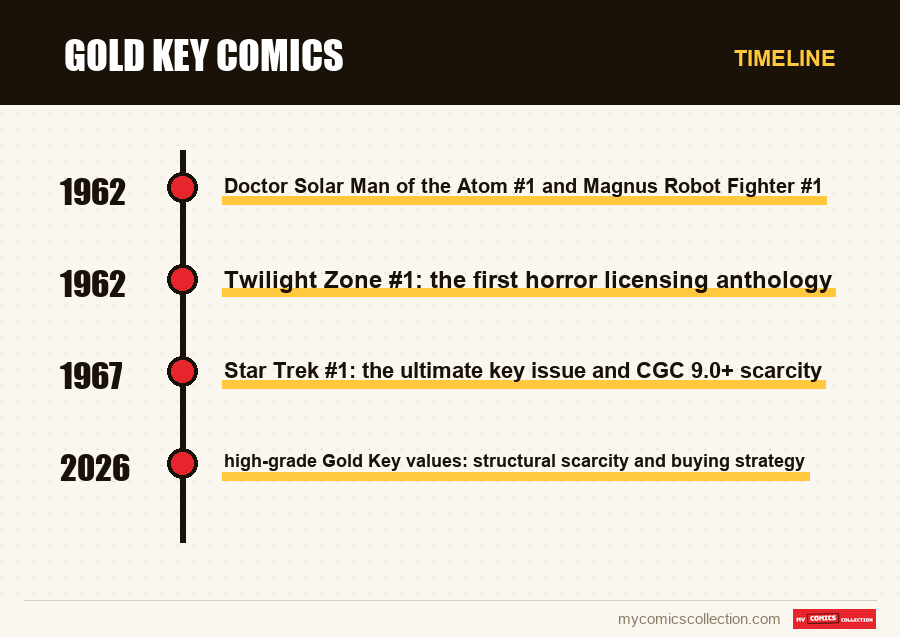
Gold Key Comics, the Western Publishing imprint active from 1962 to 1984, specialized in licensed adaptations: Disney, Hanna-Barbera, Tarzan, Star Trek, Twilight Zone, Doctor Solar, Magnus Robot Fighter. The three foundational key issues are Star Trek #1 (July 1967), Twilight Zone #1 (November 1962), and Doctor Solar, Man of the Atom #1 (October 1962). Magnus, Robot Fighter 4000 A.D. #1 (February 1963) rounds out the essential quartet. High-grade scarcity (CGC 9.0 and up) drives 2026 values between $800 and $6,000 depending on the title, versus $50-$200 raw in VG-FN. Destructive young-reader handling and the absence of period bagging explain the shortage of surviving NM copies.
When people talk about the Silver Age in the United States, they think Marvel and DC first. Yet a third player deserved the same attention from collectors: Gold Key Comics, the Western Publishing imprint that dominated the licensed-comics segment between 1962 and 1984. Without Gold Key, there would have been no Star Trek comic during the franchise's first decade, no illustrated Twilight Zone, no Mickey Mouse or Donald Duck in the American comic book format throughout the entire Silver Age and half the Bronze Age. This publisher put out thousands of titles, a handful of which became holy grails for savvy collectors precisely because the combination of licensing + destructive young-reader handling + massive but poorly preserved print runs produced a high-grade scarcity that surprises even seasoned Silver Age Marvel collectors.
This guide reviews the history of the Western Publishing imprint that became Gold Key, the foundational licensing key issues (Star Trek #1 from July 1967, Twilight Zone #1 from November 1962, Doctor Solar #1 from October 1962, Magnus Robot Fighter #1 from February 1963), the complete licensing catalog (Disney, Hanna-Barbera, Tarzan, TV series), and the 2026 values of high-grade CGC copies with an analysis of the scarcity that drives them. The goal is to give the collector concrete reference points for spotting Gold Key opportunities on a market that remains largely under-exploited compared to the Marvel/DC market.
Gold Key Comics: the Western Publishing imprint from 1962 to 1984
Western Publishing Company, founded in Racine, Wisconsin, in 1907, started out as a school-textbook printer before becoming one of the pillars of American children's publishing. In the 1930s, Western signed a distribution partnership with Dell Publishing to release comics licensed from Disney, Warner Bros, and MGM. For three decades, these comics appeared under the Dell brand but were in fact produced editorially by Western. In 1962, Western ended that arrangement and launched its own label: Gold Key Comics. The first issue bearing the Gold Key stamp shipped in June 1962. The imprint would stay active until March 1984, twenty-two years of publishing spanning the end of the Silver Age, the entire Bronze Age, and the start of the Copper Age.
Gold Key's visual signature came down to three elements. First, the painted covers, often by George Wilson, Vic Prezio, or Disney illustrators, which gave the imprint a more mature, more collectible look than the inked Marvel or DC covers of the same era. Second, the systematic absence of a Comics Code Authority seal on the cover: Western had its own internal editorial charter, deemed strict enough that it didn't submit its publications to the CCA. And third, the paper stock, slightly thicker than average, along with frequent use of the stylized gold logo that gave the imprint its name.
The business model rested on three complementary pillars. The first pillar was the historic Disney licenses: Walt Disney's Comics and Stories, Donald Duck, Uncle Scrooge, Mickey Mouse, Chip 'n' Dale, all produced by Western's California studios with Carl Barks and Don Rosa as occasional contributors. The second pillar was the Hanna-Barbera licenses: Yogi Bear, Flintstones, Jetsons, Huckleberry Hound, Top Cat, which rode alongside the first big wave of televised cartoons. The third pillar was the live-action film and TV licenses: Tarzan, Twilight Zone, Star Trek, Lost in Space, Outer Limits, Bonanza, Mighty Samson, which targeted a slightly older readership.
Western Publishing kept up the pace into the early 1980s, but the erosion of the newsstand market and competition from Marvel and DC hastened the end. The last Gold Key issue shipped in March 1984. Western would try to relaunch its titles under the Whitman label with a different format aimed at drugstores, but without lasting success. The Gold Key imprint nonetheless remains the definitive reference for anyone interested in American licensed comics between 1962 and 1984, and its catalog represents a still largely unexplored gold mine for the collector looking to get off the beaten Marvel/DC path.
Star Trek #1 (July 1967): the ultimate key issue and CGC 9.0+ scarcity
Across the entire Gold Key catalog, Star Trek #1 dated July 1967 remains the most sought-after and highest-valued key issue in 2026. The issue appeared roughly nine months after the pilot episode The Man Trap (September 8, 1966) aired on NBC. It is the first comic adaptation of the Star Trek universe, predating the first Marvel Star Trek series (1980) by more than ten years and kicking off an unbroken run of comic exploitation that continues to this day. The issue was scripted without explicit credit (common practice at Gold Key) and illustrated inside by Nevio Zeccara, with a photo cover taken from the TV series production.
The issue's historical interest rests on several features. The cover uses a retouched photo of Leonard Nimoy as Spock, a rarity for an era when comic covers were almost exclusively illustrated. The interior presents the Kirk-Spock-McCoy trio from the very first page, along with the starship Enterprise in a depiction that would remain the visual reference for decades to come. The story, titled The Planet of No Return, follows an exploration mission to a planet where the vegetation turns aggressive, a narrative formula typical of the first TV season that reassured readers about its fidelity to the source.
The 2026 value reflects the combination of scarcity + cult status. In CGC 9.8 NM/M, Heritage and ComicConnect auctions top out between $18,000 and $28,000 depending on the buzz around Paramount+ releases. CGC 9.4 NM ranges between $4,800 and $6,500. CGC 9.0 VF/NM, which remains the collector sweet spot, trades between $2,200 and $3,200. Moving down, CGC 7.0 FN-VF drops to $600-$900, and raw VG-FN to $180-$280. The pyramid is extremely stretched: fewer than 80 copies are graded CGC 9.6 or higher in the 2025 census, which explains the considerable premium for the very top grades. Checking the sales history on ComicConnect and Heritage Auctions remains the most prized barometer for tracking quarterly movements.
The reason for this high-grade scarcity comes down to the readership profile. The Gold Key Star Treks were bought by kids and teenagers who were fans of the show, and they read them without any care, folding the covers and tearing the spines when they shelved them. The photo cover, particularly prone to fingerprints and yellowing, ages badly. Modern plastic sleeves (Mylar) didn't exist, and copies kept in cellophane were the exception. The result is that the CGC 9.4+ census represents less than 2% of the copies still likely in existence, versus 8-10% for an equivalent Silver Age Marvel book like Strange Tales or Tales to Astonish. This structural shortage will mechanically keep supporting high-grade prices. To understand CGC investment strategy on Silver Age vintage books, our comparison of vintage versus modern CGC details the trade-offs.
Twilight Zone #1 (November 1962): the first horror licensing anthology
Before Star Trek, Gold Key had already tapped the TV licensing vein with The Twilight Zone #1 dated November 1962. Rod Serling's series had premiered on CBS in October 1959 and already had three seasons under its belt when Gold Key secured the comic rights. The issue was the first in a series that would last twenty years in its Gold Key form (through issue #92 in 1982), with a Whitman transition on the final issues. It is also the first major horror/science-fiction licensing anthology in the American comic book format, well ahead of competitors like Charlton (Ghostly Tales, 1966) or Marvel (Tower of Shadows, 1969).
Issue #1 features three short stories in the anthology style of the TV series. The painted cover is signed by George Wilson, showing a cosmic clock face with stars in the background, an iconic composition that would be reused as a visual template for several subsequent issues. The interior content, probably scripted by Leo Dorfman and illustrated by Reed Crandall, Alex Toth, and Mike Sekowsky depending on the story, offers self-contained five-to-eight-page tales in a fantastical vein. It is precisely the interior art quality, with Crandall and Toth at the top of their game, that explains why the Gold Key Twilight Zone has held a significant value without relying solely on TV nostalgia.
The 2026 value of Twilight Zone #1 in high grade reflects a scarcity comparable to Star Trek #1 but on a less speculative footing. CGC 9.6 NM+ trades between $3,800 and $5,200 depending on the freshness of the painted cover (sensitivity to shading and foxing). CGC 9.4 NM ranges between $1,600 and $2,400. CGC 9.0 VF/NM, the serious-collector tier, falls between $700 and $1,100. CGC 7.0 FN-VF drops to $220-$340, and raw VG-FN to $60-$110. The pyramid is less stretched than Star Trek's, because the Twilight Zone community is more stable and less dependent on reboot announcements, which reduces high-grade volatility.
The Gold Key Twilight Zone run includes several other notable issues. #2 (February 1963), with a cover showing a character facing their mirror double, is almost as sought-after as #1 in high grade. #9 (September 1964) features a story illustrated by Frank Frazetta, making it a secondary key issue for Frazetta collectors. Issues #50 and #75 were printed in smaller quantities following the early-1970s sales decline, giving them a raw scarcity (not just in high grade) that places them in the series' top ten. For a collector who wants to build up gradually, starting with #1, #2, and #9 raw in VG-FN for a total of 250-400 euros is a reasonable entry point, to be compared with other niche-catalog strategies we detail in our guide to getting started with pre-Marvel Atlas Comics.
Doctor Solar Man of the Atom #1 (October 1962) and Magnus Robot Fighter #1 (February 1963)
Alongside the TV licensing adaptations, Gold Key also produced its own original superheroes in direct competition with Marvel and DC. The two foundational key issues of this line are Doctor Solar, Man of the Atom #1 dated October 1962 and Magnus, Robot Fighter 4000 A.D. #1 dated February 1963. Both scripted by Paul S. Newman, these characters embodied Western Publishing's proprietary superhero identity at a time when Marvel was building its universe (Fantastic Four #1 appeared in November 1961) and DC had just kicked off the Silver Age with Showcase #4 (1956).
Doctor Solar #1 introduces Dr. Philip Solar, a nuclear scientist exposed to an atomic accident that transforms him into a being of pure energy capable of manipulating matter. The dark-red costume with black goggles is drawn by Bob Fujitani, with a painted cover by Richard Powers. The issue is short (32 pages) but establishes the complete mythology: origin, civilian identity, recurring villain Nuro, and partner Gail Sanders. The Doctor Solar universe would run for 27 issues until 1969 before being revived by Valiant in 1991 as Solar, Man of the Atom, turning Doctor Solar #1 into a key issue with dual significance (vintage Gold Key + Valiant ancestor).
Magnus Robot Fighter #1 opens a science-fiction universe set in the year 4000, where a human raised by a benevolent robot battles the tyrannical machines of a vast city. The painted cover is by George Wilson, with interiors entirely by Russ Manning, one of the greatest American Silver Age illustrators, whose precise, expressive line influenced an entire generation of SF artists. Magnus would become one of Gold Key's three most profitable proprietary characters, with 46 issues running through 1977. The character would be revived by Valiant in 1991, giving the Gold Key #1 the same hybrid status as Doctor Solar #1.
The 2026 value reflects this dual legacy. Doctor Solar #1 in CGC 9.4 NM trades between $1,800 and $2,600. CGC 9.0 ranges between $700 and $1,000, CGC 8.0 between $300 and $450, and raw VG-FN between $80 and $140. Magnus Robot Fighter #1 reaches slightly higher levels thanks to the Russ Manning premium: CGC 9.4 between $2,400 and $3,400, CGC 9.0 between $900 and $1,300, raw VG-FN between $100 and $170. These levels place both titles in the accessible Silver Age key-issue category, to be compared with a Tales of Suspense #39 (first appearance of Iron Man), which costs 10 times more in an equivalent grade. To accurately estimate your own Gold Key copies before any purchase or sale, our free comic appraisal service now includes Silver Age licensing references.
Collecting this series?
Track what you own, what you are missing and what your collection is worth. 7 day trial.
Start my trial →Gold Key licensing catalog: Tarzan, Disney, Hanna-Barbera and film series
Beyond the three pillars of Star Trek, Twilight Zone, and proprietary superheroes, the Gold Key catalog includes several hundred licensing titles, a fraction of which hold significant collector interest. Gold Key Tarzan picked up the historic Dell series in 1962 at issue #132, with Russ Manning on art through 1968, then Mike Royer, Doug Wildey, and others. The Gold Key Tarzan run peaked artistically between 1965 and 1967 under Russ Manning, whose pages have become collectors items in their own right. Notable issues include Tarzan #155, #157, #163, and #169, which trade between $50 and $200 raw in VF and between $300 and $600 in CGC 9.2.
The Gold Key Disney line deserves separate treatment. Walt Disney's Comics and Stories continued its historic Dell numbering with Gold Key starting at #265 (October 1962). Uncle Scrooge took over from Dell with the same continuous numbering. Carl Barks's occasional contributions to early Gold Key Uncle Scrooge (issues #44 to roughly #71) make up a very specific collector sub-segment, with CGC 9.4 values ranging between $800 and $2,000 for the best issues. Mickey Mouse, Donald Duck, Chip 'n' Dale, Daisy and Donald, Beagle Boys, and Junior Woodchucks make up a complete line with several hundred issues, of which only 20 to 30 have an identified key status.
The Hanna-Barbera licenses, Yogi Bear, Flintstones, Jetsons, Huckleberry Hound, Top Cat, Magilla Gorilla, and Quick Draw McGraw, make up a collector category driven mainly by adult 1960s TV nostalgia. The #1s of each series draw attention, especially Flintstones #1 (November 1962) and Jetsons #1 (January 1963). Jetsons #1 in CGC 9.4 trades between $1,600 and $2,200 in 2026, a premium sustained by the anticipation of a possible animated reboot that never happened. Flintstones #1 reaches comparable levels. These two titles are part of the broader list of the most expensive comics sold in 2026 in the cartoon licensing category.
Finally, the film and live-action TV licenses round out the ecosystem. Lost in Space (#1 in December 1965), Outer Limits (#1 in January 1964), Bonanza , Daniel Boone , Voyage to the Bottom of the Sea (#1 in December 1964), Land of the Giants , Time Tunnel , Get Smart, and several dozen other titles build a panorama of 1960s and 1970s American television seen through the lens of comics. None of these series reaches the value of Star Trek #1, but their raw scarcity (smaller print runs, poorer preservation) makes them sleeper opportunities for the patient collector. Our comic catalog built into the app now lists most of the Gold Key catalog with dynamic valuation.
2026 high-grade Gold Key values: structural scarcity and buying strategy
Analyzing the 2026 Gold Key values reveals a consistent pattern across all titles: the gap between raw VG-FN and CGC 9.4 NM is wider for Gold Key than for Marvel or DC from the same era. On Silver Age Marvel, a typical multiplier between raw VG and CGC 9.4 NM falls between 8 and 15. On Gold Key, that same multiplier climbs between 20 and 40 depending on the title. This divergence stems from three structural factors that every collector should factor into their buying strategy.
The first factor is destructive young-reader handling. Licensed comics were bought mostly by children aged 6 to 12, versus 9 to 16 for Marvel and DC at the same time. That difference in target age translates into rougher physical treatment: folding, tearing, scribbling, school-binder stapling. The percentage of copies arriving in NM at professional grading is mechanically lower than for teenage superhero comics.
The second factor is the painted cover. Unlike inked Marvel/DC covers, Gold Key's painted covers are sensitive to humidity swings, fingerprints, and yellowing shadows. A painted cover that looks like a 9.0 raw tends to be graded 8.5 by CGC because of the strict criteria on painted-surface defects. This differential degradation shrinks the CGC 9.4+ pyramid even further.
The third factor is the absence of period collector speculation. Marvel and DC benefited from an already-active collector community by the late 1960s, with plastic sleeves, storage binders, and resales through fanzines. Gold Key, perceived as a children's publisher, didn't attract the same collector attention until the 1990s. The result is that there are almost no pristine copies stored under Mylar straight off the newsstand, unlike the superhero comics for which first-owner stocks still exist in their original boxes.
The 2026 buying strategy for a rational collector comes down to three priorities. Priority 1: secure a Star Trek #1 in CGC 7.0-7.5 (budget 400-700 euros), which combines the title's international recognition with a buffer against deflation. Priority 2: add Twilight Zone #1 and Doctor Solar #1 in CGC 8.0-8.5 (budget 300-500 euros each), which offer diversified exposure to the licensing catalog + proprietary superheroes. Priority 3: round things out with a Magnus Robot Fighter #1 in raw VF-NM (budget 150-250 euros), which adds the Russ Manning argument and the Valiant angle. Total: 1,200 to 1,900 euros for a coherent Gold Key core. For a broader view of comic investment strategies, our strategic comic investment guide offers a complete methodological framework.
Gold Key Comics FAQ: collectors' questions
When did Gold Key Comics publish its first issue?
Gold Key Comics published its first issue in June 1962. It was the comics imprint of Western Publishing Company, founded in Racine, Wisconsin, in 1907. Before Gold Key, Western had produced Dell comics editorially under a distribution agreement since the 1930s. When the agreement ended in 1962, Western launched its own Gold Key label. The imprint stayed active until March 1984, twenty-two years of publishing spanning the end of the Silver Age, the entire Bronze Age, and the start of the Copper Age. The total catalog runs into the thousands of issues spread across dozens of simultaneous series.
Why is Gold Key's Star Trek #1 worth so much in high grade?
Star Trek #1 dated July 1967 is the first comic adaptation of the Star Trek universe, published nine months after the NBC pilot. Its 2026 CGC 9.8 value of $18,000 to $28,000 comes down to three combined factors: CGC 9.6+ scarcity (fewer than 80 graded copies in the 2025 census), a Leonard Nimoy-as-Spock photo cover that is especially prone to yellowing, and demand sustained by the Paramount+ franchise. The collector sweet spot remains CGC 9.0 VF/NM between $2,200 and $3,200, which offers the title's recognition without the extreme premium of the very top grade. Raw VG-FN at $180-$280 is the entry point for a tight budget.
Are Doctor Solar and Magnus Robot Fighter official superhero comics?
Yes, Doctor Solar Man of the Atom #1 (October 1962) and Magnus Robot Fighter 4000 A.D. #1 (February 1963) are Gold Key's two original proprietary superheroes, with no connection to Disney, Hanna-Barbera, or the TV licenses. Both scripted by Paul S. Newman, they embodied Western Publishing's answer to competition from Marvel and DC. Doctor Solar ran for 27 issues until 1969, Magnus 46 issues until 1977. Both characters were revived by Valiant Comics in 1991, giving the original Gold Key #1s a dual value: a proprietary Silver Age key issue + the direct ancestor of the 1990s Valiant series. This dual significance supports their 2026 value.
Which Gold Key Disney comics have the highest value in 2026?
The highest-valued 2026 Gold Key Disney comics are concentrated on the early Gold Key Uncle Scrooge line with Carl Barks contributions (issues #44 to roughly #71), which trade between $800 and $2,000 in CGC 9.4 depending on the issue. Walt Disney's Comics and Stories continues from Dell starting at #265 (October 1962), with notable issues between $200 and $800 in CGC 9.4 for the early Gold Key numbers. Donald Duck remains a stable title but with less explosive values, between $150 and $500 in CGC 9.4 for the best issues. The other Disney titles (Mickey Mouse, Chip 'n' Dale, Daisy and Donald) are niche collectibles with more modest values but a high-grade scarcity comparable to Star Trek.
Is CGC grading worthwhile for vintage Gold Key books?
Yes, CGC grading is especially worthwhile for vintage Gold Key books because the value gap between raw and high-grade CGC is wider than for Marvel and DC from the same era. On Gold Key, the multiplier between raw VG-FN and CGC 9.4 NM ranges between 20 and 40 depending on the title, versus 8 to 15 for Silver Age Marvel/DC. This divergence stems from destructive young-reader handling, the sensitivity of painted covers to surface defects, and the absence of period collector speculation that would have preserved NM stocks. For a Star Trek #1, Twilight Zone #1, Doctor Solar #1, or Magnus #1, going through CGC is all but mandatory once you go above VF grade. Our CGC grading guide details the full procedure.