
Ghost Rider's Bronze Age spans 1972 to 1985, opening with Marvel Spotlight #5 (August 1972) by Roy Thomas, Gary Friedrich, and Mike Ploog , and closing when Ghost Rider Vol.1 ended in 1983 after 81 issues. This guide lays out the 10 key issues to target first if you want to build a coherent collection of the Spirit of Vengeance during the Johnny Blaze era, with creative context, indicative CGC price ranges, and market signals.
The Bronze Age is still the most hotly contested stretch of the Ghost Rider market. It's the era when the character was born at Marvel Comics , when Johnny Blaze established himself as a recurring anti-hero, when the solo series Ghost Rider Vol.1 ran 81 issues over a decade, and when the flaming-skulled rider joined the Champions and the Defenders for his first crossovers. For collectors, these are the priciest key issues but also the most stable: none were heavily reprinted as single issues, and the scarcity of high CGC grades has been pushing prices up ever since the first wave of live-action adaptations.
This deep dive lays out the ten issues to prioritize across the 1972-1985 period, each with its creative context (writing/art team), its narrative significance, and an indicative price range to handle with care depending on the CGC grade. For the modern-era market (Ketch, Aaron, Reyes), see our consolidated Ghost Rider key issues guide covering all periods.
Ghost Rider in comics history
Ghost Rider was born at a very specific moment in Marvel's editorial history. In 1971, the Comics Code Authority loosened its rules on supernatural figures. Marvel Comics then kicked off a horror wave that produced, in quick succession, Tomb of Dracula , Werewolf by Night , Son of Satan , and, in August 1972, Marvel Spotlight #5. The concept was dreamed up by Roy Thomas and Gary Friedrich , the look by Mike Ploog: a flaming skull, a studded leather jacket, a burning Harley-Davidson. Stuntman Johnny Blaze sells his soul to Mephisto to save his adoptive father, ends up bound to the demon Zarathos, and becomes, every night, an instrument of vengeance against the wicked.
The solo series Ghost Rider Vol.1 launched in September 1973 and lasted until June 1983 across 81 issues, making it one of the most durable Bronze Age Marvel series in its category. Several writers took turns at the helm: Gary Friedrich , Tony Isabella , Don Glut , Jim Shooter , then Michael Fleisher . On art, Jim Mooney , Don Heck , and above all Don Perlin covered the bulk of the decade. On the team-book side, Ghost Rider briefly joined the Defenders, then became a founding member of the Champions alongside Hercules, Black Widow, Iceman, and Angel.
For the collector, the Bronze Age concentrates the character's most stable first appearances and his foundational story arcs. None of these issues was reprinted identically as a single issue, and the relatively modest print runs of the era, fitting for a second-tier character, explain the current shortage in high CGC grades. The indicative ranges below reflect the state of the secondary market in 2025-2026, with a sustained upward trend ever since the first big-screen adaptation in 2007.
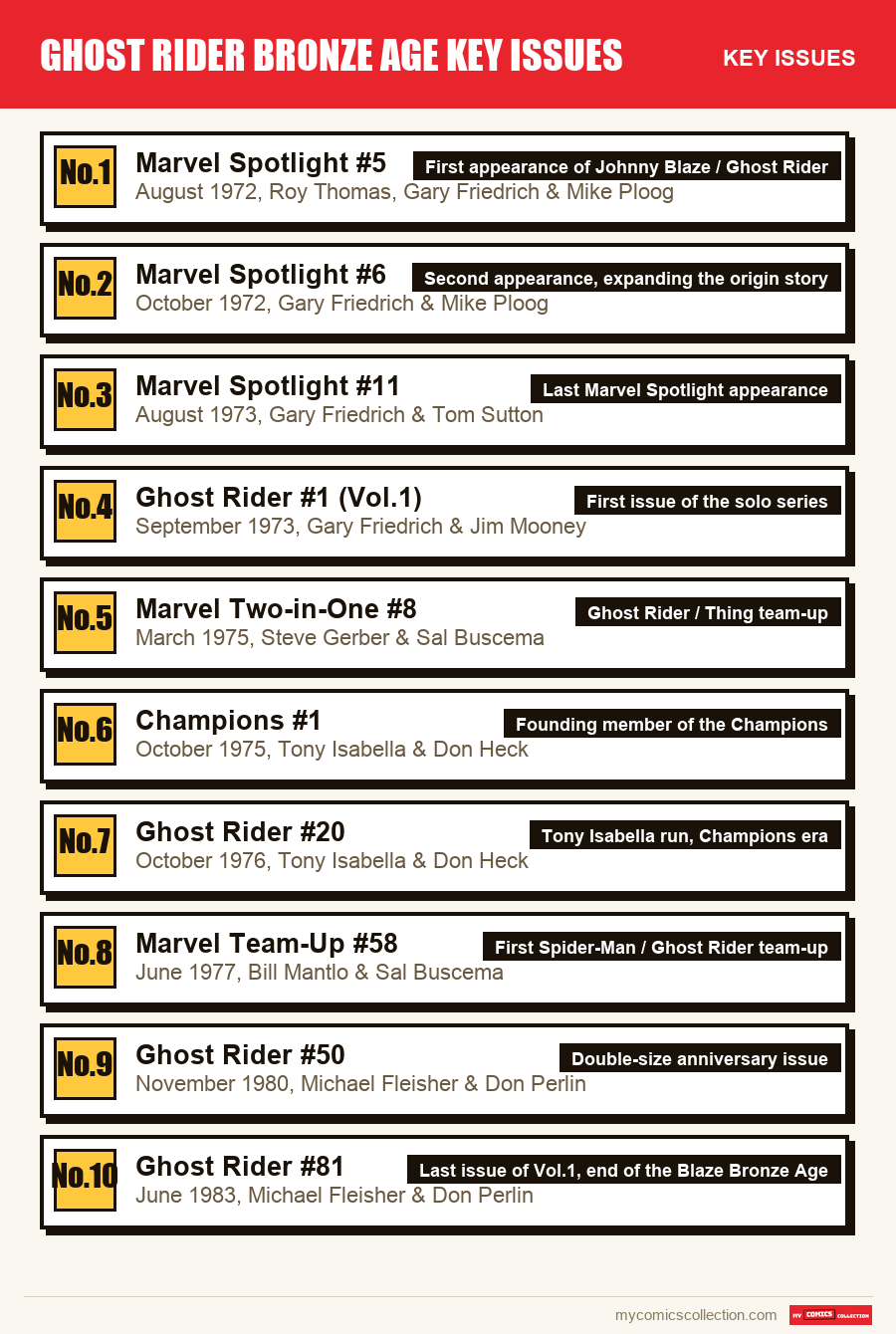
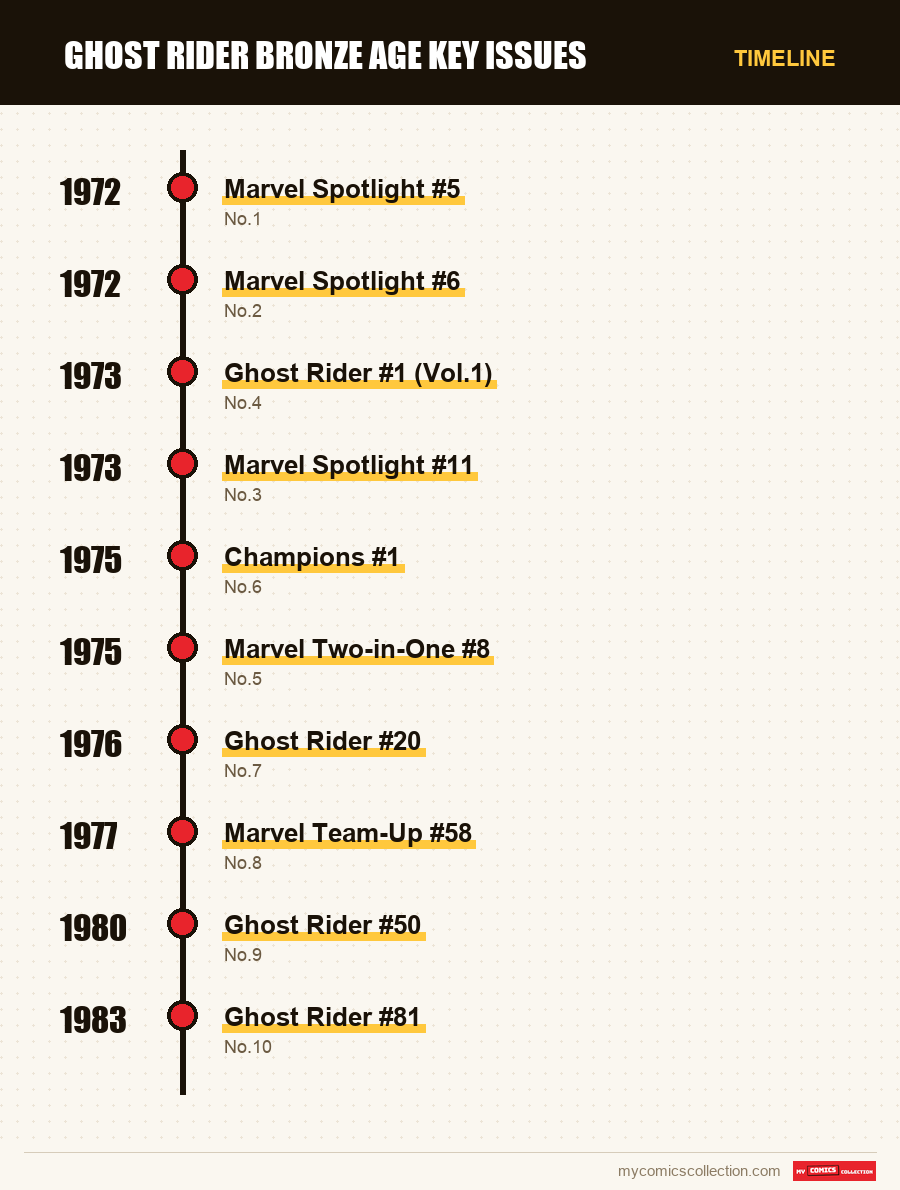
Top 10 Ghost Rider key issues
A Bronze Age-focused selection (1972-1985): first appearances, foundational arcs, and Champions and Defenders crossovers. The ranges cited are indicative and vary widely depending on the CGC grade, cover condition, and recent auction dynamics.
Marvel Spotlight #5
Marvel Spotlight #5 is the absolute foundational issue. The first appearance of Johnny Blaze as Ghost Rider, by Roy Thomas, Gary Friedrich, and Mike Ploog. The Ploog cover, with the flaming skull astride a Harley, is still one of the most reproduced images of Marvel's Bronze Age horror line. The issue lays out the entire mythology: the pact with Mephisto, the nightly transformation, Crash Simpson. An absolute cornerstone of any serious Ghost Rider collection, on par with Werewolf by Night #32 from the same '70s horror wave.
Marvel Spotlight #6
Marvel Spotlight #6 is Ghost Rider's second appearance and the first full development of the pact with Mephisto. Often overlooked in favor of #5, this issue remains a sought-after classic in high grade for its direct narrative contribution: it extends the origin story laid out the month before and cements the recurring Faustian dimension. Its value has been rising since 2018 on grades 9.4 and up, driven by the scarcity of well-preserved copies and its status as the inseparable companion to #5.
Marvel Spotlight #11
The last issue devoted to Ghost Rider in the Marvel Spotlight series before the launch of the solo title. Tom Sutton replaces Ploog on art and wraps up the five-issue introductory run. Often bought alongside #5 and #6 by collectors looking to complete a full Marvel Spotlight arc on Ghost Rider. A modest Bronze Age print run and proven scarcity in high CGC grade.
Ghost Rider #1 (Vol.1)
Ghost Rider #1 launches the character's first solo series, which would run 81 issues through June 1983. Gary Friedrich stays on as writer, and Jim Mooney takes over the art. The issue establishes Ghost Rider as a standalone franchise at Marvel and sets the road-movie/horror tone that would dominate the decade. A wider Bronze Age print run than the Marvel Spotlight issues, so more accessible in mid grades but valuable in high CGC grade. An essential keystone of any Johnny Blaze-focused collection.
Marvel Two-in-One #8
The first notable team-up between Ghost Rider and The Thing in Marvel Two-in-One #8. A worthwhile Bronze Age issue for anyone collecting both Ghost Rider and the Fantastic Four. The arc weaves the Spirit of Vengeance into mainstream Marvel continuity beyond his own solo series. A moderate value, but on a steady climb, supported by crossover interest from Fantastic Four fans.
Champions #1
Champions #1 introduces the Los Angeles-based Champions, of which Ghost Rider is a founding member alongside Hercules, Black Widow, Iceman, and Angel. The launch is by Tony Isabella and Don Heck, built on an unconventional West Coast concept. The series ran 17 issues through January 1978 and remains one of the few durable Bronze Age team-ups for Ghost Rider outside his solo title. A sought-after issue for crossover collectors of Black Widow and the extended Avengers family.
Ghost Rider #20
A representative issue from the Tony Isabella run on the solo series, during the period when Ghost Rider split the spotlight between his own title and his role in the Champions. Isabella deepens the Blaze/Zarathos duality and establishes some of the recurring Bronze Age antagonists. An issue to target for anyone looking to assemble a coherent Isabella run, as a complement to the contemporaneous Champions #1-17.
Marvel Team-Up #58
The first significant team-up between Ghost Rider and Spider-Man in Marvel Team-Up #58, written by Bill Mantlo. A niche issue, but one well-loved by crossover collectors of Amazing Spider-Man and Ghost Rider. Its value has been climbing steadily since 2007 and the Nicolas Cage adaptation, supported by the dual demand for Bronze Age Spider-Man and Bronze Age Ghost Rider. Worth a look for anyone rounding out a secondary Spider-Man collection.
Ghost Rider #50
The solo series' anniversary issue, by Michael Fleisher on script and Don Perlin on art. A double-size format, traditional at Marvel at the time, with a special arc centered on the evolution of the Blaze curse. An issue to target for anyone chasing the regular milestones of the Fleisher run, which covers issues 35 through 81 and redefines the series' tone over the second half of its publication.
Ghost Rider #81
Ghost Rider #81 closes out Vol.1 after ten years of continuous publication. Michael Fleisher signs off on the Bronze Age Johnny Blaze run, which would lie editorially dormant until the launch of Vol.2 in May 1990 with Danny Ketch. A sought-after issue as an end-of-cycle milestone, and relevant for anyone putting together a complete 1-81 run. Proven scarcity in high CGC grade, with few preserved copies compared to the early issues.
Collecting this series?
Track what you own, what you are missing and what your collection is worth. 7 day trial.
Start my trial →The essential Ghost Rider story arcs
Beyond the single issues, several Bronze Age arcs shape the Johnny Blaze mythology and deserve to be identified before any serious purchase. These runs define the tone of the decade and are still available in omnibus or TPB form for reading, but the original single issues retain their collector value.
The Marvel Spotlight introduction arc
The five issues Marvel Spotlight #5 through #11 (August 1972 - August 1973) lay out the entire origin mythology: the pact with Mephisto, Crash Simpson, the first confrontations with demonic figures. By Roy Thomas, Gary Friedrich, and Mike Ploog (then Tom Sutton). Essential for understanding the character's Bronze Age cosmogony.
The Tony Isabella run
Tony Isabella takes over the solo series' script around #6 and lays the groundwork for the Blaze/Zarathos duality that would dominate the whole decade. This period coincides with the launch of the Champions, where Isabella also writes the team-up. An essential run for anyone wanting to understand how Marvel turned a horror concept into a recurring anti-hero.
The Champions
17 issues between October 1975 and January 1978, written by Tony Isabella, then Bill Mantlo. Ghost Rider shares the marquee with Hercules, Black Widow, Iceman, and Angel in an unconventional West Coast team. A major crossover with Marvel Team-Up and several appearances in Avengers continuity. For completists, a short but coherent series.
The Michael Fleisher run
Michael Fleisher takes back over the solo series around #35 and carries it through to its conclusion in #81 (June 1983). With Don Perlin on art for most of the run, Fleisher hardens the tone, deepens the urban-horror dimension, and stages the final Blaze/Zarathos confrontation. The longest coherent writing run on the Vol.1 series.
Defenders and cross-title appearances
Ghost Rider briefly joins the Defenders in the mid-1970s, during a period when the team welcomed plenty of anti-heroes without a fixed roster. Several notable appearances in Defenders #35-40 or so. Relevant for anyone completing both a Bronze Age Defenders collection and an exhaustive Ghost Rider run.
To follow these arcs, which span several series and dozens of issues, use My Comics Collection's issue-by-issue collection tracking feature, create your own custom lists, and identify the missing comics arc by arc.
How My Comics Collection manages your Ghost Rider collection
Collecting Ghost Rider Bronze Age means juggling four series at once (Marvel Spotlight , Ghost Rider Vol.1 , Champions , Marvel Team-Up) and precisely tracking the first appearances and anniversary issues. My Comics Collection centralizes all these runs in a single interface: a built-in catalog of 1,000+ Marvel/DC/Image series, automatic key-issue identification, dynamic CGC valuation, a list of missing comics per series, and daily-updated eBay price tracking.
FAQ: Ghost Rider key issues
Build your Bronze Age Ghost Rider collection methodically
Catalog Marvel Spotlight, Ghost Rider Vol.1, Champions, and Marvel Team-Up in one click, identify your missing key issues, and track their estimated value from current eBay listings. 7-day free trial.
🚀 Start your 7-day free trial