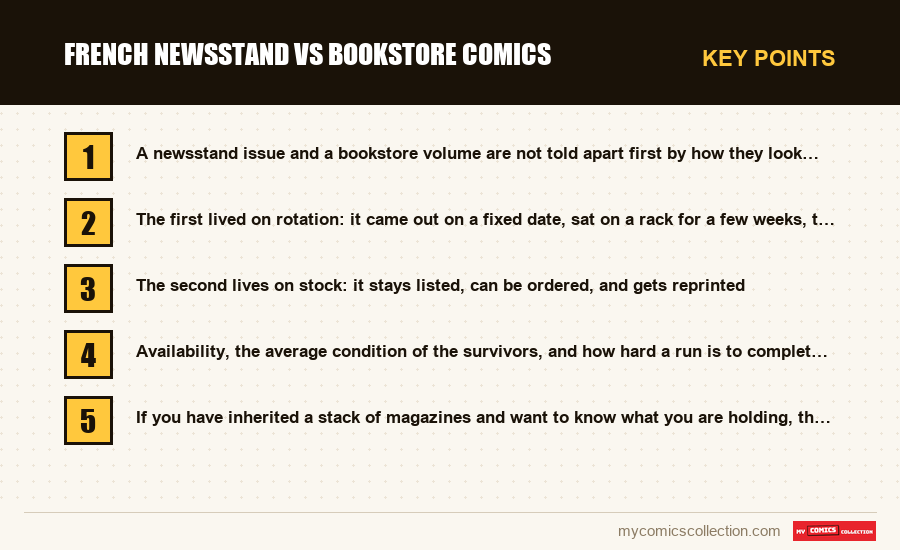
A newsstand issue and a bookstore volume are not told apart first by how they look, but by the channel that put them in the reader's hands. The first lived on rotation: it came out on a fixed date, sat on a rack for a few weeks, then made room for the next one. The second lives on stock: it stays listed, can be ordered, and gets reprinted. Availability, the average condition of the survivors, and how hard a run is to complete all follow from that single difference.
If you have inherited a stack of magazines and want to know what you are holding, the question of the channel comes before all the others. A French collector works with a publishing legacy that changed its commercial logic along the way, and that shift left measurable traces: in how titles are dated, in how long the series run, in how the issues follow one another. The catalog we maintain lists sixty-seven French series and their issue-by-issue contents, and what it tells is not a story about formats, but a story about distribution.
As always on this guide, only verified information (creators, issues, dates) is stated as fact; the analysis is our own, with no reproduction of protected artwork or dialogue.
Two channels, two contracts with time
The press distribution network works in slots. A title is given a place in the rotation, goes on sale on an agreed date, and its unsold copies go back. Nothing in this system provides for an issue to stay available after its turn on the stage: it is not built to last on the shelf, it is built to be replaced. A reader who missed his week did not catch up, he waited for the following month.
The bookstore works the other way around. A volume enters with a stable reference, waits for its buyer, gets restocked, and a title that sells is reprinted instead of disappearing. The object is no longer perishable, it becomes backlist. For the collector, this distinction is decisive: in one case time worked against the survival of copies, in the other it tends to work for it.
Everything that follows comes from this contrast. You do not hunt in the same way for an issue that was on sale for only thirty days and a volume that may have been reordered for years. You do not preserve it in the same way either, and you do not describe your collection with the same vocabulary.
The printed date tells you the channel
This is what the catalog lets us observe directly, and it is the most telling clue in this whole file. On the major monthly magazines, the date is not a month: it is a specific day of the month, and always the same one. The issues of Strange are dated the fifth, from one end of the run to the other. Those of Ombrax, Titans, or Spidey carry the tenth.
This fixed day is not a printer's affectation, it is an on-sale slot. Two titles from the same publisher split the month so they do not compete on the same rack. The date you read on the cover therefore does not tell you when the story was written, it tells you when the object took its place in the network. It is logistics information that has become collector information.
And the contrast is sharp. Titles that were not part of this monthly rotation are dated much more loosely: by quarter for Une Aventure des Fantastiques, by year alone for Les Fantastiques or for Artima color, Marvel géant. When the object has no slot, it has no day. The catalog holds more than a thousand dates down to the day and several hundred reduced to a single year: this imbalance is not a flaw in the source, it is the fingerprint of two sales regimes.
A word of caution all the same: a vague date in the catalog can also come from a copy with no printed date or an incomplete record, and sources disagree on some late titles. The rule stays the same: the cover decides, not the database entry.
Long-running series are a signature of the press network
Measure the length of the series and the channel shows up a second time. The median series in the catalog runs a good thirty issues or so, which corresponds to a lifespan of two or three years. But a handful of titles go past one hundred, and they are all newsstand monthlies that settled in for the long haul.
Ombrax lines up two hundred forty-two issues between 1966 and 1986. Strange lines up two hundred twenty-eight before the publishing imprint changes hands. A number like that only happens in a channel where the de facto subscription to the rack renews itself: as long as the title holds its slot, it keeps going. In bookstores, a series does not survive through inertia, it survives through restocking, which is a far more selective test.
The immediate practical consequence: the series that are easiest to find at retail are also the longest to finish. You will come across issues of these monthlies everywhere, and you will spend years on the dozen or so that are missing. Conversely, the short series in the catalog, those that stop under twenty issues, are achievable goals, but their copies rarely turn up.
The numbering does not restart, and that means something
Another observation the catalog makes indisputable: when a magazine changes publisher, its counter keeps going. Strange stops at issue two hundred twenty-eight and picks up at the next one under a different corporate name. The same phenomenon shows on Titans, on Nova, on Spécial Strange, and on Un Récit Complet Marvel.
In the press network, the issue number works as an administrative identity as much as a commercial one: it designates a place in a rotation, not an edition. Resetting the counter to zero would have meant starting over as a new title, with everything that implies for distribution. The publisher therefore inherited the counter along with the slot.
For you, this has two opposite effects. The good news: an issue reference stays unambiguous across the whole life of the title, and a list kept by issue numbers does not contradict itself. The bad news: nothing on the object tells you the house has changed, and it is up to you to know where the seam lies if you are looking for a specific period. Clean relaunches exist too, with some series from the 1990s starting over from a first issue, which creates namesakes in your own files.
Do you collect this series?
Track what you own, what you are missing and what your collection is worth. 7-day trial.
Start my trial →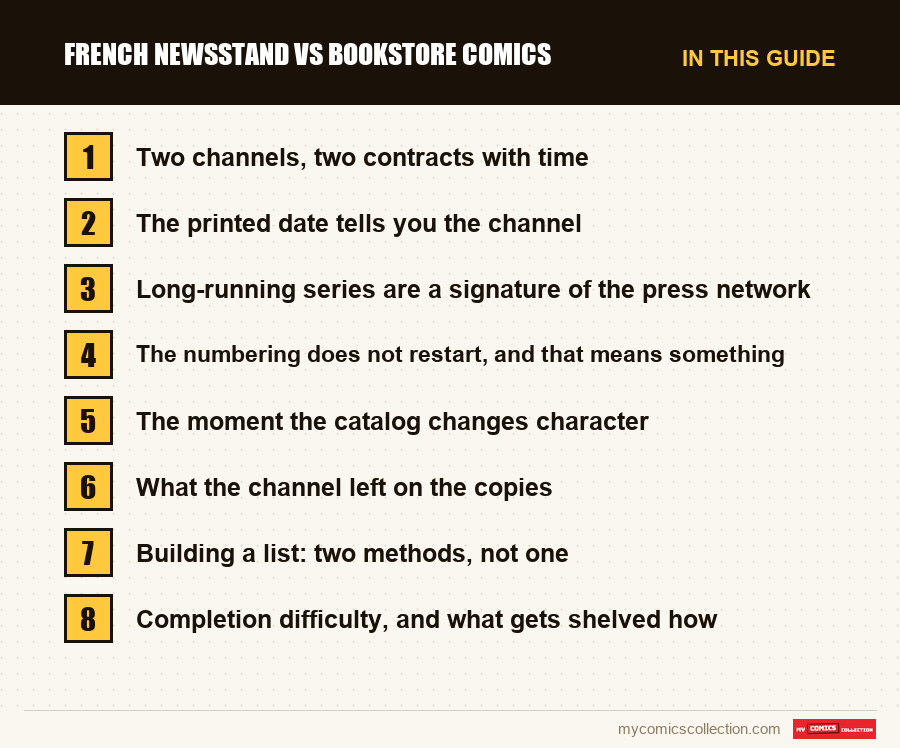
The moment the catalog changes character
Break the launches down by decade and you see a very lopsided curve. The 1970s alone account for thirty-two title launches, close to half of the catalog: it is the golden age of the rack, when the publisher multiplies slots because the network can absorb them. Then the pace drops.
A gap of several years follows, with no recorded launch at all, in the middle of the next decade. And 1989 is the exception: about ten titles appear in the catalog all at once, because one house takes over another and re-registers its whole lineup under its own name. This is not a creative bloom, it is a portfolio takeover, and it has to be read as such.
The detail that matters for our subject lies elsewhere. From this period on, titles designed for a complete story per volume settle in, such as Un Récit Complet Marvel, whose first issue carried "Le prix de l'honneur," written by Chris Claremont with art by Frank Miller, Bob Layton, and Joe Rubinstein. These objects are no longer episodes to be continued: they stand on their own. An object that stands on its own no longer needs the newsstand rotation, it can live on stock. The channel shift begins there, long before it is visible in the shop window.
What the channel left on the copies
A press issue was handled by people who were not buying, set down and put back on a rack, sometimes folded into a pocket the same day. The one that found no taker went back, and some of those returns were never resold. The copies that reached us are therefore, overwhelmingly, read copies: that is the norm of the channel, not an individual accident.
The bookstore volume follows a gentler path. It is displayed standing or flat, leafed through by more determined buyers, and kept by a reader who chose it rather than happened across it. Its average condition is better, not because it is better made, but because it went through fewer hands over the same number of years.
Draw the right conclusion when buying. On a newsstand monthly, demanding the flawless copy amounts to looking for the exception to the channel, and the wait becomes the real cost. On a bookstore item, a tired copy should raise questions: it was mistreated outside the trade, so by an owner, and whatever damaged the cover has often damaged the spine.
Building a list: two methods, not one
A newsstand collection is described by sequence. You note the title, then the range of issues, then the gaps. It is the only description that holds up when a series goes past one hundred installments, and it is also the one that lets you search efficiently, because a magazine seller thinks in lots and ranges too.
A bookstore collection is described by unit. Each volume is a standalone reference, with contents you can name, and the notion of a gap loses its meaning: there is no missing issue twenty-seven, there is a title you do not have. Mixing the two logics in the same file is the most frequent source of error, and it is paid for in duplicates.
The compromise that works is to keep one entry per physical object, but to systematically fill in two fields: the original channel and the issue range when there is one. You can then sort your gaps by series for the newsstand and by title for the bookstore, without rewriting your inventory.
Completion difficulty, and what gets shelved how
Completing a press series is a tail-of-the-distribution problem. The first issues are often the rarest because the initial print run came before the title had settled in, and the last ones are rare because distribution was collapsing before the end. The middle, for its part, turns up without effort. So aim for the ends first and leave the belly of the series for last: it is the opposite of intuition, and it is the order that gets you there.
A bookstore set poses a different problem, that of the edition. The same content can exist in several printings, and it is the printing statement, not the number, that tells your copies apart. Completion is shorter there but more demanding in verification.
For shelving, separate by channel before separating by hero. Press issues stand upright, snug but without compression, away from light, because their paper is the weak point of the whole. Bookstore volumes tolerate vertical storage better and are identified by their spines, which allows a visible alphabetical order. Cross-cutting sagas, those that run through both channels as you can see with the mutant series or the Hulk titles, deserve a separate concordance sheet rather than a mixed shelf.
Frequently asked questions
Because that day was their on-sale slot in the press network. Issues of Strange carry the fifth of the month, those of Titans the tenth. Two titles from the same publisher split the calendar this way so they would not compete on the rack. This date tells you about distribution, not about when the story was created.
Not necessarily. Many off-rotation releases showed only a quarter or a year, because they had no slot to respect. The catalog reflects what is printed on the object. If the entry is vaguer than your copy, trust your copy, and if it is more precise, check before recording it in your inventory.
No, not on the major magazines. The counter was taken over as it stood, with no reset to zero, so a reference stays unambiguous across the whole life of the title. On the other hand, some series launched in the 1990s start over from a first issue with a name already used earlier. There, the launch year is your only reliable discriminator.
Take it as an entry point, not an inventory. A newsstand magazine published several installments per issue, and the catalog keeps only one per release. The rest of the contents have to be noted from the copy itself. That is why no equivalence with a US edition can be asserted from a single database line.
Start with the one that matches what you already have, since your existing holdings determine your gaps. If you are starting from scratch, bookstore items offer a readable progression and more uniform condition. Press series give access to contents you cannot find elsewhere, at the price of a long hunt and a deliberate tolerance on condition.