Francine and Katchoo last ninety chapters because they are constructed in opposition on everything, except the essential. One wants an ordinary life and cannot achieve it; the other has an extraordinary life and doesn't want it. One constantly doubts herself, the other never doubts and is often wrong. What they share is the refusal to name what binds them: and it is this one thing, held for fourteen years, that keeps the entire book together.
You can summarize a plot in three lines. We can't summarize a duo that took fourteen years to build, and that's precisely the problem when we want to explain why this work matters.
This article dismantles the construction of these two characters, shows what makes them credible, and explains why the third protagonist is essential to the device.
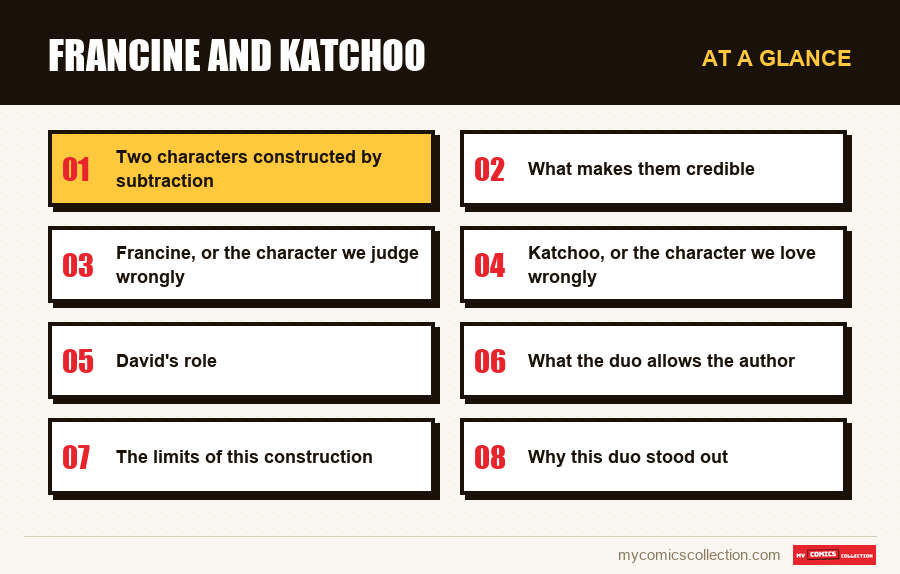
Two characters constructed by subtraction
The method is evident as soon as you compare their files, and it is more rigorous than it appears.
Francine has what Katchoo doesn't have: a family, an intact reputation, the possibility of a normal life. Katchoo has what Francine does not have: total confidence, a capacity for immediate action, no fear of judgment.
Each wants, exactly, what the other has. And each one despises a little what she herself has: Francine finds her life mediocre, Katchoo finds her freedom cumbersome.
This device ensures that no conversation between them can be neutral. Everything one says about her day is, for the other, the description of a life she will not have. It’s what fuels ninety chapters without the plot having to provide conflict.
What makes them credible
They don't learn
An ordinary fictional character learns from his mistakes. They do the same thing again, years apart, knowing perfectly well what they are doing.
This is what brings them closest to real people, and what infuriates some readers the most.
Elles sont désagréables
Francine is passive and complains; Katchoo is violent and manipulative. The story never excuses them or demands approval.
They are getting old
Fourteen years of publication allow for physical changes and diverging trajectories. Nothing is fixed in the state in which the story found them.
They have a past before the book
The story begins years after their meeting. Everything that binds them was formed off-camera, and the book only tells it in fragments.
Francine, or the character we judge wrongly
It is the one of the two that readers like the least, and the treatment gap is worth examining.
She hesitates, procrastinates, returns to situations that she knows will make her unhappy. She barely makes any clear decisions for dozens of chapters. Faced with a character who acts, she appears weak.
But that's a fiction reader's judgment, not a judgment of what she does. Francine has something to lose: a family, a position, an image of herself: where the other has nothing. Prudence and cowardice are only distinguished by what is at stake.
The story actually proves her right more often than it seems: her hesitations regularly prevent her from disasters into which her friend finds herself. Simply, avoiding a catastrophe doesn't produce a memorable scene.
This is a well-known and rarely solved writing problem: prudence is invisible in fiction, because it manifests itself in things that do not happen.
Katchoo, or the character we love wrongly
Symmetry is instructive. The one that readers prefer is also the one that causes most of the damage.
She is funny, loyal, capable of anything for her friend. She is also violent, a liar, and incapable of letting anyone decide for themselves. His protection is a form of control, and the story shows it without ever stating it.
What makes it endearing despite this is a simple process: she assumes. She doesn't justify herself, doesn't ask for forgiveness, doesn't pretend to be someone else. In a fiction populated by characters who explain themselves, someone who never explains himself seems honest.
It's an illusion of form, and it's interesting. Confidence reads as frankness, and hesitation as weakness: when nothing guarantees this match in real life.
The book plays on this bias without commenting on it. An attentive reader ends up noticing that he excuses in one what he criticizes in the other, and this awareness is part of the reading.
The test that reveals the device. After a first reading, ask yourself which of the two annoyed you. The answer usually says less about the characters than about what the reader values-action or caution, confidence or doubt.
It is the only book by its author which produces this effect, and this is probably what explains the persistence of discussions between its readers for thirty years.
David's role
The third protagonist is regularly presented as the apex of a love triangle. It is not, and understanding it changes the reading of the entire book.
A triangle involves competition and a choice to make. Nothing of the sort here: David does not contest Francine's place, does not seek to separate the two women, and understands their relationship better than they understand it themselves.
Its function is elsewhere. He is the only character who appointed what the other two are silent about. Placed outside the link, he can say what neither of the two can express, and he says it, several times, without it changing anything.
This gives him an unusual status: a lucid character in a story of blindness, whose lucidity serves no purpose. He sees right and gets nothing, which is probably the most painful situation the book describes.
A reader who waits to know “who she will end up with” therefore misses three characters at once. The question of the book is not that.
What the duo allows the author
The construction is not only elegant, it solves concrete writing problems on a very long story.
It provides ongoing conflict without an antagonist. Two characters wanting what the other has produces tension in any scene, including a breakfast. No external threat is necessary.
It allows changes in tone. The transition from comedy to drama, which confuses so many readers, is made possible by this duo: two people who know each other too well can laugh about one thing and tear each other up about the next without it seeming incoherent.
It makes the criminal intrigue incidental. This is the least successful side of the book, and it counts for little: because what we follow is not the investigation but what the investigation does to the relationship.
Collecting this series?
Track what you own, what you are missing and what your collection is worth. 7 day trial.
Start my trial →The limits of this construction
A tension that cannot be resolved
The device works as long as it lasts. Resolving it would destroy it, which condemns the story to cycles of coming together and moving away.
A cumulative frustration
Seeing two characters not speak to each other for ninety chapters ends up exasperating, even committed readers.
The rest of the cast fades away
The attention given to the duo leaves little room for the others. Several promising secondary characters disappear without being developed.
A rhythm dictated by the relationship
The plot grinds to a halt every time the relationship demands space. This produces slowdowns that readers who come for the story find it difficult to tolerate.
Why this duo stood out
Thirty years later, it is this duo that we cite when we cite this work, and it is worth saying why rather than observing it.
At its inception, American comics offered few long-form stories built on a relationship between two adult women that was neither a rivalry nor a decorative friendship. The void was not total, but it was considerable.
What this duo demonstrated was that such a relationship could carry a narrative of ninety chapters: with a readership that follows, a tension that holds, and without the need for a man to organize the plot around them.
The demonstration has removed an argument from circulation, and it is the most lasting form of influence: we can no longer maintain that this type of story does not find its audience.
How to approach these characters in reading
Three tips, which follow from all of the above.
Don't choose sides. The book is constructed so that we prefer one of the two, and so that we are wrong to do so. Resisting this reflex makes reading richer.
Don't wait for a resolution. The tension between them is not a problem that the story will resolve: it is the subject. Waiting for it to unravel produces guaranteed frustration over ninety chapters.
Read David as a character, not an obstacle. It's the reading that changes the experience the most, and it's the one that the book's summary discourages the most.
What to note while reading
On a story this long, two notes taken while reading are better than a memory reconstructed years later.
Your impression of each character, dated. It changes as you read it, and that's precisely the point: seeing that Francine was judged harshly in the third volume and not at all in the tenth says a lot about what the book did.
The volume where you are, in original numbers. On a story that we read in spaced periods, this is the only data that remains accurate if we change the edition in the meantime, and the change of edition is frequent on this title.
These two notes answer a question that rereading inevitably poses: what did I think of these people the first time, and what has changed since then?
Frequently asked questions
Because she hesitates and procrastinates in the face of a character who acts, which makes her appear weak. This is a judgment of the reader of fiction rather than a judgment on her actions: she has something to lose where the other has nothing, and prudence is invisible in fiction since it manifests itself in things that do not happen.
The story doesn't decide, and that's deliberate. She is loyal and funny, but also violent, deceitful and incapable of letting anyone decide for themselves: her protection is a form of control. What makes her endearing despite this is that she assumes instead of justifying herself, and her confidence easily reads as frankness.
No, and this is the main misinterpretation of this book. A triangle supposes a competition and a choice to be made; he does not contest anything and seeks less to fit in than to understand. Its function is to name what the other two are silent about, without it changing anything: a lucid character whose lucidity is of no use.
Because each wants exactly what the other has, which makes any neutral conversation between them impossible. Everything one says about her day describes, for the other, a life she won't have, and it provides constant tension without the need for any external antagonist.
He suggests a way out, but the tension that carries it is not a problem to be resolved: it is the subject of the book. A reader who waits for the outcome of this specific question will go through ninety chapters waiting, and miss what is happening during that time.
Your impression changes as you read
Notating it dated, volume by volume, is what makes rereading it interesting years later.