The same character has had four successive code names, and each one is cheaper than the last. As of August 29, 2026: $61.11 raw median under the first identity, $25.00 sous la deuxième, $19.99 under the third, 13,99 $under the fourth. But the most useful result is not this decrease: is that none of these four names belongs exclusively to this character, which makes any search by name unusable.
This is probably his editor's character the most difficult to follow, and the difficulty is entirely documentary.
The following explains what the four statements show, why the numbers decrease, why the names do not designate anyone in particular, and how to nevertheless find the appearances of a character with multiple identities.
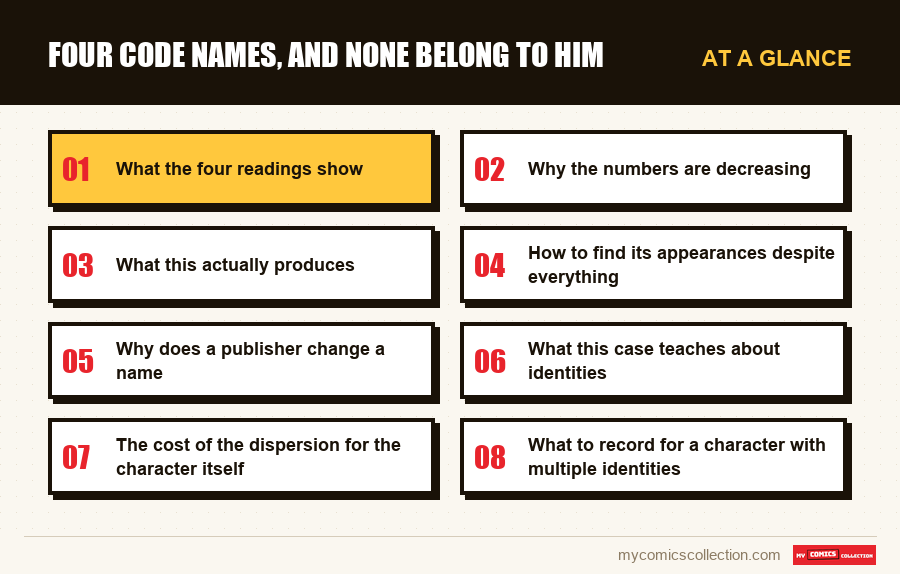
What the four readings show
The first identity
Raw : 148 annonces, median $61.11, maximum $8,249. Certified: 50 listings, median $495.00.
La deuxième
Raw : 163 ads, $1.00 to $349.99, median $25.00. Certified: 14 listings, median $237.50.
The third
Brut : 175 annonces, $0.99 to $599.50, median 19,99 $. Certified: 6 ads only.
The fourth
Brut : 175 ads, $0.99 to $369.83, median $13.99. Certified: 15 listings, median $127.99.
Asking prices observed on August 29, 2026, gross and certified counted separately, never sales concluded. Each question concerns a code name, not a character: a distinction which is precisely the subject of this article.
The decrease is regular and the supply increases in the opposite direction: 148 advertisements under the first name, 175 under the last two. The later the name, the more numerous and cheaper the issues.
The number of verified copies follows the same movement, with one exception: six advertisements certified only under the third identity, compared to fifty under the first. The verified segment is almost completely disinterested in late identities.
Why the numbers are decreasing
Three causes combine, and the first is enough to explain the essential.
Identities follow one another over time. Each name corresponds to a period, and older periods have rarer fascicles, printed on fragile paper and destroyed in greater numbers. The decrease therefore firstly measures a chronology.
The first identity contains the origin points. It is under this name that the character appears for the first time, which concentrates the demand on a handful of issues and pulls the entire population upwards.
Renames are not creations. A character changing their name does not produce a new first appearance in the market sense. The issue where he adopts a new name is an episode, not a birth.
We must therefore be wary of an attractive but false reading. These figures do not show that the public prefers the first identity: they show that the oldest fascicles are the rarest, which is not the same statement.
One nuance nevertheless deserves to be put forward, cautiously: the market never seems to remunerate a change of name.
On this character as on others, the booklet where a new identity is adopted is not distinguishable from its neighbors. A first appearance creates an object; a renaming does not create any, because it does not introduce anyone: it redesignates someone who already existed.
Why do these names not refer to anyone?
This is the most important practical point, and it does not appear in any of the figures above.
Each of these four names has been borne by several different characters. The first identity had at least three successive bearers, the second and third were taken up by others, and the fourth as well.
The questions are therefore porous by construction. The populations surveyed mix fascicles concerning unrelated characters, and nothing in a title always allows us to decide.
This porosity deforms the medians in unpredictable ways. She can pull them down if the namesake is a secondary character, and up if he appears in researched booklets. We don't know which way without examining the ads one by one.
The four statements above must therefore be read for what they are. These are measurements of names, not characters, and this is exactly the problem that anyone trying to build a collection on this figure has.
What this actually produces
The practical consequences are numerous and accumulate over the course of a collection.
A search by name does not work
Searching for a code name brings up multiple characters, with no easy way to separate them.
Contemporary homonyms
Two characters had the same name at the same time, even on the same team.
An illegible timeline
Following the character requires knowing what name he had on what date, information that is rarely within reach.
Ads that simplify
Many use the best-known name regardless of the identity actually present in the booklet.
Very different costumes
Visual identification does not work: nothing links appearances together.
Team collections
The republications follow the collective series, never the journey of a particular carrier.
How to find its appearances despite everything
Four methods work, in order of decreasing reliability.
Go through the character's civilian name. This is the only stable identifier of his entire career. He doesn't appear on the covers, but he appears in the catalog, and it is he who links the four identities together.
Go through the series rather than the character. Its presence is continuous in certain collective series over long periods; following the series suddenly resolves the question of names.
Go through the dates. Each identity corresponds to a chronological slice. Knowing the boundaries allows you to immediately rule out homonyms located outside them.
Go through the creator or team. Method of last resort, useful for poorly documented periods, but it creates a lot of noise.
The first method makes the other three almost useless. A character with multiple identities is not collected by their code name, they are collected by their civil identity: and that’s the only rule to remember from this entire article.
Collecting this series?
Track what you own, what you are missing and what your collection is worth. 7 day trial.
Start my trial →Why does a publisher change a name
It is worth understanding the mechanism, as it sheds light on reading the periods.
To signal a change in power or tone. A character whose abilities evolve receives a new name which announces it to the kiosk reader without having to explain it.
To restart a figure that doesn't work. A new name offers a second chance at a lower cost, without creating an additional persona to maintain.
To free a name that has become useful elsewhere. An identity that the publisher wants to entrust to someone else must first be left by its bearer, which mechanically produces a renaming.
None of these reasons have anything to do with the quality of the character. These are catalog management decisions, and they leave behind documentation that no one anticipated would become a problem.
What this case teaches about identities
Three valid observations beyond this character.
A name is a property of the editor, not of the character. It flows between figures as needed, and granting it a stability it does not have is the source of most confusion.
The multiplication of identities damages readability. A character who can't be named consistently is difficult to recommend, research, and republish-which weighs on his notoriety as much as his stories.
The market ignores renamings. None of the three name changes produced a sought-after booklet, while the first appearance alone produced several.
These three points converge towards the same conclusion. The code name is a commercial convention, and treating it as an identity leads to both documentary and commercial errors.
The cost of the dispersion for the character itself
This instability has an effect that is poorly measured and which goes beyond the documentary question.
A character that cannot be named in one way cannot be transmitted. An oral recommendation, a reading advice, an improvised research: all this requires a unique name. When it takes four, the transmission interrupts itself.
Figures whose notoriety has been maintained over several decades almost all share one characteristic: a constant name, immediately associated with a silhouette. This one never had either.
Recent adaptations have also decided by returning to the first name, including for periods when the character no longer wore one. It's a useful admission: the original name is the only one that works with a wide audience.
A more general observation must be made. The readability of a character is a resource that is consumed, and each renaming spends a part of it without ever replenishing it: which explains why a publisher gives it up as soon as it targets a new audience.
What to record for a character with multiple identities
The documentation should make up for exactly what the covers don't say.
The civil name, as the main entry. This is the only field that remains constant throughout the career, and it must take precedence over the code name in inventory organization.
The code name carried in this specific booklet. In the secondary field, because it changes; noting it allows you to reconstruct the chronology without reopening the copies.
The mention of a possible homonym. When a name is shared, explicitly indicating which of the bearers appears in the booklet avoids an error which is never obvious.
The series and its date, systematically. On a character spread across dozens of collective titles, it is this couple that makes a line findable.
The nature of the appearance. Main role, team member or simple presence in the background: on such a dispersed figure, a collection which does not distinguish these three cases quickly becomes unmanageable.
Firstly because it is the oldest: its fascicles have survived less. Then because it contains the character's points of origin, which concentrate the request. The observed decrease: 61.11 then 25.00 then 19.99 then $13.99: therefore measures a chronology before measuring a preference.
No, and it's constant. The issue where a new identity is adopted is not distinguished from its neighbors, because a renaming does not introduce anyone: it redesignates someone who already existed. Only a true first appearance creates an object that the market pays for.
They measure names, not characters, and it must be said frankly. Each of these four names was carried by several different figures, so that populations mix unrelated fascicles. The distortion can work in both directions and can only be corrected by examining the ads one by one.
By his civil name, which is the only stable identifier of his entire career and which appears in the catalog even if it does not appear on the covers. The other methods (by series, by dates, by creative team) only serve to fill in the gaps of the first.
To signal a change in power or tone without having to explain it, to relaunch a figure that doesn't work without creating a new one, or to release a name that he wants to entrust to someone else. These are catalog management decisions, unrelated to character quality.
Four names, several bearers: which one do you have?
On a character with multiple identities, only the civil name links the documents together.