
On three issues of the same set of characters, the share of certified copies in the offer ranges from 3% to 84%. As of August 29, 2026, the first appearance of the second bearer of the name counts 85 certified announcements for 101 gross; the original fascicles of the first bearer, 50 for 148; and the most discussed number of the series, only one for 31. This proportion says more than prices: it measures the liquidity of an object, not its importance.
It is an indicator that almost no one looks at, even though it can be read directly in any statement and explains otherwise incomprehensible discrepancies.
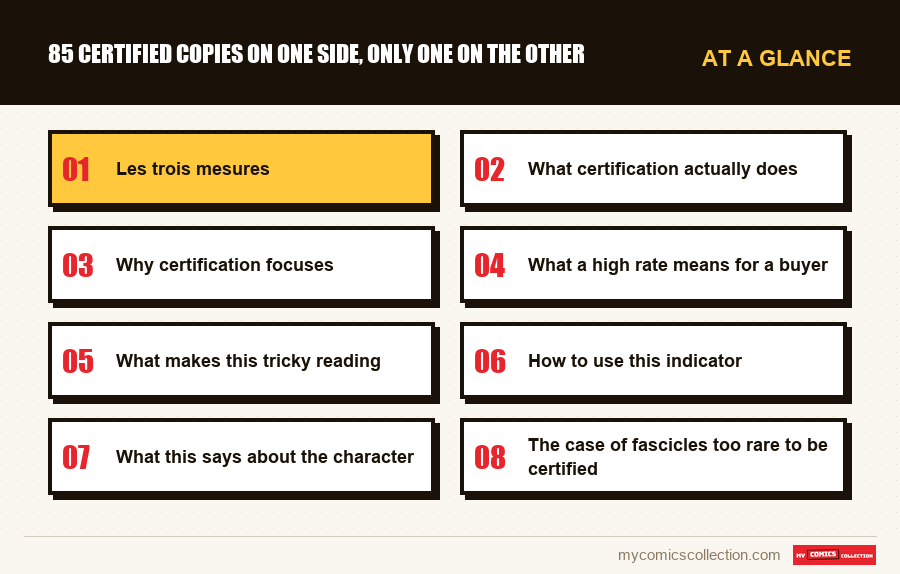
The following presents the three measures, explains what the certification actually does, why it focuses on so few objects, what a high rate implies for a buyer, and how to use it.
Les trois mesures
The first appearance of the successor
Brut : 101 ads, median 89,00 $. Certified: 85 ads, médiane $187.99. Part certifiée : 84 %. Multiplier: 2.1.
Les fascicules d'origine
Raw : 148 ads, médiane $61.11. Certifié : 50 annonces, médiane 495,00 $. Part certifiée : 34 %. Multiplier: 8.1.
The most discussed number
Brut : 31 annonces, médiane $7.00. Certified: une annonce. Certified share: 3%. Aucun multiplicateur calculable.
The regularity that emerges
The higher the certified share, the lower the multiplier. The two quantities vary in opposite directions.
These figures are asking prices observed on August 29, 2026, raw and certified counted separately. The shares are calculated on the populations of advertisements noted, which do not represent the entire market but the offer visible that day.
The regularity observed is worth paying attention to: where certification is most widespread, it brings in the least. The fascicle certified at 84% only sells for twice the price of rough, while that certified at 34% sells eight times more expensive.
This is not contradictory, it is the normal functioning of a mature market. When almost the entire offering is verified, verification ceases to be a distinctive advantage and becomes a simple entry condition again.
What certification actually does
Three distinct functions, which are often confused under the word guarantee.
It renders a comparable state. Without it, two sellers describe the same item differently. With it, a position on a common scale replaces adjectives, and two announcements become comparable.
It certifies integrity, not just beauty. Restoration, cropping, replaced pages: these are interventions that a buyer cannot detect on a photograph, and this is often the real reason for the process.
It makes the object negotiable at a distance. This is the least cited and most determining function. A verified copy is sold without being seen, to someone who does not know the seller, which considerably expands the number of possible buyers.
This third function explains everything else. Certification is first and foremost a liquidity instrument, and it logically concentrates where liquidity has value: that is to say where objects are exchanged often and expensively.
Hence the most useful conclusion of this file: the share of certified copies measures ease of resale, not quality or importance.
A rate of 84% indicates a standardized item, which buyers are constantly looking for and which sellers can sell without effort. A rate of 3% indicates the opposite: a booklet that is kept or sold at the price of the lot, without anyone organizing its circulation.
Why certification focuses
Four conditions must be met for a booklet to be massively verified, and it is rare that they all are.
The object must be unambiguously identifiable. A first appearance is designated with a sentence, is verified in a second, and is not confused with anything. A known number for a scene requires explaining which one, which is already an obstacle.
The price gap between states must be significant. If a good copy is worth twice as much as an average copy, the verification pays for itself. If it's worth three dollars more, it costs more than it brings in.
There must be continued demand. An item sought by a few people every six months does not warrant any preparation for resale. The process requires knowing that a buyer will come forward.
The booklet must exist in sufficient quantity. This is the most counterintuitive point: an object that is too rare is not widely certified, due to a lack of a regular flow of copies to process.
These four conditions exactly describe a widely distributed first appearance. They almost exclusively describe this, which explains the extreme concentration of the verified segment on a single category of fascicles.
What a high rate means for a buyer
The situation is not neutral, and it has opposite practical consequences depending on what we are looking for.
Crude becomes difficult to evaluate. When most of the supply is verified, the remaining raw copies are often those that no one has deemed useful to have examined: which is not reassuring without necessarily being worrying.
The price of entry goes up. A low multiplier does not mean an accessible market: it means that crude has been driven up by certified, not the other way around. The floor observed at $8.59 concerns peripheral objects, not the targeted issue.
Negotiation disappears. A standardized market is traded at the displayed price. The gap between sellers is narrowing, and opportunities are becoming exceptional rather than frequent.
Conversely, a poorly certified booklet leaves plenty of room for personal appreciation. It's riskier and much cheaper, and the choice between the two comes down to tolerance for uncertainty much more than budget.
What makes this tricky reading
The indicator is useful but fragile, and several precautions are necessary.
Sometimes tiny numbers
A share calculated on one or two advertisements means nothing and shifts at the slightest change.
Porous questions
A search brings back neighboring fascicles, which distorts the proportion in both directions.
A photograph of a single day
The observed share describes the offer visible on a date, never an evolution.
Uneven rotation
Verified copies come up for sale more often, which mechanically overrepresents them.
Ambiguous mentions
Some titles evoke a note without the copy actually being verified.
Excluded sets
Booklets sold in packages do not appear in either segment and distort the total.
Collecting this series?
Track what you own, what you are missing and what your collection is worth. 7 day trial.
Start my trial →How to use this indicator
Three concrete uses, in order of their usefulness.
Evaluate ease of resale before purchasing. A high rate indicates an object that will be replaced without difficulty; a zero rate indicates a definitive purchase, to be made only if you want the object for itself.
Identify the segments still open. An important but poorly certified booklet is a place where the description and the eye still count, therefore where an attentive buyer maintains an advantage over a hurrying buyer.
Correct a price reading. A certified median calculated on three advertisements does not compare to a median calculated on eighty-five. Looking at the headcount before the amount avoids most hasty conclusions.
These three uses have in common that they shift attention. The number of advertisements is information at least as rich as their amount, and it is almost always ignored in favor of price.
What this says about the character
Applied to this set of characters, the indicator draws a hierarchy which does not correspond to any narrative hierarchy.
The successor carries the liquidity. Its first appearance is the standardized object of the group, the one that the market knows how to deal with, and its rate of 84% makes it almost a financial booklet.
The original fascicles carry the value. Their multiplier of 8.1 reflects a real rarity in good condition, on examples over sixty years old whose survival is uncertain.
The most discussed number carries nothing. His fame is entirely documentary, and the verified segment ignores him with remarkable consistency.
Three functions, three fascicles, no overlap. What the market remembers about a character is never what their readers remember about them, and the gap is measured here with unusual clarity.
The case of fascicles too rare to be certified
The fourth condition stated above deserves development, because it contradicts the most widespread intuition.
An extremely rare booklet does not have a high certification rate. It presents an erratic rate, because the population of advertisements is too low for a proportion to have any meaning: three copies for sale, two of which are verified, give 67%, and the arrival of a fourth changes everything.
Mass certification, on the contrary, presupposes a flow: examples which present themselves regularly, buyers who return, an established practice. It describes an active market, not a rare market.
Confusing the two leads to a symmetrical and frequent error. A high rate indicates that the item is rare, but it indicates exactly the opposite: an item that is common enough for a verification industry to be interested in.
In the oldest periods, where the surviving examples are sometimes counted in dozens, the indicator therefore becomes unusable. It should be reserved for abundant fascicles, that is to say precisely to those whose availability we least doubt.
What to record on a verified copy
A certified fascicle calls for fields that a raw copy does not require.
The grade awarded, as is. This is the information that determines everything else, and rounding or rephrasing it renders it unusable for later comparison.
The date of the verification. Scales and practices evolve; an old note does not read exactly like a recent note, and without the date we cannot take it into account.
Les mentions particulières. Reported restoration, provenance, special qualification: these are what explain an unexpected price difference, and they are quickly forgotten.
The identification number. It links the object to its original record and remains the only way to verify consistency years later.
The condition of the case, separately from the note. A cracked or scratched support does not affect the issue but affects resale, and confusing the two in a single assessment distorts the estimate.
Ease of resale, not quality or importance. A rate of 84% indicates a standardized item that buyers are constantly looking for; a rate of 3% indicates a booklet that is kept or sold at the price of the lot. Both extremes coexist here on the same set of characters.
Because generalized verification ceases to be distinctive. When 84% of the offer is verified, the approach becomes a condition of entry rather than an advantage, and the supplement is reduced - 2.1 times here, compared to 8.1 times on a fascicle certified at 34%.
Not in itself. It indicates an object with little liquidity, therefore a purchase that must be wanted for its own sake and not to replace it. On the other hand, this is where the description and the eye still count, and therefore where an attentive buyer maintains an advantage over a hurrying buyer.
With precautions. It describes the visible offer of a single day, the questions bring back neighboring issues, and the verified copies come up for sale more often, which over-represents them. On numbers of one or two announcements, it means nothing at all.
Yes, and this is the main recommendation of this file. A median calculated over three ads does not compare to a median calculated over eighty-five, and nothing in the figure indicates this. The headcount is information at least as rich as the amount, and almost always ignored.
Note, date, mentions: is everything recorded?
A note without its date or its particular mentions becomes unusable for any subsequent comparison.