Monitoring the evolution of the price of your comic collection requires three reflexes: precisely document each issue (series, print run, condition or CGC grade), regularly compare this figure to recent sales rather than posted prices, and re-evaluate everything at regular intervals rather than piecemeal, keeping in mind that graded rarity, cultural news and the macroeconomic market cycle weigh much more than the simple age of an issue.
A comic book collection is never set in stone. An issue purchased for €15 at a small flea market can be worth ten times as much two years later because a series has been announced as an adaptation, just as a piece purchased at the height of a speculative boom can lose a quarter of its value in twelve months when the market corrects. Unlike other collectibles, the comic book combines several layers of value which move independently of each other: the physical rarity of the original print, the state of conservation validated by a third-party grading company, the narrative importance of the content (first appearance, death of a character, cult run of an author) and finally the general climate of the market, itself cyclical.
Monitoring this evolution over time is not an exercise reserved for investors. It is above all a tool for understanding one's own reader heritage: knowing what one's collection is really worth allows one to arbitrate a resale, to better insure a valuable lot, to prioritize the issues to be graduated, or simply to understand why a particular run from the 1990s is no longer worth much when it sold for a lot ten years ago. It is also a technical exercise: the prices displayed on a product sheet say nothing about what is actually selling, and an ungraded copy compares poorly to a certified copy.
This guide details the method for correctly monitoring the evolution of the price of a comic collection: understanding where the market reference tools come from, identifying the factors that cause a price to move, setting up concrete and sustainable monitoring, and measuring the real impact of audiovisual adaptations on the value of an issue.
Where do the tools that allow you to track the price of comics come from?
Structured monitoring of comic book prices is not a recent phenomenon. It dates back to November 1970, when Robert M. Overstreet published the first edition of his reference guide, a 218-page work with only 1,000 copies printed and sold for $5, built in part from Jerry Bails' research notes. This annual guide played a decisive role in structuring the market: by giving specialized stores and collectors a common vocabulary to evaluate an issue, it encouraged the growth of the direct market for comic shops compared to traditional kiosks.
The second major break occurred in 2000, with the creation of Certified Guaranty Company (CGC) in Sarasota, Florida. Before CGC, the condition of a comic was based on a subjective assessment of the seller or buyer. Since then, CGC grades each copy on a scale of 0.5 to 10, in increments of 0.5 points up to 9.0 then in finer increments up to 10.0, and seals the comic in a tamper-proof case. This standardization made possible a second essential tool for monitoring price developments: the census, or population report, a public register which indicates how many copies of a given number have been graded, and at what level. The census only lists the examples subject to grading, not the raw copies which are still dormant in private collections, but it remains the most reliable indicator of rarity available to a collector to locate his own copy.
The third, more recent development is the democratization of sales data. Online auction platforms now publish the history of transactions carried out, which has allowed the emergence of market indices segmented by editorial era (Golden Age, Silver Age, Bronze Age, Copper Age, Modern Age). This transparency had a direct effect on the behavior of collectors during the 2020-2021 period: confinements, available money and the search for entertainment caused an unprecedented speculative boom, with a Copper Age index up 168% between March 2020 and July 2021, and a Bronze Age index up 137% over 27 months. This peak was then followed by a prolonged correction from 2022, a cycle which alone illustrates why tracking your collection over time, and not just at the time of purchase, has become essential.
The factors that really move the rating of a comic
Before setting up monitoring, you need to know what you are tracking. The price of a comic book never changes for a single reason: it always results from a combination of several factors, some of which are stable over time and others that change from one month to the next.
Graduated rarity, not just the original print
The original print run of an issue gives a general indication of its availability, but it is not this number that determines its value today: it is the number of surviving copies in a given state, measured by the CGC census. Two issues with a comparable circulation can have radically different odds if one has withstood time better (fewer readers, better storage) than the other. Conversely, a massive print run does not guarantee abundant copies in very high grade: handling, the acidic paper of comics from the 1970s and 1980s and amateur storage drastically reduce the number of copies which reach 9.6 or 9.8 several decades later.
State of conservation and grade
The same number can be worth ten, twenty or fifty times more depending on its grade. This is the most measurable factor and the easiest to track over time, because a graded example does not (normally) change grade once sealed. The main risk of poor monitoring is precisely the confusion between a price observed on a raw (ungraded) copy and a price observed on a CGC 9.8 certified copy: these are two different markets which cannot be compared directly.
Narrative content: first appearance, death, cult run
An issue which contains the first appearance of a character, a pivotal moment in the scenario (death, resurrection, change of costume) or which is part of a particularly sought-after run by a screenwriter or artist sees its rating raised by a factor which depends neither on rarity nor on condition: cultural demand. This factor is the most volatile of the four, because it can be reactivated decades after publication by news outside the comic itself.
The macroeconomic market cycle
Finally, the price of a comic evolves with the general climate of the collecting market, itself sensitive to interest rates, investor confidence and arbitrage between asset classes. After the 2021-2022 peak, a correction took place in several segments: the Bronze Age index has fallen by 24.7% since its peak in June 2022, and the Silver Age index has lost around 23% compared to its 2022 high. Over the most recent period, the Silver Age index has fallen by another 4.78% over one year and the Bronze Age by 5.69%, while the Modern Age will grow by 3.27% in 2025, a performance that exceeds inflation and sets this segment apart from others. This generalized decline, however, does not affect all quality levels in the same way: key Silver Age numbers graded CGC 8.0 and above have maintained, or even increased slightly, over the period 2024-2026, with structural scarcity at high grades continuing to support demand despite the correction across the market as a whole.
A final, more structural factor deserves to be monitored: the very organization of distribution. Diamond Comic Distributors, which has long been the almost sole distributor of the American direct market, saw its monopoly crumble from 2020 when DC Comics moved to a competing distributor, followed by Marvel in 2021 then by IDW and Dark Horse. Diamond ended up filing for bankruptcy in early 2025 after months of delivery delays. This type of industrial recomposition has no immediate effect on the price of an old issue, but it influences the availability and distribution of new releases, and therefore indirectly the dynamic of rarity of the series being published at the time when they too will become sought-after key issues.
Collecting this series?
Track what you own, what you are missing and what your collection is worth. 7 day trial.
Start my trial →Implement concrete monitoring of your collection over time
Tracking the price of a collection is not about checking a quote once and then forgetting about it. It is a process that is constructed in four stages, each bringing an additional layer of reliability to the final costing.
1. Document Every Number Accurately
The basis of monitoring is an exhaustive inventory: series, number, year and publisher, print run (first printing, reprint, variant), estimated condition or CGC grade if the copy is certified, and date of acquisition with purchase price. Without this basis, any subsequent estimate remains approximate, because two copies of the same issue can have very different values depending on whether it is a first printing or a reprint, a standard cover or a limited edition variant. This is precisely the role of a collection management application: to centralize this information number by number rather than dispersing it in a spreadsheet that is updated once a year. OUR comic collection management application was designed for this specific use case, by associating each number with its characteristics and its valuation history.
2. Compare to sales made, not displayed prices
The most common mistake is relying on a seller's asking price rather than the price actually paid by a buyer. A number can remain listed at a high price for months without ever finding a buyer, which in no way reflects its real market value. The only reliable indicator is the sale made, compared while respecting three simultaneous criteria: same number, same grade (or equivalent condition for a raw copy), and recent transaction, ideally less than six months old given the current volatility of the market.
3. Reassess at regular intervals, not piecemeal
A one-off revaluation, triggered for example by a desire to resell, gives a snapshot at a given moment which can fall at the bottom or peak of the market. Useful monitoring is rather based on a regular cadence: a quarterly update is sufficient for active collections, a half-yearly or annual update for a more static collection. This regularity makes it possible to identify underlying trends (a run which has been gradually increasing over the past year) and to distinguish them from occasional jolts linked to current events (film announcement, death of an author, convention).
4. Isolate news-sensitive numbers
Not all pieces in a collection move at the same pace. Key issues linked to an active character in the entertainment industry (adaptations, video games, animated series) deserve more frequent monitoring than anthology series issues unrelated to an active franchise. Segmenting your collection between “dormant numbers” and “news-sensitive numbers” allows you to concentrate the monitoring effort where it is most likely to reveal a significant price movement.
The impact of adaptations on the rating
Since the release of Iron Man in 2008, each announcement of a film or series linked to a Marvel or DC character almost systematically triggers an increase in demand for issues containing his first appearance. This phenomenon has been documented and measurable for almost two decades, with very variable amplitudes depending on the characters and the context.
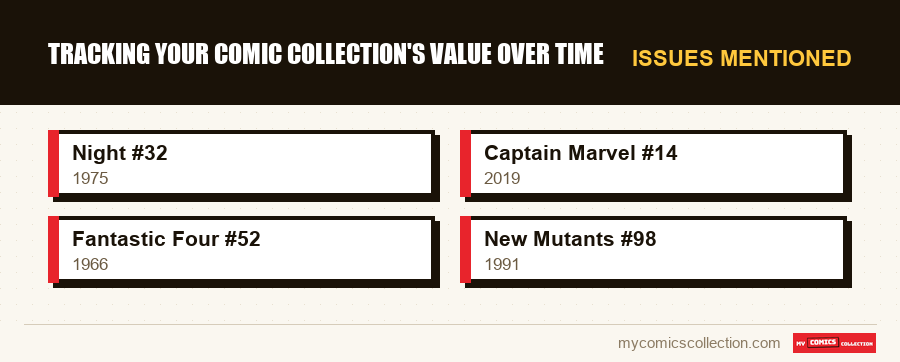
The most spectacular example concerns Moon Knight: the announcement of the Disney+ series propelled Werewolf by Night #32 (1975), which contains the first appearance of the character, to new heights, a copy graded CGC 9.4 having sold for more than €10,000 in 2022. Another documented case, that of Kamala Khan: at the announcement of the Ms. Marvel series, the value of Captain Marvel #14 (2019), which presents the first appearance of the character in this specific continuity, was multiplied by five in just a few days.
The effect is not unique to the streaming era. Avant la sortie de Black Panther en salles début 2018, CGC recensait pour Fantastic Four #52 (1966), première apparition du personnage, seulement 2 618 exemplaires gradués au 26 décembre 2017, dont cinq copies au grade 9,8 seulement : une rareté en haut grade qui explique la vente d'un exemplaire CGC 9,8 pour 83 650 dollars dès février 2016, bien avant le pic médiatique du movie. De même, à l'approche de la sortie de Deadpool 2 en 2018, New Mutants #98 (1991), qui marque la première apparition de Deadpool, comptait déjà 14 488 exemplaires gradués recensés par CGC au 10 avril 2018, un volume qui illustre à quel point ce numéro était devenu une référence suivie de près par les collectionneurs bien avant la sortie du film.
What these examples show is a recurring pattern: the value rises sharply upon announcement or release, peaks around the hype period, and then stabilizes at a level higher than before the announcement but generally lower than the speculative peak reached during peak attention. For a collector who follows his collection over time, this means two concrete things: first, that a peak in price linked to an adaptation is not necessarily a lasting value to be integrated as is into an asset estimate; secondly, that a key number linked to a character as yet unexploited on screen retains a potential for re-evaluation which justifies active monitoring, particularly when casting or project announcements begin to circulate.
The adaptation market itself, however, remains dependent on the general climate: the post-2021 wave of Marvel releases was accompanied by a slowdown that several market observers have dubbed the “MCU malaise”, an erosion of the knock-on effect of films and series on ratings, partly linked to the multiplication of productions and the dilution of public attention. Monitoring the impact of an adaptation therefore requires putting it into perspective with the macroeconomic context of the moment, and not just with the critical or commercial success of the film or series concerned.
Buying guide: follow your collection without getting trapped
Following the evolution of the price of a collection serves as much to buy better as to resell better. Here are the concrete points of vigilance to integrate into your method.
- Never compare a raw copy to a graded copy. A price observed on a CGC 9.8 says nothing about the value of a non-certified example in visually comparable condition: the gap in confidence between the two markets systematically results in a price gap, sometimes very significant.
- Be wary of spikes linked to recent news. A number that has just jumped following a casting or film announcement can drop significantly once the peak of media attention has passed; do not base a long-term estimate on a sale made in the midst of an outbreak.
- Check the census before purchasing a “rare” number. The term “rare” is often used without numerical reference; the CGC population report allows you to objectively verify how many copies exist in the desired grade.
- Distinguish between first printing and reprinting. Many key issues have been reprinted, sometimes with almost identical cover art; the difference in value between the two versions can be considerable, while there is nothing to distinguish them to the naked eye for an uninitiated person.
- Reevaluate your collection on a fixed date, not just before a sale. Regular monitoring makes it possible to spot an underlying trend before it becomes a missed opportunity or a risk of loss of value.
- Segment numbers sensitive to cultural news. Focus monitoring on characters still active in the entertainment industry rather than following an entire collection at the same pace.
- Keep track of purchase history. Price paid, date, origin: this information makes it possible to measure real performance rather than a simple instantaneous value.
To transform this method into a lasting habit, the combination of a precise inventory via a collection management application and a spot check of the rating via a estimator based on current eBay listings covers the essentials of monitoring: the structure on one side, the updated market data on the other.