A $500-a-month comics budget ($6,000 a year) demands investor discipline, not consumer habits. Recommended allocation: 40% vintage Bronze CGC 9.4-9.6 (one piece every 3 months, ~$650 ticket), 40% hot modern CGC 9.8 (3 to 5 pieces per month, $55-$90 ticket), 20% immediate speculation (ratio variants, announced first appearances). Monthly portfolio review is mandatory; CGC pre-screening required on any purchase over $220.
The $500-per-month threshold marks a genuine inflection point in what it means to be a comics collector. Below that level, it's a budgeted hobby. Above it, you're managing a portfolio: with everything that entails: purchase tracking, valuation monitoring, bias prevention, and tax planning. This 2,000-word guide lays out a strategy for a $6,000 annual budget over a rolling 12-month window: asset class allocation, acquisition cadence, pre-screening methodology, monthly review metrics, and the specific mistakes that trip up high-capital collectors. The target reader: an established professional, 35-55 years old, comfortable income, looking to put serious money into comics without blowing it on impulse buys.
The typical $500/month collector profile
A $500 monthly budget isn't trivial. Statistically, it corresponds to a household net income above $5,000 per month, with established savings and stable discretionary spending. The dominant profile: senior executive aged 35-55, independent professional, small business owner, or expat. The goal is no longer reading enjoyment: it's building a comics portfolio that blends passion with value preservation.
At this level, three things distinguish this collector from someone working with $50 or $150 a month. First, the holding horizon is long: 10 to 25 years, sometimes with the intention of passing the collection on to children. Second, liquidity is a secondary concern: no need to flip quickly, which opens the door to heavy positions like a Bronze Age key issue in CGC 9.6. Third, the tolerance for the occasional mistake is higher: a bad $440 purchase doesn't derail the following month. That tolerance must never become carelessness.
The classic trap for the high-budget collector is the mirror image of the low-budget trap. The low-budget collector buys too little and misses opportunities. The high-budget collector buys too much, accumulates middle quality that never appreciates, and ends up with 600 pieces where 80% are worth roughly half what they cost. Buying discipline is inversely proportional to how easy it is to swipe the card. The comics passion vs. investment guide covers this trade-off in depth.
The 40-40-20 split: a diversified portfolio
The recommended portfolio structure for a $6,000 annual budget follows investment-fund logic: 40% stable core, 40% growth, 20% speculation. Mapped onto the comics market, the split becomes: 40% vintage Bronze CGC high-grade, 40% hot modern CGC 9.8, 20% immediate speculation on first appearances and ratio variants.
40% vintage Bronze CGC high-grade: $2,400 per year
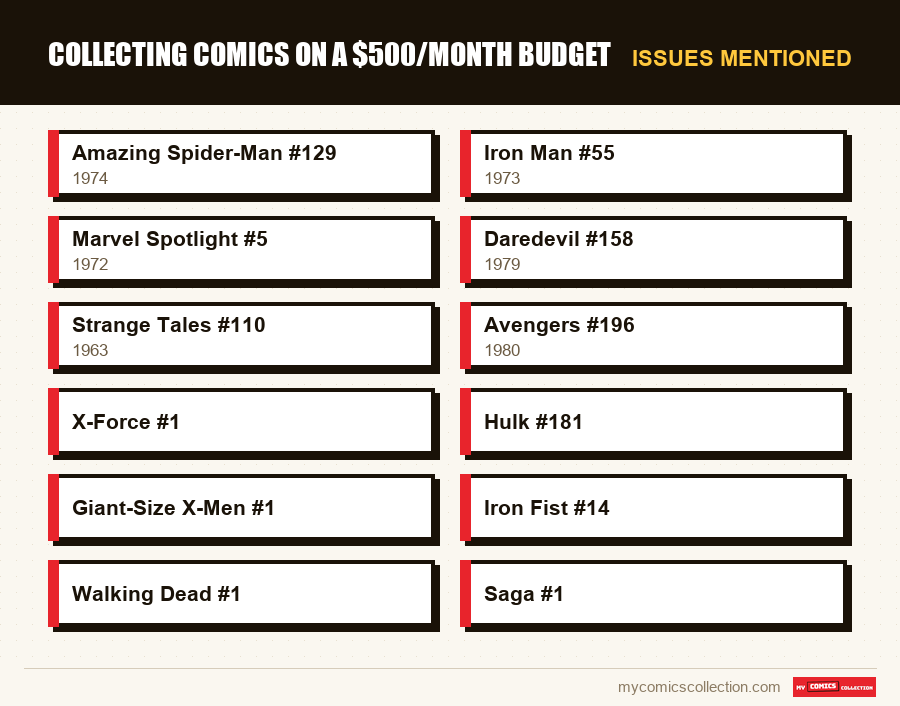
The Bronze Age pocket (1970-1985) forms the foundation. At $2,400 annually, the cadence is one piece every three months around $600, or two semi-annual pieces at $1,200 each. Target: CGC 9.4 to 9.6 on canonical key issues. Top-priority Bronze keys to watch: Amazing Spider-Man #129 (first Punisher, July 1974), #194 (first Black Cat, July 1979), Iron Man #55 (first Thanos, February 1973), Marvel Spotlight #5 (first Ghost Rider, August 1972), Daredevil #158 (Frank Miller's first issue, May 1979), Strange Tales #110 (first Doctor Strange, July 1963: Silver Age but relevant), Avengers #196 (first Taskmaster, June 1980).
The rationale: these issues have 40 to 55 years of market history. Price curves are readable, comparables are plentiful, volatility is low. An Amazing Spider-Man #129 in CGC 9.4 trades between $2,200 and $3,000 in 2026, versus $650-$1,000 in CGC 8.0. The grade-to-grade price gap is wide enough to justify pre-screening. For Bronze key valuation methodology, see understanding comic ages and undervalued comics 2026.
40% hot modern CGC 9.8-$2,400 per year
The modern pocket (post-2000) absorbs the same amount but at a higher frequency: 3 to 5 pieces per month at $55-$90 per ticket. Target: CGC 9.8 on confirmed first appearances and 1:25 or 1:50 ratio variants on active series. Hot moderns for 2024-2026 include first appearances tied to film and TV announcements 12-24 months out. At $220 monthly on this pocket, you might buy: 1 modern first appearance CGC 9.8 at $130, 1 ratio variant raw at $65, 1 signed sketch cover at $85.
This pocket carries higher volatility but also higher liquidity. A hot modern CGC 9.8 sells in 7 to 15 days on eBay; a Bronze 9.6 at $3,300 can take 3 to 6 months to find a buyer. The fast turnover offsets the volatility. For the variant framework, see variant covers guide and ratio variants 1:25 / 1:100.
20% immediate speculation: $1,200 per year
The pure speculation pocket ($100 monthly) is designed to capture very short-term opportunities: Marvel Studios casting announcements within 24 hours, Disney+ series leaks, DC film rumors. At this budget, you buy 5 to 10 raw copies per month on first appearances of secondary characters just before they're confirmed on screen. The failure rate is high, 60 to 70% of these picks go nowhere, but the 30% that work can multiply by 5 to 15x. This pocket requires active monitoring: CBSI forums, Reddit's r/comicbookspeculation, Bleeding Cool, scoop.com.
CGC pre-screening for any purchase over $220
Once a single ticket hits $220 or more, pre-screening becomes mandatory. Pre-screening means using CGC's Pre-Screen service before paying for a raw copy, to estimate the grade the book is likely to receive. The cost is negligible ($16-$28) relative to the value gap between grades. An Amazing Spider-Man #129 raw that comes back CGC 9.0 instead of the expected 9.4 represents an immediate $1,300 loss on a $2,750 purchase.
The practical method: high-resolution photos (4 angles, front and back, spine, both sides), submission to an authorized CGC broker (CovrPrice, Comics Heritage, or directly through CGC via a program member), turnaround of 5 to 10 business days with a probable grade plus or minus 0.5 points. If the probable grade falls below your target threshold, you walk away. This discipline eliminates 85% of overpayment errors on vintage raw copies.
For modern books priced at $55-$90, pre-screening isn't cost-effective. The reverse rule applies: buy copies already graded CGC 9.8; never buy a high-potential raw modern without grading. The spread between raw NM and CGC 9.8 on a modern book is 200 to 400%: four times the cost of grading (around $50 at standard tier). The CGC grading guide walks through this math in detail.
The mandatory monthly portfolio review
The monthly review is what separates a serious collector from a casual one. Once a month, ideally the first Sunday, dedicate 90 minutes to reviewing the following metrics: total portfolio valuation (month-over-month change, 12-month change), actual allocation vs. the 40-40-20 target, top 5 gains for the month, top 5 losses, budget execution rate (amount spent vs. $500 target), and the acquisition pipeline for the next 60 days.
The right tool for this review is a Comics Manager that supports historical valuation tracking. See comics collection apps and comics manager complete guide for selection criteria. Once you're 24 months in at $500/month (around 1,200 issues in the collection) a spreadsheet can't handle the complexity: you need indexed data, dynamic filters, live eBay integration, and a dedicated CGC module.
The monthly review triggers three types of decisions. First, rebalancing: selling a piece whose investment thesis failed (film canceled, character dropped from the Marvel Studios roster), redeploying the proceeds. Second, adding to winners: doubling down on a position gaining value steadily (a Bronze key moving from $2,000 to $2,300 over 6 months). Third, cutting: pausing purchases in an overrepresented theme (say, 18 Iron Man issues in 18 months: that's out of balance).
Avoiding the overhype trap
Overhype is what happens when the market piles into a hot theme, artificially inflating prices until the momentum exhausts itself and they crash. The canonical examples: the Image Comics bubble of 1992-1993 (Youngblood, Spawn, X-Force #1 printed at 1 million copies, residual raw value in 2026 nearly zero), the Heritage variants bubble of 2021 (NFT comics, value divided by 8 in 18 months), and the COVID-19 hot-modern bubble of 2020-2021 (40-60% corrections on certain books by late 2022).
At $500 a month, overhype is a structural risk. Capital is readily available, so you can chase market momentum without constraint: which means buying at the top. The most reliable warning sign: when you see the same first appearance cited in 5 different spec newsletters within 10 days, you're too late. The price has already priced in the information.
The countermeasure: a 30-day rule for any purchase over $880. When you spot a $1,300 opportunity, wait 30 days, re-check eBay comparables for that period, then decide with fresh eyes. 70% of false opportunities collapse in that window, preserving your capital for the real ones. See comics likely to rise in 2026-2027 for a disciplined speculation framework.
Tracking priority Bronze keys
With $2,400 annually earmarked for vintage, your watch list should focus on around thirty Bronze keys. The methodology: maintain an eBay saved search for each book, receive new-listing alerts, cross-reference against GoCollect and GPAnalysis price history. Priority Bronze characters to track: Avengers (secondary first appearances from the 1970-1979 roster), Iron Man (Thanos, Ultimo, proto-War Machine), Doctor Strange (Brother Voodoo, Clea, Bronze-Age Dormammu appearances), Daredevil (Bullseye, Elektra, Stick).
The buying calendar follows a quarterly rhythm. Q1: one Avengers or Iron Man book between $440 and $770. Q2: one Daredevil or Punisher book between $550 and $880. Q3: one Doctor Strange or X-Men Bronze book between $660 and $1,100. Q4: opportunistic buy based on market conditions, flexible budget $660 to $1,650. For the full list, see Amazing Spider-Man key issues and X-Men key issues.
For the heavy hitters (Hulk #181, Giant-Size X-Men #1, Iron Fist #14), an annual budget won't stretch to a high-grade copy. The strategy is to build a multi-year envelope: $2,400 in year one across 3-4 mid-tier Bronze keys, accumulating to $6,600 by year 3 to acquire a Hulk #181 CGC 9.4 or a Giant-Size X-Men #1 CGC 9.2. This multi-year approach demands dedicated savings discipline and hard walls between budget buckets.
Planning for taxes and insurance
At $6,000 invested annually, the portfolio reaches $20,000 to $28,000 in fair market value after 36 months, factoring in an average annual appreciation of 8 to 12% on Bronze keys. That figure triggers two administrative obligations most collectors underestimate: capital gains reporting on sales, and specialized home insurance.
On the tax side, in the US, comics sold at a profit are generally treated as collectibles subject to capital gains tax (maximum 28% federal rate for long-term collectibles held over one year, versus 20% for most long-term capital assets). Keep all purchase receipts, CGC invoices, and auction records. For French residents, comics fall under the "objets de collection" regime (Article 150 VI of the French Tax Code): a flat 6.5% tax on the sale price applies to items over €5,000, unless you opt for the capital gains regime (progressive deduction from year 3, full exemption after 22 years). Track acquisition dates and invoices carefully to preserve that option.
On insurance, a $25,000 comics portfolio fits inside no standard homeowner's or renter's policy. Most contents limits cap collectibles at $8,000-$10,000. A specific scheduled-items rider or a dedicated collectibles policy is required, with a detailed inventory, photos, and independent appraisals. The annual premium runs 0.3-0.6% of declared value: $75-$150 per year on a $25,000 collection. See protecting and storing your comics.
Track your comics portfolio with My Comics Collection
At $500/month, your monthly review demands a tool that supports live eBay valuation, CGC grade tracking, asset-class allocation breakdowns, and multi-year history. The subscription, priced for your country after a 7-day free trial, includes all of these features and syncs across iPhone, iPad, Android, and web.
FAQ
Is $500 a month an excessive comics budget?
Not if it stays below 5% of your household net monthly income and you already have an emergency fund covering 6 months of fixed expenses. At $5,000 net income, $500 is 10%: too high. At $11,000 net income, $500 is about 4.5%: reasonable. Standard wealth-management guidelines cap illiquid assets at 15-20% of total net worth.
Is it better to buy 1 book at $500 or 10 books at $50 per month?
The 40-40-20 split answers this precisely: neither exclusively. One $500 monthly book concentrates risk on a single Bronze key with no time diversification. Ten $50 books spreads too thin and cuts you off from the vintage pieces that appreciate sustainably. The optimal mix: 1 vintage piece around $220 + 3 modern CGC 9.8s at $88 each + 2 raw spec picks at $33 each.
Is CGC grading worth it on every purchase?
No. Grading costs $50-$105 depending on tier and declared value, and takes 30 to 120 days. Grading makes sense when the expected post-grade value exceeds the raw value plus grading cost by 200% or more. A raw modern at $33 that comes back CGC 9.8 at $165: that's a 5x ratio, grading pays. A raw Bronze at $1,320 that comes back CGC 8.5 at $1,540: that's a neutral to negative outcome.
How do you avoid buying at the top on modern books?
Three cumulative rules. Rule 1: never buy a book mentioned in 3 different spec sources within 7 days. Rule 2: 30-day wait on any ticket over $880. Rule 3: verify that the current price is no more than 1.8x the 90-day average. Above that ratio, the remaining upside generally doesn't justify the correction risk.
Should you diversify by publisher or stick with Marvel?
Diversification recommended at 60-65% Marvel, 20-25% DC, 10-15% Image and independents. Marvel concentrates most of the liquidity and MCU catalysts. DC offers sleepers (undervalued Bronze keys). Image and independents provide high-upside speculative bets (Walking Dead #1, Saga #1). See DC Comics history and Image Comics history.
What role do European and Franco-Belgian comics play?
Within a primarily American comics portfolio at $500 a month, European comics remain a marginal addition. A supplementary $110-$220 monthly envelope can be allocated to blue-chip Franco-Belgian albums (Tintin first editions from 1955, Astérix first editions from 1961, Spirou Atelier from the 1960s), but this is a separate strategy with its own market benchmarks. See managing BD, manga, and comics across formats.
When should you sell a book from the portfolio?
Three sell triggers. Trigger 1: the investment thesis failed (film canceled, character removed from the Marvel Studios lineup). Trigger 2: the price has multiplied by 4 or more in under 18 months: bubble signal, sell 50% of the position. Trigger 3: you need liquidity for a stronger opportunity. Outside these three cases, hold long-term: 10 to 25 years for Bronze keys, 24 to 60 months for hot moderns.
How do you pass a $28,000 collection on to your children?
Two paths. Option 1: a lifetime gift with proper documentation and independent appraisal (US annual gift tax exclusion: $18,000 per recipient in 2026; amounts above go against the lifetime exemption). Option 2: include it in your estate at appraised value. Either way, a detailed inventory with photos, purchase receipts, and CGC grades is what makes the transfer smooth. See inheriting a comics collection.