
DC Comics is the other major American comics publisher, home of Batman, Superman, Wonder Woman and the Justice League since 1934. If you've just discovered DC through films, TV series or popular culture, and you want to dive into the original comics, prepare to navigate a rich but sometimes confusing universe for newcomers.
DC Comics is the other major American comics publisher, home of Batman, Superman, Wonder Woman and the Justice League since 1934. If you've just discovered DC through films, TV series or popular culture, and you want to dive into the original comics, prepare to navigate a rich but sometimes confusing universe for newcomers.
DC is objectively more complex than Marvel for a beginner, for one main reason: the Crises. Since 1985, DC has regularly reset its continuity via major events that rewrite characters' histories. This means a 1960 Batman, a 1987 Batman and a 2011 Batman can have radically different origin stories. This guide helps you find your way and pick your first DC comic methodically, whatever your profile.
Understanding DC complexity: Crises and reboots
Before recommending issues, it's essential to understand why DC Comics is harder to approach than Marvel. The DC Universe has undergone several complete continuity resets over the decades, each triggered by a cosmic event called a "Crisis":
- Crisis on Infinite Earths (1985): The first big DC reboot, which merged parallel universes into one and simplified (in theory) continuity.
- Zero Hour (1994): Attempt to clean up post-Crisis inconsistencies, with mixed results.
- Infinite Crisis (2005): Sequel to the original Crisis, modifying certain aspects of main continuity.
- Flashpoint (2011): The event that triggered the New 52, the most complete reboot since 1985: 52 new series relaunched simultaneously with #1s.
- DC Rebirth (2016): Partial correction of the New 52, restoring certain elements of the older continuity.
The good news: you don't need to understand all of this to start. The smartest strategy for a DC beginner is to focus on autonomous, elegant stories that function independently of global continuity. And DC produces many, notably in its graphic novels and Elseworlds lines.
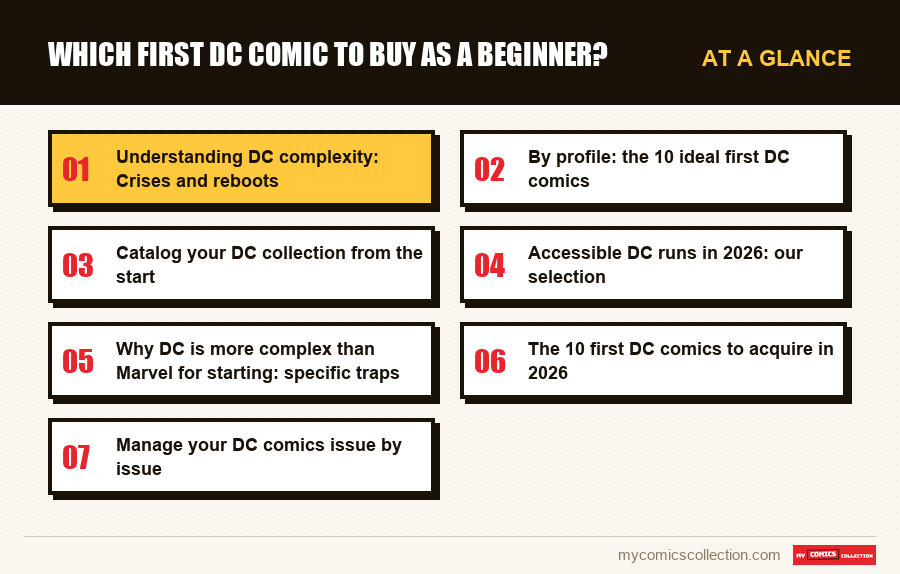
By profile: the 10 ideal first DC comics
If you love Batman
Batman: Year One (Batman #404-407, Frank Miller and David Mazzucchelli, 1987) is the absolute entry point for any Batman fan. This four-part miniseries tells simultaneously Bruce Wayne's beginnings as Batman and James Gordon's first steps in Gotham City. The narrative is autonomous, dense and visually stunning. It's the origin that inspired Christopher Nolan's Batman Begins film.
As an alternative or complement: Batman: The Long Halloween (Jeph Loeb and Tim Sale, 1996-1997, 13 issues) is a 13-episode thriller set at the start of Batman's career, with a complete rogues gallery and a serial murder plot. Batman: Hush (Loeb and Jim Lee, 2002-2003) is perfect if you come from recent films: the character list is broad and Jim Lee's art is spectacular.
If you love Superman
All-Star Superman (Grant Morrison and Frank Quitely, 2005-2008, 12 issues) is universally considered the best Superman comic ever written. The premise: Superman learns he's going to die and decides to complete 12 modern labors of Hercules before his end. Totally autonomous, graphically perfect, narratively devastating. It's the first Superman comic to read.
As a complement: Superman: Secret Identity (Kurt Busiek and Stuart Immonen, 2004) is a touching Elseworlds where a young man named Clark Kent discovers he actually has Superman's powers in our real world. Whatever Happened to the Man of Tomorrow? (Alan Moore, 1986) is a definitive farewell to the Silver Age Superman, dense and moving.
If you love the Justice League
JLA: New World Order (Grant Morrison and Howard Porter, 1997, JLA #1-4) is Morrison's reformation of the original Justice League: Superman, Batman, Wonder Woman, Flash, Green Lantern, Aquaman, Martian Manhunter: against invading aliens. An excellent entry point because Morrison's complete run (JLA #1-41) is considered the absolute peak of Justice League comics. The first four issues are perfectly autonomous.
If you have a tight budget
On a limited budget, the DC Rebirth trade paperbacks are your best ally. They collect entire arcs for $15-20 each. In single issues, New 52 and DC Rebirth back issues can be found very easily used for $3-5 apiece at specialty shops or comic marketplaces. Start with a complete arc in four or five issues, read it in full before buying more.
Catalog your DC collection from the start
My Comics Collection supports every DC Comics series. Catalog your Batman, Superman and Justice League issue by issue, and identify your gaps at a glance.
Start my free DC catalogAccessible DC runs in 2026: our selection
Here are the DC runs we recommend in 2026 for their accessibility, narrative quality and store availability:
Scott Snyder, Batman (New 52, 2011-2016)
The Scott Snyder run on Batman (issues #1 to #52 of the New 52, with Greg Capullo on art) is the most acclaimed Batman run since Frank Miller. He introduces the Court of Owls, a secret council that has governed Gotham for centuries, in a long-form narrative arc that completely renews the character's mythology. The New 52 being a reset, these issues are perfectly accessible without prerequisites. Individual issues are easy to find used.
Grant Morrison, JLA (1997-2000)
The Grant Morrison run on JLA (#1-41) is the peak of the Justice League in comics. Morrison uses ambitious science fiction ideas and elevates each team member to maximum potential: Superman is a god, Batman is the world's best detective, Wonder Woman is a divine warrior. The run starts with a four-issue arc that's perfectly accessible and builds throughout the forty subsequent episodes.
Geoff Johns, Green Lantern (2004-2012)
Geoff Johns devoted eight years to rebuilding Green Lantern after years of editorial eclipse. His Green Lantern run (2004-2012), starting with Green Lantern: Rebirth which resurrects Hal Jordan, is one of the most successful DC character renewals of the 2000s. Accessible from the first issue of Green Lantern Rebirth (2004), it culminates with the Blackest Night event (2009) that broke sales records.
Brian Azzarello, Wonder Woman (New 52, 2011-2014)
The Brian Azzarello run on Wonder Woman in the New 52 (#1-35) is particularly recommended for Greek mythology fans. Azzarello reinterprets the Olympian gods universe in a modern, dark way, with exceptional Cliff Chiang art. It's one of the best DC comics reads of the 2010s, and it's perfectly autonomous.
Collecting this series?
Track what you own, what you are missing and what your collection is worth. 7 day trial.
Start my trial →Why DC is more complex than Marvel for starting: specific traps
Beyond the Crises, several DC Comics characteristics can disorient beginners:
Multiple versions of the same character
DC often has several versions of the same character coexisting. There are multiple Flashes (Barry Allen, Wally West, Jay Garrick), multiple Green Lanterns, multiple Robins who became Nightwing or Red Hood. For a beginner, identify which version interests you and stay on a run centered on that version before exploring others.
Mandatory crossover events
DC regularly publishes crossover events (Blackest Night, Infinite Crisis, Flashpoint) that affect all series simultaneously. For a beginner, these events may seem essential but are often better appreciated after reading the relevant series. Don't start with a crossover: read the regular series first.
The temptation of exhaustive continuity
DC has 90 years of published history and no reader, even the most devoted, has read it all. Resist the urge to understand everything before starting. Pick a character, an author, a run, and read it from start to finish. Continuity will come naturally with experience.
Elseworlds and out-of-continuity stories
DC publishes many stories labeled "Elseworlds" or "DC Black Label" that take place outside main continuity. These stories are often the most accessible and narratively ambitious. Don't avoid them because they're "not canon": Kingdom Come, The Dark Knight Returns and Watchmen are all outside main continuity.
The 10 first DC comics to acquire in 2026
Our definitive selection of the 10 first DC comics to acquire, in order of recommendation for a 2026 beginner:
- Batman: Year One (Miller/Mazzucchelli, 1987): The essential Batman origin. Readable in total autonomy.
- All-Star Superman (Morrison/Quitely, 2005-2008): The best Superman ever written, outside continuity.
- The Dark Knight Returns (Frank Miller, 1986): Aged Batman coming out of retirement. Founding Elseworlds.
- Batman: The Long Halloween (Loeb/Sale, 1996-1997): 13-episode thriller, accessible and captivating.
- Kingdom Come (Waid/Ross, 1996): The Justice League on the brink. Breathtaking Ross art.
- Batman (New 52) #1-11: The Court of Owls (Snyder/Capullo, 2011-2012): The best modern Batman arc.
- JLA: New World Order (Morrison/Porter, JLA #1-4, 1997): The original Justice League reformation.
- Green Lantern: Rebirth (Johns, 2004-2005): Hal Jordan's rebirth, ideal Green Lantern entry point.
- Wonder Woman (New 52) #1-12 (Azzarello/Chiang, 2011-2012): The best Wonder Woman of the 2010s.
- Watchmen (Alan Moore/Dave Gibbons, 1986-1987): Technically outside DC continuity, but essential to any comics lover.
Note on Watchmen: Watchmen isn't a "classic" DC comic: it deconstructs the superhero genre. But it was published under the DC label in 1986-1987 and remains one of the most important works in American comics history. If you should read only one comic in your life, whether you're a DC fan, Marvel fan or non-initiated, it's this one.
FAQ, Starting your DC Comics collection
Manage your DC comics issue by issue
My Comics Collection supports every DC series: Batman, Superman, Justice League, Elseworlds. Catalog your collection and never lose track of your issues.
Manage my DC comics