You want to dive into Marvel comics collecting but don't know where to start. You've watched the films, maybe the Disney+ series, and now you want to explore the original stories on paper.
You want to dive into Marvel comics collecting but don't know where to start. You've watched the films, maybe the Disney+ series, and now you want to explore the original stories on paper. Good news: the Marvel comics universe is one of the richest and most accessible in all American comics: provided you know how to enter it.
The classic beginner trap is wanting to start "from the beginning," meaning buying 1961-1962 issues thinking it's mandatory. It's not. Marvel has relaunched dozens of times, and each decade offers excellent modern entry points: accessible and narratively self-contained. This guide helps you pick your first Marvel comic based on your profile and affinities, avoiding costly beginner mistakes.
Understanding the Marvel universe before you buy
Before talking specific issues, it's useful to understand a few concepts that will help you navigate the Marvel catalog. The Marvel universe is a shared continuity where all characters coexist and influence each other. That means an event in Avengers can have repercussions in Spider-Man or X-Men.
Good news for the beginner: you don't need to read everything to enjoy a series. Most major runs are designed as self-contained entry points. A good writer creates stories that function independently, even if references to global continuity enrich the experience for long-time readers. Focus on one series, one run, one character, and gradually expand your horizon.
Available formats: single issues vs. trade paperbacks
Marvel comics sell in two main formats. Single issues (or floppies) are the individual monthly issues, generally 22 to 32 pages, sold for $4 to $6 new. Trade paperbacks (TPB) are collections bundling 4 to 8 issues, sold for $15 to $25. For a beginner, trade paperbacks offer better reading value: you get a complete story without having to hunt scattered issues.
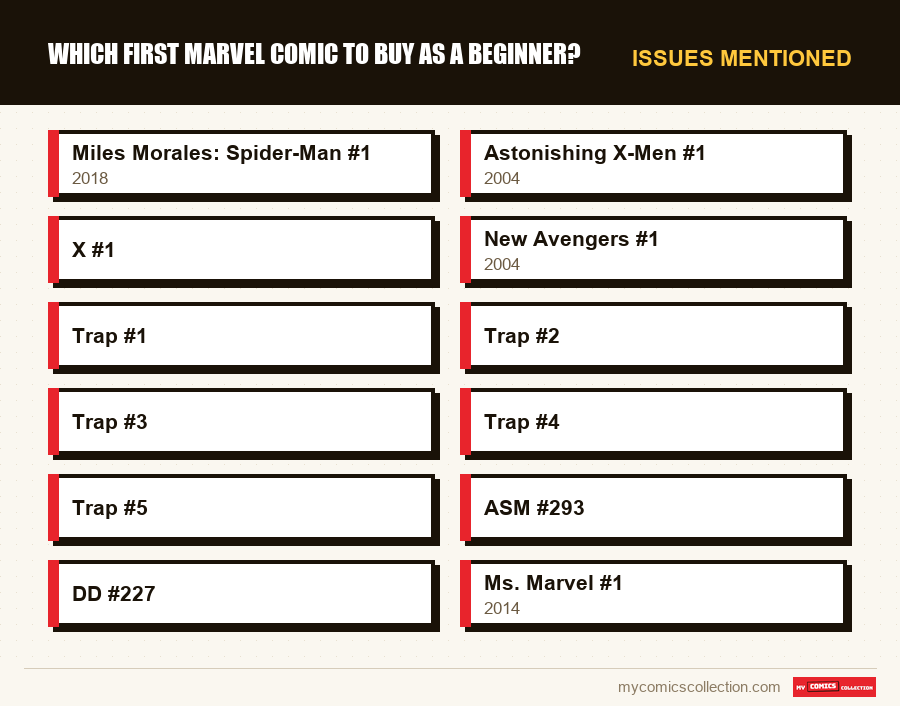
Based on your profile: the 10 ideal first Marvel comics
Your ideal Marvel entry point depends on your affinity with characters you already know through cinema or popular culture. Here's our selection by profile:
If you love Spider-Man
Amazing Spider-Man: Brand New Day Vol. 1 (2008) is an excellent entry point: after the controversial "One More Day" reboot, this series presents a single Peter Parker in a refreshed universe with a modernized character gallery. The Nick Spencer run on Amazing Spider-Man Vol. 5 (#1-74, 2018-2022) is also highly recommended: dense, narratively rich, with an adult Peter Parker and well-managed continuity.
If you want something even more modern and accessible, Miles Morales: Spider-Man #1 (2018) by Saladin Ahmed is a perfect entry point: the character is introduced clearly and the story works autonomously.
If you love the X-Men
For X-Men fans, Astonishing X-Men #1 (2004) by Joss Whedon and John Cassaday has been the most recommended entry point for twenty years. This 24-issue series is complete, requires no prior knowledge and features some of the most beautiful art of the 2000s. As a more recent alternative, House of X #1 and Powers of X #1 (2019) by Jonathan Hickman revolutionized the X-Men, but require some character familiarity.
If you love the Avengers
The Jonathan Hickman run on Avengers (#1, 2012) is excellent but complex. For a smoother start, New Avengers #1 (2004) by Brian Michael Bendis is more accessible and offers an original team reformation. MCU fans will appreciate the team composition (Spider-Man, Captain America, Iron Man, Spider-Woman) which resembles what they've seen on screen.
If you have a tight budget (under $25)
On a limited budget, modern single issues are your best option. Recent issues of ongoing series (Amazing Spider-Man, Avengers, X-Men) can be found at specialty shops for $4-6 each. You can also find lots of comics in very good condition at shows and marketplaces for a few dollars apiece. Trade paperbacks from your local library are also a great way to test your interest before investing.
If you're interested in the collecting and investment angle
If your interest in comics goes beyond reading and includes collecting or heritage dimensions, start by documenting your approach. Read our guide on how to invest in comics before buying expensive issues. Beginner's golden rule: never spend more than you're willing to lose on a single issue, and always buy what you enjoy first.
Catalog from your first comic
My Comics Collection lets you catalog each issue from the first purchase, track your comics' condition and build your collection step by step with method.
Start my free catalogClassic beginner pitfalls to absolutely avoid
Every beginner falls into the same traps. Knowing them in advance saves time, money and disappointment.
Trap #1: Wanting to buy everything at once
The Marvel catalog contains thousands of issues and the temptation to buy massively is real. Resist it. Start with one run or one series, read it fully and expand progressively. The satisfaction of a complete, well-read run far exceeds a pile of unread comics.
Trap #2: Buying Silver Age without knowing condition
60s-70s comics are attractive but their condition is crucial for both value and readability. A poor-condition issue can be disappointing to read and poorly valued. If you buy Silver Age, learn CGC grades and condition criteria before any significant purchase.
Trap #3: Buying cover variants without understanding their value
Stores often offer cover variants at higher prices than the regular edition. For a beginner, the standard edition is almost always enough. Variants have value mainly for savvy collectors who know print ratios and specific demand.
Trap #4: Ignoring storage from the start
Comics deteriorate fast without protection. From your first purchase, invest in Mylar sleeves and backing boards. The cost is minimal (a few cents per issue) and preserves your comics' condition for years. A well-organized collection is also much more pleasant to browse.
Trap #5: Not cataloging your purchases
From the first issue, keep an inventory of your collection. Without a catalog, you'll buy duplicates, forget what you own and lose track of your acquisitions. My Comics Collection is built exactly for this: starting to catalog from the first comic is the best investment you can make.
Collecting this series?
Track what you own, what you are missing and what your collection is worth. 7 day trial.
Start my trial →The 10 first Marvel comics recommended by My Comics Collection
Here's our definitive selection of the 10 first Marvel comics to acquire, based on narrative accessibility, artistic quality and representativeness of the Marvel universe:
- Amazing Spider-Man: Kraven's Last Hunt (ASM #293-294 + tie-ins, 1987): The most universally admired Spider-Man arc. Readable without prerequisites.
- Astonishing X-Men #1-24 (Whedon/Cassaday, 2004-2008): The best X-Men entry point of the 2000s.
- Daredevil: Born Again (DD #227-233, Miller, 1986): Frank Miller's masterpiece, readable autonomously.
- New Avengers #1 (Bendis, 2004): Modern Avengers team formation, very accessible.
- Ms. Marvel #1 (Kamala Khan, Wilson, 2014): Perfect for MCU fans, fresh and funny.
- Thor: God of Thunder #1 (Jason Aaron, 2012): An epic Thor across three eras, magnificently drawn.
- Hawkeye #1 (Fraction/Aja, 2012): The most influential comic of the 2010s, graphically revolutionary.
- Black Panther #1 (Ta-Nehisi Coates, 2016): A new political and narrative vision of the character.
- Miles Morales: Spider-Man #1 (Saladin Ahmed, 2018): Autonomous and representative of 21st-century Spider-Man.
- Immortal Hulk #1 (Al Ewing, 2018): The most acclaimed Hulk run in decades. Horror and philosophy.
Good to know: All these runs are available in trade paperback at specialty shops or on Amazon. Starting with TPBs lets you read a complete story for $18-25, without chasing scattered individual issues. It's the ideal format to test your interest before investing in single issues.
Why start with modern runs rather than Silver Age
The question comes up often: "Isn't it better to start with the very beginning?" The answer is generally no, and here's why. Marvel Silver Age comics (1961-1969) are the universe's foundations, but they're also dated in their storytelling, dialogue and social portrayals. Stan Lee had a habit of explaining in captions what the art already showed, and stories are often resolved in twenty pages without much narrative depth.
Modern runs, by contrast, benefit from 60 years of medium evolution. Contemporary writers build arcs over years, develop characters with complex psychology and collaborate with artists whose level far exceeds standard 1960s production. You can always go back to the origins once you're familiar with the universe, but starting with a modern run is almost always more satisfying for a 21st-century reader.
How to choose your first purchase: questions to ask yourself
Before buying your first Marvel comic, ask these few questions:
- Which character interests me most? Starting with a character you already love is always the best motivation to continue.
- Do I want to read a complete story or follow an ongoing series? If you want a complete experience, go for a TPB or finished run. If you want to participate in current comics releases, buy the latest issue of an ongoing.
- What's my monthly comics budget? A monthly series costs $4-6 per issue, about $55-75 per year. It's a reasonable commitment, but plan it.
- Do I want digital or physical? Physical copies have collecting value and better reading experience for many. Digital (Marvel Unlimited) gives vast access for a monthly fee if pure reading is your goal.
FAQ, Starting your Marvel collection
Start right with the app
My Comics Collection is the ideal tool to catalog your collection from the first issue, track your acquisitions and never buy a duplicate.
Start free