The five cheapest listings in a search for this character's first appearances all advertise a first appearance, and ask between $2.75 and $5.99. In the reading of August 29, 2026, one sells the first appearance of an unknown figure, another that of a group, a third the troisième appearance of a character in a given costume. The mention has become a search word, not information: and knowing what it really means is the only way to avoid paying for a formula.
This phenomenon affects all popular characters, but it's especially noticeable here, where a single series has produced dozens of secondary debuts.
The following shows what these ads actually contain, distinguishes the types of first appearances, explains why the formula has emptied, what retains value, and how to check before buying.
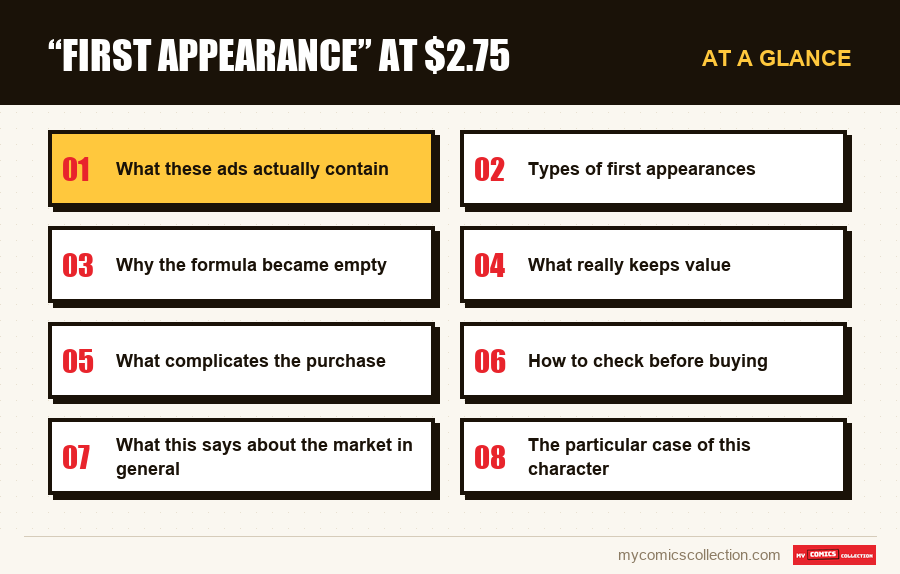
What these ads actually contain
Une figure inconnue
À 2,75 $, an ad sells the first appearance of a secondary character whose name means nothing to almost anyone.
A group rather than an individual
À $4.99, another features the first appearance of a set of characters, which is not the same as an individual debut.
Une troisième apparition
À 5,99 $, an announcement highlights the third appearance of a character in a given costume, presented as an argument.
Une simple présence
À $3.00, a booklet is proposed on the sole mention that the character appears there, without claiming anything else.
Asking prices observed on August 29, 2026, gross and verified counted separately, never sales concluded. The survey population includes 145 gross listings, from $2.75 to $350.00, for a median of $24.99; verified segment has 38 listings, median $108.50.
The remarkable fact is not that these ads are dishonest: they are not. Each states something true. A first appearance of a secondary character is indeed a first appearance, and a third appearance in a costume is indeed the third.
The problem is elsewhere. The formula no longer distinguishes anything, because every booklet necessarily contains the first appearance of something.
Types of first appearances
There are at least six, ranging in value from one to a thousand.
The first appearance of a lasting character. It is the only one that systematically produces a market: a figure entered in the catalog, reused for decades, eventually adapted for the screen.
The first appearance in costume. Distinct from the previous one when the character first appears in civilian clothes, sometimes several issues earlier. The two fascicles exist and do not have the same value.
The first cover. The first issue where the character appears on the main illustration. Wanted for visual reasons, it has no connection with a narrative beginning.
The first appearance of a group. It concerns a collective entity, often introduced as a whole, and is distinguished from the individual beginnings of its members.
The first appearance of a version. A character existing in a new costume, a new form, a new era: it is a variation, not a birth.
The first appearance of a figure without a future. Statistically the most common: a character introduced and then never reused. She's real and doesn't interest anyone.
This last category represents the overwhelming majority of cases. Each issue of a long series introduces figures that will never return, and each technically constitutes a first available appearance for a title.
Hence the rule that sums it all up: it's not the first appearance that has value, it's the character.
The mention only designates a location. What determines the price is what occupies that space, and if no one is looking for that figure, the location is worthless, whatever formula is used to advertise it.
Why the formula became empty
Four mechanisms produced this inflation, and none involves bad faith.
The formula works as a search word. Buyers type it, so sellers write it. An ad that omits it becomes invisible, which mechanically pushes everyone to use it.
The documentation has become exhaustive. Today it is possible to find out which figure appears for the first time in any issue. This knowledge, formerly reserved for specialists, now applies to uninteresting booklets.
The qualifiers have multiplied. No longer able to distinguish themselves with a simple first appearance, the announcements specify: first in costume, first on a cover, first under such identity. The precision increases while the value decreases.
The ordinals followed. Once the first appearance is trivialized, the second and third become arguments in turn, as shown in an announcement from this survey.
This last point marks the culmination of the process. When a third appearance becomes a selling point, the formula has definitively ceased to inform and is nothing more than a signal addressed to a search engine.
What really keeps value
Three conditions must be met, and they are rarely all present.
The figure must still be used. A character who reappeared regularly for decades built a demand. A character abandoned after one issue never got one.
The booklet must be unambiguously identifiable. A single series, a single issue, no competition between several candidates. As soon as two issues compete for title, demand divides and the price falls.
The request must exist before the mention. This is the decisive point. An ad does not create buyers; it captures them if they already exist. A formula applied to a character that no one is looking for produces absolutely nothing.
The survey illustrates the two extremes. The verified maximum reached $1,238.00 on this same question, when five ads also announcing a first appearance were below six dollars.: it's the same word for two unrelated realities.
What complicates the purchase
The difficulties are practical and accumulate quickly.
Impossible sorting by search
Since the formula is everywhere, it no longer allows interesting ads to be filtered.
Homogeneous figures
Several characters have similar names, and the announcement does not always specify which one.
Competing applications
Two fascicles sometimes claim the same first appearance, for dating reasons.
Partial appearances
A silhouette, a shadow or an end box sometimes counts as the official start.
Cumulative mentions
A single ad stacks several claims, only one of which is significant.
Reissues announced like the original
The word refers to the content, not the print run, and allows for reprints.
Collecting this series?
Track what you own, what you are missing and what your collection is worth. 7 day trial.
Start my trial →How to check before buying
Four checks are enough, in this order.
Identify the figure concerned, not the formula. Read the ad to find out who exactly it is, then ask yourself if this character is being reused. This question alone eliminates the majority of cases.
Check the number in the catalog. Confirm that the announced booklet is indeed the one which contains the claimed beginning, and that no other disputes it.
Distinguish the type first. Character, costume, cover, group, version: these five answers have neither the same status nor the same price level.
Contrôler le tirage. Make sure that it is the original issue and not a later reprint, which the mention never distinguishes.
These four checks take less than two minutes. They transform a formula into verified information, and this is exactly what the inflation of mentions has made necessary.
What this says about the market in general
Trois enseignements dépassent largement ce personnage.
An effective criterion is destroyed by its own diffusion. The first appearance was a useful landmark as few people knew about it. Its generalization has rendered it ineffective, without its theoretical relevance having changed.
The precision of a title does not measure its value. The most detailed ads in this survey are the least expensive, because precision serves to distinguish what, without it, would not be distinguished.
The price remains the only indicator that cannot be manipulated. An ad can say whatever it wants; the amount requested, compared to those of neighboring advertisements, says what the seller really thinks he can obtain.
This last point offers a convenient shortcut. A first appearance advertised at three dollars among one hundred and forty advertisements is a worthless first appearance, and the seller knows it perfectly: the price is the admission that the formula does not make.
The particular case of this character
This figure illustrates the phenomenon better than others, for a reason relating to its construction.
Elle a été introduite progressivement. Silhouette first, indirect presence then, complete role later: this rise in power produces several fascicles, each of which can legitimately claim a starting status.
Added to this is a device which further multiplies the candidates: the character surrounds himself with subordinates recruited from existing figures, so that each of these recruitments in turn creates a “first appearance as” which can be exploited in an ad.
A single series therefore produced dozens of worthy debuts, which explains the density observed in the survey: one hundred and forty-five raw advertisements, the least expensive of which all announce something first.
This is a textbook case more than an exception. Any character introduced slowly and surrounded by a suite produces the same effect, and caution when purchasing must increase proportionally to this complexity.
What to note on a booklet announced as a first
This type of acquisition requires recording what the ad leaves unclear.
The exact figure concerned. Full name, not the formula used by the seller. On homonymous or close characters, this is the only mention that makes the line usable.
Le type de première. Character, costume, cover, group or version: to be recorded clearly, otherwise two issues with very different statuses look the same in an inventory.
The possible existence of a competing booklet. When two numbers claim the same beginning, noting it avoids believing the question is settled when it is not.
The source of the claim. Catalogue, seller's announcement or common use: the three do not have the same solidity and the gap explains many subsequent disagreements.
Le tirage constaté. Original or reprint: the mention of first appearance never specifies, and yet this is what separates two objects with no price relationship.
No, and that's what makes the phenomenon difficult to spot. Each states something exact: a first appearance of a secondary character is indeed one, and a third appearance in a costume is indeed the third. The problem is that the formula no longer distinguishes anything, since every booklet contains the first appearance of something.
Looking at the figure, not the formula. Three conditions must be met: the character must still be used, the booklet must be identifiable without competitors, and the demand must pre-exist the announcement. A mention applied to a character that no one is looking for produces absolutely nothing.
Because precision serves precisely to distinguish what, without it, would not be distinguishable. A truly researched booklet does not need stacked qualifiers. The most detailed listings in this survey are the least expensive, and this inverse correlation is a convenient indicator.
Almost never, and the announcement at $5.99 raised on August 29, 2026 confirms this. The appearance of ordinals beyond the first marks the culmination of inflation: when a third appearance becomes an argument, the formula has ceased to inform and is no more than a signal addressed to a search engine.
Identify the figure in question and ask yourself if it is reused today. This one question eliminates the majority of ads. Then come checking the catalog number, distinguishing the type of premiere, and checking the print run: the whole thing takes less than two minutes.
Whose premiere, exactly?
Character, costume, cover, group or version: five very different statuses under a single formula.