To identify missing numbers in a run, you must cross-reference your inventory with the complete list of the series. Manually, it's tedious and error-prone. With an application connected to a worldwide comics database, missing items are automatically displayed, and you can view them in store from your phone.
How to know which numbers you're missing in a comic run
Completing a run is one of the deepest pleasures of comic book collecting. Owning every issue of Amazing Spider-Man from 1963 to present, every episode of Chris Claremont's run on Uncanny X-Men, every Batman from the Snyder era: it's a goal that motivates years of chasing. But before completing a run, you need to know precisely what is missing. And this is where most collectors run into a practical problem that is much more complex than it seems.
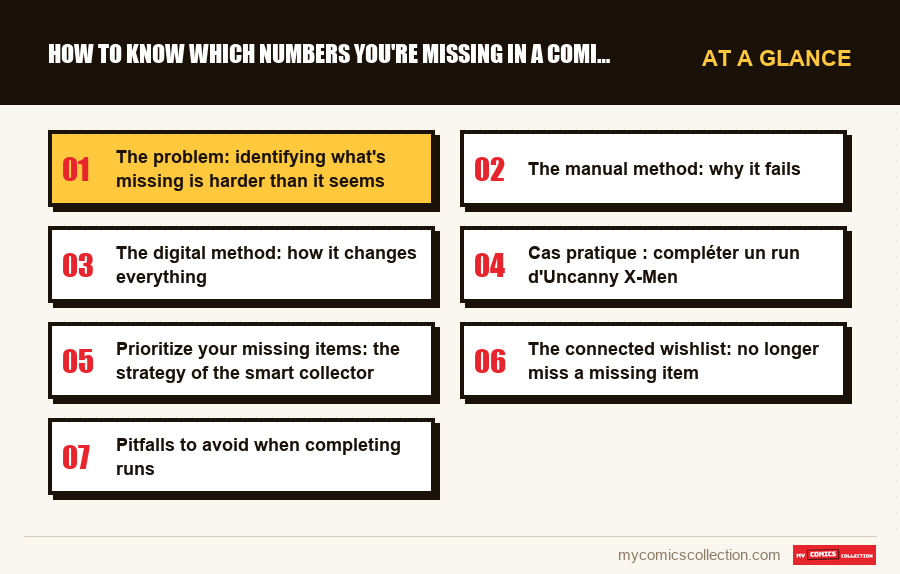
The problem: identifying what's missing is harder than it seems
At first glance, it's simple. You have numbers 1 to 50 in a series, except 12 and 37. You know that. But in reality, things get complicated quickly.
Long series
Amazing Spider-Man has over 900 issues in its original series (1963-2024), plus several relaunches (vol. 2, vol. 3, vol. 4, vol. 5, vol. 6). Uncanny X-Men exceeds 600 issues. Batman is approaching 1,000 issues in its main series. On these volumes, no one can list the missing numbers from memory. Even with a well-maintained Excel file, going through 900 lines to find the holes is a painful exercise.
Renumberings
Marvel and DC have made a habit of relaunching their series with new #1 issues, then returning to the original numbering for anniversary issues. Amazing Spider-Man went from issue #441 to a new issue #1 (vol. 2, 1999), then returned to the original numbering at issue #500 (2003), before starting again several times. Tracking these numbering changes manually is a nightmare.
Annuals and specials
Does a full run include Annuals? The Giant-Size? The .1 (Point One) numbers? The numbers 0? These special numbers are often forgotten in manual inventories, which creates false feelings of completion. You think you have it all, but your run has invisible holes.
Variants and prints
For a strict completionist, each separate draw is a different number. The A cover, the 1:25 incentive variant, the store exclusive variant: technically, they are not the same comics. Deciding what counts as "missing" depends on your personal collecting rules, and those rules should be clearly defined before you begin the hunt.
The manual method: why it fails
The classic method is to take the complete list of a series (from a reference site or guide) and compare it number by number with what you have. Here's why this method always ends up breaking down.
The time needed. For a series of 300 issues, manually comparing your inventory with the full list takes 30 to 45 minutes. And this work must be redone every time you buy new issues. Multiply by the number of series you collect: time explodes.
Counting errors. Simply skip a line in your file or mix up two numbers to create a false missing (you think you're missing 156 when you have it) or a complete false (you think you have 203 when you're missing it). These errors are virtually undetectable without physical verification in longboxes.
Lack of mobility. Your missing list is on your desk. You are in agreement. You see a Wolverine #10 in a bin. Do you miss him? Impossible to verify. Result: either you buy it “just in case” (risk of duplicates), or you move on (risk of missing a number you are looking for).
The digital method: how it changes everything
A management application connected to a comics database completely transforms the identification of missing items. Here is how it actually works.
The catalog knows every number
The worldwide comics database, used by My Comics Collection, references more than 2 million issues. For each series, he knows all the issues published: the regular series, the annuals, the specials, the different volumes and renumberings. When you save your collection in the app, she knows exactly what numbers exist and which ones you don't have.
Missing items are displayed in one click
Open a series in the app. You immediately see which numbers you have (checked) and which ones you are missing (unchecked). No manual comparison, no going through a spreadsheet line by line. The list of your missing items is générée automatiquement et mise à jour en temps réel every time you add a number.
The list of missing people on the phone
It's the game changer. At conventions, in stores, at garage sales, you open the app on your phone and view your missing items by series. You know in 10 seconds if the comic you are holding fills a gap in your run. No more involuntary duplicates, no more missing items missed out of ignorance.
Cas pratique : compléter un run d'Uncanny X-Men
Let's take a concrete example. You collect Uncanny X-Men and you own around 350 issues out of the 544 of the original series (1963-2011). You vaguely know that you are missing numbers, but you don't know exactly how many or which ones.
With the manual method: you go to a reference site, you print the list of 544 numbers, and you compare it with your Excel file or your physical longboxes. Estimated time: 2 to 3 hours. Reliability: average (you will miss numbers or count them twice).
With My Comics Collection: you open the "Uncanny X-Men" series in the app. The interface displays the 544 numbers with, for each, an ownership indicator. At a glance you see that you are missing 194 numbers. You can filter to only display missing items, and sort them by estimated value to prioritize your purchases. Time: 10 seconds (assuming your collection is already cataloged).
The difference in efficiency is massive. But the real advantage is downstream: this list of missing items is permanently accessible. Conventionally, when you come across a bin of X-Men, you know exactly what numbers to look for.
Prioritize your missing items: the strategy of the smart collector
Having a list of what is missing is good. Knowing where to start is better. Not all missing issues are equal, neither in narrative importance, nor in market value, nor in rarity.
Key issues first
If your run of Amazing Spider-Man has holes, and among those holes are #129 (first Punisher), #194 (first Black Cat) or #300 (Venom), these are the ones you should look for first. These numbers increase in value over time and become increasingly difficult to find in good condition. Waiting means paying more.
The numbers accessible afterwards
Current issues from the 80s and 90s, often available for a few euros in convention bins, are easily found. Keep them on your list and buy them when the opportunity presents itself. No rush: they will always be available and affordable.
Rare numbers last
Some issues are objectively difficult to find: low print runs, fragile condition (Golden Age), limited distribution. For these, patience is the only strategy. Set up eBay alerts, mention them in collector forums, and wait for the opportunity to present itself.
The connected wishlist: no longer miss a missing item
The missing list is passive: it tells you what you're missing. The wishlist is active: it alerts you when something missing appears. The two work together to create an efficient completion system.
Concretely: you identify a priority missing item (say, Uncanny X-Men #141, the famous “Days of Future Past”). You add it to your wishlist. From now on, every time you check your convention app, this number will be highlighted. You can no longer walk past it without seeing it.
This connection between inventory, missing items and wishlist is what distinguishes a serious management tool from a simple spreadsheet. It's a system that works for you, even when you're not actively thinking about it.
Pitfalls to avoid when completing runs
The “almost complete” trap. You have 95% of a run and you are missing 5 numbers. The temptation is to pay any price to “finish”. This is exactly the time when sellers take advantage. Keep a cool head: a 95% run is already remarkable, the remaining 5% will come.
The multiple collection trap. You collect Amazing Spider-Man, Uncanny X-Men, Batman, and Saga at the same time. Result: four incomplete runs that progress slowly. Better to concentrate on one or two priority runs and complete them before tackling others.
The state trap. You are looking for Wolverine number 181. You find it, but in poor condition (Good or Fair). Are you buying it to fill the gap, or are you waiting for a better condition copy? The answer depends on your collecting standards: set them in advance to avoid regrets.
Questions fréquentes
My Comics Collection uses a worldwide comics database, a collaborative database that references more than 2 million comic issues. Each series is cataloged with all its issues, including annuals, specials and various volumes. When you select a series, the app automatically compares the numbers you have with the complete catalog list to identify your missing numbers.
Yes. The catalog distinguishes each volume of a series. For example, Amazing Spider-Man vol. 1 (1963-1998), vol. 2 (1999-2003), and subsequent volumes are treated as separate series with their own number lists. You can track your missing items separately for each volume, or group all volumes of the same title together to get an overview.
No. You can start with just one set. Catalog the numbers you have in this series, and the app will immediately display the missing numbers for this series. You don't need to have cataloged your entire collection to benefit from missing items detection. Most collectors start with their priority series and add the others gradually.
Yes. The worldwide comics database lists the Annual, Giant-Size, Special and other special issues as separate entries. If your run of Uncanny
Yes. My Comics Collection allows you to share your collection (and therefore your missing items) via a link. This is particularly useful for exchanges between collectors: a friend can consult your list of missing items and offer you the numbers he has in duplicate. This is also handy for convention sellers: show your shortage list and ask if they have anything that matches.
With My Comics Collection's built-in valuation, each missing issue has a price estimate. By adding up the estimated value of all your runs in a run, you get an approximation of the total budget needed to complete the run. It is a valuable tool for planning your purchases and prioritizing the series to complete according to your budget.