Fear Agent is Rick Remender's seminal work, and the most complicated to buy of his entire production. The series started with one publisher then continued with another, and it went through several editions linked to incompatible cuttings. The story is simply read in order: Heath Huston, the last exterminator of extraterrestrials, alcoholic and alone, goes through a pulp science fiction that turns into drama. Identify the edition before purchasing: that’s the only real trap.
Two major designers worked on it, one of whom would accompany the author years later on another series. This is also where everything he writes next takes place.
This article explains what the series is about, why it reads better in second position, and above all how not to buy the same chapters twice: a real problem with this specific title.
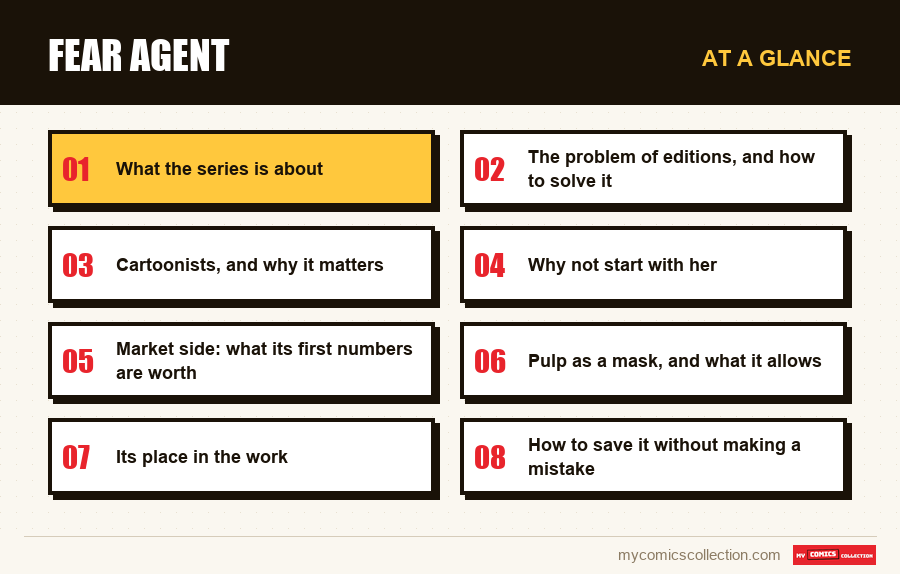
What the series is about
Heath Huston is the last of a profession that should never have existed: alien exterminator. He works alone, drinks too much, and carries around a guilt whose exact origin the story deliberately takes a long time to reveal.
The setting borrows openly from 1950s pulp science fiction: cobbled together ships, grotesque creatures, hostile planets. But the borrowing is a setting: beneath the adventure, it is a man who destroyed what he loved and who runs faster than his past.
The story uses time travel, which produces a looping construction where the consequences sometimes precede their causes. It's the only real reading requirement in the series, and it ends neatly: no loop left open at the end, which wasn't a given.
The problem of editions, and how to solve it
This is the particularity of this title, and it deserves to be addressed before any reading advice.
Two successive editors
The series began with one publisher and continued with another. The booklets therefore bear two different logos, and numbering which does not always read in one piece depending on how you count.
Multiple related formats
Thin original volumes, then thicker reissues bringing together more chapters. The volume boundaries do not coincide between the two series of volumes.
The same volume number says nothing
A “volume 2” of one edition and a “volume 2” of another do not contain the same chapters. This is the main source of error, and it produces both holes and duplicates.
The solution: count in chapters
Always note which issue numbers a volume contains: the information is usually on the credits page. It is the only stable unit between all editions.
The rule that avoids error. Before purchasing a bound volume in this series, look for the numbers contained, not the volume number. An edition that does not specify this anywhere merits a question to the seller.
This precaution is specific in this respect in the author's work: his more recent series have only known a division.
Cartoonists, and why it matters
The series does not have a single designer, contrary to what the author would systematically do afterwards. It's a noticeable difference, and you can hear it in the reading.
Tony Moore establishes the tone of the beginning: a round, almost cartoonish line, which makes considerable violence bearable and gives pulp science fiction its good-natured side. This is a deliberate contrast with the substance of the story.
Jerome Opeña then takes over for an important part of the series, in a much denser and more textured register. The change is clear, and it accompanies a darkening of the story: the two movements respond to each other.
This collaboration will be important: the author will find this designer years later, first on a very noted superhero series, then on a fantasy in his own name. It is here that one of the most enduring duos of his career begins.
Why not start with her
A rougher first third
The first chapters assume their pulp register to the point of seeming light. The shift towards drama comes later: a reader who judges the series by its beginning is mistaken about what it is.
Purchasing is more complicated
Two publishers, several bound editions: it is the author's series which requires the most vigilance when purchasing. It's not the best entry point when you don't yet know if you will like the author.
A loop construction
Time travel produces flashbacks that involve remembering details. The series does not lend itself well to very split reading.
It tastes better afterwards
Knowing the later series allows us to recognize, in the beginning, what the author will refine there. The retrospective interest is considerable, and it doesn't exist if you start there.
Market side: what its first numbers are worth
The first issue of this series is the one which is the most expensive of all the author's production in raw copy.
Asking prices observed on August 28, 2026 on the American market, lots and reissues excluded: the median is established at $16.10 on 132 listings, in a range from $0.99 to $259. These are current listings, not completed sales.
The certification market is very narrow: 6 ads only, at a median of $99. This is low, and it means that there is virtually no established benchmark for valuing a graded copy of this title.
This contrast is instructive. The series leads the classification of raw copies by its age and its least reprinting, but seniority alone does not create a demand for certification: this follows other sources, in particular the notoriety of the designer among collectors.
Pulp as a mask, and what it allows
There is a fundamental reason for the choice of the pulp register, and understanding it completely changes the reading of the first chapters.
A direct story about alcoholism and remorse would be unbearable in the long run. By disguising it as a space adventure with creatures, the author achieves two things: he brings the reader in through the entertainment, and he gives himself the right to be head-on once it is established. The decor is not a covering, it is a door.
This process explains the imbalance felt by many readers between the beginning and the sequel. The first chapters must appear light so that the shift can operate: this is not the clumsiness of a young author but a construction.
We will find the process in his following series, each time in a different genre: dimensional science fiction, fantasy, school story. The genre changes, the function remains the same:make a subject readable which would not be readable if it were dealt with head on.
Collecting this series?
Track what you own, what you are missing and what your collection is worth. 7 day trial.
Start my trial →Its place in the work
Everything that the author will develop next is already there, in a less controlled form.
The protagonist responsible for his own misfortune, whose addiction is not a character trait but a driving force of the story. The destroyed family, present in hollow. Violence that leaves after-effects instead of dissipating. And this way of making a genre story carry an intimate guilt.
What is still missing is the mastery of rhythm. The following series will be tighter, better divided into autonomous arcs, and entrusted from start to finish to a single designer. Here we read an author who is still searching for his form, and it's fascinating provided you know what you're reading.
How to save it without making a mistake
On this series more than any other by the same author, two details make the difference between a useful catalog and an ambiguous list.
The numbers contained. For a bound volume, the range of chapters it groups together: never the single volume number, which means nothing from one edition to another. It is the unit that remains stable whatever the presentation.
The publisher and the year. Two houses have published this series, and the reissues span several years. These two fields are enough to identify an edition without ambiguity.
For booklets, the condition and cover remain the two decisive pieces of information, as with any first issue whose range extends from less than a dollar to several hundred.
The question a catalog should be able to answer is simple: “Am I missing any chapters?” » A list of volumes will never say that about this series. A list of number ranges answers this immediately.
Who to advise
It particularly suits three profiles, and predictably disappoints a fourth.
To readers of classic science fiction, who will recognize the references and appreciate what is done with them. To those who have already liked another series by the author and want to trace its source. To drawing enthusiasts, for the confrontation of two opposing styles on the same story.
It is poorly suited, on the other hand, to those looking for a quick and fragmented read. Construction in loops requires retaining elements from one chapter to another, and reading spread over months erases part of the benefit.
Should it be read in installments or volumes?
In volumes, without hesitation, for a first reading. Bringing the series together into the booklet requires juggling two editors and a numbering that is not continuous depending on how you count it: a disproportionate effort to discover a story.
The booklets retain their interest on a specific point: the first issue, the only truly sought-after object in the series. The following do not present any availability tension.
The most economical approach is therefore to read the whole thing in bound volumes, checking the chapter ranges, and then search for the first issue separately if you wish. It is also the least likely to produce duplicates.
Frequently asked questions
Because it was published by two successive houses then reissued in formats grouping the chapters differently. A volume number therefore does not designate the same content from one edition to another, which indifferently produces holes and duplicates among buyers who rely on it.
Yes, the series has an end. The construction of time loops unravels, and the questions asked at the beginning are answered. It is not an interrupted story, contrary to what the complexity of its publication might suggest.
It is clearly noticeable, the two styles being very different, but it accompanies a darkening of the story rather than contradicting it. Many readers describe it after the fact as a coherent progression rather than as a rupture suffered.
It is in substance (self-destructive protagonist, guilt, violence with consequences) but not in form. His later series are tighter and entrusted to a single designer from start to finish, which gives them a unity that this one does not have.
For the first issue, yes: it is the only one in the series that the market is truly looking for, with the highest gross median of the author's entire production. For others, the abundance of announcements removes all interest from the hunt, and the bound volumes are significantly less expensive per chapter.
On this series, the volume means nothing
Saving the chapter range rather than the volume number is the only way to answer "am I missing something?" ".