In short
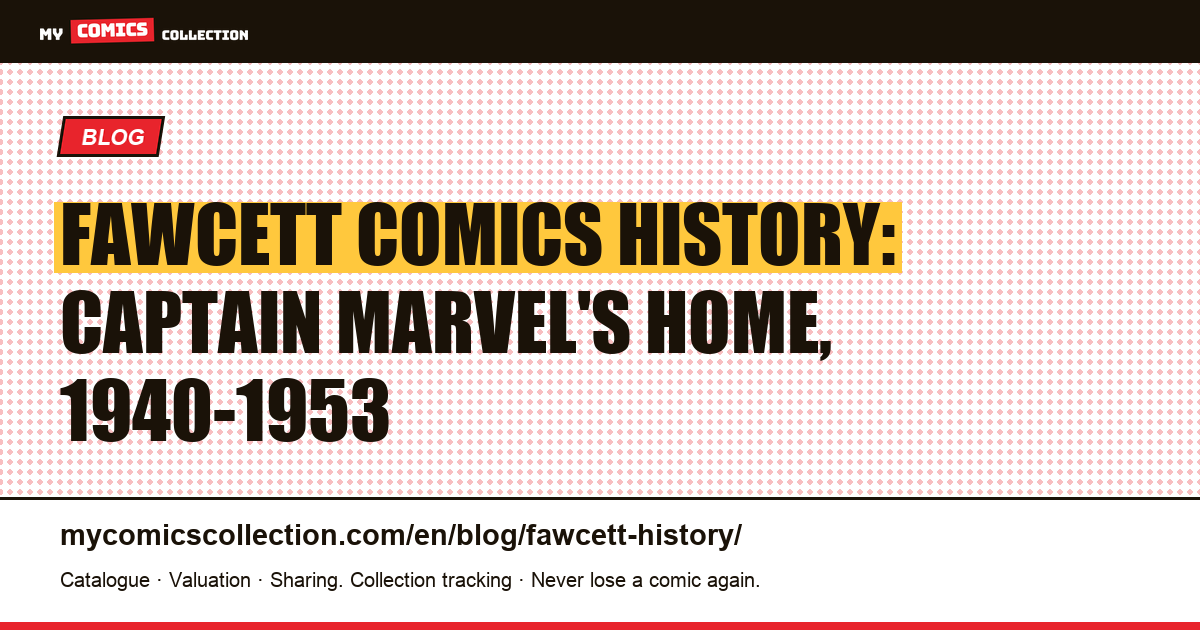
Fawcett Publications, the magazine house founded by Wilford Fawcett in 1919, ran a comics division through the Golden Age. Its star was Captain Marvel, created by writer Bill Parker and artist C. C. Beck, who reached print in Whiz Comics #2 (February 1940). The line grew into Captain Marvel Jr., Mary Marvel and the Marvel Family. After the long suit brought by National Comics over Superman, Fawcett settled in 1953 and stopped its comics; DC licensed the characters in 1972 and launched Shazam! in 1973.
Fawcett is a Golden Age publisher whose best-known hero became the subject of a twelve-year copyright fight, and whose superhero line ended because of it. The company's comics lasted only about thirteen years, yet the family of characters it built is still in print under another name.
Every cover date, issue number and creator credit below was checked one by one, with the lawsuit dated from the court decisions; the reading of what each stage meant for a collector is our own analysis.
A magazine publisher enters comics (1919 to 1939)
Fawcett Publications was founded by Wilford Fawcett in 1919 with the humor magazine Captain Billy's Whiz Bang. The name matters for the story, because "Whiz" would return two decades later as the title of the comic that launched the company's superhero line. A publisher of pulp-style magazines moved into newsstand comics when the format was proving itself, and the comics division took the same editorial instincts: bright covers, simple promises, and a broad range of subjects.
Fawcett Comics dates from 1939, when the company joined the comic book boom of the late 1930s and early 1940s. Its first entry, Thrill Comics #1, was released only as an ashcan copy. Nothing about its early years suggested a rival to the established houses. The collecting interest sits in what came next, a single character that gave the company an identity and a creative direction.
Whiz Comics #2 and the birth of Captain Marvel (1939 to 1940)
The first issue of the new book was prepared under the title Thrill Comics and existed only as an ashcan, with the lead character named Captain Thunder. The content was reworked, the lead renamed Captain Marvel, and the book retitled Whiz Comics. The resulting issue, Whiz Comics #2, carries the cover date February 1940 and holds the debut of Captain Marvel by writer Bill Parker and artist C. C. Beck.
The premise is quick to state: Billy Batson, who talks his way into a job as an on-air radio reporter at station WHIZ, says a magic word and becomes an adult hero. The same issue introduces Dr. Sivana, the scientist who becomes a lasting enemy. What changed in the market was tone. Captain Marvel did not copy the grim origin patterns that dominated rival stories; Beck's clean, rounded line and Parker's fast, humorous plotting gave the character a distinct look. The guide to Whiz Comics #2 covers the issue itself, and the Shazam history page follows the character's later life.
A line that kept growing (1941 to 1946)
Success produced spin-offs at speed. Captain Marvel Adventures ran from 1941 to 1953 for 150 issues, and Whiz Comics itself reached 155 issues across 1940 to 1953. Beyond the lead hero, the company launched Bulletman (16 issues, 1941 to 1946), Spy Smasher (11 issues, 1941 to 1943), Ibis (6 issues, 1943 to 1948), Golden Arrow (6 issues, 1942 to 1947) and Captain Midnight (67 issues, 1942 to 1948).
Collectors tracking Fawcett quickly learn to sort the line into three layers: the Marvel Family titles, the secondary superhero books, and the licensed or genre books. The secondary heroes give a smaller collection a way into the period; the broader Golden Age collecting guide covers that approach. The structure of Fawcett's list, with its many short-lived series, is also a numbering warning: several titles share a character but have separate counts.
The Marvel Family takes shape (1941 to 1945)
The Captain Marvel concept multiplied. Captain Marvel Jr. first appears in Whiz Comics #25 (December 1941), created by Ed Herron, C. C. Beck and Mac Raboy. He then starred in Master Comics from #23 (February 1942) before receiving his own series, which ran 118 issues from 1942 to 1953.
The hero's counterpart Mary Marvel appears in Captain Marvel Adventures #18 (December 1942), a creation of Otto Binder and Marc Swayze. Her own series ran 28 issues between December 1945 and September 1948. The family then reached a shared title: The Marvel Family #1 appeared in 1945 and is also where Black Adam first appears, a villain created by Otto Binder, and the series ran 89 issues until 1954. Binder created Mister Mind in the same period, during the mid to late 1940s.
The change in strategy is worth noting. Rather than one hero in many books, Fawcett built an extended household: a brother figure, a sister figure, comic relief characters and a recurring evil rival. The Marvel Family #1 guide explains why that issue matters beyond its date.
Mister Mind and the Monster Society of Evil (1943 to 1945)
The best-remembered villain team of the Fawcett line is the Monster Society of Evil, a band of Captain Marvel's enemies working in tandem. Its leader, Mister Mind, came from Otto Binder, the same writer behind Mary Marvel and Black Adam, which shows how much of the extended cast one writer shaped in the space of a few years.
A villain group that recurs across many issues shows how the company treated its flagship as a long-form world instead of a string of unrelated adventures. For a collector, that continuity turns the Captain Marvel Adventures run into a coherent reading project rather than a loose set, and it argues for keeping consecutive issues together instead of picking single covers.
Beyond the Marvels: romance, Westerns and horror (1946 to 1953)
Superheroes were only part of the output. Fawcett published romance (Sweethearts, 54 issues), humor (Ozzie and Babs, 13 issues), animal comics (including Hoppy the Marvel Bunny) and a series of licensed Western titles built around Tom Mix, Lash LaRue and Monte Hale. Hopalong Cassidy ran 84 issues from 1946 to 1953.
In the early 1950s a horror line followed, including This Magazine Is Haunted (14 issues, 1951 to 1953) and Strange Suspense Stories (5 issues, 1952 to 1953). Both were short runs that ended in 1953, the year the superhero books stopped.
Do you collect this series?
Track what you own, what you are missing and what your collection is worth. 7-day trial.
Start my trial →
National versus Fawcett: the lawsuit (1941 to 1953)
The lawsuit shaped the whole story. In June 1941 Detective Comics failed to persuade Fawcett to stop publishing Captain Marvel or Republic Pictures to hold back its Captain Marvel serial, and in September 1941 Detective Comics and Superman, Inc. sued Fawcett, naming Republic as a co-defendant. By the time the trial began in March 1948 the plaintiffs had merged into National Comics.
The trial court's 1950 decision found that Superman's copyright had been abandoned because some newspaper strips lacked a proper copyright notice, yet it found Captain Marvel to be an illegal copy. On August 30, 1951 the Second Circuit, with Judge Learned Hand writing the majority opinion, reversed in part: it held that Superman's copyright was valid and that the strips were not under copyright, and it sent the case back to decide which specific elements amounted to infringement.
The dispute ran twelve years from the first complaint. In 1953 Fawcett settled out of court and agreed to stop publishing comics related to Captain Marvel.
The end of Fawcett Comics and where the characters went (1953 to 1972)
The closure came fast. Whiz Comics ended with #155 and Captain Marvel Adventures with #150, both in 1953, and The Marvel Family ended with #89 in 1954. Fawcett ceased publishing its superhero titles in 1953, and several completed stories, artwork and characters were sold to Charlton Comics. The company's non-comic divisions continued, and Fawcett returned to comics in the 1960s mostly with Dennis the Menace titles.
A separate problem arrived in 1967, when Marvel Comics gained the "Captain Marvel" trademark through an unrelated character's series. That trademark explains why DC later used a different title. For readers new to the period, the practical lesson is that the original Fawcett run holds the characters under their first name, while the modern issues use a different title. The wider picture of how the publisher fits into DC's story is in the DC Comics history.
DC's licence, Shazam! and the name change (1972 to today)
DC licensed Captain Marvel and the Marvel Family from Fawcett in 1972, and Shazam! #1 followed with a cover date of February 1973. In 1973 Shazam and the Marvel Family also became an additional Earth in DC continuity, known as Earth-S. Because of Marvel's trademark, DC used the title Shazam!; a cease-and-desist from Marvel forced a subtitle change to "The World's Mightiest Mortal" starting with #15 (December 1974). DC later acquired full rights to the characters, and Mary Batson was reintroduced in Jerry Ordway's graphic novel The Power of Shazam! in 1994.
The New 52 relaunch brought the final step. A Shazam! backup began in Justice League volume 2 #7 in March 2012, and during the New 52 relaunch the character was renamed Shazam, with a new origin told in Justice League #0 (2012) and #21 (2013). The best Shazam runs page ranks the stretches that followed, from the 1970s revival to the modern series.
The key issues across the line
- Whiz Comics #2 (February 1940): the debut of Captain Marvel, by Bill Parker and C. C. Beck, with Dr. Sivana.
- Whiz Comics #25 (December 1941): the first appearance of Captain Marvel Jr.
- Captain Marvel Adventures #18 (December 1942): Mary Marvel arrives, by Otto Binder and Marc Swayze.
- The Marvel Family #1 (1945): the first appearance of Black Adam, created by Otto Binder.
- Whiz Comics #155 (1953): the final issue of the original flagship.
- Shazam! #1 (February 1973): the DC revival after the 1972 licence.
How to collect Fawcett
Decide whether you collect the characters or the publisher. A character collection can start with the DC revival from Shazam! #1, then work backward; a publisher collection starts with the Fawcett books and treats the later DC volumes as the aftermath. In either case, keep each series in its own section: Whiz Comics, Captain Marvel Adventures, Captain Marvel Jr. and The Marvel Family number independently, so a shelf order by number alone will mix them.
Check the cover logo and publisher line on every copy, because the Fawcett and DC periods use the same hero under different titles. Record the cover date, the issue number and any restoration notes for each copy; for Golden Age comics the physical condition is the main record, and a clear entry makes later comparison straightforward.
Frequently asked questions
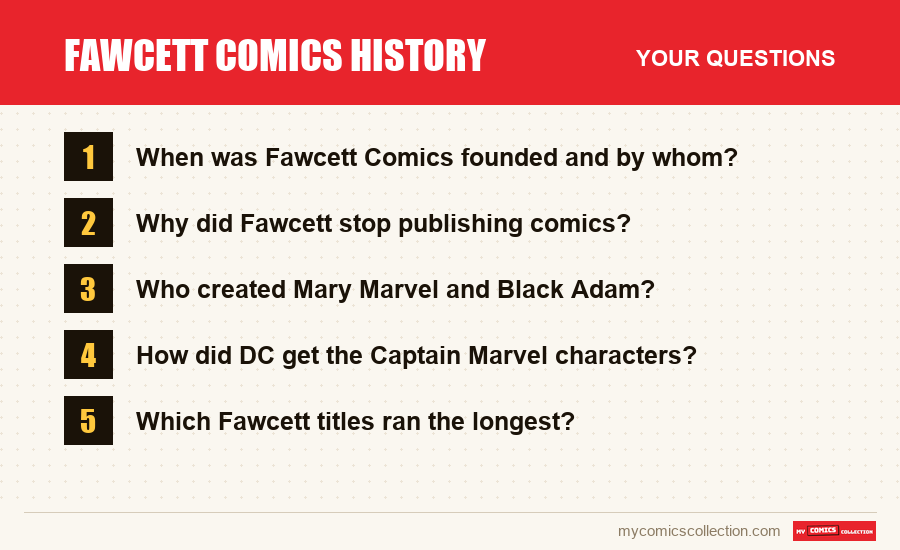
Fawcett Publications was founded by Wilford Fawcett in 1919 with the magazine Captain Billy's Whiz Bang. The comics division is dated to 1939, and its first superhero hit, Whiz Comics #2 with Captain Marvel by Bill Parker and C. C. Beck, carries a cover date of February 1940.
Fawcett had been sued by National Comics over the similarity between Captain Marvel and Superman. The Second Circuit revived the case in 1951; two years later the company settled out of court and dropped Captain Marvel along with the rest of its costumed heroes.
Mary Marvel first appears in Captain Marvel Adventures #18 (December 1942), created by Otto Binder and Marc Swayze. Black Adam, created by Otto Binder, debuts in the opening issue of The Marvel Family in 1945; that series ran until 1954.
DC licensed Captain Marvel and the Marvel Family from Fawcett in 1972, and later acquired full rights to the characters. The first DC issue, Shazam! #1, carries a cover date of February 1973, and the title used the word Shazam because of Marvel's trademark on Captain Marvel.
Among the superhero books, Whiz Comics reached 155 issues (1940 to 1953) and Captain Marvel Adventures reached 150 issues (1941 to 1953). Captain Marvel Jr. ran 118 issues and The Marvel Family 89, while Hopalong Cassidy ran 84 issues from 1946 to 1953.
Holding a Whiz Comics or Captain Marvel Adventures issue from the Fawcett years? Get a quick idea of what your copy is worth.
Estimate my comic