An editorial event is not a bigger story: it is an engineering problem disguised as a story. You have to coordinate dozens of series written by different people, impose a schedule on everyone, produce a readable story that only follows a title, and deliver without delay. The constraint is not narrative but logistical, and this explains the very particular shape of these objects, including their recurring defects.
Understanding this mechanism avoids blaming these stories for weaknesses that are not weaknesses.
This article sets out the problem posed, the solutions employed, what they impose on the story, and why these objects age in a particular way.
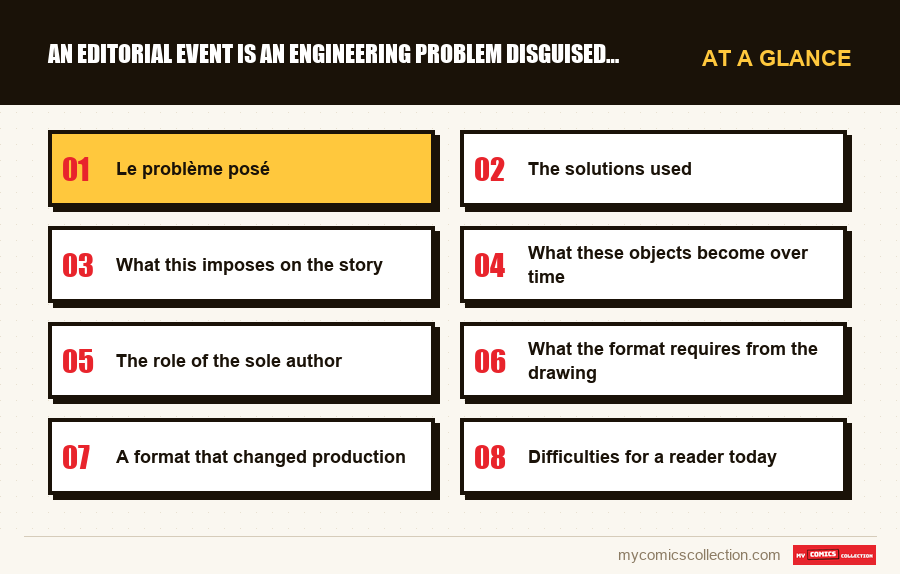
Le problème posé
Four contradictory requirements that must be satisfied simultaneously.
Tell a complete story in a central series, readable alone, with a beginning, a development and an end.
Involve dozens of titles whose writers have their own ongoing arcs and didn't ask to be interrupted.
Stay accessible to a reader who will only buy their usual series and must be able to follow it without buying the rest.
Maintain a common calendar while each series has its own rhythm and delays.
These four requirements contradict each other two by two. A truly complete story makes other titles unnecessary; really involved titles make the central series incomprehensible on its own: and any arbitration dissatisfies someone.
The solutions used
An independent central series
It carries the essentials and can be read alone. The other titles refer to it without their reading being necessary.
This is the decision that protects the casual reader.
Short interruptions
The series involved devote one or two issues to the event, no more, so as not to sacrifice their own arcs.
A preliminary framing
Authors receive what they have to respect and keep control of the rest. The less we impose, the better the episodes are.
Announced consequences
What will change afterwards is decided and communicated upstream, otherwise each series would start in an incompatible direction.
What this imposes on the story
Three constraints which explain the recognizable shape of these objects.
A huge cast. You have to feature a lot of characters, often briefly, because their presence justifies the involvement of their series. This produces those overcrowded boxes characteristic of the format.
A permanent exhibition. The story must constantly remind us who is who, for readers who do not know half of the figures present. This work consumes pages and makes the text heavier.
A rhythm imposed from the outside. The number of issues is fixed before writing, based on a commercial calendar. The story must flow there, which produces visible accelerations and stretching.
These three constraints are structural. A poorly paced or overcrowded event is not poorly written: it is written under conditions that mechanically produce these defects, and avoiding them entirely is probably impossible.
The most common criticism is also the least well-founded. We readily criticize these stories for their confusion, forgetting that they are designed to be read by people who do not have the same background.
A long-time reader finds the reminders heavy; a newcomer finds them insufficient. No adjustment satisfies both, and the choice chosen, serving the second, is defensible even if it annoys the first.
What these objects become over time
They age in a special way, and it's worth describing.
The context disappears. An event responds to a specific editorial situation: continuity that has become unmanageable, series to be relaunched, an anniversary. This context is erased, and the story is left alone with choices which then seem arbitrary.
The consequences are canceled. What was supposed to change definitively ends up being undone, which retrospectively empties the event of its significance.
Tie-ins become untraceable. The numbers of the series involved are scattered, and reconstituting the whole requires work that is not guided by anything.
The result is an object difficult to read forty years later: we inherit the form without the context that justified it, which is the fate of everything that was designed for a specific moment.
The role of the sole author
A production decision deserves to be isolated, because it distinguishes successful events from others.
Entrusting the central series to a single screenwriter rather than to a collective changes everything. A story written by several hands on a common issue produces breaks in tone and contradictions that the reader immediately perceives.
Single author provides voice and rhythm, which gives the whole thing the coherence that an operation of this magnitude naturally loses.
The price is a considerable workload over a short period, with a schedule that does not suffer any delay since dozens of series depend on it. It is probably the most demanding exercise in the profession.
This is also why these missions are entrusted to people who have already produced a monthly publication without fail. The skill sought is not narrative ambition but reliability, which explains the choices of screenwriters which are sometimes surprising.
What the format requires from the drawing
A graphic aspect conditions the feasibility of these stories and it is rarely discussed.
Including dozens of characters in the same image requires a designer capable of making them all identifiable, in small form, without the box becoming illegible. Few people are capable of it.
This is a rare and very specific skill: distinct from ordinary graphic talent, and it limits the number of artists to whom we can entrust this type of series.
She also explains a visual characteristic of the format: these stories include images designed to be looked at for a long time, where the reader searches for the figures they know. It's a special pleasure, close to that of a group photograph.
This pleasure is real and it is not part of the story. Part of what these objects offer is this contemplation., which explains why they are often better judged by leafing through than by reading.
A format that changed production
A final consequence goes beyond the stories and affects the very organization of the catalogs.
Before these operations, series from the same publisher coexisted without much coordination. Each followed its course, and the meetings between titles were occasional.
The events required permanent coordination: you now have to know what others are doing, plan for interruptions, and coordinate schedules. This infrastructure, once created, does not disappear between two operations.
It has lasting effects on what can be written. A series can no longer make a major decision without consulting, and this constraint weighs constantly, including outside events.
This is a cost that is rarely counted. The format bought its overall coherence at the price of the autonomy of each title, and it is not certain that the exchange was favorable for the series taken one by one.
Collecting this series?
Track what you own, what you are missing and what your collection is worth. 7 day trial.
Start my trial →Difficulties for a reader today
Scattered tie-ins
The series numbers involved belong to dozens of different titles, with no accessible reference list.
An unmanageable distribution
Dozens of unknown characters appear briefly, without the story being able to present them all.
A vanished context
The editorial reasons for the event are nowhere explained, and without them certain decisions appear gratuitous.
Undone consequences
What the event established has often since been canceled, making it difficult to take seriously.
How to read an event today
Three recommendations that make these objects significantly more readable.
Read the central series alone, first. It was designed for this. Adding tie-ins from the first reading drowns the main thread in side scenes.
Don't try to identify everyone. The story doesn't ask for it and it works without it. Finding out who each figure is turns reading into documentation work.
Find out the context, but afterwards. Knowing why the event happened sheds light on decisions that seemed arbitrary, and knowing beforehand would spoil the story.
This approach gives access to the best that the object has. An event read as a story often works better than an event read as a file, while it is the second way that we usually recommend.
What this format has produced that is lasting
One consequence goes beyond the stories themselves and is worth noting.
The success of these operations made them a regular event, and what was exceptional became periodic. A format designed to solve a one-off problem has become business routine, which blunted its effect.
Wear and tear is comparable to that of character deaths: an effective process, repeated until the audience stops believing in it, and in which each new occurrence must promise more to obtain the same attention.
This inflation has a ceiling, reached a long time ago. What remains is a format that readers pass through out of obligation rather than interest, and which burdens series that it regularly interrupts.
It’s a frequent and predictable trajectory. Effective narrative processes are destroyed by their own success, not by their faults: an observation which recurs in several files of this campaign and which seems to be a rule rather than a coincidence.
What to record
On an object split between dozens of titles, the sheet must reconstruct a perimeter that nothing provides.
The list of linked numbers you have, with their original series and their position in the event. No accessible source correctly lists these sets, they are scattered across dozens of titles, and an isolated tie-in in a collection is indistinguishable from an ordinary issue.
This is the only way to know whether you have a whole or fragments: a question impossible to decide by looking at a shelf.
What you read about the central series before the tie-ins, noted as such: the order completely changes the experience, and remembering your own allows you to know if a confusion comes from the story or the way in which you approached it.
These two mentions address the only real problem with these objects, which is neither the price nor the rarity but the reconstitution of a perimeter that the publisher has never documented for posterity.
Questions fréquentes
Because the presence of a character justifies the involvement of his series. It is therefore necessary to include many figures, often briefly, which produces these crowded boxes. This is not a writing flaw but a format constraint, and avoiding it entirely is probably impossible.
No, the central series was designed to be read alone. Adding tie-ins on the first read drowns the main thread in side scenes: it's better to read the story first and only go to the titles involved if you want to extend it.
Because the story is aimed at readers who do not know half of the characters present. A longtime reader finds these reminders cumbersome, a newcomer finds them insufficient: no setting satisfies both, and serving the latter is defensible even if it annoys the former.
Because they responded to a specific editorial situation (unmanageable continuity, series to be relaunched) and this context is disappearing. We inherit the form without the reasons that justified it, and certain decisions then appear gratuitous. Added to this is the fact that the announced consequences have often been canceled since.
Yes, by repetition: what was exceptional has become a recurring event, and each occurrence must promise more to obtain the same attention. It's the same trajectory as character deaths: an effective process destroyed by its own success, not its flaws.
Ensemble complet, ou fragments ?
An isolated linked number in a collection is indistinguishable from an ordinary number.