
Echo is Terry Moore's most classically constructed series, and the most reassuring for a hesitant reader. A photographer finds herself in the wrong place when an experimental device is destroyed in flight: fragments of the alloy fall on her, stick to her skin and refuse to leave. Thirty chapters, six volumes, a stalking plot with soldiers, scientists and a countdown. Narrative completed, and the only one of his production which frankly adopts the codes of the science fiction thriller.
This is the title by which many readers discover that an author from intimate drama is perfectly capable of constructing a mechanism of suspense, of maintaining it over thirty chapters and of concluding it without shying away.
This article explains what it's about, how it differs from his other books, and why it's a good second purchase rather than a first.
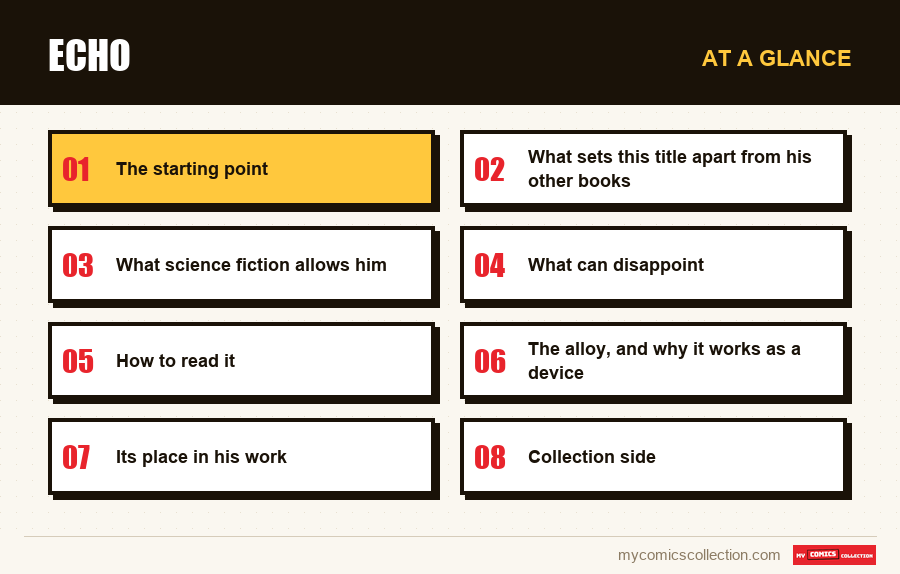
The starting point
Julie Martin photographs alone in the desert, on an ordinary morning at work. High above her, a flight test goes wrong and the device disintegrates in mid-air. What falls on her is not ordinary debris: a still liquid alloy, which is deposited on her bust, hardens in a few seconds, and becomes purely and simply a part of her.
She can neither remove it, nor hide it for long, nor understand what exactly he is doing. On the other hand, she notices quite quickly that he reacts to specific things: to his emotions, to his fear in particular, and to what approaches her.
Several parties then search for it: the organization that funded the program, a man who lost something in the accident, and the missing fragments themselves, which did not all fall in the same place. The story is a race, and he assumes all the codes.
What sets this title apart from his other books
A mechanical plot
Where his other stories advance through relationships, this one advances through issues: an object to recover, pursuers, a deadline. The structure is classic and perfectly maintained.
This is what makes it most accessible to a reader coming from genre stories.
An ordinary protagonist
Julie has no criminal past, no power, no destiny. She's simply someone this happens to, which makes her every decision plausible.
An unexpected technical drawing
Machines, vehicles, military installations: the author shows a graphic register that was not known in his dramas.
Less humor than usual
The dialogue remains lively, but the comic counterpoint is more discreet here than anywhere else at home. Suspense occupies the place.
What science fiction allows him
As with his horror story, the genre is not a disguise: it makes concrete a subject that the author treats elsewhere in an indirect way.
The alloy that sticks to Julie and never leaves is a very simple image of what her other books tell at length: something happened, it wasn't your fault, and you're carrying it now. Where its intimate drama takes hundreds of pages to establish a past that sticks to the skin, science fiction poses the idea in three sections.
The genre also allows him to address the question of the body head-on. Julie is altered without her consent, observed, measured, and coveted for what she contains rather than for what she is. The device says this without needing to say it.
Finally, it allows a measurable progression (the fragments come together, the countdown advances) which gives the story a tension that his dramas obtain otherwise, and more slowly.
Why make a second purchase rather than a first. This title is the most accessible of his production, but also the least representative: suspense takes the place that human relationships occupy elsewhere.
A reader who starts there and moves on to his major work would find the latter slow and talkative. The reverse order works much better: we then appreciate what the mechanics provide, instead of regretting what it replaces.
What can disappoint
A deliberately summary science
The technical explanations remain vague and the story does not seek rigor. A reader of demanding science fiction will find this light.
A predictable structure
The codes of the stalking thriller are respected without being subverted. The pleasure comes from the execution, not the surprise.
Fewer memorable characters
The distribution is more functional than elsewhere at home. Those who come for its secondary figures will find less.
An ending that divides
The conclusion fully assumes the register of spectacular science fiction, which is surprising after a story kept close to reality.
How to read it
Two recommendations are enough, this title being the simplest in its bibliography to approach.
In one go or almost. The narrative is based on continuous acceleration and a countdown. Spread out, it loses exactly what sets it apart from his other books.
In volume. The whole is contained in six volumes divided in a single way, with no rival collection blurring the boundaries. The checks imposed by one's ledger before each purchase are useless here.
Nothing imposes a particular place in his bibliography: the story is sufficient in itself, and the late book in which he brings together his different creations requires no prior reading.
The alloy, and why it works as a device
The object at the center of the story deserves examination, because its success is due to specific choices rather than a good general idea.
It does not confer power in the usual sense. Julie does not become stronger, nor invulnerable, nor able to fly at will. What she acquires is dangerous and poorly controlled: something that reacts to her fear rather than to her will, and whose effects terrify her as much as they terrify others.
This move changes everything. A character endowed with power seeks to use it; a character with a problem seeks to get rid of it. The second produces a plot of flight, the first a plot of conquest, and the author systematically chooses the first.
The device is also irreversible and visible. Julie can neither remove it nor hide it entirely, which prevents her from leading a double life and removes any comfort of secrecy. Each encounter becomes a negotiation on what it lets you see.
Finally the alloy is coveted, which transforms the protagonist into an object in the eyes of almost every character she meets. This is the point where the story joins, without ever saying it, what the author writes elsewhere about women who are seen for something other than themselves.
Collecting this series?
Track what you own, what you are missing and what your collection is worth. 7 day trial.
Start my trial →Its place in his work
This series occupies a pivotal position that we only perceive in hindsight.
It comes after the conclusion of his great book, at a moment when the author had to show that he could do something other than the relationship drama that had made him known. It therefore constitutes a demonstration of range as much as a story.
She is also preparing the following. The rigor of construction that he experiences here (a plot with revelations, a coherent system, a measurable progression) will be found in his horror story, where it will serve a more personal purpose. This title is the workshop where he learned to carpenter.
For a reader, this means that it is better as a second or third read than as a discovery. We then see an author expanding his means, rather than just another science fiction thriller.
Collection side
One characteristic of this title makes it interesting for anyone building a collection without a big budget: it is the least sought after of his production.
It has nothing to do with its quality. The relationship drama that made him known attracts readers from literature; horror attracts a large genre audience. A stalking sci-fi, without a recurring character or adaptation, has neither of these two demand drivers.
This results in a comfortable situation for the buyer: booklets from a complete series, from a recognized author, available without any particular competition. It is the title of his bibliography with which it is most reasonable to begin a collection by fascicle rather than by volume.
Two technical clarifications nevertheless. Its numbering has never been revived, so a number designates a unique object: an advantage that its ledger does not offer. And the issues are now around fifteen years old: on staples of this age, the wear of the corners and the flatness of the spine become real criteria.
What to record
Two fields are enough on this title, which is not enough.
What object is it? A stapled, a volume, or the complete collection: three presentations under a single title, for very different quantities of story.
Dans quel état. In the absence of sealed shells on this segment, everything is based on what the description states, and fifteen years of shelving leave traces that must be named.
If you have a signed copy, write that down too. On an author who produces all of his books alone and sells part of his prints in person, the signature does not have the same status as on a collective work.
Who to advise
The audience for this title extends beyond the author's, which is not true of any of his other books.
It is suitable for a thriller reader who has never opened an intimate graphic novel, for someone who wants a tense read without a long commitment, and for a science fiction fan who accepts that technique takes a back seat.
It is less suitable, on the other hand, for those who are looking for exactly what makes the author's reputation: the funny dialogues, the memorable secondary figures, the accuracy of the relationships between characters. All of this exists here, but in less quantity: suspense has taken its place.
It is therefore the title to offer to someone who does not like this type of book, and the least appropriate for someone who already likes this author.
Frequently asked questions
It's the easiest, but not the most representative, and the two are not the same. Suspense occupies the place that human relationships hold in his other books, so much so that a reader starting there risks finding the rest of his production slow and talkative.
The story does not seek technical rigor and remains deliberately vague on how what it describes works. This is not speculative science fiction but a thriller that uses a science fiction device as a driving force: judged on this ground, it holds up perfectly.
It is, and its author wrote the ending rather than endure it. This conclusion shifts to a much more spectacular register than what precedes, which divides readers, but no question asked along the way remains unanswered.
Absolutely not, the story is entirely self-contained. Knowing them only brings additional pleasure: we then realize what new the author is trying here, and we recognize the framework that he will reuse later in a different register.
Because suspense occupies the space that comic counterpoint takes elsewhere. The dialogues remain lively, but a story built on continuous acceleration has difficulty supporting the funny breaths which give its dramas its charm: it's a trade-off, not an oversight.
A signed copy does not have the same status here
On an author who produces all of his books alone, this is information that deserves a field.