
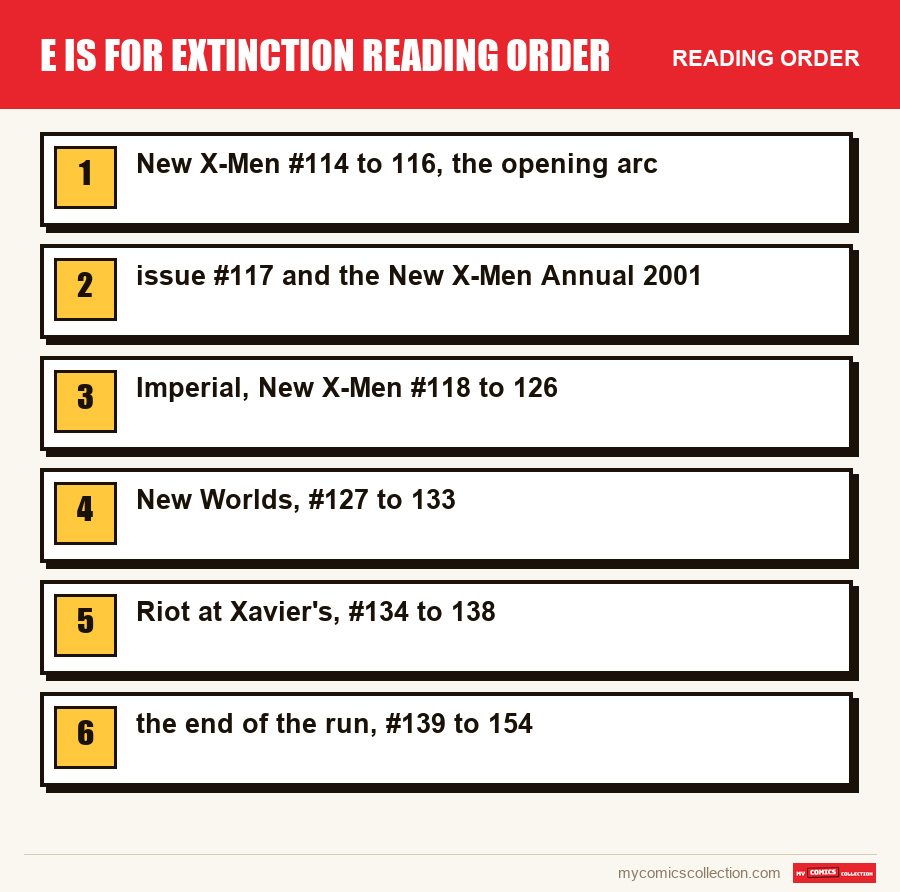
The E Is for Extinction reading order starts with New X-Men #114 to 116, published in 2001, written by Grant Morrison and drawn by Frank Quitely. Read those first, then issue #117 and the New X-Men Annual 2001, before continuing with Imperial (#118 to 126). The arc has no crossover and no required tie-in: the series itself is the logical next step.
In 2001, the X-Men series changes its name, its tone and its creative team without changing its numbering. It takes Grant Morrison and Frank Quitely just three issues to turn the mutants' situation upside down: here is the reading order, the useful extras and the issues that can wait, with no detailed plot retelling.
As always in this guide, only verified information (creators, issue numbers, dates) is stated as fact; the analysis is our own, with no reproduction of protected pages or dialogue.
What to read before
Good news: E Is for Extinction is built as an entry point. The series picks up the numbering of X-Men vol. 2, launched in 1991 alongside Uncanny X-Men, and becomes New X-Men from issue #114 with Grant Morrison writing, recruited by editor in chief Joe Quesada. No reading is required, then; here is what helps, from the most useful to the most optional.
- The 2001 relaunch itself. Issue #114 is not a #1: it continues the numbering from 1991. You can open it without knowing the earlier issues, because the creative team sets up its own situation from the first pages.
- X-Men #129 (January 1980). Chris Claremont and John Byrne create Emma Frost there, and her return to the team is one of the stakes of the arc. It is not essential, but reading it sheds light on how Grant Morrison reuses the character. Our page on the best Emma Frost comics offers other entry points.
- An overview of the X-Men universe. Our history of the X-Men in comics sets out the teams and locations, if you arrive without landmarks.
If you are short on time, start from issue #114 with no other preparation: it is the choice closest to what the relaunch aimed for, and most readers are happy with it.
Phase 1: New X-Men #114 to 116, the opening arc
The E Is for Extinction arc fills issues #114 to 116, all drawn by Frank Quitely. Grant Morrison writes the series; the two creators together are credited with the character of Cassandra Nova, who appears in issue #114.
Spoiler: Cassandra Nova launches a new generation of Sentinels against Genosha, and the island, home to mutants, is destroyed. Emma Frost, for her part, returns among the X-Men at the end of the arc. This shock sets the tone for the rest of the series: the mutants no longer just fight an adversary, they count their dead.
Read the three issues in one sitting. They form a narrative unit, with an opening, a high point and a conclusion, and the series only finds its rhythm again afterward. Our page on Cassandra Nova extends what you need to remember about the character.
Frank Quitely does not leave the series after these three issues: you find him among the artists of Imperial, then alone at the helm of Riot at Xavier's. Spotting his pages helps you follow the visual line he and Grant Morrison set in 2001.
Phase 2: issue #117 and the New X-Men Annual 2001
Issue #117 is in the series' first collected edition, which gathers issues #114 to 117 and the annual. Read it right after the three opening issues, as that edition does.
The Annual 2001 reads between the first arc and the second: that is the place the first collection gives it, right after issue #117. It is titled The Man from Room X, it is drawn by Leinil Francis Yu, and it takes place in Hong Kong, where an officer tries to secretly sell a captive mutant named Xorn to John Sublime, the man behind the U-Men; Cyclops convinces Xorn to join the X-Men.
This is an issue not to skip if you want to understand the rest of the series: it brings a new member into Cyclops's team and sets up John Sublime, whose U-Men return in Imperial.
Phase 3: Imperial, New X-Men #118 to 126
After the opening arc, the series moves into Imperial, nine issues that explore Cassandra Nova's motivations. The art is shared: Ethan Van Sciver, Frank Quitely and Igor Kordey work on the arc, which makes the look less uniform than in the opening.
This is also the arc where Angel Salvadore and Beak, two young mutants, appear, and where the Stepford Cuckoos and the U-Men grow in importance. For a collector, this is the window where the series' supporting cast takes shape.
The method stays the same: read in issue order, without hunting for tie-ins. The first volume of the Ultimate Collection edition covers issues #114 to 126 and the annual, which makes it a good stopping block if you want to limit your reading to the introduction.
Phase 4: New Worlds, #127 to 133
The third arc deals with the aftermath of Genosha's destruction: tensions between humans and mutants, the rebuilding of a status. The artists are Igor Kordey, John Paul Leon, Phil Jimenez and Ethan Van Sciver, which again makes for a mixed set.
Mild spoiler: this is the arc where the psychic liaison between Cyclops and Emma Frost begins, a mechanism that will make waves in the following issues. To understand what the arc does to the couple formed by Cyclops and Jean Grey, our Jean Grey reading guide puts the stakes back in context.
If your goal is to read the initial event, you can stop at issue #126, or even #133: beyond that, the story enters arcs that develop other threads.
Phase 5: Riot at Xavier's, #134 to 138
Frank Quitely returns for this five-issue arc, which follows Quentin Quire. After learning he was adopted, then after the death of Jumbo Carnation, the student turns against Xavier's teaching and leads a militant band of classmates who take a drug, Kick. Many readers read this arc separately, because it puts the school at the center of the story.
The same artist as on the opening handles the look, which gives the arc a visual continuity with E Is for Extinction.
Do you collect this series?
Track what you own, what you are missing and what your collection is worth. 7-day trial.
Start my trial →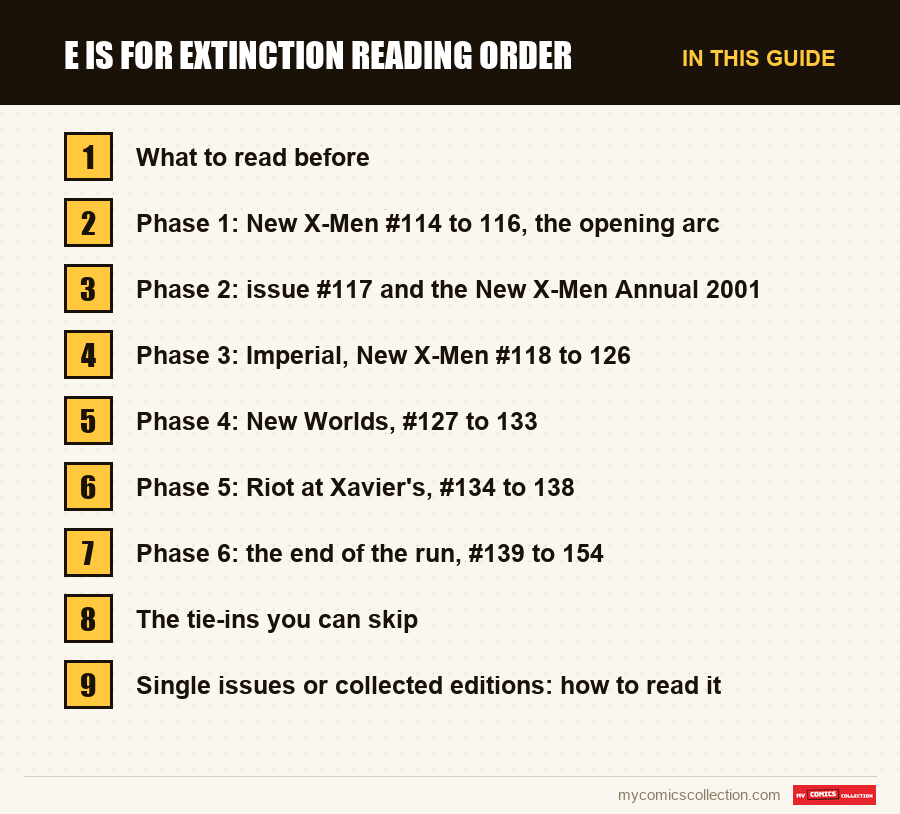
Phase 6: the end of the run, #139 to 154
Four arcs follow. Murder at the Mansion (#139 to 141) is drawn by Phil Jimenez; Jean Grey confronts Cyclops and Emma Frost there about their liaison, and Bishop leads the investigation. Assault on Weapon Plus (#142 to 145) is drawn by Chris Bachalo; Cyclops and Wolverine, with Fantomex, enter the orbital station Weapon Plus.
Planet X (#146 to 150) is again drawn by Phil Jimenez. Jean Grey, Beast and Emma Frost leave the school at the start of the arc; we say no more about what follows. Finally, Here Comes Tomorrow (#151 to 154) is drawn by Marc Silvestri and is set in a distant future where the Crawlers hunt the X-Men and the Phoenix Egg is carried off toward the future version of Beast.
Grant Morrison's run ends with issue #154. The following issues belong to another team and another stage of the series: they do not affect your understanding of the opening arc.
The tie-ins you can skip
Here, the word tie-in has little meaning: E Is for Extinction is not a crossover that spills into other monthly series, and no outside issue is needed to read it. The series stands on its own.
What you can skip is the content that comes after your needs. If you only want the opening, stop at issue #116 or #117. If you want the opening and its context, stop at issue #126. Issues #155 and 156 belong to the post-Morrison era: they are collected with issues of Uncanny X-Men (#435, #436, #442 and #443), for anyone who wants to extend the reading in another direction.
There is no disparagement here: these are follow-up reads, not preparation, and they are for those who want to follow the series further than the opening arc. Our X-Men collecting guide helps you decide how far to go.
Single issues or collected editions: how to read it
In single issues, the series reads in issue order from #114 to 154, with the Annual 2001 slotted between the first and second arcs. This is the option most faithful to the original publication, and the most costly in hunting time, because each issue has to be found separately.
In collected form, the first volume, titled E Is for Extinction, gathers issues #114 to 117 and the annual. The other volumes of the series follow arc by arc, up to the seventh, Here Comes Tomorrow, which covers issues #151 to 154. Another option, the Ultimate Collection, is split into three volumes: issues #114 to 126 and the annual, then #127 to 141, and finally #142 to 154.
Finally, the New X-Men Omnibus gathers issues #114 to 154 and the 2001 annual in a single volume. This is the option to choose if you want the complete run without chasing single issues; the single issue keeps its appeal if you collect the series or are after the opening issues.
The key issues to know
No dollar figures here: these are the single issues to hunt first, depending on what you want to own.
- New X-Men #114. The opening of the arc and of the series under its new title, in which Cassandra Nova, created by Grant Morrison and Frank Quitely, appears. It is the natural landmark of the relaunch.
- New X-Men #115 and 116. The development and conclusion of the arc, which are mostly worth owning as a set.
- New X-Men Annual 2001. The Man from Room X, drawn by Leinil Francis Yu: a less visible issue than the regular series, useful to complete the run.
- New X-Men #118 to 126. The Imperial arc, where Angel Salvadore and Beak appear.
- New X-Men #134 to 138. The Riot at Xavier's arc, with Quentin Quire, drawn by Frank Quitely.
For variants and alternate covers, check each issue's catalog page and compare printings before buying. Before paying for a copy, match it against completed sales for a comparable condition. Our Emma Frost selection offers other landmarks on a key character of the run.
Recap: the complete order
- New X-Men #114 to 116, the E Is for Extinction arc (Grant Morrison and Frank Quitely, 2001).
- New X-Men #117 and New X-Men Annual 2001 (Leinil Francis Yu).
- Imperial: New X-Men #118 to 126.
- New Worlds: New X-Men #127 to 133.
- Riot at Xavier's: New X-Men #134 to 138.
- Murder at the Mansion: New X-Men #139 to 141.
- Assault on Weapon Plus: New X-Men #142 to 145.
- Planet X: New X-Men #146 to 150.
- Here Comes Tomorrow: New X-Men #151 to 154.
Frequently asked questions
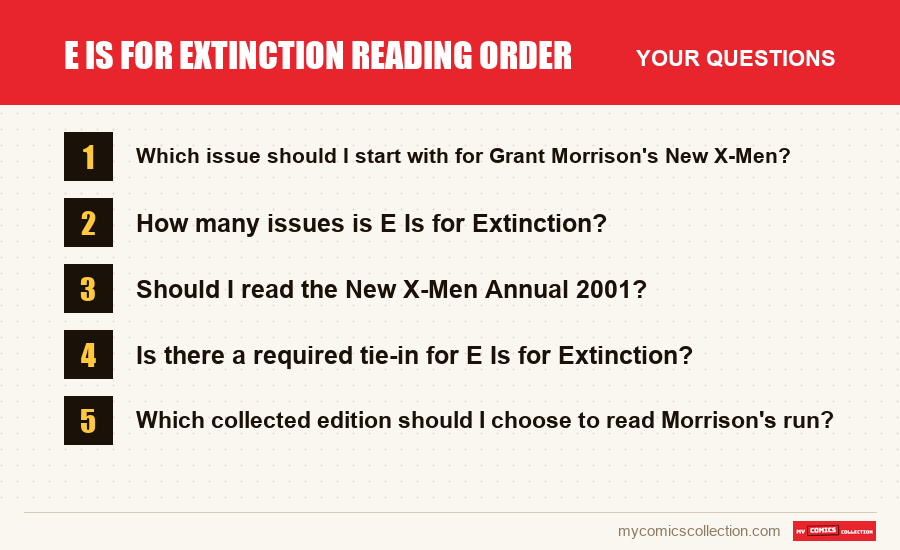
Start with issue #114, which opens the E Is for Extinction arc: the series keeps the numbering of X-Men vol. 2 but changes creative team. No prior reading is needed. Then read issue #117 and the Annual 2001, and continue with the Imperial arc.
The arc is three issues, #114 to 116 of New X-Men, written by Grant Morrison and drawn by Frank Quitely. The series' first collected edition adds issue #117 and the Annual 2001. The rest of the run picks up with the Imperial arc.
It is recommended. The Annual 2001, drawn by Leinil Francis Yu, slots in between the opening and the Imperial arc, and brings the mutant Xorn into the team. You can do without it for a quick read, but it usefully fills in the context and the run.
No. E Is for Extinction is not a crossover: the arc reads in New X-Men alone, with no issue from another series. The only recommended addition is the Annual 2001. The question of what to read next comes afterward, depending on whether you want to follow the run through issue #154.
Three options. The first volume, E Is for Extinction, gathers issues #114 to 117 and the annual; the Ultimate Collection comes in three volumes; the New X-Men Omnibus gathers issues #114 to 154 and the annual in one volume, which suits anyone who wants the complete run.
Did you find an issue of New X-Men in your boxes? Appraise it before deciding whether it completes the run or goes up for sale.
Appraise my comic