
In short
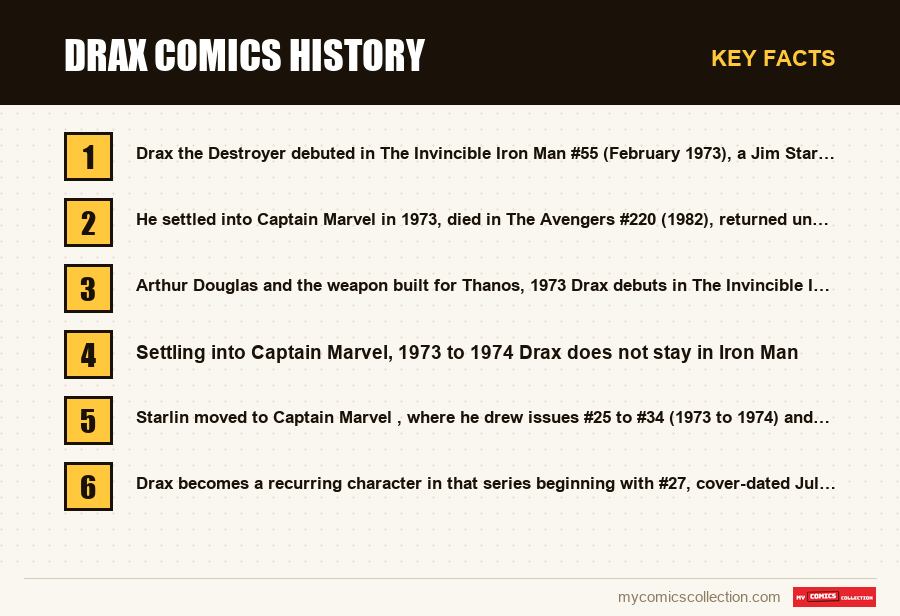
Drax the Destroyer debuted in The Invincible Iron Man #55 (February 1973), a Jim Starlin creation scripted by Mike Friedrich. He is Arthur Douglas, a human whose spirit was placed in a new body to fight Thanos. He settled into Captain Marvel in 1973, died in The Avengers #220 (1982), returned under Starlin in 1990, killed Thanos in Annihilation (2006), joined the Guardians in 2008, and died again in 2010.
Drax is a character defined by a purpose, and the history of the character is the history of what happens to a weapon after its target is gone. Over five decades he has been a killer, a prisoner, a teammate, a victim and a detective, and the same body carries all of it.
Credits, issue numbers and cover years in this timeline were checked against published issue data, and years appear without months whenever a month could not be confirmed. How each period changes the character is analysis, not an editorial statement.
Arthur Douglas and the weapon built for Thanos, 1973
Drax debuts in The Invincible Iron Man #55, cover-dated February 1973. Jim Starlin created him, and Mike Friedrich is the writer credited on the issue, which is the same booklet that introduces Thanos. Its importance for Drax only became obvious after the character had a long history behind him.
The origin is the part that matters. Drax's human identity is Arthur Douglas, a man from Burbank, California. Thanos's ship attacked his car in a desert; Douglas died, and his daughter survived and was raised on Titan, where she became Moondragon. Kronos and Mentor then placed Douglas's spirit in a new, powerful body. The result is a being built for one job: to stand against the Mad Titan.
That structure is the key to every later version. A man who was killed by his enemy and then rebuilt as that enemy's opposite has a motive that never needs to be explained again, which gives later writers a simple engine: point Drax at Thanos and see what happens. It also means he has a built-in tension between the weapon and the person, which is the thread that runs through all the stories that follow.
Our guide to the issue covers the debut booklet itself, so this page moves on to what happens afterward.
Settling into Captain Marvel, 1973 to 1974
Drax does not stay in Iron Man. Starlin moved to Captain Marvel, where he drew issues #25 to #34 (1973 to 1974) and took over the plotting from the issue after #25. Drax becomes a recurring character in that series beginning with #27, cover-dated July 1973. The issue does not mark his debut, but it marks the point where he becomes a regular.
That placement says something about how Marvel used him. In 1973 he is not a headliner. He is a powerful presence attached to the book where the cosmic story is running. The later reputation of Drax as a brooding giant starts here, in the margins of someone else's series.
He continues to appear in Captain Marvel afterward: in #42 to #44 (1976) he attacks Captain Marvel for robbing him of his purpose, and he is back in #58 to #62 (1978 to 1979). For Drax's first decade, these Captain Marvel issues are the nearest thing to a home series, so a classic-era Drax shelf starts here.
Warlock, Iron Man and a character in transit, 1975 to 1981
The second half of the 1970s scatters Drax across several books. He appears in Warlock #10 (December 1975), in Iron Man #88 (July 1976), in Warlock #15 (November 1976), in Logan's Run #6 (June 1977) and in Thor #314 (December 1981). The list is useful because it shows a character who is borrowed rather than owned.
Starlin wrote and drew Warlock #9 to #15 in 1975 and 1976, and the Drax appearances there put him back in the cosmic orbit that created him. The cameo in Logan's Run and the appearance in Thor show how a recognizable cosmic figure could be dropped into unrelated settings, which is typical of a supporting character in this period.
For a collector, this stretch is the thinnest part of the timeline. The issues are individual appearances, not an arc, and each one is best treated as a single acquisition rather than the start of a run.
Death at the hands of Moondragon, 1982
Drax is killed by Moondragon in The Avengers #220 (June 1982), after appearing in #219 (May 1982): she forces his life essence out of his artificial body. The irony of the death is built into the origin. Moondragon is Arthur Douglas's daughter, the child who survived the attack that killed him, and the character who ends Drax's life is the family member the whole premise began with.
The death closes what could be called the first era of the character. For eight years he is simply gone, and the version of Drax that readers know today has to be understood as something that came after this ending rather than a continuation of it. A reader who wants the pre-1990 story as a complete shape can treat the period from #55 to #220 as a single arc: creation, a decade of service, a death.
The Starlin resurrection, 1990 to 1996
Starlin, then writing the series, brings Drax back in Silver Surfer vol. 3 #35 (1990), where he has a recurring role until issue #50. Starlin's revival of that book also brought Thanos back, and it leads to The Infinity Gauntlet (1991), where Drax appears in all six issues.
The next stage is Warlock and the Infinity Watch, which ran 42 issues from 1992 to 1995 and in which Drax is a member of the title team. Starlin wrote issues #1 to #31 of that run, from 1992 to 1994. For the first time Drax is part of a fixed cast with a monthly book behind it, rather than a guest in someone else's series.
The era ends with Cosmic Powers Unlimited #4 (February 1996), in which Moondragon petitions Kronos to restore Drax's mind to its former acuity. It closes the chapter that began with his return, and it is a short, specific marker and a good place to stop if you are building a shelf around the Starlin years.
Warlock, Captain Marvel and the long interlude, 1998 to 2001
Between the Infinity Watch years and the next major reinvention, Drax appears in Warlock vol. 3 #1 to #4 (1998 to 1999) and in Captain Marvel vol. 4 #4 to #6. The issue numbers there are the verified landmarks; the stretch is short and mostly useful for completists who want an unbroken line of appearances.
The point for a timeline is that Drax stays in print between 1996 and 2005. He stayed in circulation as a recognizable cosmic figure.
Do you collect this series?
Track what you own, what you are missing and what your collection is worth. 7-day trial.
Start my trial →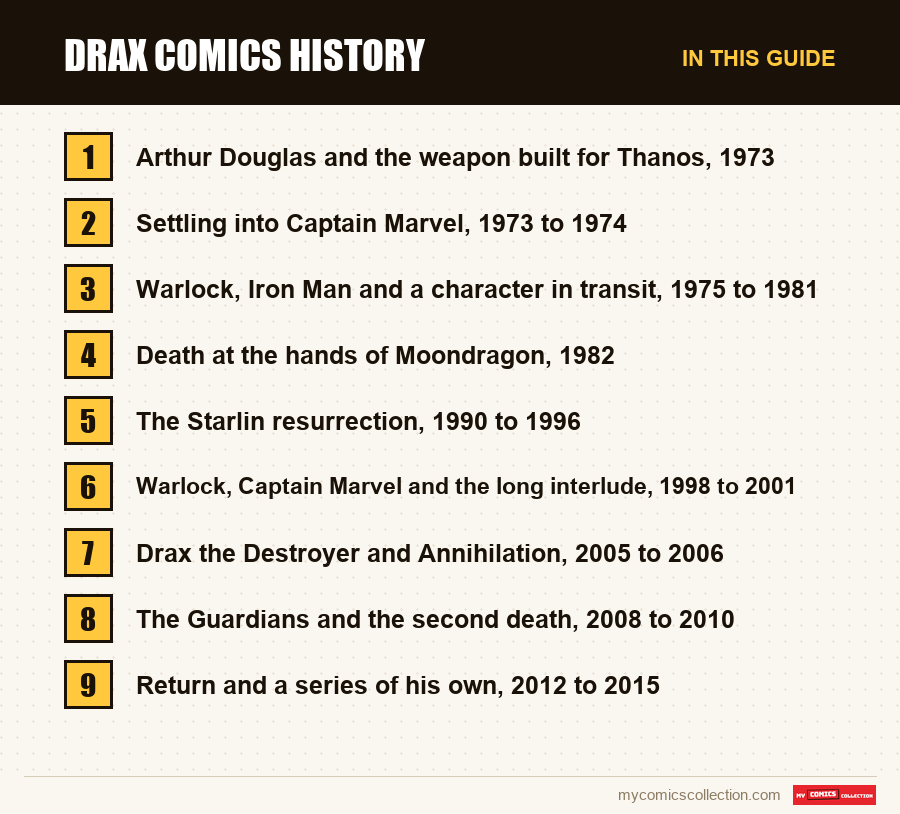
Drax the Destroyer and Annihilation, 2005 to 2006
The modern reinvention begins with the four-issue Drax the Destroyer miniseries, written by Keith Giffen and drawn by Mitch Breitweiser, dated 2005 and 2006 and collected as Drax the Destroyer: Earthfall. In it the prison transport carrying Drax crashes in Alaska, he befriends a teenage girl named Cammi, and a second prison ship arrests them both. It is a smaller, more human story than anything in the 1970s, and it gives later writers a more detailed personality to build on.
That work leads into the Annihilation event of 2006. Cammi and Drax survive the Annihilation Wave in Annihilation: Prologue, then leave what remains of Xandar with Nova Prime in Annihilation: Nova. In the six-issue Annihilation series, scripted by Giffen and pencilled by Andrea Di Vito, he is part of the United Front's land-based army, kills Thanos in #4 just before Thanos can betray Annihilus, and with Moondragon releases the Silver Surfer.
This is the moment when the original premise pays off. The weapon built to destroy Thanos does, finally, destroy him. It is also a handoff, because it moves Drax from a Starlin creation to a character that a new generation of cosmic writers can use. The reading order for the event is covered in our Annihilation guide, and Drax's presence in Nova vol. 4 #4 to #7 (2007) carries him into the follow-up story.
The Guardians and the second death, 2008 to 2010
When Marvel relaunched Guardians of the Galaxy in July 2008, Drax was part of the team, with Dan Abnett and Andy Lanning as the writing team. In that series Drax is an ensemble member, which is a different register from a lone avenger.
It ends with The Thanos Imperative (2010), also written by Abnett and Lanning, with Miguel Angel Sepulveda on the main series. In it Thanos kills Drax, and his death as the avatar of life alerts Mar-Vell to Thanos's presence. The death is notable because it reverses the 2006 story: the destroyer who killed Thanos is killed by him.
For a long-run collector, the 2005 to 2010 stretch is the best-organized period of the character, with a clear start, a clear middle and a clear end, all by the same creative circle.
Return and a series of his own, 2012 to 2015
Drax comes back in Avengers Assemble #4 to #8 (2012), without any reference to his death. Brian Michael Bendis wrote that series. Drax then became part of the Marvel NOW! relaunch of Guardians of the Galaxy, the third volume of the title.
In 2015 Drax received his own series. Drax #1 is cover-dated November 2015, with Scott Hepburn on the cover art. The collected volumes are Drax Vol. 1: Galaxy's Best Detective (issues #1 to #5) and Drax Vol. 2: The Children's Crusade (issues #6 to #11). Reading the 2015 series after the 1973 debut shows how far the character travels: from a weapon built for one man to the lead of a book of his own.
The key issues across his history
- The Invincible Iron Man #55 (February 1973): the debut of Drax, alongside Thanos, from Starlin and Friedrich.
- Captain Marvel #27 (July 1973): Drax becomes a recurring character in the series.
- The Avengers #220 (June 1982): Moondragon kills Drax.
- Silver Surfer vol. 3 #35 (1990): Starlin brings Drax back.
- Warlock and the Infinity Watch #1 (1992): Drax joins a fixed cast in a monthly series.
- Drax the Destroyer #1 to #4 (2005 to 2006): Keith Giffen and Mitch Breitweiser's miniseries.
- Annihilation (2006): Drax fights in the United Front's land army and kills Thanos.
- The Thanos Imperative (2010): the second death, by Abnett and Lanning.
How to follow Drax in a collection
A series-by-series checklist is the only reliable method, because no single series follows Drax from start to finish. Build the list in the order of this page: the debut in Iron Man #55, the Captain Marvel issues of 1973, the death in The Avengers #220, the Starlin revival, and then the modern books.
The trap is volume numbering. Silver Surfer, Captain Marvel, Warlock and Guardians of the Galaxy have each been relaunched more than once, and an issue number without a volume number can point to the wrong book. Always write the volume or the year next to the number, and match listings by cover date rather than on-sale date.
If you want a shorter route, start from the 2005 miniseries and the 2008 Guardians run, then work backward to Starlin. Our companion guide on where to start follows that path in more detail, and the Thanos hub places all of these books in their larger setting.
Frequently asked questions
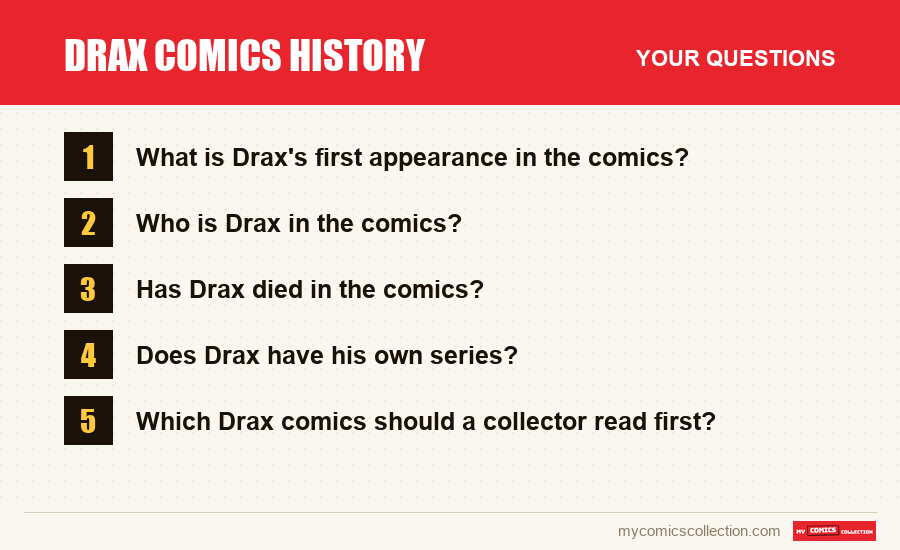
Drax first appears in The Invincible Iron Man #55, cover-dated February 1973. Jim Starlin created the character, with Mike Friedrich as the credited writer. The same issue introduces Thanos.
Drax is Arthur Douglas, a man from Burbank, California, whose car was attacked by Thanos. His daughter survived and became Moondragon. Kronos and Mentor placed his spirit in a powerful new body, built to oppose Thanos, and he became Drax the Destroyer.
Yes, twice. Moondragon killed him in The Avengers #220 (June 1982), and Thanos killed him in The Thanos Imperative (2010). Between those deaths Starlin revived him in Silver Surfer vol. 3 #35 (1990), and he returned in Avengers Assemble in 2012.
He has had solo projects, including the four-issue Drax the Destroyer miniseries (2005 to 2006) by Keith Giffen and Mitch Breitweiser, and a Drax series launched in 2015, collected in two volumes. Most of his history is in other books.
The clearest entry is the 2005 to 2006 Drax the Destroyer miniseries, followed by the 2008 Guardians of the Galaxy series by Dan Abnett and Andy Lanning. To go back to the source, read Iron Man #55 and the Captain Marvel issues from #27.
If you own Iron Man #55 or an early Captain Marvel issue with Drax, find out where it stands before you decide how to keep it.
Estimate my comic