In short
The Dormammu key issues start with Strange Tales #126 (November 1964), his debut by Stan Lee and Steve Ditko, followed by #127, #146 and #150 from the original Strange Tales feature. After that come the Avengers and Defenders crossover of 1973 by Steve Englehart, Thor Annual #9 (1981), Doctor Strange, Sorcerer Supreme #1 (1988) and The Amazing Spider-Man #500 (2003). Eight numbers cover his whole history.
Dormammu is a character you can follow across sixty years without ever leaving the key list, because the writers who used him each added one durable layer: a debut, a duel, a cosmic clash, a family secret, a crossover villain role, a modern return. This ranking sorts those layers into a buying order and says what each issue gives you.
The credits and cover dates in this ranking were checked against published reference pages for the character and the series. The ordering is editorial judgment about how much each issue changes the story, and the buying notes describe how copies of these books tend to behave, not the result of any specific sale.
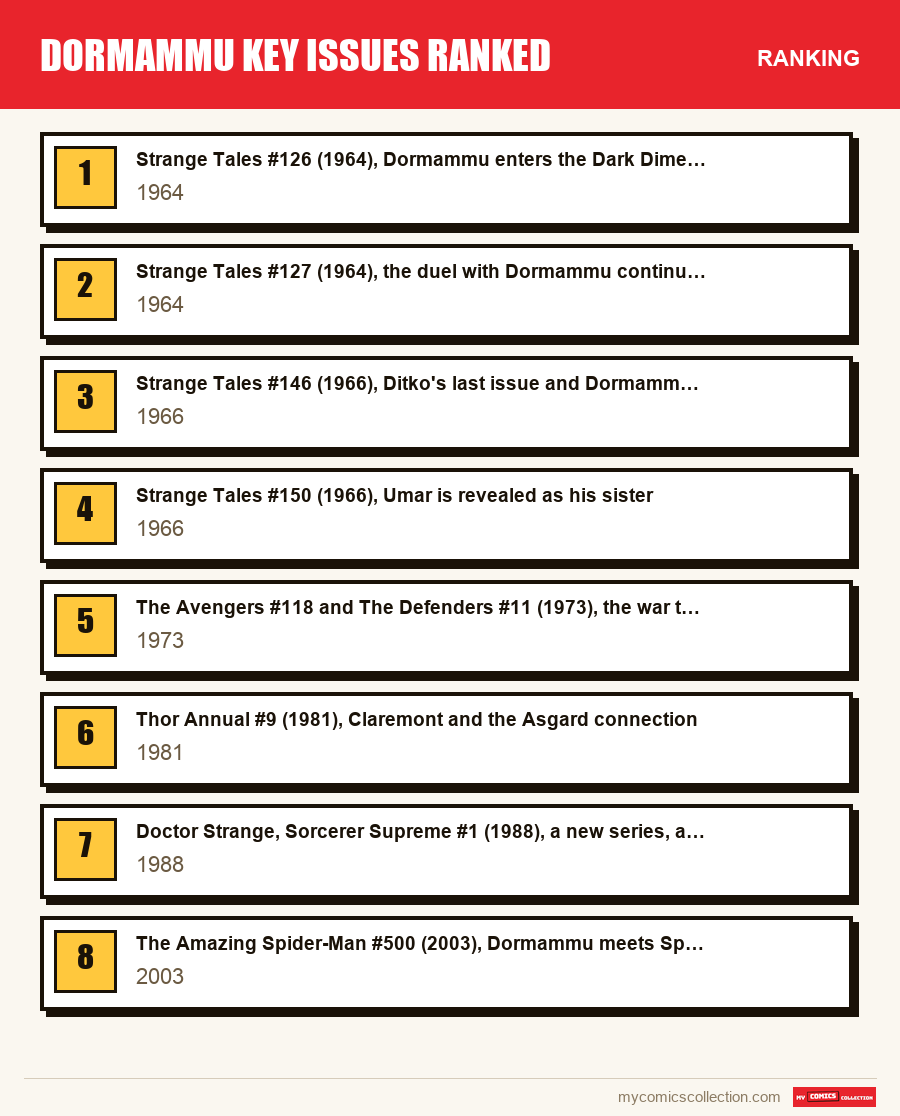
1: Strange Tales #126 (1964), Dormammu enters the Dark Dimension story
Cover dated November 1964, this is the number every ranking begins with. In the Doctor Strange feature, "The Domain of the Dread Dormammu!", Lee and Ditko bring the sorcerer into a realm ruled by a being whose head is a mask of flame, and Clea debuts in the same pages. For the exact credit lines, the cover dating and a checklist of what to inspect, the companion guide on the #126 debut covers them in detail.
Why it ranks first is simple: nothing else on this list exists without it. For buying, remember that the issue is a split book, with Doctor Strange as the secondary feature, so condition problems on a cover designed for another character still count against a copy. Treat this as the target, and decide your budget for it before you spend anything on the rest of the list.
2: Strange Tales #127 (1964), the duel with Dormammu continues
The following issue, dated December 1964, carries the sequel story "Duel With the Dread Dormammu!" by the same Lee and Ditko team. It is where the confrontation set up in #126 plays out on the page, and it is the issue that makes the first meeting feel like the start of a rivalry instead of a single scare.
It ranks second for story value and below the debut for market attention. For many collectors it works as the practical pair: the debut as the centerpiece, #127 as the issue that completes the first chapter and is usually easier to find in presentable condition. Buying both from the same period of production also makes it easier to compare paper tone and cover gloss side by side, which is a quiet way to catch a doubtful copy.
3: Strange Tales #146 (1966), Ditko's last issue and Dormammu against Eternity
Dated July 1966, #146 closes the Ditko run on the feature. The story, "When the Unliving Strike!", is scripted by Denny O'Neil and drawn by Ditko, and it closes the fifteen-issue Dormammu storyline that ran from #131, the same saga that introduced Eternity. The climax pits the tyrant against Eternity one on one, and the tyrant loses.
Collectors prize it twice over: as the end of the Ditko period on Doctor Strange and as the high point of the Dormammu and Eternity conflict. The cover and the lead story are the elements to examine, because a creased spine in a 1966 book is common and affects the number of defects you will need to accept. If you want a single follow-up to the opening pair, this is a natural pick.
4: Strange Tales #150 (1966), Umar is revealed as his sister
The issue dated November 1966 reveals that Dormammu has a sister, Umar. That moment turns the villain from a lone tyrant into a figure with a lineage, and it provides the backbone for later stories in which family ties drive the plot. With #150 the Doctor Strange feature also received its own cover logo, designed by Sol Brodsky, a small production detail that helps date the book at a glance.
This is a lore key rather than a visual one, so its appeal is strongest for readers who follow continuity. For a buyer it is the least expensive way into the Ditko-to-Everett transition on the title, since the art after Ditko passes to Bill Everett for #147 through #152. If you want one issue that shows Dormammu after the original creator has left, this is a sound choice.
5: The Avengers #118 and The Defenders #11 (1973), the war that Dormammu helped start
In the autumn and early winter of 1973, Steve Englehart wrote the Avengers and Defenders crossover in which Dormammu and Loki manipulate two teams into fighting each other. The story alternates between The Avengers and The Defenders over the autumn of 1973, with the last chapters, The Avengers #118 and The Defenders #11, dated December 1973, and Sal Buscema is among the artists who drew it. Check the indicia and the story pages of each chapter before you assemble a set.
It ranks fifth because Dormammu is a manipulator here, not the star, and because the story is shared across two titles. It is nonetheless the clearest case of the character acting as a force in the wider Marvel line, outside the pages of his home feature. The most useful way to buy it is as a block of chapters: you get the Englehart plot in order, and you can judge which two or three numbers matter most to your shelf.
Do you collect this series?
Track what you own, what you are missing and what your collection is worth. 7-day trial.
Start my trial →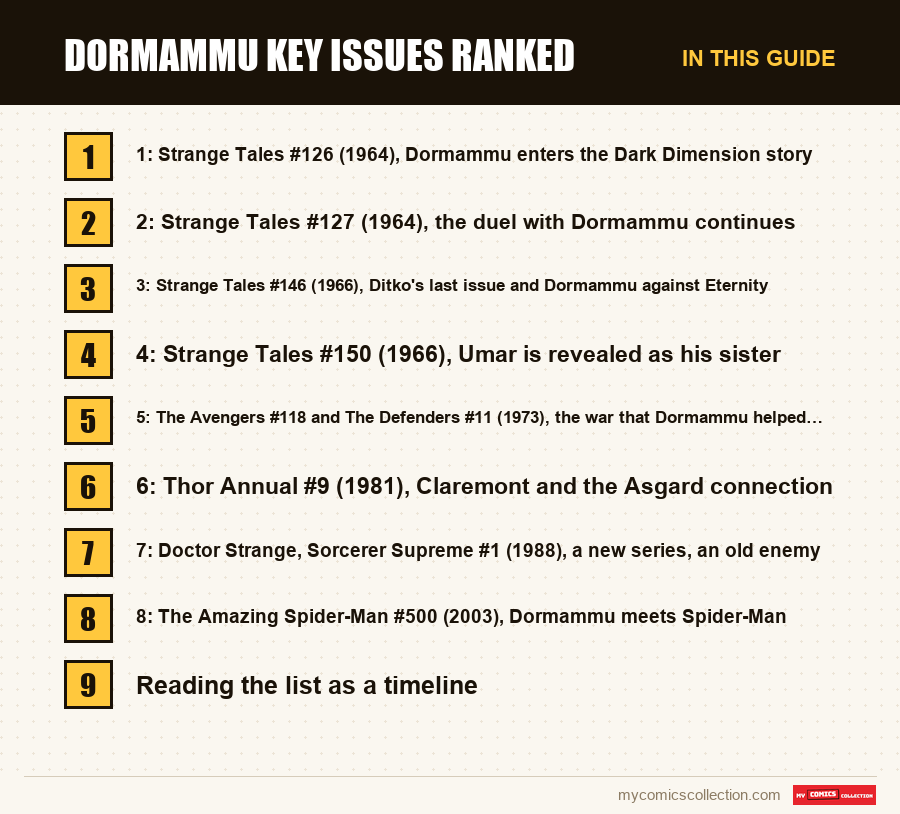
6: Thor Annual #9 (1981), Claremont and the Asgard connection
This annual brings Dormammu into Thor's world. Chris Claremont scripts "The Great Game!", Luke McDonnell and Vince Colletta handle the art with Colletta on inks, and the Dark Dimension ruler becomes a player in a contest of cosmic stakes involving the Asgardians.
Annuals tend to be overlooked, which is why this one belongs in a sleeper conversation. A single oversized issue by a major writer, with a clear creative team, is easy to document and easy to display. Check the staples and the spine of any annual closely, since the thicker format stresses the binding, and compare more than one copy if you can, because condition varies from one to the next.
7: Doctor Strange, Sorcerer Supreme #1 (1988), a new series, an old enemy
The series launched with a November 1988 cover date and a creative team of Peter B. Gillis as writer, Richard Case as penciler and Randy Emberlin as inker. Dormammu is part of the first two issues, which makes the launch of the series also a return of the character to a monthly book.
Late 1980s keys of this kind depend on condition more than on scarcity, so the decision is about the label as much as the book: a certified copy at a high grade is a different purchase from a raw copy at the same apparent grade. Read the comparisons in the guide to the best Doctor Strange runs for where this series fits.
8: The Amazing Spider-Man #500 (2003), Dormammu meets Spider-Man
The story that runs through The Amazing Spider-Man #498 to #500, dated October to December 2003, is the major Dormammu appearance in the Spider-Man book. J. Michael Straczynski wrote it, with John Romita Jr. and John Romita Sr. as pencillers and Scott Hanna as inker. Issue #500 is the closing chapter.
It ranks last because it is a visitor appearance, but it is a useful one: it connects the character to the biggest franchise in the line and gives completists a modern book with a clear creative team. Its appeal lies in the story and the creators, so judge a copy by condition and not by any scarcity premium.
Reading the list as a timeline
Laid end to end, the eight entries span about forty years of cover dates, from November 1964 to December 2003, and they sort into three groups. The Silver Age group (#126, #127, #146 and #150) comes from one magazine and the Ditko style that Everett followed, which is why those numbers look consistent on a shelf and why a collector can compare them directly. The middle group (the 1973 crossover, the 1981 annual and the 1988 launch) shows other writers, Englehart, Claremont and Gillis, shaping the character for new readers. The final entry, from J. Michael Straczynski's run on the Spider-Man title, shows the villain traveling beyond his home feature.
That grouping also helps with timing. The Silver Age group is where condition and certification matter most, so it deserves patience and a clear ceiling. The later groups reward breadth: you can add them as opportunities appear without disturbing the plan for the Silver Age issues. The same logic applies if you are working toward a Doctor Strange shelf in general, where the sorcerer's own debut in #110 and the Dormammu numbers form the Silver Age core.
How to build the Dormammu set
The order that tends to protect a budget is the order of the story, with a pause at each decision point.
- Start with the pair from 1964. Buy the more affordable of #126 and #127 in a grade you can live with, then upgrade the other when the market gives you an opening. Do not rush the debut: a better copy bought slowly beats a worse copy bought quickly.
- Add #146 and #150 as your anchors. They bracket the Ditko era from end to lore reveal, and between them they tell the story of Dormammu's rise as a cosmic figure.
- Treat the Englehart crossover as a block. Buy the issues together, because individual chapters from a split story are harder to sell later.
- Leave the modern issues for last. The 1981, 1988 and 2003 books are inexpensive relative to the Silver Age numbers, and they fill the shelf without drawing on the budget meant for the 1964 issues.
Two extra titles round out the list for readers who want more. Hellcat #1 to #3 (2000), by Steve Englehart and Norm Breyfogle, returns to the character, and New Avengers #46, written by Brian Michael Bendis with Billy Tan as penciler and Matt Banning as inker, makes Dormammu the patron of the Hood. They are not essential, but they show how far the character travels from the Dark Dimension.
Pitfalls to avoid
The most common mistake is to pay a debut price for a mention. In Strange Tales #111 (August 1963), another character mentions Dormammu's name before he appears, and a listing that calls it a first appearance is overstating the case. A second mistake is to treat a reprint as an original. Collected editions carry the same stories at a fraction of the cost, and a listing that is vague about the printing, the indicia or the paper deserves a direct question before you buy. The guide to Doctor Strange reprints and look-alikes covers the details.
A third trap is to trust the grade alone. Two copies with the same number can differ in restoration, trimmed edges or a replaced cover, and only a close look at scans, or a certified holder with a clean label, will reveal it. For the wider approach to building a run, see the key issues for the whole Doctor Strange line, which sets Dormammu's numbers beside the sorcerer's own.
Frequently asked questions
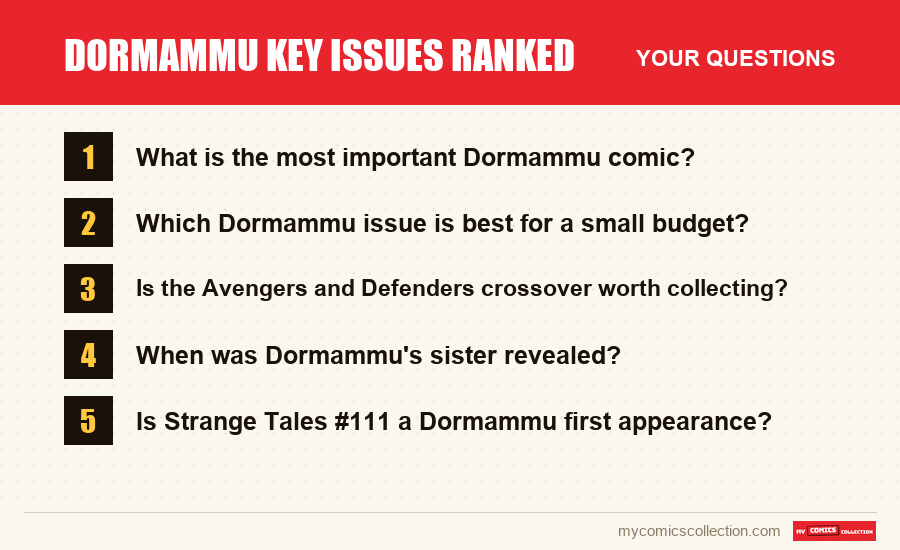
Strange Tales #126, cover dated November 1964, is the most important Dormammu comic because it is his debut, created by Stan Lee and Steve Ditko. It also introduces Clea. Every other number on a Dormammu list follows from the story that begins there, so it anchors any collection built around the character.
The modern entries are the lighter commitments: Thor Annual #9 from 1981, Doctor Strange, Sorcerer Supreme #1 from 1988 and The Amazing Spider-Man #500 from 2003. They carry clear credits and story value, and none of them competes with the 1964 debut for attention or for room in a budget.
Yes, as a story. Steve Englehart's 1973 Avengers and Defenders crossover shows Dormammu and Loki manipulating two teams, and it spans The Avengers and The Defenders. It is a block purchase more than a single-issue key, so decide early whether you want the full run of chapters.
Umar is revealed as Dormammu's sister in Strange Tales #150, dated November 1966, the first issue with a dedicated Doctor Strange cover logo. It follows the Ditko run, since Ditko left the feature after issue #146, and it is a favorite among collectors who follow the continuity of the Dark Dimension.
No. In Strange Tales #111, dated August 1963, another character speaks Dormammu's name more than a year before he is seen on the page. The debut is Strange Tales #126 from November 1964, so a listing that calls #111 a first appearance is describing a mention, not an appearance.
Own one of these Dormammu issues? Enter the number and its condition to see where it stands today.
Estimate my comic