In short
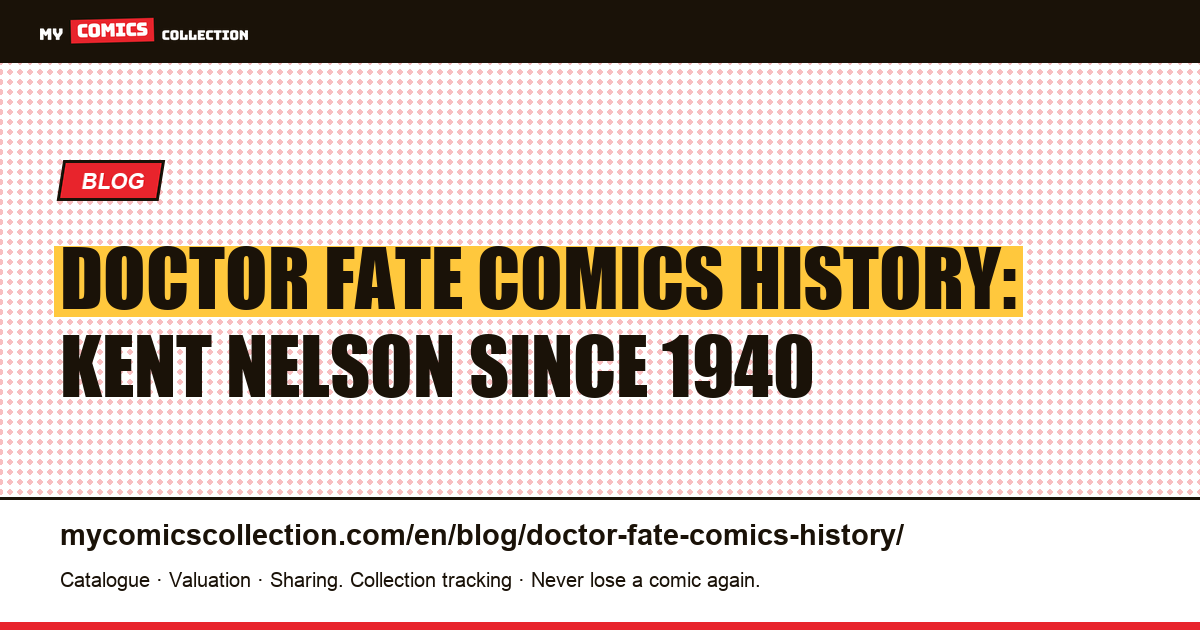
Doctor Fate debuted in More Fun Comics #55 (1940), created by Gardner Fox and Howard Sherman. Kent Nelson, a young man raised by the Lord of Order Nabu, wears the helmet and joins the Justice Society that same year. The character then passes through Eric and Linda Strauss in 1987, Jared Stevens in 1994, Hector Hall in the 2000s and Khalid Nassour in 2015, with the Levitz and Liew series as the clearest modern reset.
Few DC characters have changed hands as often as Doctor Fate. The helmet outlasts every wearer, and each decade gives it to someone new, which makes the history of this sorcerer a story about succession as much as about one man. Following that thread is the most reliable way to sort the books on a shelf.
The credits and cover dates in this guide were checked issue by issue, including the dates of the 1980s and 1990s series. The reading of what each change meant for the character, and every suggestion about assembling a run, is our own analysis.
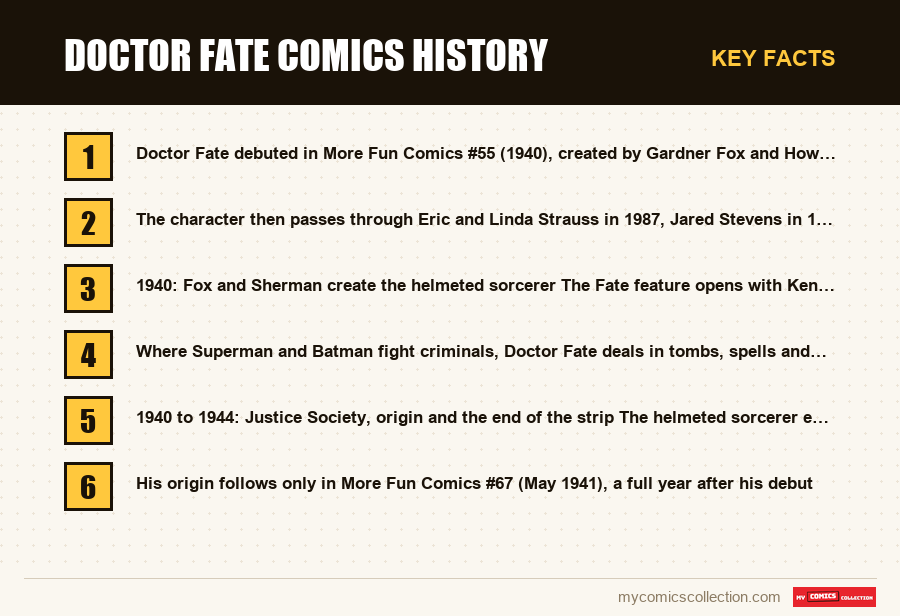
1940: Fox and Sherman create the helmeted sorcerer
The Fate feature opens with Kent Nelson in More Fun Comics #55, cover-dated May 1940. Writer Gardner Fox and artist Howard Sherman created the feature, and Sherman drew the monthly stories for roughly the first three years.
The premise is occult rather than scientific. Where Superman and Batman fight criminals, Doctor Fate deals in tombs, spells and the Lords of Order, a vocabulary that sets him apart from the other heroes of 1940. Fox gave the feature a tone closer to pulp fantasy than to street-level crime fiction. Our page on Gardner Fox lists his other DC credits.
1940 to 1944: Justice Society, origin and the end of the strip
The helmeted sorcerer enters the Justice Society of America with All Star Comics #3 in winter 1940, the same year as his debut. His origin follows only in More Fun Comics #67 (May 1941), a full year after his debut. In that telling Kent Nelson is the son of an archaeologist. The boy accidentally kills his father with poisonous gas, and the cosmic being Nabu takes pity on him, raises him and trains him to become Doctor Fate. Inza, his love interest, appears in the Golden Age under varying surnames: Cramer, Sanders and Carmer.
The run ends in the middle of the war. His last All-Star Comics appearance is #21 in summer 1944, and his own strip closes in More Fun Comics #98, dated July to August 1944. For a collector, that gives the Golden Age Fate a clean boundary: four years of stories, with the debut, the Justice Society entry and the origin as the three issues that define him.
1963 to 1985: the Silver and Bronze Age returns
After the Golden Age heroes vanish from newsstands, Doctor Fate comes back through team-ups. From 1963 the Justice League of America and the Justice Society meet in annual crossovers, and the 22nd and last of that run appears in 1984 in Justice League of America #231 and #232. Those stories keep Kent Nelson in print for two decades even though he has no series of his own. He also turns up in World's Finest Comics #201 and #208 in 1971, and the Justice Society's 1951 disbanding is covered in Adventure Comics #466.
The solo spotlight returns in December 1975 with 1st Issue Special #9, written by Martin Pasko and drawn by Walt Simonson. The Justice Society then comes back in All-Star Comics #58 to #74 (1976 to 1978), and the origin is retold in DC Special Series #10 in January 1978. In 1979 he appears in The Brave and the Bold #156 with Batman, and in July 1980 in DC Comics Presents #23 with Superman. The 1976 Justice Society revival concludes in Adventure Comics #461 and #462 (1978), and in 1981 Fate appears in DC's All-Star Squadron, with occasional appearances in Infinity, Inc. in 1984. In this stretch the character is kept familiar rather than changed, and the change comes only in 1987.
1982 to 1985: back-ups, a miniseries and the Crisis
From February to September 1982, Doctor Fate carries a back-up feature in The Flash #306 to #313, written by Martin Pasko, with help from Steve Gerber from #310, and drawn by Keith Giffen. In 1985, The Immortal Doctor Fate collects those stories and related material in a three-issue limited series, including an origin retelling by Paul Levitz, Joe Staton and Michael Nasser first published in 1978.
That same year the sorcerer is among the characters caught in Crisis on Infinite Earths, the Marv Wolfman and George Pérez event. Much of Kent Nelson's personal history remained largely unaffected by the event. That choice mattered: the character entered the new continuity with his Golden Age years still attached, which is why the 1940 and 1941 issues remain part of the standard story.
1987 and 1988: Kent dies, the Strausses take the helmet
The Doctor Fate limited series of July to October 1987 (#1 to #4) is the first big break. It introduces Eric and Linda Strauss, and Kent Nelson is killed off. In the ongoing series that begins in 1988, J.M. DeMatteis writes the first 24 issues and Shawn McManus draws them, following the Strausses.
The 1988 series then reverses itself. Kent and Inza were killed off midway and are resurrected from issue #25, in 1991. Issue #35, dated November 1991, introduces the Anti-Fate Group, and the series ends with #41 in June 1992. After Zero Hour, Kent and Inza are killed again. For a reader this means the 1987 and 1988 books are best read as one story, in order, with the resurrection as the hinge.
1994 to 1998: Jared Stevens and the Giffen return
Fate #1, dated November 1994, introduces Jared Stevens, with a cover by Anthony Williams and Andy Lanning. The series is canceled after 23 issues in September 1996. The title drops the "Doctor" from its name, which can trip up a catalog search.
From February 1997 to January 1998, The Book of Fate runs for 12 issues, written by Keith Giffen, the artist from the 1982 back-ups. With Giffen now in the writer's chair, the series appears under the Weirdoverse imprint and sits between the Stevens era and the Justice Society revival.
Do you collect this series?
Track what you own, what you are missing and what your collection is worth. 7-day trial.
Start my trial →
1999 to 2011: the JSA revival and Hector Hall
The JSA revival of 1999 reworks the character, and Jared Stevens is killed off. In 2003 Hector Hall appears in JSA and in a five-issue Doctor Fate limited series. Hall dies in Day of Vengeance in 2005, which leads into Infinite Crisis. In 2007, Countdown to Mystery (eight issues) was planned to introduce a new Fate. Its first issue, dated November 2007, has art by Justiniano and Walden Wong. Steve Gerber died during the project, Adam Beechen wrote issue #7 from Gerber's notes, and the final issue was written by Beechen, Gail Simone, Mark Waid and Mark Evanier.
From August 2009 to August 2011, Justice Society of America vol. 3 #30 to #54 features Fate. At some point in this long history, Kent and Inza are both revived into younger bodies. The Power Girl and Justice Society guide covers the same team from the angle of its other major member.
2013 to today: Khalid, a reset and a farewell
In February 2013, Earth 2 #9 introduces Khalid Ben-Hassin, created by James Robinson and Brett Booth, an alternate-world sorcerer. A different character, Khalid Nassour, leads the Doctor Fate series that runs from June 2015 to November 2016, 18 issues written by Paul Levitz and drawn by Sonny Liew. Kent Nelson returns as a mentor figure with some of his old history intact, and Nassour is the new lead. This is the clearest on-ramp the character has had since 1940.
In 2018, James Tynion IV's Justice League Dark introduces Khalid and Kent as advisors, and Khalid later becomes the sole Doctor Fate. Kent Nelson is later killed off in the storyline "A Costly Trick of Magic." Kent makes posthumous appearances in 2023 and 2024 in Green Lantern: Alan Scott and Jay Garrick: The Flash, which shows the first helmet-bearer is still a useful presence in the Justice Society's history.
What the succession tells a collector
Laid end to end, the timeline shows a pattern. A new wearer arrives roughly once a decade: Kent Nelson in 1940, the Strausses in 1987, Jared Stevens in 1994, Hector Hall in 2003, Khalid Nassour in 2015. Each hand-off comes with a new first issue, which is why the character's catalog entries carry so many #1 numbers across the 1987, 1988, 1994, 2003 and 2015 series. When you meet a listing that says only "Doctor Fate #1," the year decides which book it is.
The same pattern explains why the 1980s and 1990s volumes are easy to confuse with one another. The 1987 limited series, the 1988 ongoing series and the 1994 Fate series each restart the numbering, and the 2003 five-issue limited series and the 2015 series do so again. A short checklist of start years, kept next to your want list, prevents duplicate purchases more reliably than any title match.
The key issues across Doctor Fate's history
- More Fun Comics #55 (1940): debut of Kent Nelson as Doctor Fate, by Gardner Fox and Howard Sherman.
- All Star Comics #3 (winter 1940): Doctor Fate joins the Justice Society of America.
- More Fun Comics #67 (1941): the origin, with Kent's archaeologist father and Nabu.
- 1st Issue Special #9 (1975): solo story by Martin Pasko and Walt Simonson.
- Doctor Fate #1 (1987): the miniseries that introduces Eric and Linda Strauss.
- Doctor Fate vol. 2 #1 (1988): start of the DeMatteis and McManus series.
- Fate #1 (1994): debut of Jared Stevens.
- Earth 2 #9 (2013): Khalid Ben-Hassin, by James Robinson and Brett Booth.
How to follow Doctor Fate in a collection
Start by deciding which wearer you want. The Golden Age Kent Nelson lives in More Fun Comics and All Star Comics; the Strauss era lives in the 1987 miniseries and the 1988 series; the modern Khalid Nassour lives in the 2015 series. Treat each as its own shelf rather than a single run.
Watch the titles. The 1987 miniseries and the 1988 ongoing series share a name, so the catalog distinguishes them by volume, and Fate (1994) drops the prefix entirely. The 1982 back-ups sit inside The Flash, which makes them easy to miss unless you search by issue range. For a curated reading order, the best Doctor Fate comics guide ranks the modern entry points, and the Golden Age foundation is covered in our Golden Age collecting guide.
Frequently asked questions
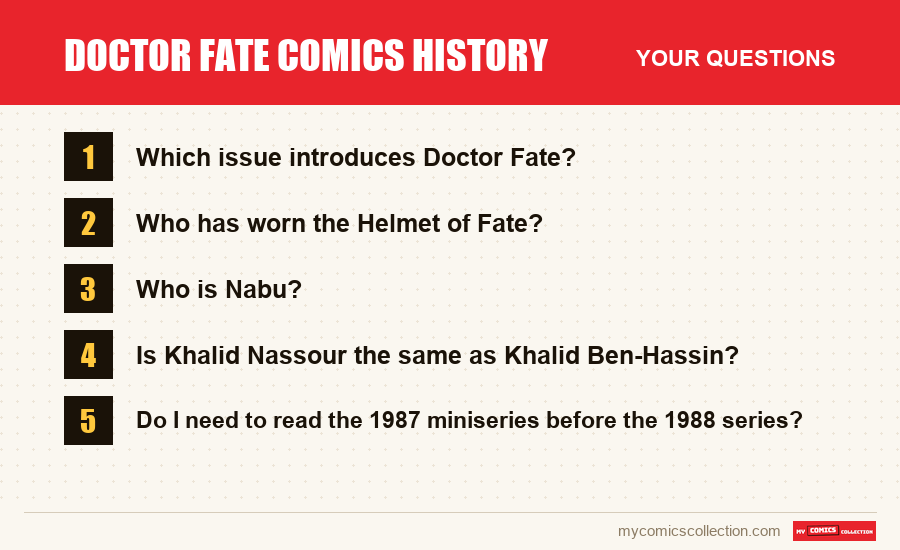
More Fun Comics #55 (May 1940) introduces Kent Nelson, with Gardner Fox writing and Howard Sherman drawing. A year later, More Fun Comics #67 (May 1941) tells his origin, while All Star Comics #3 (winter 1940) places him in the Justice Society.
Kent Nelson wears it from 1940. Eric and Linda Strauss follow in 1987, Jared Stevens in 1994 and Hector Hall in the 2000s. Khalid Nassour takes over in the 2015 series, and after Kent's death in "A Costly Trick of Magic," Khalid is the sole Doctor Fate in mainstream comics.
Nabu is the cosmic being at the center of the origin told in More Fun Comics #67 (May 1941). After young Kent Nelson accidentally kills his archaeologist father with poisonous gas, Nabu takes pity on him, raises him and trains him. The origin was retold in DC Special Series #10 (January 1978).
No. Khalid Ben-Hassin is an alternate-world version created by James Robinson and Brett Booth for Earth 2 #9 in February 2013. Khalid Nassour is the protagonist of the 2015 Doctor Fate series by Paul Levitz and Sonny Liew, which ran 18 issues until November 2016.
It is the logical order. The four-issue miniseries of July to October 1987 introduces Eric and Linda Strauss and kills Kent Nelson, and the 1988 ongoing series by J.M. DeMatteis and Shawn McManus picks up from that premise. Read together, they form one continuous story.
Found a More Fun Comics or Doctor Fate issue in your boxes? Get a clear read on what you hold.
Estimate my comic