A figure spawned by the mythology of this antagonist, a warrior from a future that he dominates, today commands more than ten times the price of the antagonist himself. The statement of August 29, 2026 gives, in asking prices observed on August 29, 2026, a raw median of $5.59 on the 132 propositions that a broad search brings back on the antagonist, facing $69.99 out of 77 raw announcements for the first appearance of the derived figure. The market does not remunerate the source of a universe, it remunerates the figure who emerged from it and who then carried his own series. The source remains an adversary scattered in the titles of others; the derivative becomes a protagonist with a unique entry point, a title to his name and an instantly recognizable silhouette. He inherits the stake without inheriting the dispersion.
We readily imagine that a fictional universe is valued from above: the entity which founded it, the one which gives meaning to the conflicts, should logically concentrate the value of the objects which depict it. The announcement statement of August 29, 2026 says the opposite, and frankly.
The following explains by what mechanism the value leaves the source to be deposited on a character that it has generated, what this movement reveals about the functioning of the booklet market, what it implies for those documenting a collection, and why the lower part of the offer on the derived figure is a purchasing trap that one must know how to read.
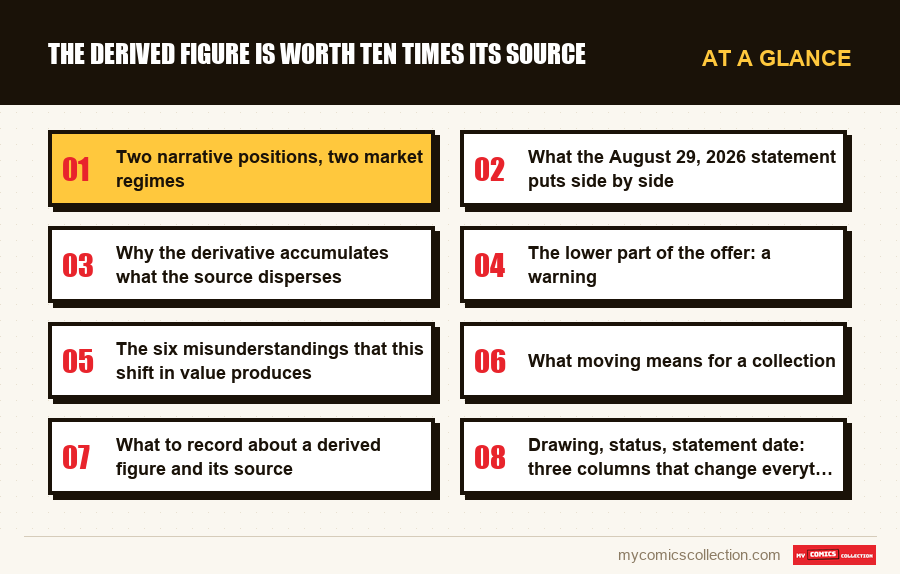
Two narrative positions, two market regimes
The source and the derivative do not occupy the same place in editorial production, and this difference in place is enough to explain most of the price difference. It is not a question of a hierarchy of popularity, nor of a judgment on the quality of the stories: it is a question of two different regimes of existence.
The source exists as an obstacle. She enters a title that belongs to someone else, takes the opponent position for one arc, then exits. His passage leaves a trace in a series which does not bear his name, and the booklet which contains this passage remains, on the market, an ordinary issue of that series. No one refers to it as “their” number, because it’s not.
The derivative exists as a protagonist. He has a first appearance that everyone names the same way, then a series in his name, then others. Each issue of this series belongs to him by construction. The whole forms an identifiable column, with a beginning, a numbering and a border: exactly the three properties that dispersion denies to the antagonist.
The derivative, however, retains all the importance of the source. He comes from the future that she created, he bears the stigmata of this world, and his entire existence is a response to this threat. The reader who buys it buys the mythology of the antagonist, but he buys it in a form that has an address.
This is the heart of the mechanism: the derivative inherits the stake without inheriting the dispersion. It captures the narrative charge accumulated by the source, and lodges it in an object that the market knows how to name, organize and rate. The source keeps the charge and loses the object.
We will add, without making it the focus of this text, that the booklet market generally values points of origin. But here the question is not to know if an origin is worth more than an episode: it is to note that one of the two characters has an origin identifiable as an object, and that the other does not have a comparable one within the series of the others.
What the August 29, 2026 statement puts side by side
Two searches launched on the same date, on the same advertisement base, keeping the verified copies separate from the others. What is cited below corresponds to asking prices observed on August 29, 2026, never sales concluded.
L'antagoniste, en brut
132 annonces, of 1,92 à 219,95 $demandés, médiane 5,59 $. An abundant supply, half of which is under six dollars.
L'antagoniste, en certifié
12 annonces seulement, de 56,00 à 289,00 $, médiane 91,97 $. The segment verified here is anecdotal in number.
The derived figure, in raw form
77 annonces, de 4,75 à 699,99 $, médiane 69,99 $. Fewer ads than on the source, for a center twelve times higher.
The derived figure, in certified
57 annonces, de 39,00 à 1 049,00 $, médiane 199,95 $. A verified segment almost as populated as crude.
The two searches partially overlap and allow objects to pass which have nothing to do with them: certain announcements satisfy both formulations, and the one which targets the antagonist as a whole necessarily yields disparate results. Despite this, the difference obtained remains an order of magnitude.
$5.59 vs. $69.99 raw median: The derived figure asks about twelve times the source median price. Certified, $91.97 versus $199.95: the gap narrows, which is logical, since certification selects objects already considered important from both populations.
We must immediately set the limit which applies to this article as a whole. A measurement taken on a single date provides information about what was offered that day, and nothing else. No conclusion about a price movement can be inferred from the above. These amounts record requests made on a given day, and their scope stops there.
The most instructive difference is not that of prices, it is that of proportions. The derived figure presents 57 verified propositions against 77 unverified ones. The antagonist, for his part, only has 12 verified when his raw segment aligns 132. The first set has mostly gone through a verification, the second almost not.
This proportion is here a reading tool, not a demonstration. It indicates that a seller incurs the cost of certification when the object is identified, standardized and exchangeable; he does not commit him to a mass of fascicles which are only valid as ordinary numbers of their series. In other words, the market has already decided which character constitutes an object and which constitutes content.
Why the derivative accumulates what the source disperses
There is nothing arbitrary about the value shift: it follows three properties that the derived figure has and that the antagonist does not have. Taken separately, none would be enough; together, they produce a market object.
Un point d'entrée unique. The question “where to start?” » has an answer for the derivative, and it's the same for everyone. This convergence is decisive: it concentrates the request on a single issue instead of diluting it across dozens of equivalent candidates. The source offers as many entry points as it has host titles, and none is essential.
A title in his name. Carrying a series means having a column in which each number belongs to the character. This creates a recurring readership, a numbering which organizes the collection, and above all a denominator: we can know what remains to be acquired. A scattered antagonist has no denominator, and a collection without a denominator never ends.
An immediately identifiable aesthetic. A warrior marked by the future he is fleeing recognizes himself in an image. This visual readability is a commercial property: it makes the object relatable in one line of an ad, recognizable on a thumbnail, and memorable by a buyer who has not read the series. An adversary who only appears intermittently does not accumulate this recognition capital at the same rate.
These three properties reinforce each other. The entry point concentrates demand; the title in his name creates a returning audience; the aesthetic makes the object circulationable. The source provides the narrative material for all of this (the future, the threat, the character's reason for being) but it remains in the position of the permanent guest.
The result can be seen in the numbers of August 29, 2026: a rarer and more expensive supply on one side, an abundant and flat supply on the other. It is not the physical scarcity of issues that produces this gap, it is the concentration of demand on a nameable object.
The lower part of the offer: a warning
In the derived figure, the raw median is at $69.99 on August 29, 2026, but the supply goes down to $4.75. This gap is not a godsend: it designates different content.
The four cheapest listings: $4.75, $7.00, $7.00 and $9.99: are explicitly second runs. They all bear the mention “first appearance”, and this mention is correct: a second printing contains the same story, therefore the first appearance of the character. There is no error or deception on the part of the sellers.
The trap is entirely on the reading side. A buyer who scans the results by retaining only two pieces of information, the price and the presence of the mention, concludes that he has just found for less than ten dollars what others are asking for seventy. He leaves with an object that has no relation to the observed median, and he will sometimes only realize this when trying to resell it.
The practical rule is contained in one sentence: on an identified booklet, the edition is as important information as the condition. Two copies can have the same cover, the same story and the same mention, and belong to two distinct markets. The first appearance statement describes content; it does not describe the object.
This is also what explains part of the amplitude observed on August 29, 2026, from $4.75 to $699.99 in gross. A population that mixes different print runs mechanically produces a wide range, and this width should not be read as a market structured in quality levels.
The same vigilance applies, in the opposite direction, to the antagonist. A general query brings up anything bearing its name, and there is no guarantee that the low $1.92 and the high $219.95 refer to comparable items. A fork is not a scale.
Collecting this series?
Track what you own, what you are missing and what your collection is worth. 7 day trial.
Start my trial →The six misunderstandings that this shift in value produces
They appear when searching, comparing or buying, and each arises directly from the difference in position between the source and the derivative.
Believing that the source is worth the most
Intuition says that the founding entity concentrates the value. The August 29, 2026 statement says the opposite, by a factor of twelve in raw median.
Confondre tirage et récit
The words “first appearance” are correct on a second print. The price is nothing comparable to that of the expected booklet.
Look for a « numéro un » at the source
The antagonist does not have an issue that belongs to him: his passages remain ordinary issues of the series that host him.
Read an amplitude like a scale
From $4.75 to $699.99 for the same query: the difference reflects the heterogeneity of the objects brought back, not the quality levels.
Believe the two watertight questions
They are porous and partially overlap. Neither defines a closed set of fascicles.
Take a reading for a trend
A day of observation describes an offer. It says nothing about an increase, a decrease or stability.
These six misunderstandings have one thing in common: they consist of reasoning on the character while the market reasons on the object. The correction is always the same: go down from the name to the issue, from the issue to the print run, and from the print run to the date of observation.
What moving means for a collection
A collector interested in this mythology finds himself faced with two projects of a different nature, and the confusion between the two is the source of most disappointments.
The “source” project is an apparitions project. It consists of following an opponent through titles that belong to others, without a fixed inventory, and without a single rule allowing you to decide what deserves to appear there. It is inexpensive per unit: the gross median observed is $5.59 on August 29, 2026, but it has no end, and its progress cannot be measured.
The “derivative” project is a series project. It consists of bringing together a bounded column, with a dear entry point, a numbering, and a border. It is expensive at the start and much more modest afterwards, since the charge is concentrated almost entirely on the original booklet.
The two projects do not require the same trade-offs. The first requires a written rule of inclusion, otherwise the collection drifts unnoticed. The second requires vigilance on the object itself: edition, condition, and consistency between what the ad states and what the copy is.
Many collections mix the two without saying it, and end up with an inventory where a three-figure item is close to dozens of issues worth a few dollars, without any information reminding us why these lines do not have the same status. It is this lack of status, much more than the amount, which makes an inventory unusable after two years.
What to record about a derived figure and its source
The useful sheet is not the same depending on the position of the character in the production. Five pieces of information make the whole thing rereadable.
The printing of the copy, even before its condition. This is the information that separates an item at a median of $69.99 from an item at $4.75 with the same designation and the same story. An inventory that notes the condition without noting the mintage makes two lines that do not belong to the same market indistinguishable, and the error is only revealed at the time of resale.
The position of the character in the booklet. For the derivative, the mention is rarely enough: first appearance, appearance on the cover, central role or marginal presence are not valued in the same way. For the source, specifying the real weight of its intervention (driving force of the plot, secondary figure, appearance for the duration of a panel) is the only way to reread its own scope later without reopening the booklets.
The host title, and whether or not it has the character's name on it. This distinction summarizes the entire article in one column. It separates the lines which belong to one of the character's series from those which belong to someone else's series, and it alone explains why two booklets depicting the same mythology do not have the same commercial status.
Certification, and the absence of certification as information in its own right. On August 29, 2026, 57 verified announcements out of 77 raw on the derivative side, compared to 12 out of 132 on the source side. Noting whether an item is verified, and leaving it explicitly blank when it is not, avoids later comparing lines that do not fall into the same offering segment.
The asking price accompanied by its statement date. An amount without a date means nothing, and it becomes even less so on an object whose offer mixes several prints. Recording the amount claimed along with the day you saw it, the method followed here, preserves the only thing that resists time: what was on offer when you looked, without claiming a trajectory.
Because the market pays for an object, not a mythology. The derivative has a single entry point, a title with its name and a recognizable silhouette: the request focuses on an identified issue. The antagonist appears in the series of others, and his passages remain valued as ordinary numbers in these series. On August 29, 2026, the gross median was $69.99 on one side and $5.59 on the other, in asking prices.
On August 29, 2026, the four cheapest listings: $4.75, $7.00, $7.00, and $9.99-were explicitly second runs. They all bore the mention “first appearance”, and this mention is correct, since the second printing contains the same story. The item, on the other hand, is nothing like the one that carries the median of $69.99. You must therefore read the print before the price.
On August 29, 2026, there were 57 certified announcements for 77 raw announcements on the derived figure, compared to 12 for 132 on the antagonist. A seller incurs the cost of verification when the object is identified and standardized, not on a mass of ordinary booklets. It is a useful indicator to distinguish the two regimes, provided you do not interpret it beyond what it shows.
No. The count was done on a single date, August 29, 2026, and relates to what sellers demanded, not to what changed hands. A measurement of this type does not support any assertion of rise, fall or hold, and it says nothing about the months to come.
No, they are porous and do not isolate watertight sets: some of the announcements can respond to both, and the general questioning of the antagonist brings back heterogeneous objects by nature. This is why the gap must be read as an order of magnitude between two market regimes, and not as an exact comparison between two closed lists of issues.
Drawing, status, statement date: three columns that change everything
An inventory which distinguishes the original issue from the second printing, and the series of the character from the home series, remains readable years later.