
In short
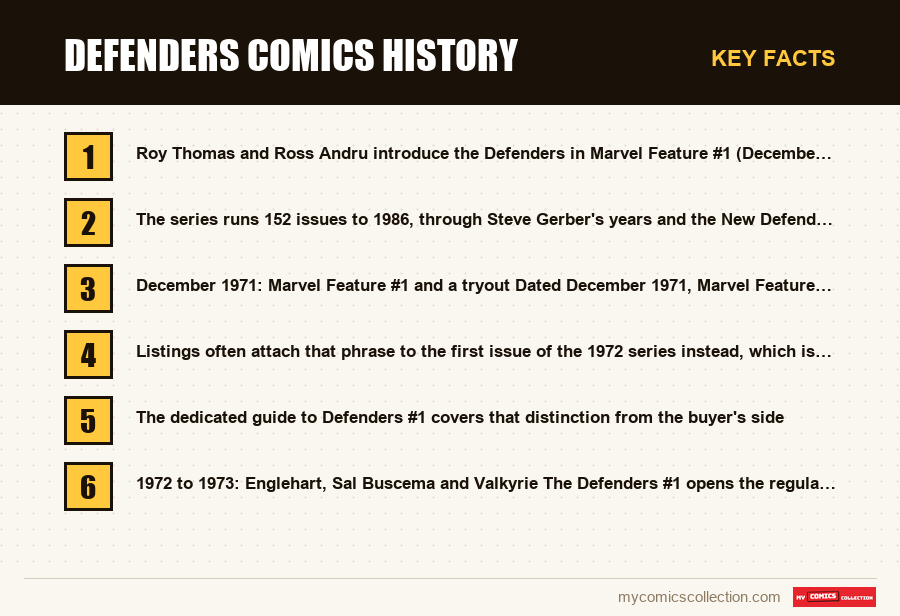
Roy Thomas and Ross Andru introduce the Defenders in Marvel Feature #1 (December 1971), and Steve Englehart and Sal Buscema open The Defenders #1 in 1972. Doctor Strange, the Hulk and Namor form a team that refuses to be one. The series runs 152 issues to 1986, through Steve Gerber's years and the New Defenders era, then returns in revivals from 1993 to 2021.
Marvel has published the Defenders for more than fifty years without ever settling what the team is. It has no charter, no headquarters and, for long stretches, no agreement among its members that they belong together. That refusal is the premise, and it is why the history is a series of experiments instead of one continuous story.
Every writer, artist and issue number in this history was confirmed against published credit lists, and a month appears only where a cover date was seen. What each era does to the team is our reading, not a statement from the books.
December 1971: Marvel Feature #1 and a tryout
Dated December 1971, Marvel Feature #1 comes from Roy Thomas and Ross Andru. Yandroth is the foe that brings Doctor Strange, the Hulk and Namor together. The book is a tryout slot, used to test concepts before Marvel commits to a regular series.
The founding logic is a collision of three characters who each carry their own legend. A sorcerer, a rampaging scientist and an undersea monarch have no reason to share a room, and that is the point. The concept is a team assembled by circumstance, which sets the tone for every later version.
On the shelf, this issue stands for the concept in its infancy. Listings often attach that phrase to the first issue of the 1972 series instead, which is why this page keeps the two apart. The dedicated guide to Defenders #1 covers that distinction from the buyer's side.
1972 to 1973: Englehart, Sal Buscema and Valkyrie
The Defenders #1 opens the regular series in 1972, with Steve Englehart writing and Sal Buscema penciling, and Roy Thomas becomes editor. The series runs to issue 152, in 1986, so the first issue is the start of a long count. Issue #4, dated February 1973, adds Valkyrie, who becomes one of the team's anchors.
The early run is where the non-team identity is written down. The members come together because a threat requires them, then drift apart, and the stories move between the mystical and the cosmic. Our reading is that Englehart's gift here is to treat the lack of structure as a feature: the team can be any three or four powerful loners that the plot needs.
The Silver Surfer counts among the founders, and the roster rotates heavily afterward. Valkyrie, Nighthawk, Hellcat, Gargoyle, Beast, Son of Satan and Luke Cage all become recurring names. The long list is part of why the Defenders resist a simple entry point.
October to December 1973: the Avengers-Defenders War
The first big crossover comes in autumn 1973. The "Avengers-Defenders War" runs from October to December 1973 and covers The Avengers #116 to #118 and The Defenders #9 to #11, with Englehart writing both titles. It is the story that sets the two teams against each other, and afterward Englehart leaves the Defenders, not wanting to write two team books at the same time.
The crossover is the first time the series is defined by contrast with a more orderly neighbor. The Avengers have a charter, a headquarters and a roster list; the Defenders have none of that, and the clash makes the difference explicit. Len Wein then writes the series briefly, introducing Alpha the Ultimate Mutant and the Wrecking Crew, and Nighthawk enters during this period.
For collectors this is the moment the Defenders become part of the wider Marvel timeline instead of a private experiment. Issues #9 to #11 are best read together with the three Avengers issues, because the story only makes sense across both titles.
1975 to 1976: Steve Gerber's run
Steve Gerber first writes the team in Giant-Size Defenders #3 (January 1975), and he then writes the monthly series until issue #41, dated November 1976. The run is the best-remembered stretch of the series, and it works by reviving forgotten Marvel characters, among them the Headmen and the Guardians of the Galaxy.
The team also meets Howard the Duck in Marvel Treasury Edition #12, from 1976. That crossover is a useful marker for the tone of the period: the Defenders are comfortable enough with absurdity that a talking duck from another book can wander through. Our reading is that Gerber discovers the team's real subject, which is the strangeness at the edge of the Marvel Universe.
After Gerber, Gerry Conway has a brief run that ends abruptly in mid-production at #45, an issue drawn by Keith Giffen after a story conference but with no written plot. The abrupt end shows how closely the title's identity was tied to its writer in those years.
1976 to 1979: Kraft, Slifer and Hannigan
David Anthony Kraft takes over, first with Roger Slifer and then with Ed Hannigan. The period covers the "Scorpio Saga" in #46 and #48 to #50, "Xenogenesis" in #58 to #60, and "Defenders for a Day" in #62 to #64. Valkyrie's backstory is told in #66 to #68, dated December 1978 to February 1979, and Hannigan becomes the sole writer with #68.
This is a transitional stretch, and it is less visible than the Englehart and Gerber years. Its value for a collector lies in the Valkyrie issues, which give a founding member the origin that the team had not yet supplied. The title is steady rather than spectacular here, and the issues are often easier to find than the ones on either side.
1979 to 1983: Steven Grant, DeMatteis and Gruenwald
Steven Grant writes #76 and #77 in late 1979 and concludes Gerber's Omega the Unknown storyline, killing most of the original characters. J. M. DeMatteis becomes the writer from #92, and he co-writes #107 to #109, dated May to July 1982, with Mark Gruenwald, resolving the Valkyrie plot threads.
The Omega issues are an unusual case of a team book closing out another series' story. They show how deep Gerber's influence ran even after he left the title. The DeMatteis and Gruenwald issues, in turn, close the long Valkyrie thread that Kraft had opened.
1983 to 1986: The New Defenders
With issue #125, dated November 1983, the title becomes The New Defenders. The original four members leave, and Beast reforms the team. DeMatteis writes six issues before leaving, and Peter B. Gillis, working with Don Perlin, takes over.
The series ends with #152, dated February 1986, when the title is cancelled to make room in Marvel's schedule for the New Universe line, and the mutant members leave to join X-Factor.
This period changes the nature of the team more than any other. For eleven years the Defenders were three powerful outsiders and their friends; for the last three years they were a different group under Beast. The title says Defenders, but the cast reads like a different book.
Do you collect this series?
Track what you own, what you are missing and what your collection is worth. 7-day trial.
Start my trial →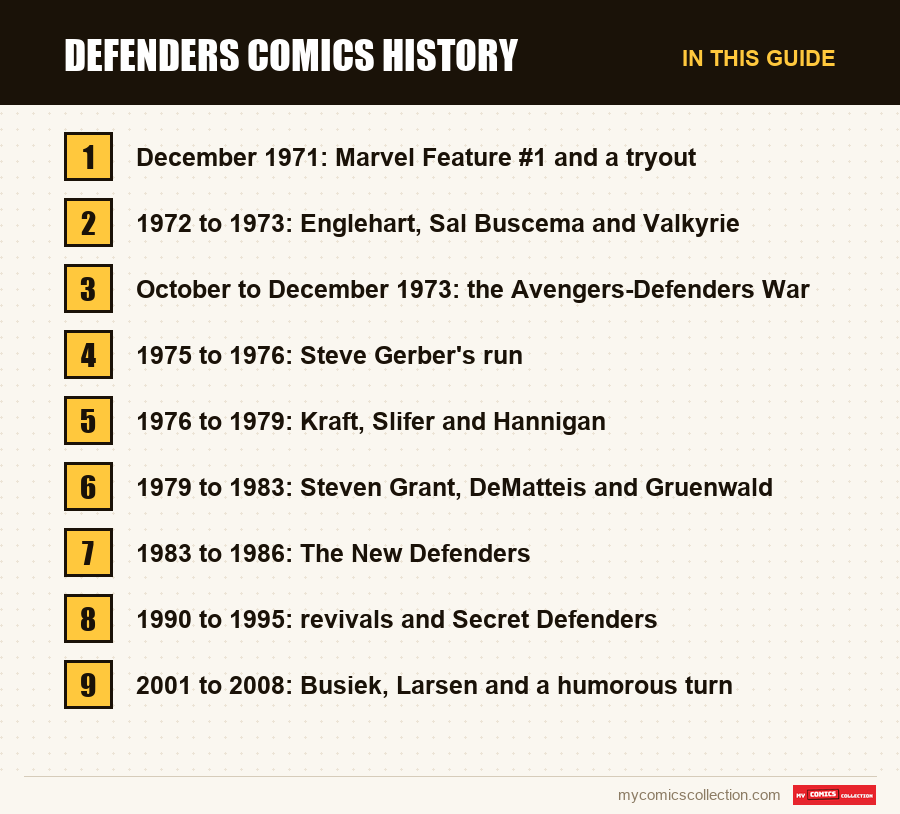
1990 to 1995: revivals and Secret Defenders
The original trio reunites in 1990 in The Incredible Hulk #370 and #371. Secret Defenders follows from 1993 to 1995, launched by Roy Thomas and Andre Coates with #1. Doctor Strange organizes rotating teams until he leaves the book, Doctor Druid takes over, and the series ends at #25.
The rotating-team idea is the natural extreme of the non-team concept. Instead of a stable core with changing guests, every storyline has a different group assembled for the job. Our reading is that this is where the premise runs out of room, because without a core the series has no identity beyond the title.
2001 to 2008: Busiek, Larsen and a humorous turn
A second volume, Defenders #1 to #12 from 2001 to 2002, reunites the team under Kurt Busiek and Erik Larsen. It is followed by The Order #1 to #6. In July 2005, Keith Giffen, J. M. DeMatteis and Kevin Maguire write a five-issue miniseries aimed at humor, and in 2008 Joe Casey writes The Last Defenders with a new roster after Civil War.
The three projects take three tones: a classic reunion, a comedy, and a post-Civil War reset. The existence of a comic version is the best illustration of how loosely the title holds. Where the 1970s run was about strangeness, the 2005 miniseries was about the awkwardness of three powerful people sharing a room.
2011 to 2013: Fear Itself and Fraction
Fear Itself: The Deep, starting in August 2011, has Cullen Bunn and Lee Garbett reforming a Defenders team led by Doctor Strange to fight Attuma. A Defenders series by Matt Fraction and Terry Dodson follows from December 2011, with twelve issues before cancellation at #12. Fearless Defenders launches in February 2013 from Cullen Bunn and Will Sliney, focused on the Valkyrior, with little connection to the team beyond the name.
The Fraction series is the sharpest example of a short, ambitious relaunch, and it stopped at #12. The Bunn title shows the other danger for buyers: a name that looks like the team, but a cast that has little to do with the original lineup.
2017 to 2026: the Netflix name and Al Ewing
In August 2017, a Defenders series based on the Netflix team begins, with David Marquez drawing the first issue. In December 2018, "The Best Defense" crossover includes a Defenders issue drawn by Joe Bennett. In August 2021, Al Ewing and Javier Rodriguez launch a new Defenders. A miniseries, Queen in Black: Defenders of Light and Dark, by Tom Waltz and Zé Carlos, was announced in March 2026.
The 2017 title reuses the name for different heroes, a point our page on the Netflix series versus the comics covers in detail. It is the second naming trap in the history, after Fearless Defenders. The Ewing relaunch, by contrast, returns to a cast built from the classic idea.
The key issues across the team's history
- Marvel Feature #1 (1971): the team's first appearance, by Roy Thomas and Ross Andru, against Yandroth.
- The Defenders #1 (1972): the series opens with Steve Englehart and Sal Buscema.
- The Defenders #4 (1973): Valkyrie joins the team.
- The Defenders #9 to #11 (1973): the Avengers-Defenders War, with The Avengers #116 to #118.
- Giant-Size Defenders #3 (1975): Steve Gerber's first work on the team.
- Marvel Treasury Edition #12 (1976): the Defenders meet Howard the Duck.
- The New Defenders #125 (1983): the original four leave and Beast reforms the team.
- The Defenders #152 (1986): the final issue of the original series.
For ranking the stories instead of the milestones, our guide to the best Defenders runs approaches the same books from the reader's side.
How to follow the Defenders in a collection
Start with the original series, issues #1 to #152, and treat Marvel Feature #1 as the separate debut copy. Within the series, pick a writer: Englehart for the foundation, Gerber for the strangest stretch, DeMatteis for the long Valkyrie thread, Gillis for the New Defenders years. Each is a self-contained reading, and a collector can stop at any of them.
Three traps recur. First, the title changes at #125 to The New Defenders, so a complete set contains two very different books under one numbering. Second, several later series reuse the name for unrelated heroes, and Fearless Defenders and the 2017 title are the clearest cases. Third, the revivals restart at #1, so a listing that reads only Defenders #1 can describe a book from 1972, 2001, 2011 or 2021.
The one-shot crossovers deserve a note of their own. Giant-Size Defenders #3 and Marvel Treasury Edition #12 are filed under other series, and so are the Avengers issues of the 1973 war, which means a search for the Defenders alone will miss them. A written list of owned numbers, including the crossover issues filed under other titles, keeps gaps visible.
The members' own histories are also worth reading for context. Namor and the Silver Surfer each have a long career outside the team, and our Namor history traces one of them from its beginning.
Frequently asked questions
Marvel Feature #1 (December 1971) carries the first appearance, from creators Roy Thomas and Ross Andru, with Doctor Strange, the Hulk and Namor against Yandroth. Steve Englehart and Sal Buscema then open the monthly The Defenders in 1972.
The founding group is Doctor Strange, the Hulk, Namor and the Silver Surfer. Valkyrie joins in issue #4, dated February 1973, and later recurring members include Nighthawk, Hellcat, Gargoyle, Beast, Son of Satan and Luke Cage. The roster rotates heavily across the original 152 issues.
No charter and no headquarters bind these heroes, who assemble when a crisis forces them to. The concept was set at the start, with three powerful loners in Marvel Feature #1, and it contrasts with the Avengers, a contrast that the 1973 Avengers-Defenders War makes explicit.
The original series ends with issue #152, dated February 1986. From #125 in November 1983 it was titled The New Defenders, with Beast reforming the team. The title was cancelled to make room for Marvel's New Universe line, and its mutant members left the team to join X-Factor.
Not closely. A Defenders series based on the Netflix team began in August 2017, reusing the name for heroes with no connection to the classic lineup. The original team is Doctor Strange, the Hulk and Namor, first seen in Marvel Feature #1 in 1971.
If a Defenders issue from any of these eras is in your collection, you can get a free estimate in a few clicks.
Estimate my comic