The Deathstroke comics history starts with Slade Wilson, who appears at the end of The New Teen Titans #2 (cover-dated December 1980), created by Marv Wolfman and George Pérez at DC. An elite mercenary, he was first an enemy of the Titans, then the star of his own books: Deathstroke the Terminator (1991), three Deathstroke series (2011, 2014 and 2016) and Deathstroke Inc. (2021). What defines him today is a professional who wins through preparation, and whose family matters as much as his contracts.
Most heroes' adversaries live in the shadow of the one they fight. Slade Wilson did the opposite: introduced in the last pages of a single issue, he went on to carry five ongoing series and to cross DC's biggest sagas without ever becoming a hero. This page tells his publishing life era by era, from 1980 to 2021, and leaves the reading list aside: a separate guide exists for that.
As always in this guide, only verified information (creators, issues, dates) is stated as fact; the analysis is our own, with no reproduction of protected pages or dialogue.
His first appearance
In 1980, DC was looking to relaunch a team of young heroes that had lost its audience. Wolfman and Pérez built a team of seven, with Dick Grayson as Robin and three brand-new creations, Raven, Starfire and Cyborg. The first issue sets up the team. In the very next one, The New Teen Titans #2 (December 1980), a contract targeting the team comes in: it comes from H.I.V.E.
The first hitman is Grant Wilson, who goes by Ravager. His failure costs him his life, and it is his father who then bursts in during the last pages to finish the job. That father is Slade Wilson, introduced as Deathstroke the Terminator. He only occupies the end of the issue: nothing, reading it in 1980, points to a future pillar of the DC universe. The issue is therefore a quiet point of origin, and the guide devoted to this #2 details what the copy contains and how to read a listing.
Keep in mind that Deathstroke is not in issue #1 of the series. Keep in mind, too, that Wolfman and Pérez conceived him as an answer to the team's youth: facing seven teenagers and young adults still in training, he is a trained adult who owes nothing to superpowers and everything to a career.
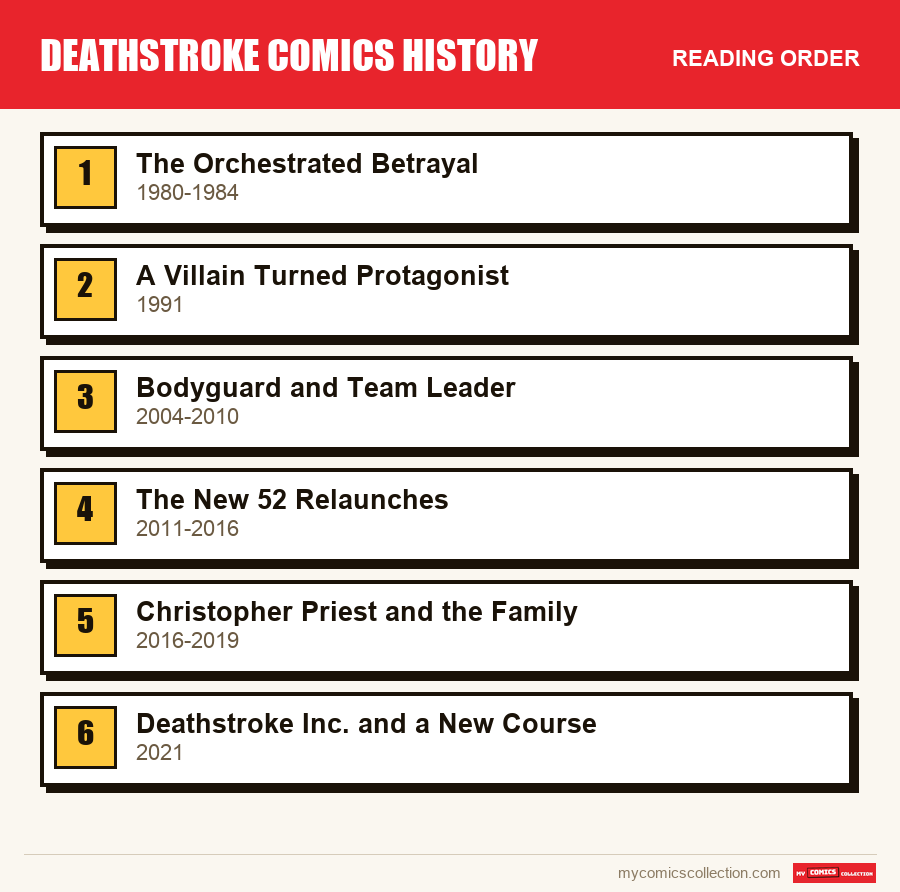
Era 1: The Orchestrated Betrayal (1980-1984)
For several years, Slade Wilson remains one recurring antagonist among others in The New Teen Titans. Four single issues carry the 1984 betrayal known as The Judas Contract: three from Tales of the Teen Titans and one Annual. Note the series name: starting with #41, The New Teen Titans is retitled Tales of the Teen Titans, and that title runs until 1988. Marv Wolfman and George Pérez still sign the whole thing.
Warning, spoiler: Terra, the team's young recruit, betrays her friends on Slade's behalf. What makes this choice interesting is the method. The mercenary doesn't look for a direct fight: he prepares, infiltrates and exploits the human weak points of a team that opened its door to a new ally. Jericho, another of Slade's sons, also enters the story, which widens the Wilson circle beyond Grant.
Slade's setup also leaves a mark on his main adversary: it is in #44, in the middle of this trap, that Dick Grayson wears the Nightwing costume for the first time. The story won the Comics Buyer's Guide fan award for best story of the year in 1984, and it was collected in a trade paperback as early as 1988. To follow the other thread of the story, that of the Robin who grew up, see our Nightwing history. It explains what the 1984 costume changed for him, while here we follow what this betrayal changed for Slade.
What changes for Deathstroke: he stops being a hired gun for an organization and becomes the architect of the series' most famous coup. The rest of his publishing career grows out of this image of a strategist who spends a long time preparing his operations.
Era 2: A Villain Turned Protagonist (1991)
After 1984, DC keeps Slade Wilson in circulation. In the Titans Hunt arc of The New Titans, he even helps the team he hunted for so long, when several of its members disappear. Warning, spoiler: behind the abductions is Jericho, possessed, and Slade has to kill his own son to save the other Titans. The episode shows a character who bends to a logic of alliance when it serves his interests, at a price few heroes' adversaries have paid.
In 1991 the series bearing his name arrives. Deathstroke the Terminator #1 is dated August 1991: Marv Wolfman writes, Steve Erwin draws, and the cover is by Mike Zeck. The character's creator picks him up eleven years after imagining him and turns him from adversary into protagonist, without making him a hero. The reader follows the contracts, the logistics and the family conflicts of a professional who apologizes for nothing.
The series title changes along the way: it becomes Deathstroke the Hunted for #0 and for #41 to 45, then simply Deathstroke from #46 to #60, where the series ends. Sixty regular issues, four Annuals and a #0 make up the whole run.
What changes for Deathstroke: he gets a biography of his own, separate from the Titans'. Contracts, professional honor, family: the three poles of his modern characterization are set in this decade, before other writers reinterpret them.
Era 3: Bodyguard and Team Leader (2004-2010)
In the early 2000s, Slade Wilson becomes a go-to figure DC calls on to give weight to its big events. In Identity Crisis, by Brad Meltzer, Rags Morales and Michael Bair (2004), Doctor Light hires him for protection. When the heroes find Light, a fight follows, with Deathstroke playing the bodyguard. The character is secondary there: it is an appearance to file as such, rather than as a step in his biography.
The 2008 Titans series gives him a more active role. In Titans: Villains for Hire Special #1, dated May 2010, Eric Wallace writes and Fabrizio Fiorentino draws: Slade leads his own team of mercenaries, who ambush Ryan Choi, the Atom, at his home. The story continues in Titans #24, and a 2011 collection gathers the special and issues #24 to 27.
What changes for Deathstroke: from a lone man preparing a job, he becomes a business owner who recruits, hands out missions and picks targets. It is a facet later eras reuse, sometimes to contradict it.
Era 4: The New 52 Relaunches (2011-2016)
The 2011 overhaul of the DC universe gives Slade a new series. Issue #1 of the second Deathstroke series carries a November 2011 date; Kyle Higgins writes it and Joe Bennett draws it. This version rewrites the character's origin and shows him as more brutal. The Legacy collection gathers the first eight issues and dates from August 2012.
This era holds a particular place: it is less celebrated than the others, because it mostly serves as a point of comparison. It suits a reader who wants to measure the gap with Wolfman's version, and the first eight issues read as a single block.
A third Deathstroke series follows in 2014 and runs twenty issues, collected in four volumes, from Gods of War to Family Business.
What changes for Deathstroke: his biography is reset.
Do you collect this series?
Track what you own, what you are missing and what your collection is worth. 7-day trial.
Start my trial →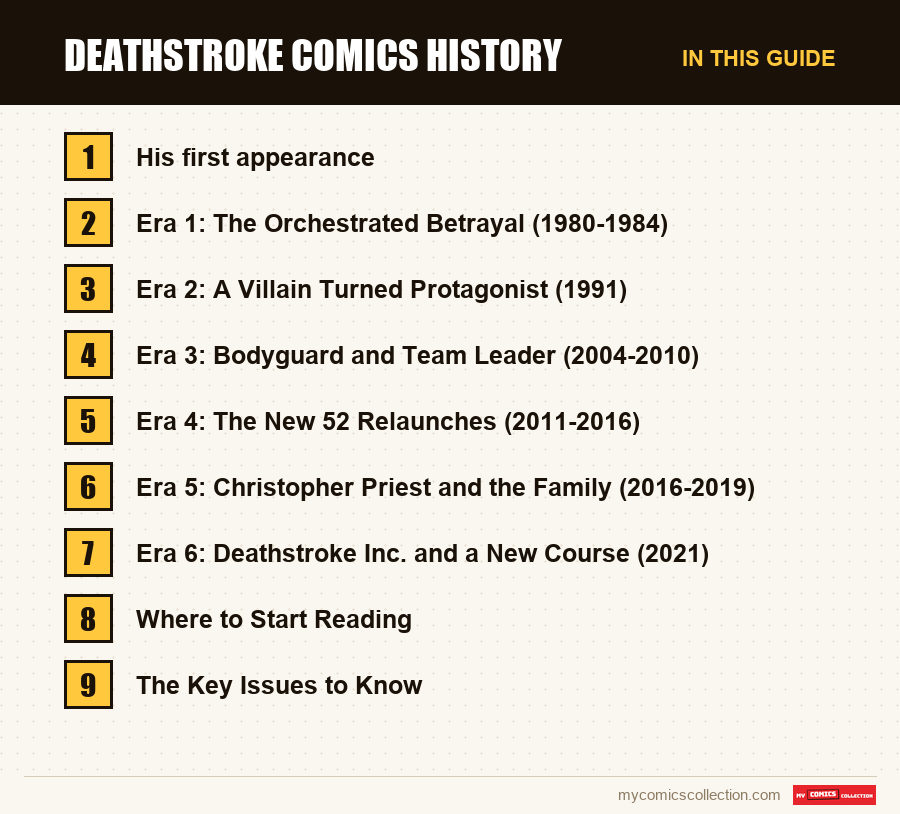
Era 5: Christopher Priest and the Family (2016-2019)
The 2016 Rebirth launch hands the series to Christopher Priest. A Deathstroke: Rebirth issue, dated October 2016, precedes the ongoing series, which runs fifty issues, all written by Priest, from 2016 to 2019. Several artists take turns depending on the arc. The writer cares less about Slade's feats than about his family and the way a tradesman's decisions fall back on his children.
The run is organized in arcs. The Professional covers #1 to 5 and opens the series; The Gospel of Slade follows, then Twilight (#12 to 18) extends the family theme. The Lazarus Contract is a crossover with the two Titans series: Slade appears in #19 and 20 of his own book, and the collection of the same name also includes Titans #11, Teen Titans #8 and a special. Against Batman, Slade fills issues 30 to 35, later collected in a volume titled Batman vs. Deathstroke.
The story jumps back and forth in time constantly: it is best approached volume by volume. For the adversary of #30 to 35, see our Batman history.
What changes for Deathstroke: his missions matter less than what they leave behind. The question is no longer what he accomplishes, but what he destroys around him, especially among his descendants. The series ends at #50, with the R.I.P. arc.
Era 6: Deathstroke Inc. and a New Course (2021)
Deathstroke Inc. puts Slade back at center stage in 2021. Joshua Williamson writes it, Howard Porter draws it. Worn down by losses, Slade changes direction: he joins T.R.U.S.T., a discreet organization whose mission is to take down DC's major criminals. He ends up partnered with Black Canary.
The novelty is to put him on the side of a cause, at least on the surface. Slade keeps his professional reflexes, but he puts them in the service of an unusual employer. The series ties Slade to the whole DC universe, with many guest stars, and it reads from #1.
What changes for Deathstroke: he is no longer an isolated man facing his contracts, but the agent of a structure, which sets this series apart from the 1991 one.
Where to Start Reading
- The Judas Contract (1984), in a trade paperback: for the reader who wants to understand why the character matters. The stakes are clear without having read the three previous years, even if the characters gain depth with that background.
- Deathstroke the Terminator (1991), first issues: for the 1990s series fan, ready to accept a serial pace and period artwork. The first issues by Wolfman and Steve Erwin form a coherent block.
- Christopher Priest's Deathstroke (2016), starting with The Professional: for anyone who wants a modern solo series centered on family and consequences.
- Titans: Villains for Hire (2010): for those who prefer to see a criminal run the action. Read the special, then the collection.
- Deathstroke Inc. (2021), from #1: to follow the character's current story without knowing the previous decades.
The ranking of the best Deathstroke comics details each of these entries; here, the order follows the character's life and not the reading value.
The Key Issues to Know
To build a small, coherent set, keep the following markers in mind. They are sorted by role in the character's history rather than by rarity, and the buying method is the same for all of them: compare several listings of the same copy, note the stated condition, then check against completed sales, not just asking prices.
- The New Teen Titans #2 (December 1980): first appearance of Deathstroke and of Grant Wilson, the Ravager. This is the foundational issue.
- Tales of the Teen Titans #42, 43, 44 and Annual #3 (1984): Terra betrays the team for Slade; Nightwing is born in #44.
- Deathstroke the Terminator #1 (August 1991): the launch of his first series, with a cover by Mike Zeck.
- Identity Crisis (2004): a secondary appearance, to pick up to complete a shelf devoted to the event rather than the character.
- Deathstroke #1 (November 2011): the start of the second series.
- Deathstroke: Rebirth #1 (October 2016): the entry point to Christopher Priest's run.
- Deathstroke Inc. #1 (2021): the starting point of the most recent series.
For the first one on the list, the difficulty comes from the team's launch, which happened in two steps: the lineup first appears in a preview insert before getting its own #1. Read a listing's description in full and check that the issue being sold is really the series' #2. For the others, a collected edition is enough to read the story; the period copy serves the collection.
Frequently Asked Questions
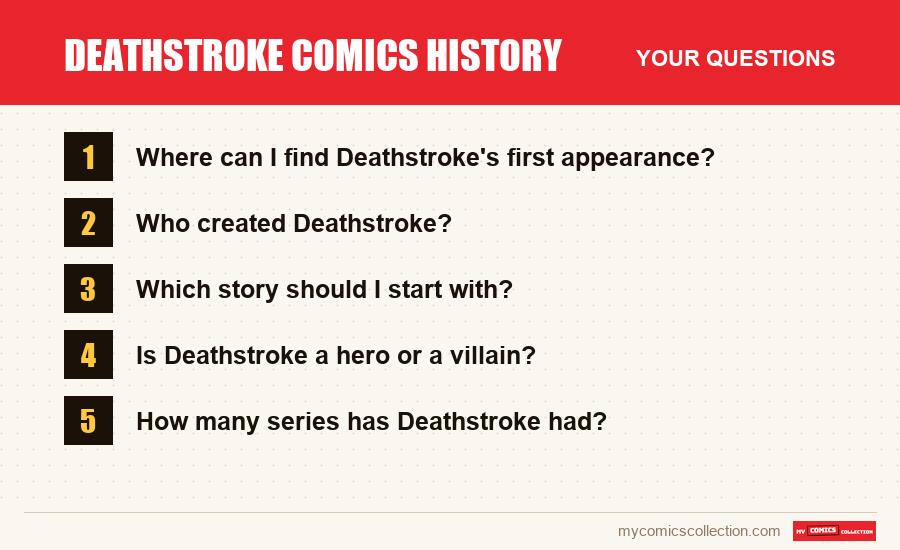
In The New Teen Titans #2, from December 1980. Marv Wolfman writes, George Pérez draws, and Slade Wilson only occupies the end of the issue. He is not in issue #1 of the series: #2 is the one to look for, along with the first appearance of his son Grant, the Ravager.
Marv Wolfman conceived him with George Pérez: the same creative team that had just put together the new Titans. Wolfman is also the writer of the first issue of Deathstroke the Terminator in 1991, drawn by Steve Erwin: the creator thus wrote the first series devoted to his own character.
With The Judas Contract, in a trade paperback: the 1984 story shows his method, with Terra's betrayal, and it remains readable with no prior knowledge. If you prefer a modern solo series, open Christopher Priest's Deathstroke starting with The Professional, which reads in volume order.
He was conceived as an adversary of the Titans, and his series show him as a protagonist without excusing him. In 2021, Deathstroke Inc. places him in the service of T.R.U.S.T., an organization tasked with neutralizing major criminals. He remains a professional: he works for a cause, at least officially, and the tone doesn't turn heroic.
Five ongoing series carry his name: Deathstroke the Terminator in 1991, with sixty regular issues, then Deathstroke in 2011, a second relaunch in 2014, another in 2016 under Christopher Priest's pen with fifty issues, and Deathstroke Inc. in 2021, by Joshua Williamson. He also led a team in a Titans special in 2010.
A New Teen Titans #2 or a Tales of the Teen Titans #44 in your boxes: have its condition estimated before deciding where it fits in your set.
Estimate my comic