
Death or Glory is Rick Remender's fastest track, and the easiest to approach. A young woman raised in the culture of outlaw truck drivers must raise an impossible amount of money in a few days, and only has what she knows how to do: drive. Drawing by Bengal, whose chase sequences achieve a readability that comics rarely achieve in this register. No parallel dimension, no magic, no future:it is his only story entirely anchored in reality.
In a bibliography dominated by science fiction and fantasy, this title stands out. It's also the easiest to recommend to someone who doesn't read genre comics.
This article explains what it says, why its design is worth looking at, and what you need to know before buying it.
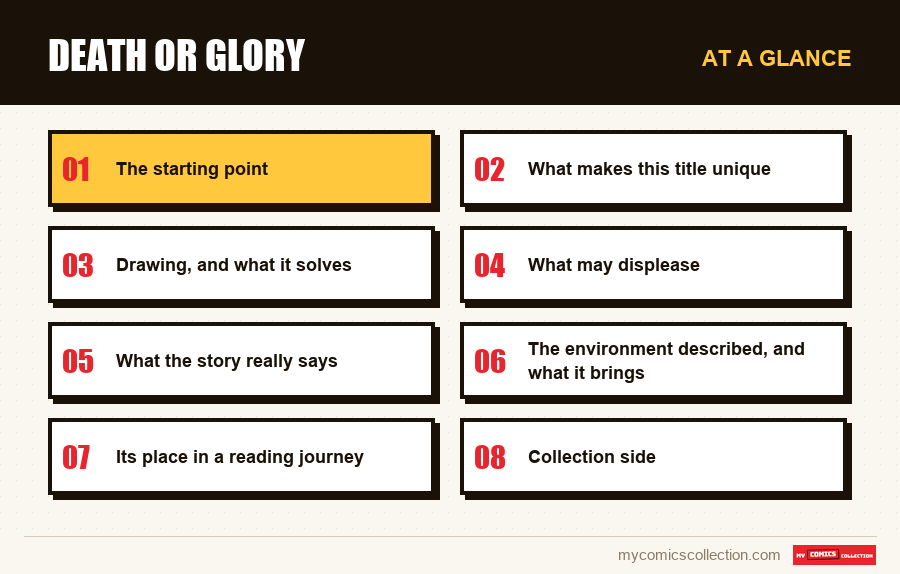
The starting point
Glory was raised on the margins of everything, by a father who made the road and the refusal of institutions a complete and assertive way of life: no papers, no bank accounts, no address declared anywhere. An existence kept entirely away from the system, and paid at the price of permanent precariousness that no one seeks to hide.
This father becomes seriously ill. The treatment that could save him costs a sum that no one in this field can raise through legal means, and the delay is measured in days rather than months. Glory therefore hits the road again for a series of deliveries that she would never have accepted in other circumstances.
The story holds in this tension: a woman who has inherited a refusal must use it to save the one who passed it on to her. The freedom claimed by his father becomes both his only tool and the whole problem.
What makes this title unique
The only story anchored in reality
No fantasy element, no anticipation. The constraints of the story are those of the world as it is: money, distances, fatigue, the police.
This is what makes it the most accessible for a reader not accustomed to the genre.
Really readable pursuits
Bengal cuts his driving scenes with rare clarity: we always know where the vehicles are in relation to each other, and in which direction everything is going.
A rhythm that never falls
The medical countdown structures the whole thing. There is virtually no downtime, which makes reading in one go very natural.
A documented environment
The culture of outlaw truckers is not a picturesque setting: it has its rules, its economies and its hierarchies, and the story takes them seriously.
Drawing, and what it solves
The vehicle chase is one of the most difficult sequences to pull off in comics, and it's worth understanding why this title achieves it.
In cinema, the movement is given: the camera follows, the spectator understands effortlessly. On a page, each box is a freeze frame, and the reader must reconstruct the trajectory himself. Most attempts fail by multiplying tight shots, which give energy but lose geography.
Bengal does the opposite. He maintains wide shots that constantly maintain the relative position of vehicles, and he achieves speed through composition rather than cutting. We never lose who is ahead, who is gaining ground, and what is coming the other way.
This clarity has a direct effect on reading: the action sequences are read quickly because they are understandable the first time, which further accentuates the impression of rhythm.
What may displease
A very classic plot
A race against time to raise a sum: the pattern is known. What matters here is the execution and the environment described, not the originality of the structure.
Little breathing
The fast pace leaves little room for calm scenes. Readers who like the characters to settle down will find the story rushed.
Dry violence
The clashes are brief and brutal, without heroic staging. It is consistent with the environment described, but it is surprising.
A short format
The story is contained in a few chapters. This is an advantage for discovering, a frustration for those who would have liked to spend more time with these characters.
Why it's a good gift. This title is the easiest to offer in its author's entire bibliography: no prerequisites, no genre to accept, a complete story in a few volumes, and an immediately attractive drawing.
It's also the only one you can give to someone who's never read an American comic book without having to explain anything first.
What the story really says
Under the chase, the title deals with a subject that its summary does not suggest, and which links it to the rest of the work.
The father organized his entire life around a refusal: to owe nothing to anyone, to appear nowhere, to depend on no institution. It is a consistent position and held to the end: until the moment when she encounters an illness which can only be cured in the system to which it has turned its back.
The freedom claimed therefore turns out to have a deferred price, due at once and payable by someone else. This is still the author's usual mechanism: we get what we wanted, and the bill arrives later.
The difference here is that it is not the protagonist who incurred the debt. Glory pays for a choice she did not make, which shifts the question of guilt to that of transmission: an angle that the author does not approach anywhere else so head-on.
The environment described, and what it brings
The culture of truckers living on the margins is not an exotic setting tacked on to a standard plot. It provides the story with its internal logic, and this deserves to be detailed.
This environment operates on a parallel economy: deliveries paid in cash, support networks which replace insurance, reputations which take the place of contracts. Nothing is written there, everything is based on the word given and on the fear of reprisals.
This organization produces a valuable narrative constraint: Glory cannot turn to any institution. No bank loan, no social assistance, no recourse in the event of theft. Each problem must be resolved within the environment, with its means.
This is what keeps the story from collapsing under an obvious objection. In an ordinary thriller, we always wonder why the character doesn't notify the police; here the question never arises, because the world described makes the answer impossible.
The environment also does thematic work. A community built on the refusal of all dependence reveals itself, when tested, to be entirely dependent on itself: the characters owe nothing to the system and everything to their peers, which is not exactly the freedom advertised.
Collecting this series?
Track what you own, what you are missing and what your collection is worth. 7 day trial.
Start my trial →Its place in a reading journey
It works well in first or last position, but for opposite reasons.
First, because it asks for nothing: neither taste for science fiction, nor familiarity with the author, nor long-term commitment. If the tone passes, all the rest of his production opens up.
Last, because a reader who is familiar with his other titles will immediately see what he is doing here without the usual setting: the same mechanics, stripped of any genre artifice. It's instructive.
It works less well in the middle of a journey, where its brevity and apparent simplicity would make it seem like a minor work. This is not the case: it is a successful stylistic exercise, and the only one of this register in his bibliography.
Collection side
This title belongs to the most accessible segment of its production, with the same characteristics as its other short series.
The bound volumes cover the entirety and are the most economical way to read. The booklets are only of interest for the first issue, the only item that the market is really looking for in this type of series.
As with all its short series, two points of vigilance: the reprints are spaced further apart than on its flagship titles, which produces temporary unavailability of new ones without creating lasting scarcity; and the single volume bearing the name of the series without a volume number is easily confused, in a catalog, with a first volume whose sequel is missing.
Finally, the mention of the designer deserves to be preserved: on second-hand markets, some of the advertisements put his name forward rather than that of the screenwriter, and a search carried out solely by the name of the author of the text misses copies.
What to record
Three fields are enough, and they resolve the most common errors.
The format. Booklet, bound volume or combined edition: all three have the same title and do not contain the same thing.
The designer. It directs the search for a missing copy and identifies the series as surely as its title.
The cover, on the first issue. This is the only issue in the series that presents multiple versions, and the word “variant” alone says nothing about the edition.
The question that an inventory must decide before each purchase remains the same throughout this segment: do I already own these chapters in another form? A title alone will never tell.
On this specific title, an additional pitfall deserves to be pointed out. The complete stories in one volume are often republished later in a different presentation, sometimes enriched with pages of sketches or a preface. These editions have the same title and tell the same story, but they do not sell at the same price and do not meet the same expectations. Noting the year of the edition owned settles the question once and for all.
Frequently asked questions
Not at all, and it's even the title of his production that requires the least context. No genre to accept, no series to have read, no universe to know: the story stands entirely on its own and is understood from the first page.
It's the only one entirely devoid of any fantasy element or anticipation. His other titles all go through a genre (science fiction, fantasy, horror) even when they deal with very concrete subjects. Here, the constraints of the story are those of the real world.
They are, and it's harder than it seems. The designer maintains wide shots which maintain the relative position of the vehicles, where most attempts multiply close-ups and lose the geography of the scene. We never wonder who is in front.
Yes, the story is brought to its conclusion and its conclusion is written as such. The short format is not the result of an interruption but a choice of construction, consistent with the countdown which structures the plot.
To just about any adult reader, which is unique in this bibliography. He assumes no familiarity with American comics, no prior taste for a particular genre, and his drawing is immediately attractive. A caveat to be aware of, however: the violence is harsh and frequent.
A single volume is confused with a volume 1
On short series, noting the format avoids searching indefinitely for a sequel that doesn't exist.