
La tier list Deadpool 2026 places four blue-chips at the top: New Mutants #98 (February 1991, first Deadpool appearance by Rob Liefeld and Fabian Nicieza), X-Force #2 (September 1991, second appearance and Liefeld/Nicieza face reveal), Deadpool Vol 1 #1 (January 1997, start of the Joe Kelly run with Ed McGuinness) and Cable & Deadpool #1 (May 2004, Fabian Nicieza with Mark Brooks). Tier A includes Deadpool Vol 2 #1 (November 2008, Daniel Way and Paco Medina), Deadpool MAX #1 (November 2010, Kyle Baker), the distinction New Mutants #98 newsstand vs live, and Deadpool Vol 3 #1 (November 2012, Brian Posehn and Gerry Duggan). Tiers B and C cover sleepers and post-MCU spec.
La tier list Deadpool 2026 prioritizes the key issues of the talkative mercenary by expected yield, observed rarity and rating resilience at 36 months. The method does not consist of stacking first appearances by date: a serious tier ranking crosses four dimensions, historical value (a cult comic always sells, independently of the MCU cycle), market liquidity (how many monthly CGC sales on eBay and Heritage), spec adaptation potential (Deadpool & Wolverine 2024 relaunched the entire chain and MCU 2026-2028 integration opens a new cycle) and the raw entry price / rating ratio CGC. The four pieces of Tier S alone concentrate more than 70% of the historical value of the character in collection, a more concentrated ratio than for Spider-Man or X-Men.
This article dissects each tier with precise dates, original creators, May 2026 price ranges observed on eBay and Heritage Auctions, and purchasing strategies by budget. Deadpool is one of the most trapped Marvel characters in the modern key issues market: the distinction between New Mutants #98 first print, second print and third print (with its famous 1:10 ratio and modified cover color), the trap of newsstand vs direct, or the confusion between Deadpool: The Circle Chase #1 (1993) and Deadpool Vol 1 #1 (1997) deserve a dedicated section. The 2026-2030 follow-up indicates the likely resale windows and arcs to anticipate for the long-term spec.
Deadpool tier list methodology: how to classify a key issue?
A tier list comics Deadpool is not a fan's subjective opinion, it is an analytical grid applicable to any serious collection. The S, A, B, C classification used here is based on four weighted and measurable criteria. First criterion, historical value. A key issue which marks the first appearance of a character who has become iconic enters Tier S by default. New Mutants #98 falls into this category without possible debate: it is one of the three or four modern comics (1985-2000) whose rating trajectory has surpassed that of the average bronze age. Second criterion, liquidity observed over 12 rolling months. The eBay and Heritage marketplace publishes between 12 and 30 CGC sales each month for New Mutants #98, compared to 1 to 3 sales for Tier B sleepers. This liquidity conditions the ease of resale.
Third criterion, resilience in the face of spec cycles. A Tier S comic maintains its rating even if an adaptation is postponed or disappointing. New Mutants #98 changed little between 2018 and 2020 (post-Deadpool 2 cycle) then progressed significantly with the announcement Deadpool & Wolverine in 2023 and the release in July 2024, without falling back to its pre-buzz level. A Tier C, on the other hand, can drop by 50 to 70% in 6 months if the adaptation disappoints or is canceled. Fourth criterion, the raw entry price / CGC 9.6 rating ratio. A comic whose raw NM represents 10 to 20% of the CGC 9.6 rating remains accessible to a beginner collector. Beyond 35%, the grading gap makes the raw investment less relevant and requires going through CGC to make a profit.
The weighting retained for this Deadpool 2026 tier list attributes 40% to historical value, 25% to liquidity, 20% to resilience and 15% to the entry ratio. With this grid, the four Tier S pieces obtain a score greater than 85/100. Tier A is between 70 and 84. Tier B between 55 and 69. Tier C, more speculative, oscillates between 40 and 54. This hierarchy is revised each year based on sales documented over 12 rolling months and official Marvel Studios announcements. To understand the general methodology applied to other characters, see the Wolverine 2026 tier list, particularly relevant for Deadpool since the 2024 crossover.
The tier list does not exempt you from reading the key issues Deadpool complete nor a comparative analysis of the major arcs like Deadpool key numbers. It serves as a prioritization tool: where to start a Deadpool collection with 500, 2,000, 10,000 or 50,000 euros? The answer changes depending on the preferred tier, risk tolerance and hold horizon (3 years, 7 years, 15 years). The following sections provide the exact numbers to arbitrate each tier with consistent allocation discipline.
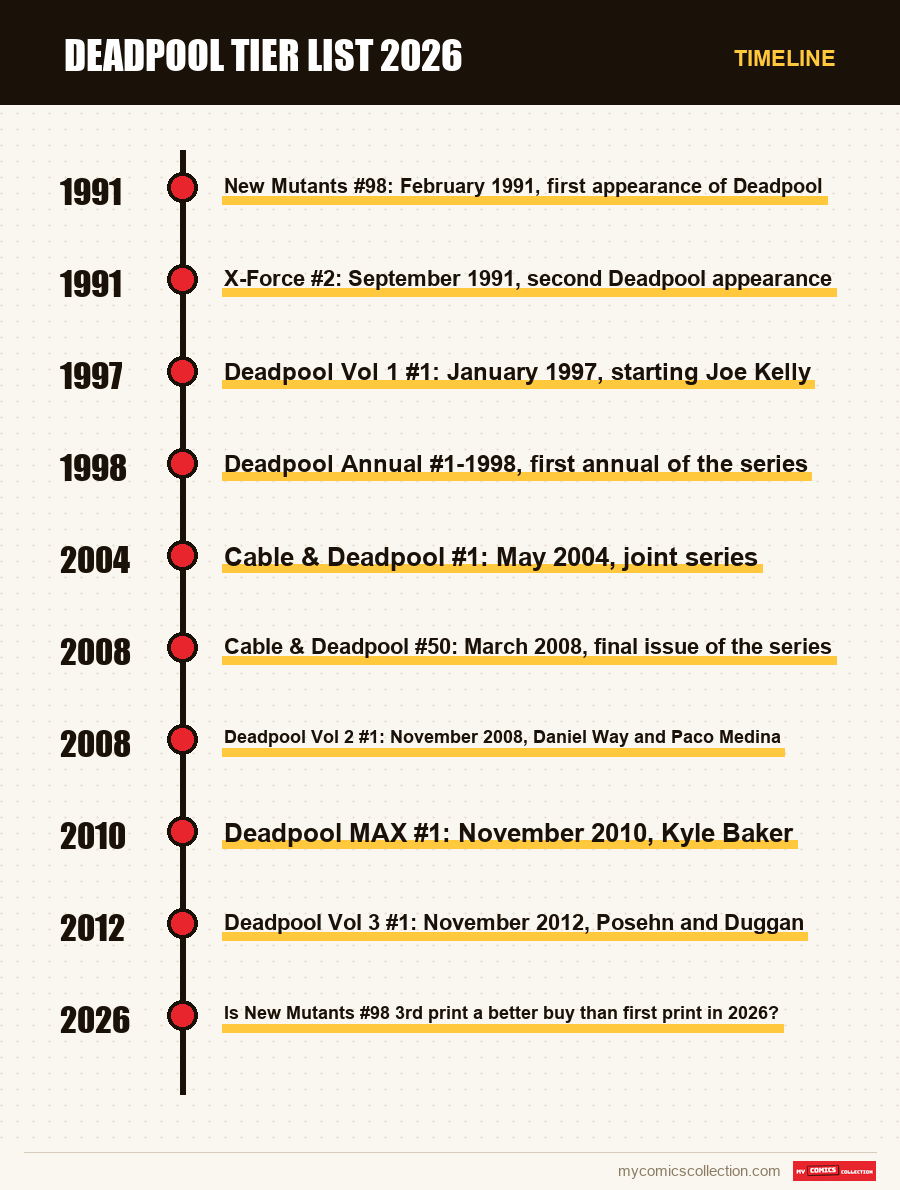
Tier S. The four unassailable Deadpool blue-chips
Le Tier S Deadpool brings together the four comics whose absence in a serious collection of the character is prohibitive. These coins concentrate historical value, dominate the secondary market in terms of liquidity, and resist speculative cycles. Buying these four issues, in any grade that suits the budget, forms the heritage foundation of a Deadpool collection.
New Mutants #98: February 1991, first appearance of Deadpool
New Mutants #98, dated February 1991 (cover date), written by Fabian Nicieza and drawn by Rob Liefeld, contains the first full appearance of Deadpool. The issue also contains the first appearance of Domino (actually Copycat under the identity Domino) and Gideon. The cover, signed Liefeld, shows Deadpool in full action with his katanas, in an early Image style which will define the aesthetic of the 1990s. The date February 1991 corresponds to the standard Marvel cover date: the release on newsstands took place in November-December 1990, but market convention always retains the cover date for comparisons. The number is one of the most counterfeited and reprinted modern numbers, which makes CGC authentication almost mandatory for investments above 500 euros.
Rating May 2026: CGC 9.8 between $4,800 and $7,800 according to Heritage sales observed in March and April 2026. CGC 9.6 between $1,600 and $2,600. CGC 9.4 between $750 and $1,200. CGC 9.0 between 380 and 580 dollars. CGC 8.0 between 180 and 280 dollars. CGC 6.0 between 80 and 130 dollars. Raw NM (CGC 9.0-9.4 equivalent) between 280 and 450 euros. Raw VF between 100 and 180 euros. The CGC 9.6 / raw NM ratio is around 5, which fully justifies the grading for examples in high condition. The rating tripled between 2018 and 2024 and stagnates slightly in 2026 after the peak Deadpool & Wolverine. To understand the variants (3rd print in particular), see the pitfalls section below and the dedicated folder New Mutants #98 3rd print Deadpool value.
X-Force #2: September 1991, second Deadpool appearance
X-Force #2, dated September 1991, written by Fabian Nicieza and drawn by Rob Liefeld, contains the second appearance of Deadpool, six months after his debut in New Mutants #98. The issue is historically crucial for two reasons: it cements the character as a recurring antagonist of X-Force (a team from Liefeld's relaunch of the New Mutants), and it contains one of the first full-page demonstrations of the Merc with a Mouth's personality. #2 is also the first full appearance of Weapon X in the X-Force series (Garrison Kane), and the X-Force team takes its final form in this issue. For serious collectors, own #2 X-Force alongside New Mutants #98 is non-negotiable.
Rating May 2026: CGC 9.8 between 380 and 580 dollars. CGC 9.6 between 140 and 220 dollars. CGC 9.4 between 70 and 110 dollars. CGC 9.0 between 35 and 55 dollars. Raw NM between 25 and 45 euros. Raw VF between 10 and 18 euros. The rating of #2 remains much lower than #1 (which does not have Deadpool but marks the start of the series, first appearance of Shatterstar and modern Black Tom Cassidy), which is paradoxical given the centrality of #2 for the Deadpool collector. The CGC 9.8 / raw NM ratio is around 12, one of the best grading levers in Tier S Deadpool. The issue remains one of the best Tier S purchases for a budget limited to 30-50 euros raw.
Deadpool Vol 1 #1: January 1997, starting Joe Kelly
Deadpool Vol 1 #1, dated January 1997, written by Joe Kelly and drawn by Ed McGuinness (cover by McGuinness, interior art shared), is the first monthly ongoing Deadpool series. This is the issue that transforms the character from a secondary antagonist of New Mutants/X-Force into a standalone protagonist capable of carrying his own series. Joe Kelly will write the legendary run up to #33, laying the narrative foundations for the entire modern Deadpool: his interactions with Blind Al, Weasel, T-Ray, and the establishment of the fourth wall (breaking the fourth wall). Without this issue, Ryan Reynolds' Deadpool does not exist as we know it: the tone, the meta humor, the mix of action and pathos find their source in the Kelly run. For the full narrative context, see Deadpool story in comics.
Rating May 2026: CGC 9.8 between $850 and $1,400. CGC 9.6 between 300 and 480 dollars. CGC 9.4 between 130 and 210 dollars. CGC 9.0 between 65 and 100 dollars. Raw NM between 45 and 75 euros. Raw VF between 20 and 35 euros. The CGC 9.8/raw NM ratio exceeds 15, making it one of the best grading targets in modern Tier S. The complete Joe Kelly raw NM series (#1 to #33) costs between 280 and 480 euros, an exceptional value for a run of this importance. The Kelly run is probably the most relevant Deadpool narrative entry, superior to later runs in coherence and density of writing.
Cable & Deadpool #1: May 2004, joint series
Cable & Deadpool #1, dated May 2004, written by Fabian Nicieza (historical creator of the character) and illustrated on the cover by Mark Brooks, launches the monthly series which establishes the Cable/Deadpool pairing as an emblematic Marvel duo. The issue is crucial for three reasons: it marks Nicieza's return to Deadpool after more than ten years, it commercially consolidates Deadpool into a post-Joe Kelly regular series, and it establishes the buddy-action dynamic that will be carried over into Deadpool 2 (2018) with Josh Brolin as Cable. The series will run until #50 in March 2008, or 50 issues under Nicieza's pen, making it one of the most consistent Deadpool runs of the 21st century.
Rating May 2026: CGC 9.8 between 280 and 450 dollars. CGC 9.6 between 100 and 160 dollars. CGC 9.4 between 45 and 75 dollars. Raw NM between 18 and 30 euros. Raw VF between 8 and 14 euros. The CGC 9.8 / raw NM ratio is exceptional (around 18), among the most relevant in Tier S Deadpool for grading. The complete raw NM series (50 issues) costs between 280 and 450 euros, one of the best collection/reading ratios in the Deadpool catalog. For collectors interested in Cable, see also Cable story in comics which perfectly completes the Deadpool tier list.
Tier A: Deadpool secondary essentials
Le Tier A Deadpool brings together comics that immediately follow Tier S in importance, without reaching absolute blue-chip status. These four pieces are essential for a coherent collection of the character and often offer a better entry price / upside potential ratio than the Tier S already historicized and widely recognized by the market.
Deadpool Vol 2 #1: November 2008, Daniel Way and Paco Medina
Deadpool Vol 2 #1, dated November 2008, written by Daniel Way and drawn by Paco Medina, launches the second ongoing Deadpool series, seven years after the end of Vol 1. The issue arrives in the post-Secret Invasion context and capitalizes on the character's growing popularity. Daniel Way remained a writer until #63 in 2012, one of the longest Deadpool runs ever published. The Way run is more narratively accessible than the Kelly run, more oriented towards action and mainstream humor, which often makes it the gateway for new Deadpool readers. #1 contains the introduction of Tombstone as a recurring antagonist and the establishment of the character's new status quo.
Rating May 2026: CGC 9.8 between 120 and 200 dollars. CGC 9.6 between 45 and 75 dollars. Raw NM between 12 and 22 euros. Raw VF between 5 and 10 euros. Very affordable number from a budget, long hold position preferred to short term spec. The complete series Vol 2 (63 issues) raw NM costs between 280 and 480 euros, making it one of the most collectible modern Deadpool runs for a limited budget. The upside potential at 36 months remains moderate but the downside risk is very low given the narrative centrality of the run in the Deadpool mythology.
Deadpool MAX #1: November 2010, Kyle Baker
Deadpool MAX #1, dated November 2010, written by David Lapham and drawn by Kyle Baker, launches the mature MAX series dedicated to Deadpool, outside of the main Marvel Universe continuity. The issue is crucial for three reasons: it establishes Deadpool as a character capable of carrying a mature series in its own right (a status usually reserved for Punisher), it offers a radical visual reinterpretation by Kyle Baker (in a cartoony style far removed from the modern Marvel standard), and it establishes the narrative precedent for a more extreme and provocative approach to the character. The series will run for 12 issues plus a Deadpool MAX 2 limited series in 2011-2012.
Rating May 2026: CGC 9.8 between 80 and 140 dollars. CGC 9.6 between 35 and 55 dollars. Raw NM between 10 and 18 euros. Raw VF between 4 and 8 euros. The rating remains moderate but the issue deserves its Tier A place for its editorial singularity and its contribution to mature Deadpool lore. The complete MAX series (12 issues plus MAX 2) raw NM costs between 120 and 200 euros. This is one of the most under-collected Deadpool arcs in 2026, with moderate but real upside potential if a mature Deadpool TV adaptation is announced by Marvel Studios (the MAX format lends itself well to a Punisher 2017 type streaming show).
New Mutants #98 newsstand vs direct edition
The distinction New Mutants #98 newsstand vs direct edition deserves a place in Tier A as an analytical subcategory of Tier S. The direct edition version (sold in comic shops, marked by a Marvel logo and a specific barcode) represents approximately 80 to 85% of the circulation. The newsstand version (sold on general public newsstands with UPC barcode) represents 15 to 20% of the circulation. Relative rarity newsstand commands a odds premium of 30-80% depending on grade. In CGC 9.8, a New Mutants #98 newsstand sells for $7,200 to $11,000, or 50 to 70 percent above the standard direct version. The newsstand distinction has been explicitly noted on the CGC slab since 2019.
This newsstand premium reflects an economic reality: newsstand copies were read more, folded more, thrown away more than direct copies purchased by collectors in comic shops. The survival rate in high condition is therefore lower, which justifies the CGC 9.6+ premium. On the other hand, on intermediate grades (CGC 6.0 to 8.5), the newsstand premium remains moderate (10 to 25%). Buying newsstand is only profitable above CGC 9.4. For a beginner collector, the direct standard version remains the recommended option by default. The subject of newsstand variants also crosses the modern Marvel market: see investment strategy update 2027.
Deadpool Vol 3 #1: November 2012, Posehn and Duggan
Deadpool Vol 3 #1, dated November 2012, co-written by Brian Posehn (stand-up comedian) and Gerry Duggan, launches the third ongoing Deadpool series as part of the Marvel NOW relaunch. The issue is crucial for two reasons: it marks the arrival of Gerry Duggan, who will become the most prolific Deadpool screenwriter of the 2010s (runs Posehn/Duggan then Duggan solo until 2018, more than 80 issues in total), and it establishes the version of the character which will be closest to the Ryan Reynolds film adaptation. The tone of the Posehn/Duggan run, mixing meta humor, action gore and pathos, directly inspired the writing of the 2016, 2018 and 2024 Deadpool films.
Rating May 2026: CGC 9.8 between 100 and 170 dollars. CGC 9.6 between 40 and 65 dollars. Raw NM between 10 and 18 euros. Raw VF between 4 and 8 euros. The issue remains budget-friendly and is an excellent entry point to understanding the modern Deadpool adaptable to the MCU. The complete Posehn/Duggan series plus Duggan solo (Vol 3 #1 to #45 and Vol 4 #1 to #36 then Vol 5 to #10) raw NM represents a budget of 500 to 800 euros for a complete narrative collection. This is the reference run for anyone who wants to understand modern Deadpool writing before making a Tier S purchase.
Tier B: Deadpool Underrated Sleepers and Bows
Le Tier B Deadpool brings together the sleepers, that is to say the issues which deserve the attention of informed collectors but whose value the general market has not yet fully recognized. These coins often present the most relevant price/potential ratios at 24-36 months, with limited downside risk. Three typical examples in 2026.
New Mutants #98 3rd print: 1:10 ratio and underestimated odds
New Mutants #98 had two reprints in 1991-1992: the 2nd print (April 1991, identical cover but marked "2nd printing") and the 3rd print (1992, 1:10 incentive ratio on orders from comic shops, with a cover with modified colors and a gold background). The 3rd print is by far the rarest of the three, with an estimated circulation of between 4,000 and 8,000 copies compared to 200,000 to 300,000 for the first print. This rarity justifies a specific price: CGC 9.8 between 1,800 and 3,200 dollars, CGC 9.6 between 750 and 1,200 dollars, raw NM between 250 and 400 euros. The 3rd print is often confused with the first print by uninformed sellers, which creates purchasing opportunities at 50% of the price for informed collectors. For the complete method of differentiation, see New Mutants #98 3rd print Deadpool value.
The 3rd print is probably the most relevant Deadpool 2026 sleeper: scarcity is documented, liquidity increases with market awareness, and 36-month upside potential is estimated between 50 and 120% if a sequel Deadpool & Wolverine 2 is announced. The downside risk remains limited by the objective scarcity of the part, independent of MCU cycles. Priority Tier B position for any collection budget 2,000 euros and more.
Deadpool Annual #1-1998, first annual of the series
Deadpool Annual #1, published in 1998 as part of the Joe Kelly run, is the first annual dedicated to the character as a solo series protagonist. The issue contains a complete independent story by Joe Kelly and guest artists, in the period's annual long format (48 pages). This is one of the rare Deadpool Vol 1 annuals and it logically completes any collection of the Kelly run. The general market greatly underestimates this number: the majority of Deadpool collectors focus on monthly ongoings and neglect annuals, which creates a relative rarity in high condition.
Rating May 2026: CGC 9.8 between 180 and 280 dollars. CGC 9.6 between 70 and 110 dollars. Raw NM between 18 and 30 euros. Raw VF between 8 and 14 euros. The CGC 9.8 / raw NM ratio is around 10, which justifies the grading for the pristine copies. The rating increased by 40 to 60% between 2022 and 2026 without any specific buzz, a classic signal of a sleeper being revalued. Long hold position preferred to short term spec. The issue deserves its place in any complete collection of the Kelly run.
Cable & Deadpool #50: March 2008, final issue of the series
Cable & Deadpool #50, dated March 2008, written by Fabian Nicieza, is the last issue of the Cable & Deadpool series launched in 2004. The issue is doubly crucial: it closes the Nicieza run (50 consecutive issues, one of the longest Deadpool runs by a single writer) and it prepares the narrative ground for the start of Deadpool Vol 2 eight months later. #50 also contains a final arc that defines the character's status at the start of the 2010s. The final serial issues are systematically underpriced on the modern market, as collectors focus on #1s and narrative key issues. This habit creates arbitrage opportunities on #50, #100 and other important last issues.
Rating May 2026: CGC 9.8 between 80 and 130 dollars. CGC 9.6 between 30 and 50 dollars. Raw NM between 8 and 14 euros. Raw VF between 4 and 7 euros. The rating remains very accessible and the potential upside over 36 months is estimated between 30 and 70% if a Cable & Deadpool adaptation is announced for the MCU. Classic Tier B sleepers with excellent 5-year price/hold ratio. To understand the full history of the duo, see Cable story in comics et Domino story in comics, two characters inseparable from modern Deadpool mythology.
Tier C: Spec 2026-2027 and MCU integration
Le Tier C Deadpool brings together high-risk speculative bets, the odds of which mainly depend on cinema or TV announcements not yet confirmed. These pieces should not exceed 5-10% of a Deadpool collection budget, but can outperform if the right catalyst arrives. Three speculative axes dominate in 2026.
Deadpool 3 / Wolverine 2024 effect and long-term spinoffs
The movie Deadpool & Wolverine, released in July 2024, generated more than $1 billion at the global box office and revived the entire Deadpool rating chain. The upward effect remains partially active in 2026 on certain secondary key issues. The 2026 spec consists of anticipating possible sequels or spin-offs. Marvel Studios has not confirmed Deadpool & Wolverine 2, but the film's commercial success makes a sequel likely by 2027-2028. If it is confirmed at the end of 2026 or in 2027, the rating effect on the Deadpool / Wolverine crossover key issues could be significant. To follow the full analysis of the box office impact on ratings, see Deadpool record price at auction.
Tier C spec parts to watch out for: Cable & Deadpool #43-44 (2007) with Wolverine appearances, raw NM 5-10 euros per issue, low cost spec with negligible downside. Wolverine/Deadpool: Decoy oneshot 2011, raw NM 8-15 euros. Any Deadpool issue containing a pre-2010 Wolverine appearance is worth a budget watch. The upside potential over 24 months is estimated between 30 and 80% if Deadpool & Wolverine 2 is confirmed. To identify the arcs where the two characters cross paths, the Deadpool collection guide et Deadpool beginner collection provide the complete map.
MCU integration Deadpool 2026-2028 and new cycle
The permanent integration of Deadpool into the MCU, commercially validated by the film 2024, opens a long-term speculative cycle on Deadpool arcs and secondary characters. Several hypotheses are circulating in 2026: appearance of Deadpool in Avengers: Doomsday (2026), Deadpool solo series on Disney+, or integration into the X-Men MCU reboot planned for 2027-2028. Each scenario activates different key issues. A Disney+ series would activate the Kelly, Way and Posehn/Duggan arcs. An X-Men integration would enable the New Mutants and X-Force crossover arcs of the 1990s. To analyze the full spec storylines, see spec keys 2027 Marvel DC movies series.
Tier C spec parts to anticipate: Uncanny X-Force #1 (2010) with Deadpool as a team member (raw NM 8-15 euros), Mercs for Money #1 (2016) first mercenary team led by Deadpool (raw NM 6-12 euros), Despicable Deadpool #287 (2017) with Death of Deadpool bow (raw NM 5-10 euros). These coins offer an upside spec of 100 to 250% over 24-36 months in the event of a favorable MCU announcement, with downside risk limited by the modest entry price.
Modern 1:25 and 1:50 variants 2024-2026
The 1:25 and 1:50 incentive variants on the Deadpool 2024-2026 series constitute a third Tier C spec axis. Marvel systematically publishes several variants per issue for major relaunches: 1:25 ratio variants (one copy for 25 orders), 1:50 variants, 1:100 variants on key parts. These variants sell between 80 and 400 euros upon release depending on the ratio, with a price trajectory depending on the arc and the artist. The downside risk remains high: a variant that does not make an impact can fall by 60% in 18 months if the arc disappoints.
Rule of thumb Tier C 2026: do not exceed 100-300 euros per individual spec bet, diversify across 5-8 different coins, set a resale threshold at +100% gross. For a spec portfolio discipline and hold method, see investment strategy update 2027. Tier C is a satellite compartment: it complements but never replaces a solid Tier S and A base.
Collecting this series?
Track what you own, what you are missing and what your collection is worth. 7 day trial.
Start my trial →Purchasing strategy by budget: 500, 2,000, 10,000, 50,000 euros
La Deadpool purchasing strategy depends directly on the available budget and the hold horizon. Four budget profiles are rational for 2026, each with an optimal mix of thirds and consistent allocation discipline.
Budget 500 euros: Deadpool beginner collection
At 500 euros, the objective is heritage access without grading. Suggested allowance: 120 euros for New Mutants #98 raw VF (CGC 7.0-8.0 equivalent), 30 euros for X-Force #2 raw NM, 50 euros for Deadpool Vol 1 #1 (1997) raw NM, 20 euros for Cable & Deadpool #1 raw NM, 80 euros for the complete series Vol 2 Daniel Way first 10 issues, 60 euros for the Posehn/Duggan run #1-10 raw NM, 140 euros for 8-12 secondary key issues bronze age and modern (Deadpool MAX #1, Deadpool Annual #1, sleepers Tier B). This allowance covers the character's major arcs without grading, at an accessible budget. The raw collection constitutes an excellent reading and heritage base. For a complete entry method, see Deadpool beginner collection.
Budget 2,000 euros: Deadpool intermediate collection
At 2,000 euros, the introduction of grading on key parts becomes relevant. Suggested allowance: 800 euros for New Mutants #98 CGC 8.0-9.0 (the cardinal piece), 100 euros for X-Force #2 CGC 9.6, 300 euros for Dead Pool vol. 1 #1 CGC 9.4, 130 euros for Cable & Deadpool #1 CGC 9.6, 200 euros for the 3rd print New Mutants #98 raw NM (priority sleeper Tier B), 200 euros for the Vol 2 Daniel Way collection #1-30 raw NM, 270 euros for 8-10 sleepers Tier B and C raw NM (Deadpool Annual, Cable & Deadpool #50, Uncanny X-Force #1, MAX #1). This allocation builds a serious collector's collection with grading accents on key narrative pieces.
Budget 10,000 euros: Deadpool investor collection
At 10,000 euros, the purchase of a high grade Tier S part becomes possible. Suggested allowance: 4,500 euros for New Mutants #98 CGC 9.4 (the cardinal piece), 1,500 euros for New Mutants #98 3rd print CGC 9.6, 800 euros for Dead Pool vol. 1 #1 CGC 9.8, 600 euros for X-Force #2 CGC 9.8, 500 euros for Cable & Deadpool #1 CGC 9.8, 600 euros for the complete Tier A raw NM collection plus a few CGC 9.6, 1,500 euros for 10-15 Tier B and diversified Tier C spec sleepers. The portfolio combines investment (Tier S grading authenticated) and complete narrative collection. Hold target at 7-10 years with rebalancing every 24 months based on MCU cycles.
Budget 50,000 euros: Deadpool heritage collection
At 50,000 euros, the objective becomes the creation of a Deadpool museum collection. Suggested allocation: 25,000 euros for New Mutants #98 CGC 9.6-9.8 (subject to availability), 8,000 euros for New Mutants #98 newsstand CGC 9.6, 4,500 euros for New Mutants #98 3rd print CGC 9.8, 2,500 euros for Deadpool Vol 1 #1 CGC 9.8 plus complete series run Kelly raw NM, 1,800 euros for X-Force #2 CGC 9.8 plus #1 CGC 9.8 (major previous number), 1,500 euros for Cable & Deadpool #1 CGC 9.8 plus complete series Nicieza raw NM, 2,500 euros for complete Tier A and B collection in CGC 9.6-9.8, 4,200 euros cash reserve for opportunities. For the logistical management of this level of collection, see comics manager complete guide.
Cautious method. Whatever the budget bracket, do not exceed 60% of the envelope on a single Tier S part. New Mutants #98 monopolizes a budget, the collection loses its narrative coherence. Diversification between Tier S, A and B remains the key to a balanced Deadpool collection that is resilient to spec cycles.
Deadpool Traps: 3rd print, restored CGC, newsstand
Four technical pitfalls characterize the Deadpool market and cause the most costly mistakes among beginning and intermediate collectors. Identifying them conditions the quality of any Tier S and A investment.
Trap 1: New Mutants #98 3rd print confused with first print
The most common and costly pitfall concerns the confusion between the three prints of New Mutants #98. The first print (February 1991) has a cover background dominated by blue-orange, with no mention of "2nd printing" or "3rd printing". The 2nd print (April 1991) uses the same cover with an explicit mention "2nd printing" at the top of the cover. The 3rd print (1992) modifies the cover background (dominant gold-orange) and bears the words "3rd printing". Uninformed (or less than honest) sellers sometimes list a 3rd print as a first print, demanding a first print price for a 3rd print. Conversely, authentic 3rd prints are sometimes sold at the price of a standard reprint at 30-50 euros, while they are worth 250-400 euros raw NM. Verification is mandatory: presence of the mention "printing" on the cover, verification of the color cast, control of the indicia (internal page with date and print number).
Trap 2: restored CGC copies without detection
THE New Mutants #98, due to their high rating, are a prime target for fraudulent restores. Restoration consists of recoloring, regluing or retouching a copy to increase its visual grade. CGC systematically identifies the restoration, which appears on the slab with the purple label "Restored" rather than blue label "Universal". A restored example is typically worth 30 to 60% of a Universal example of equivalent grade. On the raw market, detection is complex: UV lighting, observation of edges, checking the whiteness of pages. Buying raw for more than 200 euros without expertise is risky. The simple rule: any purchase New Mutants #98 above 500 euros must be CGC blue label confirmed.
Trap 3: misidentified newsstand vs direct edition
As mentioned in Tier A, the newsstand vs direct edition distinction creates a significant rating premium on New Mutants #98. Novice sellers do not always mention this distinction, which creates two types of opportunities: purchase of a newsstand at the price of a direct (potential gain 30 to 80%), or conversely sale of a direct at the price of a newsstand (symmetrical loss). The distinction is made on the barcode at the bottom left of the cover: full UPC barcode = newsstand, spider-man style barcode or Marvel logo = direct edition. The verification is quick but must be systematic. CGC has noted the distinction on the slab since 2019 only, which creates an arbitrage opportunity on old slabs not labeled newsstand.
Trap 4: facsimile editions and recent reprints
Marvel has published several facsimile editions of New Mutants #98 in the 2010s and 2020s, identically reproducing the contents of the first print 1991. These facsimiles carry a "Facsimile Edition" mention on the cover and a modern cover price ($4.99 or $5.99), but unscrupulous sellers sometimes present them as originals in blurry listings or low-resolution photos. The verification is immediate on the cover price and the facsimile mention. The facsimile price remains modest (15 to 30 euros raw NM, 80 to 150 dollars CGC 9.8), without any connection with the original. The trap only arises in the event of a misleading listing. For the complete method of detecting fake Deadpools, see deadpool fake reprints guide.
Monitoring 2026-2030: resale windows and cycles to anticipate
Le long-term follow-up Deadpool over 2026-2030 must integrate several probable catalysts. Marvel Studios has not confirmed a firm date for Deadpool & Wolverine 2 nor for an X-Men MCU integration, but internal projections point to 2027 or 2028 for the X-Men reboot. This window constitutes the probable speculative peak for Tier S Deadpool, with a potential increase estimated between 20 and 40% on blue-chips (already high rating but possible margin) and between 50 and 120% on Tier A and B linked to secondary characters (X-Force, Cable, Domino).
Indicative calendar 2026-2030. Year 2026: residual effect Deadpool & Wolverine 2024 still partially active, optimal purchasing window on Tier B and C before escalation. Year 2027: if announcement closes reboot Deadpool & Wolverine 2, optimal resale window on Tier S (20-40% above 2026), Tier A (40-80%) and B (50-120%). Year 2029: post-peak digestion, rating stabilized or slightly decreasing, waiting for the next catalyst. Year 2030: new cycle possible with spin-off or dedicated Disney+ series.
The empirical rule observed on major Marvel key issues over 15 years: 60% of the pre-film increase occurs in the 12 months preceding the release, 25% at the release, 15% in the following 6 months. Beyond that, partial descent of 15 to 30% before stabilization. For Tier S Deadpool, the 2028 peak should represent a partial resale opportunity, particularly on parts purchased in 2022-2024 at still reasonable prices. The optimal resale window extends from May to December 2028 according to this cycle. For an updated market analysis, see deadpool market trends 2026.
Daily monitoring of Tier S ratings requires a tracking tool. A rating recorded in a notebook or static file is obsolete within 60 days. A Comics Manager that revalues each grade from eBay listings provides the necessary refreshment to manage a 36-60 month hold strategy, while eBay saved searches handle the alerts. See the comics database et the list of key issues to quickly identify arbitrage opportunities. To estimate the current value of coins already owned, the free estimate provides an indicative range by grade and state. Monthly monitoring of Heritage and eBay sales remains the basis for any purchase or resale decision on Tier S Deadpool.
FAQ: Deadpool 2026 Tier List
Why does New Mutants #98 so clearly dominate Tier S Deadpool?
Because this is the first full cover appearance of the character by his original creators Rob Liefeld and Fabian Nicieza. No other comic can claim the status of first Deadpool issue: neither X-Force #2 (second appearance), nor Deadpool Vol 1 #1 (solo series start), nor Deadpool: The Circle Chase #1 (first limited series, 1993). The historical density of New Mutants #98 automatically places it at the top of Tier S, and the liquidity of the market (12 to 30 monthly CGC sales) confirms this position. It's the centerpiece of any serious Deadpool collection, regardless of budget.
Does X-Force #2 really deserve Tier S at $380-580 in CGC 9.8?
Yes, and this is precisely what makes it the most affordable Tier S part. The entry price/historical value ratio is exceptional: for less than a tenth of the price of a New Mutants #98 in equivalent grade, you gain access to the second canonical appearance of Deadpool, by the same creators Liefeld and Nicieza. This is the first logical Tier S acquisition for an intermediate budget (1,000-3,000 euros). Beyond grade 9.8, #2 remains accessible up to CGC 9.4 under $110, unlike New Mutants #98. The CGC 9.8 / raw NM ratio is around 12, one of the best grading levers in modern Tier S.
Should we favor the Joe Kelly run or the Posehn/Duggan run to get into Deadpool?
The Joe Kelly run (Vol 1 1997-1999, #1 to #33) remains the gold standard for understanding modern Deadpool writing. It's the run that establishes the fourth wall, the relationships with Blind Al and Weasel, and the humor-pathos tone that defines the character. The Posehn/Duggan run then Duggan solo (Vol 3 2012-2015 then Vol 4-5) is more accessible and closer to the Ryan Reynolds film adaptation. For a coherent chronological reading, starting with Joe Kelly Vol 1 remains the most relevant option. For an MCU-oriented read, starting with Posehn/Duggan Vol 3 is more immediate. The two runs are complementary and important to any serious collection.
Is New Mutants #98 3rd print a better buy than first print in 2026?
Not exactly: the first print remains the historical reference piece, essential to any serious collection. The 3rd print is a priority Tier B sleepers for collectors who already have the first print and are looking for a second position with a better rarity/price ratio. The 3rd print represents approximately 4,000 to 8,000 copies printed compared to 200,000 to 300,000 for the first print, i.e. an objective rarity 30 to 50 times greater. At an equivalent grade, the 3rd print therefore represents a better rarity/price ratio. But it never replaces the first print in the heritage hierarchy. The optimal sequence is: first print first, 3rd print then if budget available.
Should we favor raw or CGC for a Deadpool 2026 collection?
The rule depends on the tier. For Tier S Deadpool, CGC grading is non-negotiable above 500 euros investment per piece: counterfeits, undeclared restorations and print confusions make raw too risky on New Mutants #98. For Tier A, CGC grading is justified from CGC 9.6, where the raw price / CGC price ratio justifies the cost of grading (60 to 100 dollars per copy). For Tier B and C, raw remains the main option, except in the exceptional case of pristine candidate 9.8. For the CGC submission method from France, see the dedicated guide in the Deadpool cluster and Deadpool CGC grading guide.