Several characters who have become considerable were born in his series, and he owns none of them. This is the rule of commissioned work: what we create for a house belongs to it, and the author then has neither control over uses nor share in the operations. These figures were entrusted to others, adapted, transformed, without their creator having a say. This is the exact opposite of the model that other authors of this campaign have chosen, and the comparison sheds light on what each path costs.
This contrast runs through this entire issue and deserves to be exposed for its own sake.
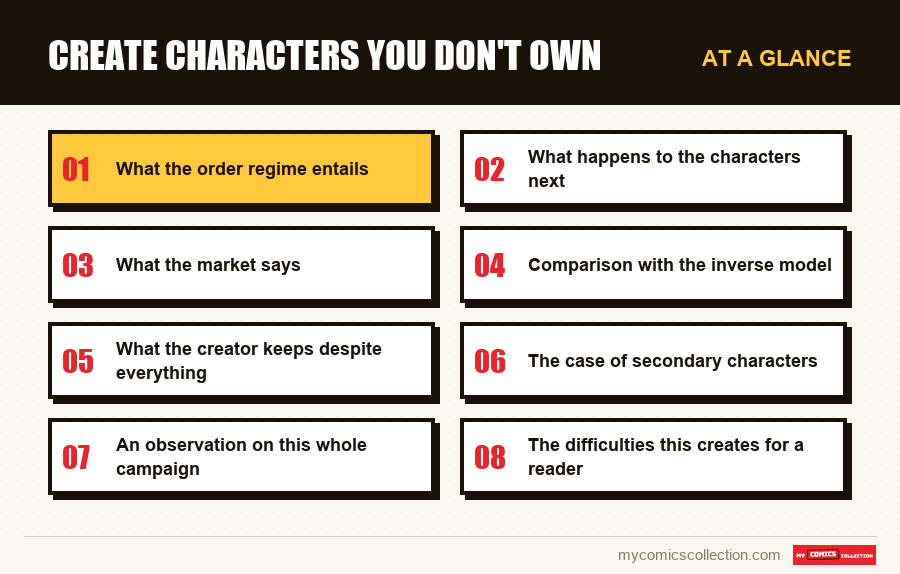
This article describes what this regime produces, what happens to the characters next, what the market says about it, and why the question of attribution is more complicated than it seems.
What the order regime entails
Four consequences, none of which are negotiable in this framework.
The property belongs to the house. A character created in a series published by a publisher becomes its property, regardless of the creative part of those who designed it.
The use escapes entirely. Other writers will write it, make it change, die, come back. The creator cannot approve or object.
Derivative operations are not coming back. Adaptations, products, licenses: the revenue goes home. Recognition agreements exist depending on the era, but they are a matter of publisher policy and not acquired rights.
The recognition is symbolic. A mention in the credits does not give rise to any rights, and its very presence depends on conventions which have varied.
These four points were the absolute standard for the entire period concerned. It was not a choice but the only path to the profession, which makes any criticism addressed to those who borrowed it anachronistic.
What happens to the characters next
They change hands
Each new screenwriter brings his reading, and a character who has passed through ten hands no longer has any assured coherence.
This is the normal fate of a figure who survives his creator in a shared universe.
They are reinterpreted
Secondary traits become central, motivations are rewritten, and the version that prevails is not always the original one.
They are suitable
The passage on screen fixes a version in the mind of the public, often different from that of the pages, and this version reacts on the following publications.
They survive everything
A profitable character doesn't disappear. It is revived indefinitely, which guarantees its presence and gradually dissolves its initial identity.
What the market says
The August 29, 2026 reading provides a clear indication, and it is counterintuitive.
The value tied to these characters is focused on the first appearance numbers: $397.50 and $31.64 gross, $1,389.99 and $327.22 certified for the top two, and nothing else.
The hundreds of numbers that developed them afterwards are worth nothing in particular. The solo series dedicated to one of them is asking for a median of $6.99 with three certified announcements.
In other words, the market values the moment of creation and ignores the work of construction. This is consistent with what we observe throughout this campaign, and it produces a distortion: we pay dearly for the issue in which a character appears, and nothing for the fifty issues which made him interesting.
These amounts do not go to anyone other than the successive sellers: a point that is worth remembering when we talk about the valuation of a character.
When it comes to attribution, caution is required and I stick to it. A character is born from the meeting between a proposed function and a drawn silhouette, in working conditions that no one documents at the time.
The testimonies arrive decades later, in often conflicting contexts, and regularly contradict each other. I therefore describe shared creations without distributing the merits: not out of excessive caution, but because the elements which would allow us to decide do not exist.
Comparison with the inverse model
This file contains both routes, which allows for a rare and instructive comparison.
Among the proprietary authors examined in this campaign, the author keeps his rights, publishes what he wants, concludes when he wants, and bears the financial risk alone. His series sell modestly and his name has no standalone market value.
Among order authors, the author is paid whatever happens, reaches an audience beyond measure, and sees his creations exploited for decades without him.
Neither path is objectively better. One trades security for control, the other the opposite, and the right choice depends entirely on what an author is looking for.
What is striking is that the two models produce opposite markets: flat medians with no high points on one side, flat medians with two considerable high points on the other. The ownership regime can be read in the price statements.
What the creator keeps despite everything
It would be wrong to conclude that an author of an order keeps nothing, and the nuance deserves to be raised.
What is not transferred is the corpus itself: the issues he wrote remain his work, whatever the follow-up given by others. A reader who wants to read his version can, and it does not change.
The subsequent reinterpretation does not erase the original, it is added alongside it. This is an important difference with the universe overhaul, which claims to cancel what preceded it, and which does not succeed either, the issues continuing to exist.
What is lost is control over what the audience will remember. When a screen version is established, it becomes the reference for millions of people who will never read the original.
This is real harm and does not affect the work. An author loses the definition of his character without losing his pages, and the two things are often confused in discussions of this topic.
The case of secondary characters
One category deserves to be distinguished, because its fate differs markedly.
A catalog of this magnitude contains many more figures created than those mentioned: characters in an arc, antagonists in an episode, close to a protagonist. Most have never been reprinted.
These figures remain as their author left them, precisely because they had no exploitation value. It's a fairly fair paradox: the best protection against denaturation is commercial indifference.
For a reader, these characters are often the most interesting in the catalog. They appear in ordinary few-dollar issues, carry no continuity burden, and the story can make them do anything: including dying permanently.
This is one more argument for reading in blocks rather than by identified characters: what the market ignores is often what an author has written most freely.
An observation on this whole campaign
This file being the last in a series of authors, it is worth formulating what the comparison revealed.
Two publication regimes were examined (commissioning from large houses, and authorship in small structures) and each produced a market recognizable at first glance.
Author's property gives flat catalogs with confidential original part: nothing was drawn en masse, and the high point comes from a tiny initial draw.
The order results in flat catalogs with character high points: everything was shot en masse, and the high point comes from a convention on first appearances.
In both cases, reading costs little and collecting is expensive, but for opposite reasons. The property regime does not only determine who gets what: it determines the shape of the market forty years later, which is a consequence that no one anticipated when signing.
Collecting this series?
Track what you own, what you are missing and what your collection is worth. 7 day trial.
Start my trial →The difficulties this creates for a reader
Incompatible versions
The same character written by ten authors presents contradictory motivations depending on the period.
A dominant screen version
The adaptation establishes an image that subsequent publications take up, including when it contradicts the origin.
An endless bibliography
A profitable character is revived indefinitely, making any completeness illusory.
Blurred credits
Mentions of creation vary according to eras and editions, although we cannot always know why.
How to read a figure of this type
Three recommendations, if you want to follow a character without getting lost.
Choose a period, not a character. Reading all the appearances of a figure over forty years is like reading ten authors who disagree. A coherent block brings more.
Locate the writers. What makes a passage good is who wrote it, not the character. Following an author through his characters produces homogeneous wholes; the opposite does not.
Treat the origin as a document. The first appearances are often less interesting than what comes after: they establish, they do not develop.
These three principles go against the usual organization of collections, which follows characters. On figures exploited for decades, this organization guarantees inconsistency, and it is better to know this before spending a budget on it.
What late recognition has changed
One point of development is worth noting, because it nuances the picture.
Practices have evolved since the periods concerned. Creation mentions appear more systematically today, and financial recognition systems exist among several publishers: variable, discretionary, but real.
These developments are largely the product of public conflicts which made it costly, in terms of image, to grant nothing. They have not transformed the property regime, which remains unchanged.
We must therefore distinguish two things: be credited and have ownership. The first has progressed, the second not at all, and confusing the two makes us believe in a change that has not taken place.
For the authors of ancient periods, these developments arrive late, when they arrive, and they only concern what remains exploited.
What to record
On characters spanning decades and dozens of authors, the file must anchor what the name does not say.
The screenwriter and time period of each appearance, noted before the character itself. A collection organized by figure brings together contradictory versions written by people who did not read each other, and arranging it like this makes it impossible to find the coherent whole that we liked.
This is the only way to reconstitute a homogeneous block in a bibliography that an editor has organized differently, according to his own needs.
The reference version that serves as your basis, noted explicitly: on a character reinterpreted ten times, knowing which one you consider as yours avoids judging all the others as betrayals when they only diverge from a personal choice.
These two mentions deal with what the order regime inevitably produces, figures without a canonical version, and which no sheet organized by name can resolve.
Frequently asked questions
Not in this regime: what we create for a house belongs to it, whatever the creative part brought. The author then has neither control over uses nor share in derivative exploitations. Recognition systems exist according to the publishers, but they are part of their policy and not an acquired right.
Rarely. A character is born from the meeting between a proposed function and a drawn silhouette, in conditions that no one documents at the time. The testimonies arrive decades later, often in conflicting contexts, and contradict each other. The elements that would make it possible to decide do not exist.
The moment of creation and nothing else. First appearance numbers reach $1,389.99 and $327.22 in certified, while the hundreds of numbers that developed these figures are asking for a few dollars. We pay dearly for the number in which a character appears, and nothing for the fifty which made it interesting.
None objectively. The command trades control for security and audience; ownership trades security for control and requires one to bear the risk alone. The right choice depends entirely on what an author is looking for, and both models produce recognizable markets.
By choosing a period rather than a figure. Reading all the appearances of a character over forty years is like reading ten authors who disagree. Following a screenwriter through his characters produces homogeneous wholes; the reverse organization guarantees inconsistency.
Which version do you consider yours?
On a figure reinterpreted ten times, writing it avoids judging all the others as betrayals.