On Jeff Lemire's series, the variant cover is not systematically more expensive than the standard cover. Asking prices observed on August 28, 2026 on the American market, raw copies: Descender #1 wonders $8.50 variant versus $9.99 standard: or less. Gideon Falls #1 and Black Hammer #1, on the contrary, display a favorable but modest gap: 26% and 16%. And Sweet Tooth #1 has no variants for sale.
“The variant is worth more” is one of the most firmly established ideas among collectors. On this specific segment, the survey does not confirm it.
This article compares, title by title, what the standard covers and alternate covers of Lemire's first four most sought-after issues ask for. The figures come from a daily reading, not a published rating.
The method, before the numbers
A market figure is only as good as how it was obtained. Here's mine, so you can redo it or challenge it.
The data are prix demandés noted on August 28, 2026 on the American market: announcements in progress, not concluded sales. An asking price says what a seller is hoping for; it generally overestimates what a buyer actually pays.
I have ruled out lots, reissues and collections, which artificially collapse the medians. I only kept the exemplaires bruts: not certified, so that the comparison relates to the cover and nothing else: mixing graded copies would distort everything, the note weighing more heavily than the illustration.
The division between standard and variant is made on the title of the ad. This is a real limit: a seller who does not write “variant” will see his copy counted as standard. The classification is therefore conservative, and it tends to underestimate the number of variants rather than the reverse.
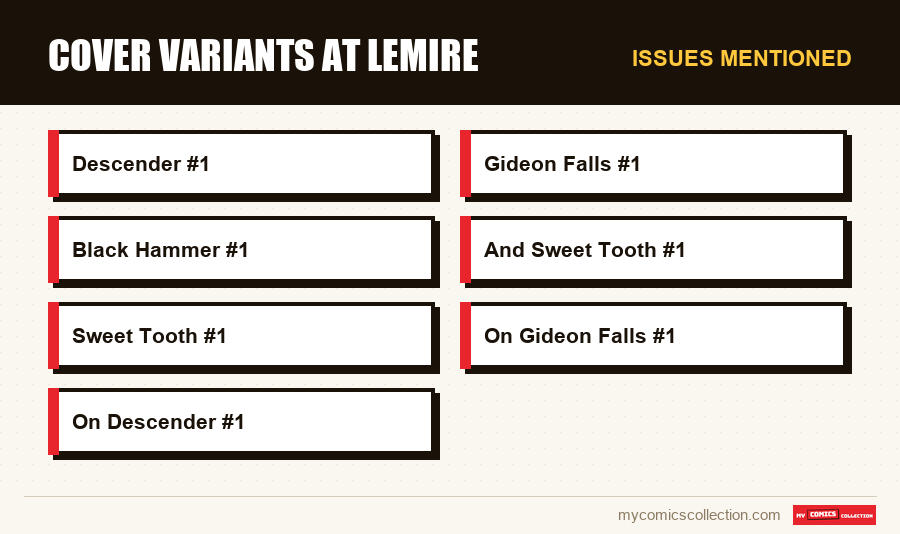
Les quatre relevés
Descender #1: the variant costs less
Standard : médiane 9,99 $ sur 87 annonces (1,25-99,99 $).
Variante : median $8.50 across 27 listings ($1.99-$75.78).
A negative gap of 15%. This is the most counterintuitive result of the survey, and it is not marginal: it concerns 114 advertisements in total.
Gideon Falls #1: a real but modest gap
Standard : median $10 out of 79 listings ($2.95-$150).
Variant: median $12.60 across 38 listings ($2.99 : $99).
26% difference. The most recent title of the four, released at a time when alternative covers had become the norm: hence a plentiful supply.
Black Hammer #1: the most expensive, the smallest difference
Standard : median $12.98 from 103 listings ($1.99-$149.99).
Variant: median $15 across 31 listings ($1.84-$399.99).
Only 16% difference, although it is the title whose standard coverage is the most expensive. The maximum at $399.99 signals a limited run, not the stock variant.
Sweet Tooth #1: no variation
Standard : median $10 from 115 listings ($2.95-$449).
Variant: no announcements.
The oldest title in the record. When it was released, alternative coverage was not a systematic practice on this type of series, so there is nothing to compare.
Why the gap is so small: when it exists
The expected supplement does not materialize here, and three mechanisms explain it.
The variant is not uncommon
On Gideon Falls #1, 38 variants are on sale simultaneously compared to 79 standard. An object available in dozens of copies at any time cannot command a significant surcharge, whatever its designation.
The standard cover is the reference image
For an author who designs his own covers, the standard East the work. Many readers prefer it, which supports its price and neutralizes the advantage of the alternative.
“Variant” covers very uneven objects
A second cover printed as widely as the first and a ratio edition reserved for large orders bear the same word. Mixed in a median, the first overwrites the second.
The segment is not speculative
These series are purchased to be read. Where speculation is absent, coverage counts less than content, and the gap narrows mechanically.
The Descender case, which deserves attention
A cheaper variant than the standard is not a statistical anomaly: 27 ads is not a negligible sample. Two explanations combine.
The first is the illustration itself. The main cover of Descender #1, painted in watercolor by Dustin Nguyen, is the image that made the series known: the one on the posters, the articles, the shelves. The alternatives, however good they may be, are not that image.
The second is the type of variant in circulation. Some of what is labeled "variant" on this title corresponds to widely available second covers, not constrained prints. They are therefore at least as numerous as the standard, without having the notoriety.
The lesson goes beyond this title: the word « variante » says nothing about the draw. It denotes a different cover, not a rare cover. Confusing the two is the most common mistake in this market.
What to check before paying extra. Three questions are better than the word "variant": at what ratio was the cover distributed, how many copies are currently on sale, and is the illustration the one that identifies the series in readers' minds?
If you can't answer any of the three, you're paying for a word, not an item.
Extreme forks, and what they hide
The maximum of the variant Black Hammer #1 reaches $399.99 for a median of $15. This difference of twenty-six times does not describe the same object.
On a multi-cover title, the high end of the range almost always corresponds to a truly constrained print run: a cover reserved for a convention, a boutique, or distributed at a high ratio. These examples justify their price by verifiable rarity.
The problem is that median and maximum have the same word in ads. A buyer who reads “variant” without identifying which one has no way of knowing which segment they are in. This is precisely what the $15 median demonstrates: the overwhelming majority of variants in circulation are not rare, and only a handful are.
The practical consequence is clear. On these titles, an ad that simply says “variant cover” without specifying which one most likely describes a copy from the current segment, around $10 to $15.
Collecting this series?
Track what you own, what you are missing and what your collection is worth. 7 day trial.
Start my trial →Sweet Tooth, or the variant that didn't exist yet
The total absence of variants on Sweet Tooth #1 deserves more than a mention. It historically situates the practice.
The series is the oldest of the four. When it was published, the alternative cover already existed, but it remained reserved for high circulation titles from major publishers. An author's series launched on a label did not benefit from this treatment: a cover, a print, period.
This is what makes the comparison between the four titles instructive. Sweet Tooth n'a aucune variante, Descender has some without added value, Gideon Falls: the most recent: has 38 on sale simultaneously. We read in this statement the gradual extension of a commercial practice over a decade.
For a collector, this means that a first old issue of this type is collectable without asking the question of coverage: there is only one. Time spent looking for a variation is time wasted.
What to note in your catalog
In this segment, “variant” is insufficient information. Three details make it usable.
What a cover. The letter or the name of the illustrator, never the single word « variante ». This is the only way to find out, later, in which price segment the copy is located.
The ratio, if known. This is what separates a $12 item from a $400 item. This information is rarely included on the comic itself and is lost if not noted at the time of purchase.
The price paid and the date. In a market where the median moves little but where the ranges are wide, knowing what you paid and when is better than any published odds.
A catalog which records “Black Hammer #1 variant” will never tell whether it is the $15 copy or the $400 one. The same specifying the coverage and the ratio answers the question in a second.
Should you buy the variant or the standard?
The survey leads to a simple answer for these four titles: take the cover you like. The price difference does not justify choosing otherwise.
At 16% and 26% extra on two securities, and a negative difference on a third, the choice of coverage comes down to taste and not investment. None of these differences compensate for the risk of paying for an abundant item at the price of a rare item.
There is a nuance to be made for the series still being published. On a recent title whose universe is expanding, a cover can acquire a value that it did not have when it was released, if it represents a character who becomes central. It's a bet on the story to come, not on rarity, and it is not played on completed series like the four noted here.
The only situation where the arbitrage becomes financial is that of truly constrained draws, which we identify by their ratio, and these are not at the median. They demand targeted research, and they pay themselves accordingly.
Questions fréquentes
It's unusual but perfectly explainable. On Descender #1, the main cover is the image that identifies the series to the public, while some of the alternate covers have been widely distributed. A more sought-after and less abundant image logically commands a higher price, whatever its official status.
By its distribution ratio, that is to say the number of standard copies that a bookseller had to order to be entitled to them. Failing that, the number of simultaneous announcements gives a usable indication: several dozen copies on sale at the same time exclude any significant rarity.
Because the note would then weigh more than the cover and distort the comparison. Staying with raw copies, the only variable that changes between the two groups is the illustration: which is precisely the purpose of the measurement.
On the contrary, it is simpler to collect: just one cover, no research to carry out, no risk of paying an unjustified extra. Sweet Tooth #1 also asks for a median comparable to that of the titles which have it.
No, these are asking prices recorded on August 28, 2026: announcements in progress, not concluded transactions. They indicate what sellers hope to get, which is usually more than the price actually paid. They are used to compare segments with each other, not to estimate a specific example.
« Variante » is not enough to identify an item
What coverage, what ratio, what price paid: three pieces of information that separate a $15 copy from a $400 copy.