Concluding a comedy that has become an epic poses a problem that few works solve: you have to satisfy two contracts at the same time. A reader who comes for laughter expects his characters to escape; a reader who has come for the epic expects the stakes to be paid. This ending chooses to hold the two apart: the comic figures survive, ancient history ends with losses, and the two registers leave each other without contradicting each other.
It is the part of the work that is least commented on and the one that best reveals what its construction made possible.
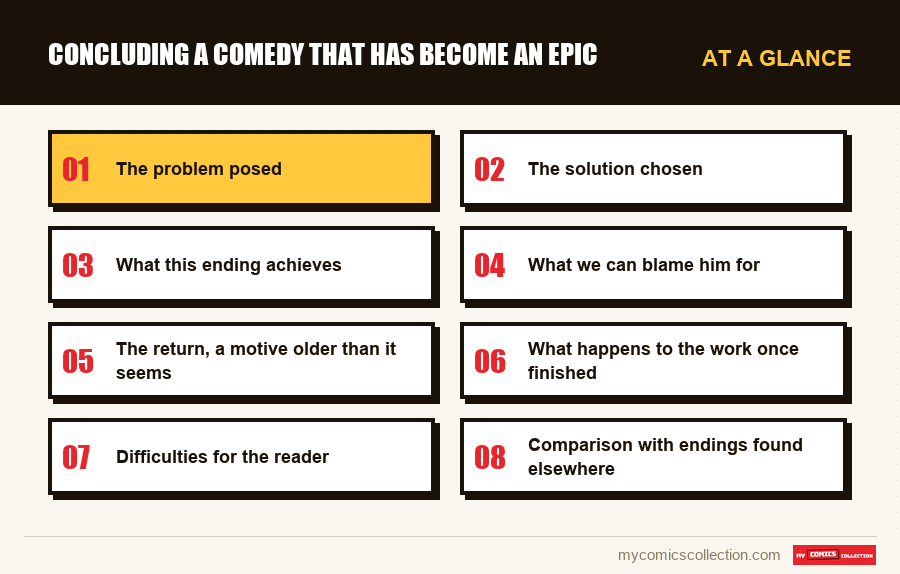
This article sets out the problem posed, the solution adopted, what it achieved, what we can criticize it for, and why an end was necessary.
The problem posed
A work that has changed its nature along the way must conclude two stories, and they do not call for the same ending.
Comedy calls for a return. Characters who leave a place return there, the initial situation is reestablished, and we can imagine that it will start again. This has always been the structure of comic storytelling.
The epic calls for a price. An issue of this magnitude cannot be resolved without cost, otherwise it would never have existed. There must be losses, and they must be permanent.
These two requirements are contradictory if applied to the same characters. To kill the comic figures would betray the comic contract; To have them triumph without damage would betray the epic contract.
Most works in this situation choose one side, and disappoint the other half of their readers.
The solution chosen
Separate registers at output
Comic figures survive and move on; the characters in the epic pay the price. Each register receives the end that its nature calls for.
This is a simple solution and rarely used, because it assumes that the two groups have been distinct from the beginning.
A return that cancels nothing
The protagonists return from where they came, in accordance with comic logic, but transformed by what they have gone through, what the story shows without formulating it.
Real losses
The epic ends with deaths and renunciations that nothing compensates for, and the story does not soften them.
A final volume with a mixed tone
The two registers coexist until the end, without either taking over: consistent with the thousands of pages that precede.
What this ending achieves
Three things, the last of which is the most difficult.
It honors the time invested. A reading of several thousand pages calls for a conclusion that unites, and the threads launched very early find their resolution here: which supposes that they have been held for thirteen years.
She does not deny the beginning. The tone of the first pages is not presented retrospectively as a naivety that has been overcome. Comedy was not a disguise that was removed at the end.
She lets the world go on. The people of the valley stay with their story, which doesn't end because three strangers leave. The story ends without the world ending.
This last point is the rarest. A conclusion which closes everything gives the feeling of a dismantled setting; this leaves the sensation of a place where life goes on without us, which is infinitely more difficult to produce.
What this ending owes to the overall structure. The solution-separating the registers at the exit-is only possible because the two groups of characters have been kept distinct throughout the work.
A homogeneous distribution would have made this conclusion impractical: it would have been necessary to decide. The ending therefore does not resolve a problem, it reaps what a decision taken in the first volume had made possible.
What we can blame him for
We must be frank, because this ending is not unanimously admired and the criticisms are well-founded.
A rapid resolution of the main issue. After a build-up of several volumes, the denouement of the central threat occupies few pages compared to what preceded it.
Late and dense explanations. A part of ancient history is delivered as a whole in the last volumes, a process which contrasts with the patient distillation employed until then.
A long goodbye. The story takes up a lot of space to end once the issue has been resolved, which is consistent with the comic register of the return but stretches the ending.
These three criticisms are consistent and they describe the same difficulty: bring together two stories with different rhythms in a single final movement. That the seam is visible in places is not surprising.
The return, a motive older than it seems
The form chosen for the protagonists' exit deserves to be situated, because it is not arbitrary.
The travel story that ends with a return to the starting point is a very old pattern. It has a property that few other structures have: it allows us to measure change by showing the immobility of what has not moved.
A character who returns to an unchanged place notices in one box everything that has happened within him, without any comment being necessary. The decor does the job.
This is exactly the use made here, and it elegantly resolves the constraint mentioned above: showing an inner transformation in characters whose features have not changed.
The process has a counterpart that the end assumes: it requires slowness. A sent return produces no effect, which explains the length of the release that some readers criticize the work.
What happens to the work once finished
A practical consequence of this conclusion deserves to be noted, because it changes the status of the whole.
A completed series is recommended differently than a current series. We can announce its exact length, guarantee that it is successful, and affirm that no volume will ever be missing: three assurances that carry weight with a reader who hesitates to commit.
This is probably what explains the commercial longevity of the work after its conclusion. A finished object sells indefinitely, whereas an ongoing series depends on its timeliness.
This also applies to libraries and prescribers, who happily buy a complete set and are wary of a series that they don't know where it will end.
The decision to conclude, which seemed costly in the short term, therefore turns out to be favorable in the long term: an observation which contradicts the dominant commercial intuition and deserves to be noted.
Collecting this series?
Track what you own, what you are missing and what your collection is worth. 7 day trial.
Start my trial →Difficulties for the reader
Long memory required
Resolutions refer to elements posed thousands of pages earlier, without any reminder.
Unusual density
The final volumes deliver a lot of information at once, after years of distillation.
Uncompensated losses
Some conclusions are harsh and the story does not soften them, which is surprising given the overall tone.
A stretched outing
The aftermath occupies a place that busy readers find excessive.
Comparison with endings found elsewhere
Situating this conclusion among the usual solutions helps to see what it avoids.
The open ending deliberately leaves elements unresolved, generally to accommodate a sequel. It has the advantage of closing nothing and the disadvantage of concluding nothing: the reader who has invested years remains without an answer.
The end by escalation resolves the issue by going beyond it: a greater threat appears, and the previous one becomes secondary. The process pushes the problem away without treating it.
The end by cancellation restores the initial situation, often by means external to the story. It satisfies the comic contract and destroys all stakes in retrospect.
None of these three solutions is used here, and that is already remarkable. The chosen ending resolves what was stated, with the means installed in the story, by paying the advertised price.
It seems the least of things. This is in reality the exception, and the merit of this conclusion lies much less in its formal invention than in its simple holding over time.
Why an ending was necessary
The question deserves to be asked, since there was no obligation to conclude a series that worked.
The story is based on a progressive transformation: the world darkens, the stakes rise, the characters become more involved. Continuous transformation cannot last forever: it reaches an end, or it cancels itself out by repeating itself.
Prolonging would therefore have meant going back, re-establishing a light situation in order to darken it again. That's what endless streaks do, and it destroys the value of the first climb in retrospect.
Added to this is the question of control: the work belonging to its author, no one could demand its continuation. The possibility of concluding was included in the mode of publication, as we observe elsewhere in this campaign among other authors who own their work.
The result is a finished whole, which is valuable to a reader: one can read it completely, know that one has read it, and recommend it without reservation on this point.
What to record
On a conclusion which brings together threads laid very early, the sheet must provide what memory cannot.
The questions left open at the end of each volume, formulated in one line. This ending answers questions posed thousands of pages earlier, without recalling them, and a reader who has forgotten the question does not recognize the answer. He then goes through a resolution without realizing that it is one.
This is the only way to measure, upon arrival, what the work has actually concluded and what it has left aside.
Your appreciation of the last volume, noted before reading external opinions: this ending divides, the available comments are clear-cut, and it is easy to retrospectively adopt a judgment that was not one's own.
These two mentions address the problem specific to long works-the gap between what one has read and what one remembers-that nothing else compensates for.
Frequently asked questions
By separating the registers at the exit: the comic figures survive and leave, the epic characters pay the price. Each group receives the end that its nature calls for. This is simple and rarely possible: the two groups must have been kept distinct from the beginning.
It is mixed, like the rest of the work. The protagonists cope in accordance with the comic logic of the return, but the epic ends with deaths and renunciations that nothing compensates for and that the story does not soften.
Three well-founded things: a rapid resolution of the central issue in view of the rise which preceded it, late explanations delivered en bloc while the story patiently distilled until then, and a long farewell after the outcome. All describe the same difficulty: bringing together two stories with different rhythms.
Because the story is based on a progressive transformation, and a continuous transformation cannot last indefinitely: it reaches an end or is canceled by repeating itself. Prolonging would have meant restoring a light situation in order to darken it again, which would have destroyed the value of the first rise.
Open questions along the way. This ending answers questions posed thousands of pages earlier without ever recalling them: a reader who has forgotten the question does not recognize the answer and goes through a resolution without perceiving that it is one.
What questions remained open?
Anyone who has forgotten the question does not recognize the answer, and nothing in the last volumes reminds us of it.