A profitable comic convention in 2026 is planned three weeks out, not the night before. A want list exported from your collection management app, a ranked wishlist with a per-issue budget cap, photos of the duplicates you want to sell, negotiating a 15 to 25% discount on Sunday after 4 p.m., a dealer table starting at $180 for sellers, and CGC Yellow Label signatures with an on-site witness for the major guests (Todd McFarlane, Frank Cho, Mark Brooks at Paris Comic Con 2026). Master these six levers and a weekend that would have cost $400 turns into a break-even, or even profitable, operation.
French comic conventions have scaled up since 2023. Paris Comic Con drew 124,000 visitors in October 2025, the Lyon Pop Culture Show tripled its attendance in three years, and both Toulouse Game Show and Marseille Comics & Games have cemented their standing as regional events pulling more than 30,000 entries. For the collector, that density creates buying opportunities you won't find in a shop: exclusive variants, CGC slabs at negotiated prices on Sunday evening, official signatures from American creators who won't be back in France for another three years. But it also multiplies the traps. An unprepared buyer spends, on average, 38% above the eBay secondary market over a single weekend, according to feedback from the CGC Society France community.
This guide explains how to approach a comic convention as a strategic collector rather than an impulse visitor. Logistical prep three weeks out, a negotiation method proven on professional dealer tables, the exact mechanics of landing a CGC Signature Series autograph on site, a comparison of France's four major conventions in 2026, and tracking your purchases through the mobile app to avoid duplicates. Every step draws on figures gathered in 2024 and 2025 from the permanent dealers at Paris Comic Con, the Lyon Pop Culture Show, and Marseille Comics & Games.
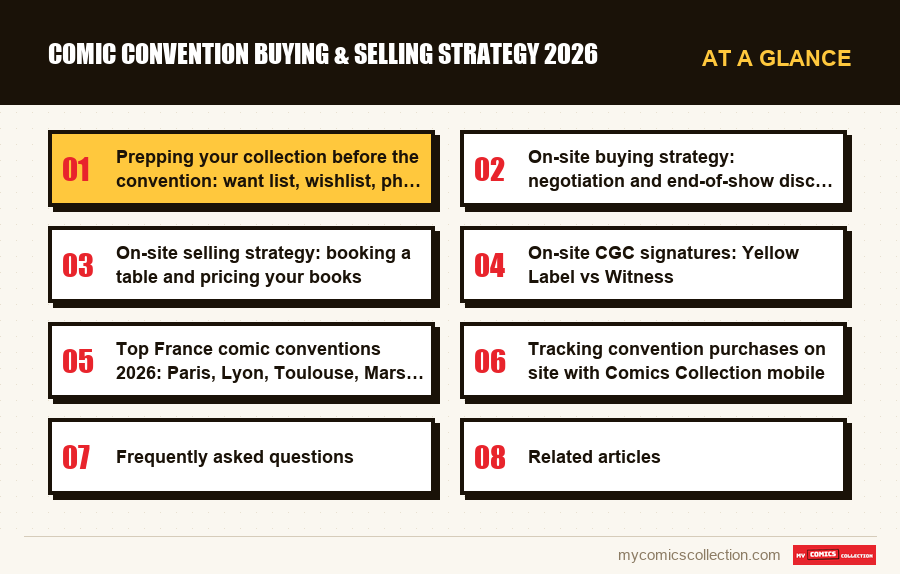
Prepping your collection before the convention: want list, wishlist, photos
The golden rule that experienced collectors live by fits in one sentence: if you walk into Paris Comic Con without a list, printed or pulled up on your phone, you'll burn 40% of your budget on redundant or off-priority buys. Useful prep starts three weeks before the event by exporting your full inventory from your management tool. In the Comics Collection app, a CSV export sorted by series and issue number fits on three A4 pages printed double-sided: a format dealers can scan quickly when you ask whether they have the issue you're missing from a run in progress.
The ranked wishlist is the second document you need. Three columns: title and number, minimum acceptable condition (raw NM or CGC 9.4 minimum, for example), and a per-piece budget cap. For a two-day convention with an overall budget of $800, a typical allocation looks like $350 on priority key issues (two or three pieces), $300 on filling open runs (eight to twelve mid-grade issues), and $150 held in reserve for opportunities you didn't see coming. That budget discipline avoids the classic Sunday-noon scenario where you realize you've spent $600 on variants with no long-term upside and have only $200 left for the CGC slab you spotted first thing Saturday morning. To understand which comics truly deserve a convention investment, read our complete CGC grading guide before you go.
Photographing your duplicates is the third pillar. Every comic earmarked for sale or trade should be shot front and back in neutral light, with a ruler or a coin for scale. Stored on your phone, these shots let you pitch a trade-in to a dealer without hauling the books around physically, and let you respond on the spot to a private buyer you cross paths with in a line. Professional dealers will often take 30 to 50% of the shop sale price as an instant trade-in on a comic in NM, which can finance a meaningful chunk of your convention buys without pulling out extra cash.
On-site buying strategy: negotiation and end-of-show discounts
A comic convention follows an inverted price curve every permanent dealer knows by heart. Saturday morning between 10 a.m. and 1 p.m., the prices on display match average eBay completed sales, sometimes 10% above for show-exclusive variants. Saturday afternoon brings the first marginal negotiating window, 5 to 10% on mid-grade pieces. Sunday morning, dealers start recalibrating to avoid packing up unsold stock. Sunday after 4 p.m., end-of-show discounts reach 20 to 30% on non-premium pieces, and 10 to 15% on high-end CGC slabs. This pattern holds from one convention to the next, from Paris Comic Con to Marseille Comics & Games.
The negotiation method that works comes down to four principles. First principle: always ask for the "cash" price on a stack of at least three comics, never on a single book. A dealer will grant 15% off a $200 lot more readily than 10% off a single $60 comic, because the volume margin offsets the per-unit concession. Second principle: show your printed want list to signal that you're a serious buyer and not a passerby. Third principle: avoid a head-on dispute over grade or condition, and instead make a factual counter-offer anchored to a recent comparable sale. Fourth principle: close or walk away in under five minutes: the dealer appreciates a quick decision and often throws in an implicit bonus (a free mylar, an acid-free board) for the customer who doesn't waste their time.
CGC slabs follow a different logic. On that segment, negotiation rarely moves more than 8% off the marked price because the market value is known precisely through GoCollect and the CGC Census. That said, on Sunday evening a dealer may take 12 to 15% off a slab whose grade is slightly below the registry average (a 9.6 on an issue where the 9.8 is still attainable at 30% more). Before finalizing a slab purchase at a convention, always verify the CGC certification number on the official site from your phone: 0.3% of slabs circulating at conventions show census anomalies or swapped labels. To compare the convention price against the online market price, cross-check with our analysis of Whatnot vs eBay for selling comics.
On-site selling strategy: booking a table and pricing your books
Selling at a convention rather than buying flips the financial equation but calls for different logistics. The cost of a table varies by event: $180 for the full weekend for a half-table at the Bourse aux comics at the Mutualité in Paris, $350 for a standard table at the Lyon Pop Culture Show, $580 for Paris Comic Con in the artist zone off the main aisle. That entry cost means a seller has to generate at least $1,200 in gross revenue over the weekend to absorb the table, travel, and lodging and hit break-even. Below that, you're better off going through Whatnot or eBay from your couch.
Table booking happens six to nine months ahead for the major conventions. Paris Comic Con opens exhibitor registration in March for the October edition, with a waitlist forming as early as April for the merchant zone. Lyon Pop Culture Show runs in May-June for the November session. Toulouse Game Show and Marseille Comics & Games handle their bookings in-house via a web form with manual approval. The required legal status varies: a sole-trader registration is enough for occasional sales declared as non-professional business income, but a volume above $10,000 a year requires an actual commercial entity. Our guide to buying and selling comics in France breaks down the tax obligations by profile.
Pricing on a convention table follows a simple rule of thumb: list raw comics at 85% of the median eBay completed price, CGC slabs at 95% of the CGC Marketplace price, and mentally accept 10 to 15% of negotiating room. The classic rookie-seller mistake is to price at the listed eBay price (not the completed price), which puts off 80% of potential buyers at first glance. Presentation matters as much as price: mylar with a board for key issues, a handwritten label with title, number, and estimated grade, a display tilted to 30 degrees rather than a flat stack. A buyer who can't read the title from the aisle walks right past. For regular sellers, also compare the auction options through ComicConnect vs Heritage Auctions, which can yield a better return on premium pieces above $2,000.
On-site CGC signatures: Yellow Label vs Witness
For the first time, the 2026 French conventions will host an official CGC Signature Series program at Paris Comic Con, with a dedicated facilitator and Yellow Label slabs returned within eight to twelve weeks. This official footing transforms the economics of a convention signature: an Amazing Spider-Man #300 raw NM signed by Todd McFarlane on site and certified CGC Signature Series Yellow Label resells for an average of $2,200, versus $1,400 for the same comic signed without certification. The Yellow Label certification premium therefore delivers a positive return on investment the moment the signature obtained is worth more than $200.
The exact Yellow Label mechanics at a convention impose four mandatory steps. First, the comic must be presented at the facilitated CGC Signature Series booth before the signing, never after. Second, a certified CGC witness physically observes the signing at the guest creator's table. Third, the comic is immediately placed in a sealed sleeve with a tracking number. Fourth, the shipment to Sarasota, Florida goes out as a grouped batch via the facilitator, with delivery to the customer's home three months later. The total Yellow Label cost for a modern comic runs around $90 to $110 depending on the tier chosen, on top of the cost of access to the signing session, which can reach $80 to $200 for major guests like Todd McFarlane or Jim Lee.
The more flexible Witness Series alternative means having the comic signed with the creator and then sending it to CGC later, accompanied by a sworn statement signed by a witness present at the signing. This route costs less in facilitation fees but is legally more fragile: CGC may decline the Yellow Label certification if the documentation is deemed insufficient, in which case the slab gets a standard Blue Universal label without the authenticated-signature notation. To understand the difference in valuation between the two options, our Yellow vs Witness comparison details the price gaps by creator and by market segment.
Top France comic conventions 2026: Paris, Lyon, Toulouse, Marseille
Paris Comic Con 2026 runs October 23 to 25 at Paris Expo Porte de Versailles, with a beefed-up comics program after the success of the 2025 edition, which drew 124,000 visitors. Confirmed guests include Todd McFarlane on Saturday, Frank Cho on Sunday, and a Marvel and DC line-up still being negotiated. The merchant zone occupies 4,200 square meters across two halls, with roughly 180 comic dealers, about thirty of them premium booths dedicated to CGC slabs and key issues. Average two-day budget for a visitor, excluding transport and lodging: $320 for a casual attendee, $850 for the collector targeting specific pieces. The two-day pass costs $58 in pre-sale, $75 at the door.
Lyon Pop Culture Show takes the late-November 2026 slot at Eurexpo, with a steady upgrade to its comics offering since 2023. Three second-tier American creators confirmed, around 80 comic dealers, about ten of them CGC specialists. The convention draws a mixed Franco-Belgian BD and US comics crowd, which creates buying opportunities on imported Marvel and DC variants that are less hunted than in Paris. For a rundown of the local Lyon scene outside the convention, read our Lyon comic collector guide 2026.
Toulouse Game Show Springbreak in April and TGS Autumn in November 2026 keep a modest but growing comics offering: 35 to 50 comic dealers depending on the edition, with a pronounced focus on indies and alternative publishers (Image, Boom, Vault). Marseille Comics & Games runs in May 2026 at the Parc Chanot with around 60 comic dealers and a strong presence of Mediterranean shops (Nice, Aix, Marseille). The value for money on modern raw comics is better there than in Paris, with local dealers under less margin pressure. To plan your trip, see the Toulouse 2026 guide and the Marseille 2026 guide. The permanent Paris shops are an alternative or a complement, detailed in Paris comic shops 2026: top 10 verified.
Collecting this series?
Track what you own, what you are missing and what your collection is worth. 7 day trial.
Start my trial →Tracking convention purchases on site with Comics Collection mobile
The costliest convention mistake is still buying duplicates. A collector who owns more than 800 issues spread across forty open runs does not have the exact number of every missing book memorized. Without a mobile tool to consult in the aisle, the inevitable scenario unfolds: back home, you check the long box and discover three comics needlessly re-bought at $15 apiece. Over a convention weekend, that waste easily adds up to $50 to $80 in dead losses. The mobile app solves this in two moves: search by title or barcode scan right at the booth, and immediate visual confirmation that the comic is missing from your inventory.
The Comics Collection app also helps in the field in three ways. First, marking each purchase on the spot with a photo of the comic and a "Convention Paris Comic Con 2026" tag, which lets you later trace the provenance and acquisition cost of each piece for resale gain calculations. Second, wishlist syncing, so the priority comics you are hunting are on your phone at every dealer's table. Third, a CSV export after the weekend, from which you can total what you spent, break it down by series, and compare it with your planned budget. To set up this kind of structured management, see our complete Comics Manager guide.
Beyond purchase tracking, the app also serves as a reference for on-site negotiations. When a dealer marks a Hulk #181 raw VG at $850, immediate access to the median of current eBay listings through the valuation tab lets you respond with facts: the $720 median justifies a documented counter-offer at $750. This informed-collector stance fundamentally shifts the buying dynamic. To go further on valuation, our free valuation tool covers 47,000 referenced issues, and the built-in worldwide catalog lets you cross-check CGC references and current prices before any important negotiation. Finally, to anticipate the exclusive variants announced at conventions, follow our comic pre-order investment strategy coverage of high-potential releases over the next six months.
Frequently asked questions
Three weeks is the minimum useful lead time for a serious collector. The first week is for exporting your full inventory and ranking your wishlist with budget caps. The second week is for photographing the duplicates earmarked for sale or trade and checking the listings of dealers already announced on social media. The third week finalizes logistics: pass bought in pre-sale (a 25 to 30% saving), a route between priority booths, and the mobile app updated with the latest sync. Prep crammed into the 48 hours before departure produces, on average, 40% off-priority buys and a 25% budget overrun.
Sunday after 4 p.m. remains the prime window for meaningful discounts, with cuts of 20 to 30% on non-premium pieces and 10 to 15% on mid-range CGC slabs. Saturday morning between 10 a.m. and noon is good for spotting pieces and making contact, without expecting a notable discount. For key issues marked above $1,000, negotiation stays capped at 5-8% whatever the hour, because the dealer knows the market value precisely through GoCollect. Avoid negotiating in the Saturday-afternoon crush: the dealer will favor the next visitor ready to pay full price.
For an occasional sale under $3,000 in annual revenue, the rules for casual sales between individuals apply, declared as non-professional income on the 2042 C return. Above that, sole-trader status becomes mandatory, with registration in the trade register and VAT declaration if you exceed the base-exemption threshold. The major conventions (Paris Comic Con, Lyon Pop Culture Show) now require a valid business registration or company number to book an exhibitor table, which effectively shuts out sellers with no entity. Association-run shows like the Mutualité in Paris remain open to individuals with light paperwork.
Yes: the average premium of a Yellow Label over a Witness for the same comic signed by a premium creator runs between 15 and 25% on the secondary market. That premium is justified by the full traceability of the signature: a CGC facilitator physically present, a certified witness, immediate sealing. The Witness route remains useful for signatures obtained outside a convention or without a facilitator, but it takes a slight discount whose size depends on the creator's profile and the quality of the documentation produced. On superstar signatures like Todd McFarlane or Jim Lee, always favor the Yellow Label if the convention offers it.
Budget $1,100 to $1,400 all-in for an active Paris-based collector over two days. The typical breakdown: $75 for the two-day pass, $600 to $850 in comic purchases, $90 to $150 in signatures with CGC facilitation on a major creator, $80 in food and drinks on site, $60 in transport and parking, and the remainder held in reserve for opportunities. A collector coming from out of town adds $200 to $350 in lodging and transport. This envelope lets you leave with three to five significant pieces and a certified signature: a coherent collector return. Cutting this budget below $600 is possible but sharply limits your room to maneuver on signatures and slabs.