Being a comic collector in Toulouse in 2026 means working a fabric of five active neighborhoods (Capitole, Saint-Cyprien, Carmes, Compans-Caffarelli, Saint-Michel), one major annual fixture: the Toulouse Game Show (TGS) in December at the MEETT exhibition center, and half a dozen comic fairs across Occitanie spread throughout the year. The regular collector population across the metro area is estimated at between 1,500 and 1,800 buyers, with a mixed profile spanning US comics, Franco-Belgian BD, and manga. The winning method is to combine brick-and-mortar shops, regional conventions, and digital cataloging through a tool like My Comics Collection to track missing issues and valuations.
Toulouse holds a singular place on the map of French comic collecting. The country's fourth-largest metro area is home to a dynamic pop culture scene, built around a large student population (110,000 students), an aerospace community drawn to American references, and a strong network of associations centered on BD and manga. Yet unlike Paris or Lyon, Toulouse has never consolidated a single comics flagship: the offering is spread across several neighborhoods, each with its own editorial specialty. This guide maps out the buying zones, the 2026 convention and fair calendar, the active communities, the typical Toulouse collector profile, and the method for organizing a regional collection with a dedicated tool.
The challenge for the Toulouse collector in 2026 is threefold: maximize the return on local shops (often generalist, with a limited comics section), tap the regional convention calendar for back issues and the secondary market, and structure cataloging to avoid scattering across formats: French-language Lug/Panini editions, recent US floppies, and Franco-Belgian BD. And all of this without falling into double-buying or losing track of pieces stashed between physical boxes and outdated spreadsheet files. To place the Toulouse approach within a national framework, comparing it with Bordeaux and Montpellier remains the best compass.
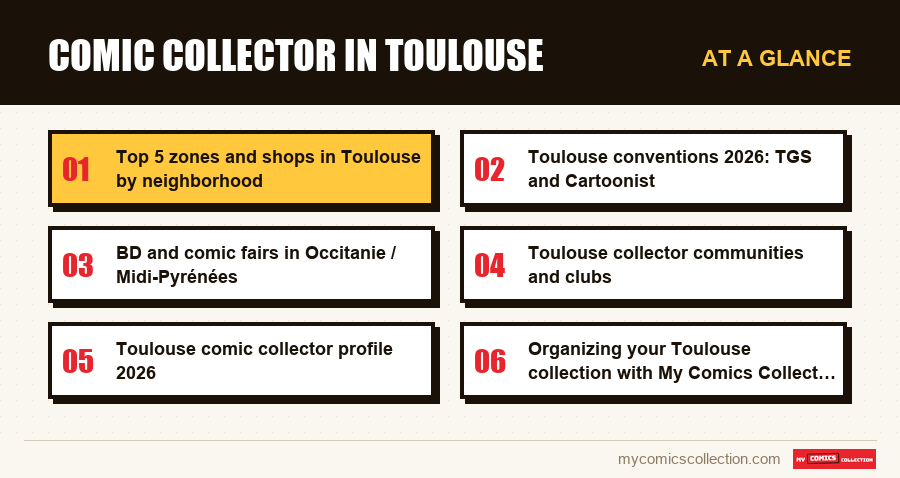
Top 5 zones and shops in Toulouse by neighborhood
The geography of comic buying in Toulouse reads across five neighborhoods. Each corresponds to a particular type of store and a particular kind of inventory. The methodical collector plans a route based on the nature of the piece being hunted: new US floppies, French-language Panini runs, Bronze Age back issues, complementary Franco-Belgian BD, or rare seinen manga. The breakdown below follows the historic commercial activity zones without naming individual stores whose survival into 2026 isn't guaranteed.
Zone 1: Capitole and city center. The Capitole district concentrates the most visible generalist BD bookshops, with heavy tourist and student traffic. For the collector, this is the zone for current Panini France, Urban Comics, and Delcourt releases, plus recent Franco-Belgian collected editions. The US comics in their original-language editions remain limited here (300 to 800 references depending on the store) but it lets you pick up the month's floppies. Prices track French retail, with no pre-order discount equivalent to the Diamond Previews system used by specialized Paris shops. Upside: central location and long opening hours (10 a.m. 7 p.m. on weekdays, Saturdays included).
Zone 2: Saint-Cyprien, left bank. A neighborhood in transition, Saint-Cyprien is home to several independent bookshops geared toward alternative BD, indie comics, and fanzines. The targeted collector profile here is more discerning: Fantagraphics, Drawn & Quarterly, L'Association, Cornélius, plus a broader seinen-josei manga section than the city center offers. This is the address to prioritize for readers expanding their collection beyond classic superheroes. Back issues remain scarce here, but the editorial advice is top quality.
Zone 3: Carmes and Esquirol. A mixed neighborhood spanning specialty shops and secondhand booksellers, Carmes is historically Toulouse's back-issue zone. This is where you'll haggle over 1970s-1990s Lug and Strange French editions, 1980s J'ai Lu BD, plus Bronze Age and Modern Age US comics at negotiable prices. Opening hours are tighter (often Tuesday-Saturday, 11 a.m. 7 p.m.), and stock turnover depends on collection consignments coming in. For key issues, check the Amazing Spider-Man key issues before your visit to prep your price grid.
Zone 4: Compans-Caffarelli. A more outlying zone but accessible by metro, Compans-Caffarelli is home to stores geared toward crafts, games, and pop culture goodies. The comics section is often secondary but complementary: exclusive variants, figurines, art books, lithographed posters. For the collector who combines comics with merchandise (a common profile in Toulouse given the weight of the aerospace ecosystem drawn to American references), this is a zone to fold into the annual circuit.
Zone 5: Saint-Michel and southern faubourgs. A more student-heavy, residential neighborhood, Saint-Michel hosts a few neighborhood BD bookshops with modest stock but genuine expertise in Franco-Belgian BD and manga. For a collector rounding out a comics collection with European BD (Moebius, Bilal, Pratt), it's an overlooked but useful option. Opening hours are irregular: check online before making the trip.
To catalog acquisitions from these five zones efficiently, using a dedicated cataloging tool helps avoid scatter. See cataloging comics: method and guide for the full procedure.
Toulouse conventions 2026: TGS and Cartoonist
In 2026, Toulouse has a tight but structuring convention calendar for the regional collector. Two main events concentrate the bulk of the local secondary market: the Toulouse Game Show (TGS) at year's end and the Cartoonist festival in spring.
Toulouse Game Show (TGS). The Toulouse Game Show is the flagship pop culture event in the Southwest. The 2026 edition is announced for December at the MEETT exhibition center in Aussonne, northwest of Toulouse. Attendance swings between editions from 70,000 to 90,000 visitors over two to three days, peaking on Saturday afternoon. The format blends gaming, manga, cosplay, TV series, and comics, with around twenty dealers specializing in comics spread across the market floor. The comics density is lower than at Paris Comic Con (50 booths) or Lyon (15-20 booths), but average pricing is more affordable and the negotiation room is wider.
The expected TGS 2026 price grid: day pass €22-28, weekend pass €39-45, VIP pass €79-99 (early access, priority line). For a collector hunting key issues, arriving at Saturday opening remains the optimal window. Dealers grant 10-20% discounts on unsold stock on Sunday afternoon, mainly on 2015-2024 moderns and new TPBs. The active secondary market mostly covers recent Panini-Urban French editions, mid-grade CGC slabs (CGC 9.0-9.4 under €1,000), and modern variants. See CGC Signature Series at conventions in France for the signature strategy.
Cartoonist Festival Toulouse. The Cartoonist festival is a BD- and illustration-focused fixture, more under-the-radar but high quality, traditionally held in spring in the city center. The format differs from TGS: less gaming, more signings, and a greater share of small independent publishers and fanzines. For a collector branching out into Franco-Belgian BD or indie comics, it's a chance to pick up signed original editions or limited print runs. The secondary market is less structured here, but good deals are possible on emerging artists.
To structure your convention monitoring and avoid duplicates on the spot, the missing comics module lets you scan a barcode in three seconds and check whether you already own the issue. In Toulouse as everywhere else at a convention, 4G/5G coverage is often saturated inside the halls: have your missing-issues list ready in an offline version.
BD and comic fairs in Occitanie / Midi-Pyrénées
The network of BD and comic fairs across Occitanie rounds out the convention calendar and gives access to a less standardized but more negotiable secondary market. The typical format is a community hall or municipal market building, with 20 to 60 private and professional exhibitors, on a single Sunday. Fairs traditionally cluster outside school holidays: September-November, then February-May.
The cities usually active in Occitanie / Midi-Pyrénées are Toulouse proper (two to three fairs a year, with the calendar circulated through local BD associations), the Toulouse metro area (Colomiers, Blagnac, Muret), Albi, Castres, Montauban, Auch, and Tarbes. Over in the former Languedoc-Roussillon part of Occitanie, the fairs in Montpellier, Nîmes, and Carcassonne also draw Toulouse collectors, with reasonable 1.5- to 2.5-hour trips over a weekend. See comic collector Montpellier: 2026 guide for the lay of the land on the Hérault side.
The price profile at a fair differs noticeably from a brick-and-mortar shop. Three notable gaps. First gap: 1970s-80s Lug-Strange-Nova French editions. At a fair, the average price drops 15 to 30% versus a specialty shop, because private sellers are more open to haggling and don't factor in the fixed costs of a commercial space. Second gap: recent new French-language comics (Panini, Urban). They stay rare at fairs, since private individuals hold onto recent releases. When they do show up, it's generally at shop price or slightly below. Third gap: CGC slabs. Very rare at regional Occitanie fairs, since pieces above €500 tend to go through eBay or ComicConnect instead. When you do find one, cross-checking against the 90-day price should be automatic: see free appraisal.
To prep for a fair, the method is the same as for a convention: exported missing-issues list, reference price grid, per-piece and overall budget caps, and a quick assessment sheet to gauge condition. For the full condition-grading method, see grading comics from outside the US: guide.
Worth remembering: at an Occitanie fair, bundle negotiation is almost always accepted. Buying three to five issues from the same booth often unlocks a 15-25% discount on the lot. Plan your mental bundle before announcing your intent to buy as a group: it's the most effective lever against a private seller who wants to lighten their box rather than maximize the per-unit price.
Toulouse collector communities and clubs
The Toulouse community fabric around comics is built on three complementary channels: in-person associations, regional online groups, and informal events on the fringes of conventions. The collector who invests in this network gains intel on new arrivals, access to collector-to-collector resales, and reference points for assessing condition before buying.
Toulouse BD-comics associations. Toulouse has several active associations around BD and pop culture, some focused on the broader ninth art, others more specifically on American comics or manga. These groups organize monthly or quarterly meetups, sometimes in partnership with a bookshop, sometimes in municipal association spaces. The upside for the beginning collector: direct access to veterans who can explain the French/original-language distinction, the market's key figures, and the pitfalls to avoid on first acquisitions. See protecting comics: conservation guide for the practical basics covered at meetings.
Regional online groups. Facebook and Discord groups dedicated to Southwest comic collectors are active in 2026, with several hundred members in the largest ones. Dominant uses: private sale listings, swapping missing issues, sharing fair and convention tips, and mutual help on assessing condition from photos. The collector-to-collector secondary market on these channels represents a meaningful share of transactions in Lug French editions and Modern Age under €200, often priced 10 to 20% below shops and fairs, but without the guarantee of a physical inspection.
Informal events. On the fringes of TGS and the fairs, informal gatherings come together in Toulouse around the month's new releases, mainly on Tuesdays (the traditional shelf day for new US original-language books transiting through Antwerp). These shifting get-togethers spread by word of mouth and through online groups. For an established collector, plugging into this circuit generally takes six to twelve months but pays off over time through access to collection consignments before they hit the shelves.
The winning discipline is to keep a contacts log (name of the person, series they follow, contact details, next meeting) and sync it with your collection catalog. This linkage turns the Toulouse network into a durable asset, independent of the churn among commercial stores.
Collecting this series?
Track what you own, what you are missing and what your collection is worth. 7 day trial.
Start my trial →Toulouse comic collector profile 2026
The typical Toulouse collector profile in 2026 shows three distinctive traits relative to the French average. Knowing this profile helps you weigh your own collecting choices and anticipate local market dynamics.
Trait 1: pronounced format mixing. The Toulouse collector combines US comics, Franco-Belgian BD, and manga in a single catalog more often than elsewhere. This mix reflects the local editorial ecosystem (BD deeply rooted in historic Occitanie with Albi, Angoulême nearby in the broader Atlantic basin, recurring manga festivals) and the student demographics. The upshot: the need for a multi-format management tool is more pronounced than in Paris, where pure US comics specialization still dominates. See managing BD, manga, and comics across all formats for the method.
Trait 2: a modest but steady average budget. The average monthly budget of a regular Toulouse collector in 2026 falls in the €80-180 range, versus €120-250 for the Paris average. The new-releases-to-back-issues ratio leans toward new releases (60-65%) and French reprints (Urban, Panini Marvel Must Have, collected editions) rather than graded US Bronze Age. The upshot: the long-term investment strategy is less developed, but the consistency of the buying flow is stronger, which favors a regular cataloging discipline.
Trait 3: strong appetite for the MCU/DCU and TV series. The MCU and DCU adaptation effect on buying is more pronounced in Toulouse than in Paris, likely tied to younger demographics and intensive streaming consumption. This shows up as buying spikes on character first appearances the moment a movie or series is confirmed, sometimes without tactical restraint. The recommended discipline: cross-check the impulse buy against a price/value/resale-horizon grid. See comics adaptations: the MCU/DCU spec effect so you don't overpay for a short-lived buzz.
On collection breakdown, the typical Toulouse profile stocks roughly 600 to 1,500 issues in active collection, with a French-edition share of 55-65%, an original-language share of 25-30%, and a BD/manga share of 10-15%. The average catalog value sits between €4,000 and €12,000, with a long tail of collectors above €30,000 in catalog value, mainly in the Bronze Age Lug French editions and premium Modern Age segments. To estimate your own catalog, see free appraisal.
Organizing your Toulouse collection with My Comics Collection
The Toulouse specificity: format mixing, multiple buying points spread across five neighborhoods, a fair calendar stretched across the year, communities active online and off: calls for rigorous cataloging. Without a structured tool, the risk is threefold: double-buying at purchase (estimated at 8-12% of acquisitions for an unequipped collector), loss of traceability on conditions and prices paid, and difficulty exporting a usable missing-issues list for the field. A dedicated platform like My Comics Collection addresses all three problems at once.
Step 1: initial cataloging. Inventory your physical stock issue by issue, starting with the most recent boxes. For each entry, fill in the series, the issue number, the publisher (Marvel, DC, Panini, Urban, Lug, Semic, J'ai Lu BD, Glénat, Pika), the year, the format (US floppy, French digest, collected edition, omnibus, manga tankobon), the condition (Mint, Near Mint, Very Fine, Fine, Very Good), and the acquisition value. This step takes 2 to 4 hours for 200 issues the first time, then speeds up. Barcode-scan entry accelerates the pace. See comics app for the full procedure.
Step 2: logging recurring purchases. Every acquisition at a Toulouse shop, an Occitanie fair, the TGS convention, or an online purchase should be entered within 24 hours, ideally the same evening. This discipline prevents forgetting key details (exact price, actual condition, source dealer) and feeds your transaction history. That history then enables trend analysis over 12-24 months to fine-tune your future buying decisions.
Step 3: field exports before traveling. Before every shop, fair, or TGS visit, export your missing-issues list as PDF or CSV. Download the list offline on your smartphone to handle network saturation at conventions. This list speeds up the buy decision, prevents duplicates, and lets the seller immediately zero in on the area to dig through in their back stock.
Step 4: value tracking. Turn on automatic value tracking for the key issues in your collection. The 30/90/180-day eBay price swings feed your hold-or-sell decisions. For a Toulouse collector who doesn't have Paris-level Bronze Age shop density, this digital monitoring more than makes up for the absence of a local specialty store. See comics: hold long vs. flip short for the trade-off decision.
Catalog your Toulouse collection with My Comics Collection
Scan cataloging, PDF exports for fairs and TGS, automatic value tracking, one account on iOS, Android and the web. Built for mixed collections spanning US comics, Lug-Panini French editions, Franco-Belgian BD, and manga.
Discover the appFAQ: Toulouse comic collector 2026
Which Toulouse neighborhoods have the best comics offerings in 2026?
Four neighborhoods shape the offering: Capitole and city center for current Panini and Urban releases, Saint-Cyprien for indie and seinen manga, Carmes for Lug and Bronze Age back issues, and Compans-Caffarelli for variants and pop culture goodies. Saint-Michel rounds it out with a few European BD addresses. The optimal route combines two to three zones per trip.
When is the Toulouse Game Show (TGS) 2026, and should you go for the comics?
TGS 2026 is announced for December at the MEETT exhibition center in Aussonne. For a comic collector, it's the annual event to put on the calendar: around twenty specialized dealers, an active secondary market in recent French editions and CGC slabs under €1,000, and day passes at €22-28. Have your missing-issues list ready offline before your visit.
Where can you find BD and comic fairs in the Toulouse area?
Several fairs are held each year in Toulouse proper, across the metro area (Colomiers, Blagnac, Muret), and in greater Occitanie (Albi, Castres, Montauban, Auch, Tarbes, plus Montpellier, Nîmes, Carcassonne). The calendar circulates through local BD associations and regional online groups. The active periods are September-November and February-May.
Is the Toulouse comics market cheaper than Paris in 2026?
On current French-language releases, prices track national retail. On Bronze Age Lug French back issues, Occitanie fairs offer 15-30% off versus specialized Paris shops. On CGC slabs above €500, the Toulouse market stays limited and the best conditions are found online or in Paris/Lyon.
How do you efficiently catalog a mixed collection of US comics, French editions, and BD in Toulouse?
Use a dedicated multi-format tool rather than a spreadsheet. Fill in series, issue number, publisher, year, format, condition, and acquisition value. Turn on barcode scanning to speed up entry, and export your missing-issues list offline before every fair, shop, or TGS. See cataloging comics: method and guide.