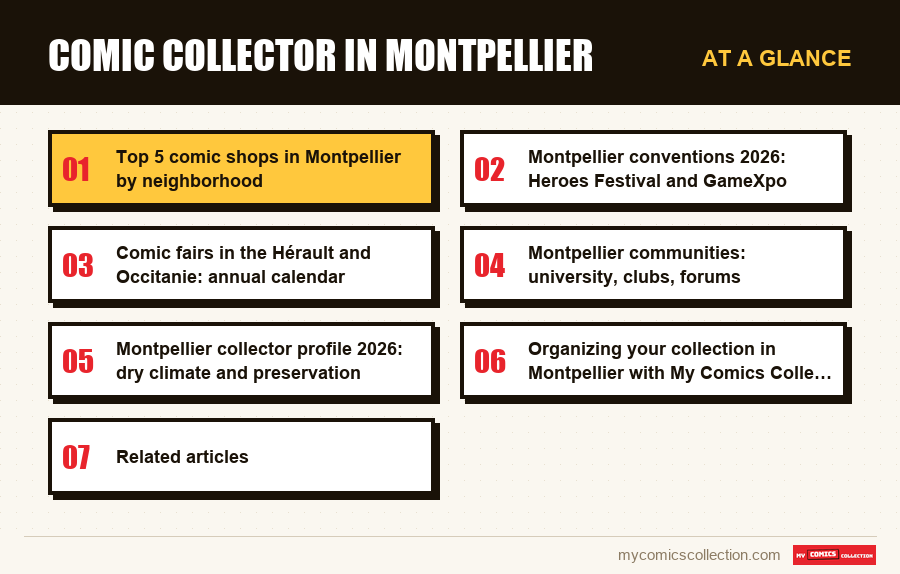
Being a comic book collector in Montpellier in 2026 means working with a regional market concentrated in five neighborhoods (Écusson, Antigone, Beaux-Arts, Boutonnet, Port Marianne), two major conventions (Heroes Festival, GameXpo), a comic fair calendar across the Hérault and Occitanie running from March to November, and a dry Mediterranean climate that favors long-term preservation. The local community draws on the student ecosystem of the University of Montpellier and a handful of active clubs centered on comics and bandes dessinées. To tie it all together, a Comics Manager like My Comics Collection acts as the backbone connecting shop purchases, conventions, trades, and long-term inventory.
Montpellier holds a distinctive spot on the map of French cities for comic book collectors. The country's seventh-largest metro area and capital of both the Hérault and eastern Occitanie, it combines a young population (the lowest average age among France's major cities), a dense student scene built around several universities, a dry Mediterranean climate, and a fabric of comics-and-BD shops spread out by neighborhood. For a collector based here or just passing through, understanding this ecosystem changes how profitable your time on the ground is: the cluster of shops in the Écusson, the schedule of the Heroes Festival and GameXpo conventions, the regional comic fair calendar, and Montpellier's collector communities form a coherent network-provided you grasp how it all fits together.
This 2026 guide maps out the five neighborhoods worth knowing, the two flagship conventions held in the metro area, the regional comic fairs across the Hérault and the wider Occitanie, the sociological profile of the Montpellier collector, the effect of the dry climate on preservation, and the method for structuring a local collection with a Comics Manager. The figures cited come from observations of the regional market, 2024-2026 market trends, and feedback from collectors active in the metro area. The practices described here carry over to other cities in the South of France, but Montpellier has specifics that deserve a dedicated treatment.
Top 5 comic shops in Montpellier by neighborhood
Montpellier doesn't have a single street dedicated to comics, but rather a neighborhood-by-neighborhood spread that follows the city's geography. Five areas shape the offering: the Écusson city center, Antigone, Beaux-Arts, Boutonnet, and Port Marianne. Each corresponds to a buyer profile, a type of store, and a distinct editorial positioning. Overall density stays below that of Paris or Lyon, but it's well above metro areas like Rennes or Strasbourg when measured per collector resident.
Écusson city center. Montpellier's historic core holds the oldest stores and the heaviest foot traffic. The area's comics-and-BD shops typically open Tuesday through Saturday from 10am to 7pm, with a short midday break (12:30-2pm) that remains common in the South. This is where a passing collector will find the most complete mix of US comics (Marvel, DC, Image), Franco-Belgian BD, manga, and figurines. The sellers generally know their Marvel/DC runs in French translation (Panini France, Urban Comics) inside out, with a more limited original-language (VO) stock than the dedicated shops in Paris or Lyon. To compare the retail network with other southern cities, see the Marseille collector guide 2026.
Antigone. The neoclassical district designed by Ricardo Bofill in the 1980s is home to several mainstream cultural retailers. The comics offering here is more generalist: smaller sections in mass-market culture stores, a rotating selection of Marvel and DC releases in French, and few back issues. It's the convenient option for residents of the area, not the destination for a collector hunting key issues. For a buyer rounding out an ongoing Panini series, the choice between Antigone and the Écusson comes down mostly to travel time and opening hours.
Beaux-Arts. The Beaux-Arts district, north of the Écusson, has a student and bohemian population. The area's businesses traditionally include independent bookstores and record shops, sometimes with a comics-and-BD section in mixed culture stores. Collector traffic here is more diffuse, but the neighborhood often serves as a gathering point for communities tied to the art schools, where indie BD, alternative comics, and fanzines all cross paths.
Boutonnet. A historic student neighborhood close to several university campuses. The presence of cafés, bars, and nightlife draws a young crowd, and the cultural businesses here follow that profile with tighter prices and quick turnover on Marvel-DC releases in French. For the weekly group outing, Boutonnet often serves as the student meeting point before a swing through the Écusson for serious buying.
Port Marianne. To the southeast, the modern Port Marianne district is home to families settled in recent housing developments. The retail offering here favors mass-market chains (the Odysseum shopping center, neighborhood retail zones). The comics section stays limited to mainstream Marvel-DC releases in French. It's the convenient buying zone for local residents, but rarely the destination for a dedicated collector.
To bring a want list into the shop before your visit, exporting the per-series selection from your collection app keeps you from buying duplicates. See comics for the structured database.
Montpellier conventions 2026: Heroes Festival and GameXpo
In 2026, Montpellier hosts two major events for collectors: Heroes Festival Montpellier and GameXpo Montpellier. These two conventions anchor the regional calendar with significant combined attendance and a volume of secondary-market transactions that makes preparation worthwhile.
Heroes Festival Montpellier. This multi-city pop culture convention (Heroes Festival runs its format in several French metros) has established itself in the Montpellier area with a classic format: guest actors and authors, comics-manga-figurine exhibitors, a gaming space, and signing sessions. For the collector, there are two uses: guest comic authors or artists make for signatures with immediate added value (between 20 and 50 euros per signature on average in France, excluding CGC witnessing), and the exhibitors bring a stock of regional back issues rarely seen in shops. The convention's logistics call for pre-ordering tickets, planning the signing sessions, and ideally pre-identifying the comics you want signed under official witnessing. See CGC Signature Series at French conventions for the full method.
GameXpo Montpellier. Leaning more toward video games, cosplay, and broad nerd culture, GameXpo draws a crossover crowd of gamers, cosplayers, and comics-manga readers. For the pure comics collector, the event offers less on direct transactions, but it remains useful for community scouting: regional exhibitors test their offerings here, some clubs showcase their activities, and informal encounters help map out the local scene.
For both events, preparation revolves around four points. First: the want list exported from your Comics Manager, so you can work the back-issue exhibitors without redundant purchases. Second: a firm budget, since conventions are psychological settings for impulse buying. Third: planning your signings if an author or artist is announced, registering early for limited sessions. Fourth: identifying the comics to have authenticated under Signature Series if you plan a later CGC submission.
Attendance at both conventions remains mostly regional (Occitanie, Provence-Alpes-Côte d'Azur), which gives a local flavor to the back-issue offering: more 1990s-2000s French editions (Semic, Marvel France, the early years of Panini France) than at the Paris conventions geared toward VO and pro grading. To compare the convention effect across other cities, see the Toulouse collector guide 2026.
Comic fairs in the Hérault and Occitanie: annual calendar
Alongside the pop culture conventions, the Hérault and the wider Occitanie host comic and BD fairs organized by clubs, associations, and local governments. These events, smaller than the national conventions, remain strategic for a collector based in the region because they give access to collections from longtime readers being offloaded locally, often at prices 20 to 40% below closed eBay comps.
The typical annual calendar opens in March-April with the spring fairs held across several towns in the Hérault. The summer stretch (July-August) is quieter due to the heat, vacations, and the tourist crush. September's back-to-school season relaunches the calendar with fall fairs, and November traditionally concentrates the pre-Christmas events, with heavier traffic from buyers looking for gifts or pieces to give.
Three categories of fair stand out in Occitanie. First type: pure BD fairs, organized by local associations, where comics remain a minority (10 to 20% of total stock). Second type: multi-collectible fairs (BD, vinyl, vintage toys, philately), which have the advantage of cross-pollinating buyer pools but spread the focus thin. Third type: mixed BD-comics-manga fairs, more recent, which track the market's demographic shift and give more room to US and French-language comics.
For the collector, the payoff from a regional fair depends on three variables. The density of comics stock present (sometimes low, sometimes exceptional depending on which sellers show up). Whether or not there's a serious Bronze Age and Modern Age selection, knowing that longtime readers often offload their complete collections as bulk lots. And the ability to negotiate on the spot, since occasional sellers generally accept discounts of 20 to 30% off their initial asking price, especially at the end of the day. To set your reference price grid before heading out, see grading comics from France: a guide and free estimate.
Pre-registration as a buyer is rarely required at fairs, unlike at some conventions. The logistics come down to four items: rigid carrying bags so you don't bend the comics you buy, bags and plastic albums for sensitive pieces, a want list printed or on your phone, and a firm budget.
Montpellier communities: university, clubs, forums
The population of active collectors in the Montpellier metro area has one notable trait: the student share is markedly higher than in cities like Bordeaux or Nice. The University of Montpellier (across all faculties: sciences, law, medicine, humanities) counts several tens of thousands of students, and a slice of that population feeds directly into the market for BD, comics, and manga. This shapes the average buyer profile: more modest individual purchasing power, higher purchase frequency, and strong interest in affordable French editions and cheap Marvel-DC reprints.
The communities organize around three poles. The first pole is associative and student-driven: BD-comics-manga clubs within the faculties, film clubs that blend with geek culture, and campus events held at the start of the academic year or at the end of semesters. These structures often stay informal but let a newcomer quickly meet local readers.
The second pole is digital: regional Facebook groups dedicated to BD, comics, and manga in Occitanie, Instagram accounts of local shops and collectors, and more specialized Discord servers geared toward trading and market scouting. These channels handle the spread of fair announcements, the organization of meetups, and peer-to-peer sales and trades.
The third pole is intergenerational: the community of established adult collectors, often settled in the region for 15 to 30 years, who have watched several market cycles come and go. This population holds the deepest collections (Lug, Semic, Marvel France back issues), and a significant share of the local resale flow rests on them-whether through shops, fairs, or online marketplaces. See syncing your comic collection across multiple devices in the cloud for long-term management across several devices.
The Montpellier university ecosystem (sometimes summed up locally with the expression "Montpellier Sup'Sup" to evoke the density of higher-education institutions and grandes écoles in the metro area) also drives stock turnover: at the end of each academic year, some departing students resell their comics locally before moving out, creating supply spikes on local marketplaces in May-June and September.
Montpellier collector profile 2026: dry climate and preservation
The average profile of a collector based in Montpellier in 2026 differs from the national average on four dimensions: age, format mix, exposure to regional conventions, and storage conditions. This last dimension deserves specific treatment because it has a lasting impact on a collection's value.
Montpellier's climate is dry Mediterranean. Average annual relative humidity sits around 60 to 70%, versus 75 to 85% in Brest, Nantes, or Lille. Prolonged spells of humidity above 80% remain rare and concentrated in short windows in November-December. This relative dryness is broadly favorable to comic preservation, since comics fear humidity (mildew, paper warping, accelerated yellowing) more than moderate heat. High summer temperatures remain a distinct risk: above 30°C sustained over several days in an un-air-conditioned room, the embrittlement of acidic paper (Bronze Age comics) speeds up, and plastic bags can deform if the polyethylene isn't archival quality.
Four practical rules follow from this climate. First rule: avoid rooms under an uninsulated roof in summer (attics, garret rooms), where temperatures can exceed 40°C and accelerate degradation. Second rule: favor storage in an air-conditioned room or a sound cellar if one is available, with a target temperature of 18 to 22°C and humidity of 45 to 55%. Third rule: use certified archival bags (mylar or high-density polyethylene) and acid-free boxes for long boxes-the dry climate is gentler on paper but doesn't waive the standard protections. Fourth rule: watch for cévenol or mistral episodes, extreme weather events that can locally drive up humidity fast in poorly ventilated rooms.
For a Montpellier collector structuring a collection over the long term, the climate's favorable preservation translates concretely into a resale-value edge: at an equivalent grade estimated visually before CGC grading, copies kept in a dry climate statistically show fewer minor defects (tanning, staple oxidation, uniform yellowing) than those kept in a humid oceanic climate. This gap isn't systematic but shows up across broad comparables. For the complete condition-assessment method, see the guide to grading comics from France.
The average demographic profile also differs from that of other large French cities: a younger median age, a higher student share, and more moderate individual purchasing power on high-end pieces (CGC 9.6+ Bronze Age, Silver Age key issues). This shapes the turnover of the local secondary market, oriented more toward a steady monthly flow than the occasional blockbuster sale on a piece worth several thousand euros.
Collecting this series?
Track what you own, what you are missing and what your collection is worth. 7 day trial.
Start my trial →Organizing your collection in Montpellier with My Comics Collection
Between purchases spread across five neighborhoods, the Heroes Festival and GameXpo conventions, the comic fairs in the Hérault and Occitanie, and intergenerational student transactions, a Montpellier collector quickly accumulates a flow of inflows and outflows that outstrips what manual tracking can handle. Centralizing in a Comics Manager becomes a practical necessity past a few hundred issues. Three uses frame this centralization: inventory, purchase planning, and valuation.
Structured inventory. A collection split between new comics bought at an Écusson shop, back issues picked up at a Hérault fair, and student lots bought at the end of the academic year becomes unreadable without a database. My Comics Collection lets you record each issue by barcode scan or manual search across a database of several million references (Marvel, DC, Image, Dark Horse, IDW, Lug, Semic, Marvel France, Panini France, Urban Comics, and other publishers). The standard fields (title, issue number, publisher, year, purchase price, place of purchase, estimated condition) let you rebuild a map of the collection at any time.
Purchase planning. The per-series want list, exportable in printable format or viewable on your phone, radically changes how profitable a visit to an Écusson shop, a stop at a Béziers or Sète fair, or a trip to the Heroes Festival convention turns out to be. Without that list, the cross-duplicate rate (buying an issue you already own) can exceed 8 to 12% for a collector with several hundred issues. With structured tracking, that rate drops below 1%. See syncing your comic collection across multiple devices in the cloud to use the list from any device between convention trips and regional fairs.
Valuation and arbitrage. A structured collection lets you estimate the overall value at any time, target the pieces to sell first (duplicates, comics whose value has risen, runs you've grown tired of), and make arbitrage decisions between keeping, CGC grading, and reselling. The app's estimate from current eBay listings gives you an objective benchmark during a negotiation at a shop or fair. See free estimate for a first pass, and the guide to grading comics from France for the full methodology.
For a Montpellier collector structuring their first year of serious tracking, the recommended sequence is as follows. Month 1: a complete initial inventory, series by series, with an estimated-condition field. Month 2: rebuilding the want list per series, flagging as priorities the pieces to complete before the next fair or convention. Month 3: integrating eBay comps on the key issues identified in the collection, with an initial overall valuation. Month 4 and beyond: monthly tracking of inflows and outflows, updating comps, and planning purchases before each convention or regional fair.
Key takeaway: Montpellier offers an ecosystem of five neighborhoods, two conventions, and a comic fair calendar across Occitanie that amply justifies centralizing in a Comics Manager. The dry Mediterranean climate favors long-term preservation, provided you follow the standard rules (air-conditioned room, archival bags, acid-free boxes, avoiding uninsulated attics in summer).
FAQ: Comic collector in Montpellier 2026
What are the best neighborhoods for buying comics in Montpellier?
The Écusson city center holds the oldest stores and the heaviest foot traffic for comics and BD, with a complete mix of Marvel-DC in French, Franco-Belgian BD, manga, and figurines. Antigone offers a more generalist convenience option, Beaux-Arts draws a student and bohemian crowd leaning indie, Boutonnet serves as a student meeting point, and Port Marianne offers a limited comics section in mass-market stores. For a serious collector, the Écusson remains the priority.
Which comic conventions are held in Montpellier in 2026?
Two major events anchor the Montpellier calendar: Heroes Festival Montpellier, a multi-city pop culture convention with guests, exhibitors, and signings, and GameXpo Montpellier, leaning more toward video games and cosplay but crossing over with the comics and manga communities. For the collector, Heroes Festival offers the main draw thanks to author signings and the back-issue stock of regional exhibitors. Preparation runs through the want list, a firm budget, and planning the signing sessions.
Where can you find BD and comic fairs in the Hérault and Occitanie?
The typical annual calendar of BD fairs in the Hérault and Occitanie kicks off in March-April with the spring events, takes a summer break in July-August, and resumes in September-November with the fall and pre-Christmas fairs. Three categories stand out: pure BD fairs (comics in the minority), multi-collectible fairs (BD, vinyl, vintage toys), and more recent mixed BD-comics-manga fairs. Prices are often 20 to 40% below closed eBay comps, with negotiation accepted especially at the end of the day.
Is Montpellier's climate good for preserving comics?
Yes. Montpellier's dry Mediterranean climate, with an average annual relative humidity of 60 to 70%, is broadly favorable to comic preservation, since comics fear humidity more than moderate heat. The standard rules still apply: avoid rooms under an uninsulated roof in summer, favor storage in an air-conditioned room (18-22°C, 45-55% humidity), use archival bags and acid-free boxes, and watch for cévenol episodes. At an equivalent grade, comics kept in a dry climate statistically show fewer minor humidity-related defects.
How do you structure a comic collection in Montpellier with a Comics Manager?
The recommended sequence for your first year of serious tracking comes down to four steps. Month 1: a complete initial inventory, series by series, with an estimated-condition field. Month 2: rebuilding the want list, flagging as priorities the pieces to complete before the next fair or convention. Month 3: integrating eBay comps on the identified key issues. Month 4 and beyond: monthly tracking of inflows and outflows, updating comps, and planning purchases before each regional trip. My Comics Collection lets you export the want list for use at an Écusson shop, a Hérault fair, and the Heroes Festival convention.