Collecting comics in Strasbourg in 2026 means tapping into a compact but dense ecosystem: five main shops clustered between the Grande Île, the Petite France and the Neudorf, a flagship annual convention (Strasbull) blending manga, comics and pop culture, regular comic-book fairs across the Grand Est region, a very active Discord/Facebook community fueled by the nearby university, and a unique cross-border edge with Germany (Kehl, Karlsruhe) and Switzerland (Basel) all under 90 minutes away for hunting down raw US books at discounted prices.
Strasbourg holds a distinctive spot on the map of French comic collecting. A European capital of more than 290,000 residents within the city proper and close to 510,000 across the Eurométropole, the city combines three assets rarely found together anywhere else in France: a very young student population (more than 56,000 enrolled at the University of Strasbourg in 2025-2026) that drives demand for modern Marvel and DC keys, a historic comics culture rooted in the Rencontres de l'illustration and the European Fantastic Film Festival, and a German border just 2 kilometers from the city center that opens direct access to the German-language comics markets. This triple anchoring makes the Alsatian capital a hunting ground that is both low-key and formidable for the methodical collector.
This guide maps out in detail the active shops neighborhood by neighborhood, the conventions and comic-book fairs on the 2026 calendar across the Grand Est region, the local groups that animate the Strasbourg community, and the typical profile of the cross-border collector that Alsatian geography has shaped. It speaks just as much to the reader settling in Strasbourg for studies or work who wants to quickly pinpoint the best places to buy, as to the established collector looking to optimize their regional network across French, German and Swiss shops. The final section breaks down the practical organization of a Strasbourg collection using the My Comics Collection tool, which is especially handy when you are juggling buying sources across three different countries.
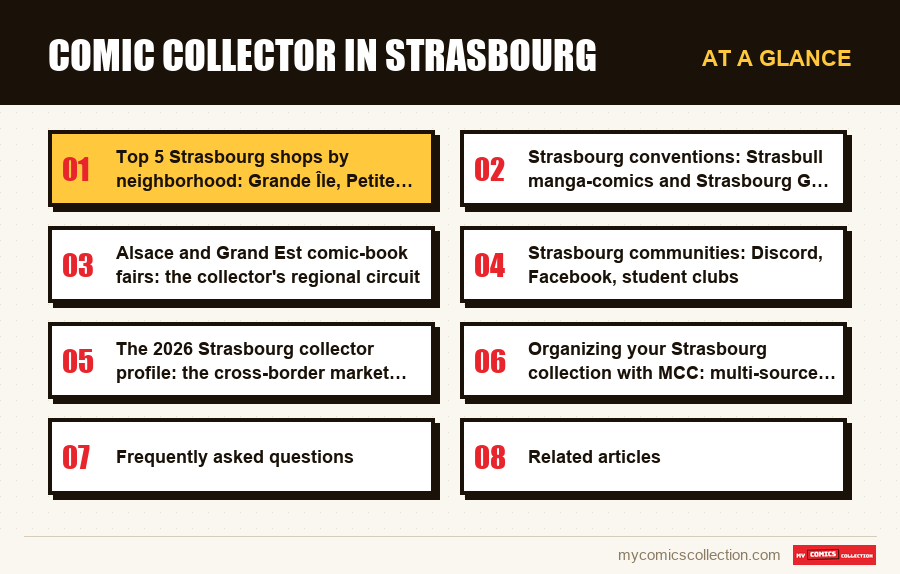
Top 5 Strasbourg shops by neighborhood: Grande Île, Petite France, Krutenau, Neudorf, Robertsau
The commercial comics geography of Strasbourg follows a simple logic: the historic center concentrates the general-interest BD/comics/manga shops, while the outer neighborhoods harbor a few more under-the-radar specialized gems. The Grande Île, a UNESCO World Heritage site since 1988, remains the nerve center with two to three major addresses less than a ten-minute walk from the cathedral. Rue de la Mésange, place Kléber and the adjacent side streets host the most visible shops, where tourist traffic keeps stock turning over briskly and therefore keeps things fresh for anyone who swings by regularly to check the new arrivals.
The Petite France, the emblematic neighborhood of canals and half-timbered houses, is home to general-interest booksellers offering a quality comics section that is nonetheless limited in volume. The buyer profile here skews more adult and Francophone, drawn to the Urban Comics, Panini France and Delcourt collected editions and to fine art books of sequential art. For single VO issues or CGC slabs, this is not the top destination, but for building a reference library in French (omnibus, deluxe, collected editions), it is a valuable complement to the rest of the offering. The storefronts stay open later during tourist season, which makes for an end-of-day stroll that can be paired with a culinary stop.
The Krutenau neighborhood, southeast of the center and historically a student district, hosts the majority of the manga-comics shops frequented by the 18-30 crowd. The stock profile here is distinctly younger: weekly Marvel new releases in VO, modern 1:25 and 1:50 ratio variants, DC Black Label series and alternative Image lines (Saga, Something is Killing the Children, The Department of Truth). It is also the neighborhood with the best price/discovery ratio on indie comics from Boom! Studios, IDW and Dark Horse, segments often overlooked by more general-interest shops. Thursday afternoons and Saturdays are the peak crowd times, with a mix of French students, German Erasmus exchange students and high schoolers who are pop-culture fans.
The Neudorf, a residential neighborhood south of the train station, has seen several hybrid setups take root since 2022: comic cafés, role-playing spaces and nonprofit-run shops that combine secondhand comics sales, TCG tournaments and reading nights. The vibe is family-friendly, prices on secondhand raw books are among the most affordable in the metro area (single issues at €2 to €4 for modern Marvel/DC), and you are more likely to run into veteran collectors offloading part of their stock at wholesale prices. For a methodical collector looking to build a long run without breaking the bank, the Neudorf is worth a monthly detour. The Robertsau neighborhood, farther out to the northeast, rounds out the map with one or two low-profile addresses open on reduced hours, geared more toward orders and collector service than toward impulse over-the-counter sales.
Strasbourg conventions: Strasbull manga-comics and Strasbourg Geek Convention
The Strasbourg event scene is dominated by two main gatherings that set the rhythm of the local collector's year. The first, Strasbull, is the historic manga-comics-pop-culture event of the Alsatian capital. Typically held in spring or fall at the Wacken (Strasbourg Exhibition Center), Strasbull brings together publishers, creators, cosplayers and specialized exhibitors over two to three days. The core of the offering remains the manga universe (logical given the sociology of the audience), but a dedicated comics section has grown year after year, with French-language publishers in attendance (Urban Comics, Panini France, Delcourt, Hi Comics) and raw US dealers who bring their stock up from Lyon, Paris or the Rhine-Germany region.
The second gathering, the Strasbourg Geek Convention, offers a complementary format tilted more toward cross-cutting pop culture: video games, TV series, film, science fiction, fantasy, with a comics presence that has strengthened as the adult audience has diversified. The exhibitor profile here is more mixed (individual resellers, French Whatnot sellers, Alsatian and Baden shops), which opens up more hit-or-miss but sometimes very rewarding hunting opportunities on recent modern keys. The event also draws foreign guests, notably US artists and colorists who have worked on Marvel and DC series, offering signing sessions you can leverage with a CGC Signature Series strategy in mind.
Beyond these two pillars, the Strasbourg calendar is occasionally enriched by satellite events: BD days at the André Malraux media library, student festivals at the University of Strasbourg with a pop-culture section, temporary exhibitions at Le Vaisseau or the European Center for Young Culture. These secondary formats do not replace the main conventions but offer opportunities to network with the local community and to spot private sellers who occasionally part with a portion of their collection. For the collector who wants to extend the convention approach beyond Strasbourg, trips to Paris (Paris Comics Expo, Comic Con Paris), Lyon (Lyon Pop Culture) or the nearby German conventions (Frankfurt Comic Con, German Comic Con in Stuttgart) are made easy by the excellent TGV and ICE service from Strasbourg station. To make the most of these trips by securing certifiable signatures, see our dedicated guide on CGC Signature Series at French conventions.
Alsace and Grand Est comic-book fairs: the collector's regional circuit
Comic-book fairs form the underlying fabric of the Alsatian and Lorraine secondary market. These events, generally held on Sundays in community halls or youth centers (MJC), gather fifteen to fifty private and semi-professional exhibitors who clear out stock accumulated over decades. The merchandise profile is typically made up of classic Franco-Belgian comics, small-format Lug and Aredit issues from the 1970s-1980s, and whole stacks of Strange, Special Strange, Nova and Spidey at very affordable prices (often €1 to €5 per issue), plus the occasional original US comic from the bronze (1970s) and copper (1980s) ages. For the Strasbourg collector, these fairs are essential for rebuilding a Francophone Lug or Aredit collection at a controlled cost.
The 2026 regional calendar revolves around several recurring dates across Alsace and the rest of the Grand Est. Fairs held in Mulhouse, Colmar, Sélestat and Haguenau in Alsace, rounded out by dates in Nancy, Metz, Reims, Troyes and Charleville-Mézières in the rest of the Grand Est, make up a circuit that seasoned collectors travel selectively based on their priorities. The lower urban density than in the North or the Île-de-France means fairs are often more intimate, with an exhibitor-to-visitor ratio that favors negotiation and making contacts. It is also at these fairs that word gets passed along about comics estate sales and the clearance stock of shops going out of business, opportunities that never surface on eBay or Whatnot.
Beyond the purely French circuit, the proximity to Germany opens access to the Comicbörsen (German comic-book fairs) held regularly in Karlsruhe, Stuttgart, Mannheim and Frankfurt. The merchandise profile there is radically different: more original US comics, CGC slabs from the German market, which has been importing US books since the 1990s, and European variants you cannot find on the French market. For the Strasbourg collector who has basic German and is willing to travel 60 to 120 minutes, these German fairs can dramatically enrich a collection at prices often lower than their French equivalents. Be mindful, though, of intra-EU customs compliance, which stays simple for personal purchases but calls for a few precautions on large volumes. To frame these cross-border flows and anticipate the associated taxes, read our guide on importing US comics into France: customs and VAT.
Strasbourg communities: Discord, Facebook, student clubs
The Strasbourg comics scene is organized around three concentric circles that partially overlap. The first, the most accessible, gathers the local Facebook groups dedicated to BD, comics and pop culture in Alsace. These groups, which typically count anywhere from a few hundred to several thousand members depending on their age, serve mainly as an informal marketplace (private sales listings) and as a relay for information on fairs, conventions and shop restocks. Moderation is generally light but decent, with the listings-to-substantive-discussion ratio leaning heavily toward sales posts. For a newcomer to Strasbourg, joining two or three of these groups in the first week remains the fastest way to identify the local players and catch the good deals.
The second circle, more engaged, gathers the themed Discord servers where the community discusses weekly releases, spoilers, ongoing story arcs and buying strategies in real time. The national Francophone comics Discords (several thousand members combined) host regional Alsace or Grand Est channels where people from Strasbourg trade shop intel, organize group-buy sessions to pool US shipping costs, and coordinate their convention attendance. The barrier to entry is higher (creating a Discord account, getting used to the asynchronous chat culture), but the informational payoff is clearly superior to that of the Facebook groups.
The third circle, the hardest to break into but the most valuable, is made up of the student clubs at the University of Strasbourg and the informal circles of veteran collectors who meet in certain bars, brasseries and café-libraries in the center. These circles do not advertise themselves publicly: you get in by recommendation, after several shop visits or fair appearances that have proven your seriousness. It is within these circles that word circulates about estates, lots before any listing is posted, rumors about sellers to avoid and cross-border logistics tips. Count on six to twelve months of regular in-person presence before being fully integrated, which remains realistic for a newcomer. To structure your monitoring even before you have built these connections, see our guide to syncing a comic collection across devices in the cloud, which helps coordinate multi-source acquisitions.
Collecting this series?
Track what you own, what you are missing and what your collection is worth. 7 day trial.
Start my trial →The 2026 Strasbourg collector profile: the cross-border market with Germany and Switzerland
The typical Strasbourg comics collector, as observation of local shops, fairs and networks lets us define them in 2026, stands out for three structural traits shaped by geography. First trait: a price pragmatism markedly more pronounced than in major metro areas like Paris or Lyon. The immediate proximity of foreign markets, where the price differential can reach 15 to 30% on certain books, trains the Strasbourg collector to systematically compare sources before buying. This best-price hunting discipline translates into less loyalty to a single shop and a wider rotation of suppliers (two to three French shops visited regularly, plus one or two occasional German or Swiss addresses).
Second trait: a remarkable linguistic mix. The average Strasbourg collector reads their comics in French, in English and sometimes in German. This linguistic versatility opens access to foreign editions left untapped by monolingual collectors: Panini Deutschland (Germany) and Panini Verlag (German-speaking Switzerland) editions sometimes cheaper than the Panini France equivalents for the same series, German variants of Marvel and DC events printed in small runs and therefore rare, and even original US comics more accessible as secondhand raw books on the German market. This linguistic openness turns the collection into a coherent multilingual heritage rather than a simple monolingual Francophone run.
Third trait: a more European convention sensibility. The proximity of Frankfurt Comic Con (200 km), German Comic Con in Stuttgart (160 km), Fantasy Basel in Switzerland (140 km) and Comic Con Luxembourg (200 km) places the Strasbourg collector within a 250 km radius of five to six major European conventions over the year. This convention density within a reasonable radius radically changes the cost/opportunity calculation of a CGC Signature Series signature, of meeting international creators and of buying slabs displayed at booths. Where a Lyon or Bordeaux collector has to set aside a full day and a TGV trip to reach a major convention, the Strasbourg one can make a round trip to Karlsruhe or Basel in a single day on a regional train. To understand the strategic value of these signatures on long-term value, see our guide to grading comics from France, which details the CGC FR and EU channels.
Organizing your Strasbourg collection with MCC: several sources, several languages
Organizing a Strasbourg comics collection poses specific challenges that My Comics Collection (MCC) helps you keep under control. First challenge: simultaneously tracking purchases in euros (French and German shops in the eurozone), in Swiss francs (Basel shops or Fantasy Basel) and in US dollars (direct US orders or purchases on Whatnot and eBay US). MCC does not convert currencies: each comic carries one purchase price, shown with the currency symbol you pick in the settings, and the eBay estimates are given in euros. The simplest approach is to enter every price in euros and keep the original amount in the comic's notes.
Second challenge: managing the multilingual editions of a single comic. A Strasbourg collector might own Amazing Spider-Man 300 as a raw US VO copy, as a 1980s German Condor Verlag edition and as a 2020 Panini French reissue collected edition. In MCC's worldwide catalog, each of these editions belongs to its own series, with its publisher and year, so the three copies stay three distinct records. This granularity avoids artificial duplicates (three copies counted as one). The same logic applies to variants: US cover A, exclusive German cover, French publisher-event cover, each variant gets its own record.
Third challenge: reconciling convention purchases, shop purchases, online purchases and private purchases. Over an active year, a Strasbourg collector can easily rack up 40 to 80 transactions spread across ten to fifteen different sources (five local shops, three conventions, two fairs, eBay, Whatnot, Discord group buys, private Facebook sales). In MCC, a free tag per channel (Karlsruhe, Basel, eBay, Discord) lets you filter your purchases by source, and from those filtered lists you can work out your own figures: average basket per channel, purchase frequency, resale rate, resale margin. These analyses are invaluable for optimizing your future trips (should you keep doing Karlsruhe or cut back?) and your annual budget. To dig into the method for estimating the value of a multi-source collection, use our free collection estimate and explore our comics database to verify the exact references before data entry. For purchases outside the eurozone, our import and customs guide usefully rounds out the process.
Frequently asked questions
In 2026, Strasbourg has between five and seven active sales points genuinely specialized or semi-specialized in comics, spread mainly across the Grande Île (two to three central addresses), the Krutenau (one to two student-oriented addresses), the Neudorf (one to two hybrid comic-café addresses) and the Robertsau (one low-profile address). On top of this specialized core are the large general-interest cultural chains (Fnac, Cultura, Gibert, independent bookshops), all of which offer a comics section of varying depth. For a methodical collector, the move is to test these seven to ten sources over the first three months and keep a rotation of visits to the three or four most relevant to their collection profile.
The answer depends on your collection profile. For Francophone BD, Panini France and Urban Comics variants and French artists, Strasbull and Strasbourg Geek Convention remain the top priorities. For original US comics, discounted CGC slabs and international English-language artists, German Comic Con in Stuttgart (160 km), Fantasy Basel (140 km) or Frankfurt Comic Con (200 km) offer greater depth of supply. The ideal for someone from Strasbourg is to mix the two circuits: one to two French conventions a year for the community dimension, two to three German or Swiss conventions for price arbitrage and exhibitor diversity.
The Grand Est region's TER rail network makes it easy to reach most comic-book fair towns by public transit: Mulhouse (1h by TER), Colmar (35 min), Sélestat (25 min), Nancy (1h25), Metz (1h45), Reims (3h via TGV). For the longest trips (Reims, Troyes, Charleville-Mézières), a carpool arranged through the regional Discords or local Facebook groups is often cheaper and more sociable. Remember to confirm the fair the day before (cancellations are possible due to weather or local constraints) and to plan a cash budget: at these fairs, cash payment remains the norm, with card accepted by only a minority of exhibitors.
For personal purchases in Germany, no customs formalities are required since both countries are part of the European Union and the Schengen area. You pay German VAT at the point of purchase (19% in 2026) and bring your comics back into France freely. For purchases in Switzerland, you are leaving the EU: any purchase over €300 per person per day must in theory be declared to French customs on the way back, with payment of French VAT (20%) on the total value. In practice, for modest purchases the checks remain rare, but the risk exists. Always keep your purchase receipts. For the details of thresholds and procedures, see our comics import and customs guide.
For a Strasbourg collector mixing French, German, Swiss and American purchases, a dedicated platform like My Comics Collection, with its interface in eight languages, quickly becomes necessary. Excel or Google Sheets spreadsheets remain acceptable for collections under 200 copies but show their limits as soon as you accumulate several currencies and several language editions of the same series. MCC keeps each language edition as its own record, offers up-to-date valuation tracking, lets you filter by tags such as the place of purchase, and syncs data across smartphone, tablet and computer so you can instantly check whether a comic is already owned during a fair or convention.