
To begin an Aquaman collection, start with the New 52 run by Geoff Johns (Aquaman #1-25, 2011-2013) available between $3 and $15 per issue in raw. Minimum recommended budget: $100-200 for a solid base of 30-40 issues. First priority purchases: Aquaman #1 (2011), #35 (1967) in low-grade, and the Peter David run in batch.
Collecting Aquaman comics is an exciting and still financially accessible adventure. Unlike Batman or Spider-Man where key issues reach astronomical sums, the Aquaman universe offers reasonable entry points, a welcoming community and real growth potential for those who know how to build their collection intelligently.
Ce beginner's guide to the Aquaman collection covers everything you need to know: where to start, how much to budget, what issues to prioritize, how to assess the condition of a comic, and mistakes to avoid. A structured journey to transform your curiosity into a coherent collection.
Why collect Aquaman
Aquaman has several specific advantages for the new collector:
- Manageable catalog: unlike Batman (5,000+ issues), Aquaman has around 400 main series issues. A complete collection is realistic.
- Accessible entry prices: 80% of numbers are under $10, even in good condition.
- Valorization potential: the film franchise is supporting demand, with still room for growth in key issues.
- Diversity of periods: from the Golden Age to modern, each era has its distinct aesthetic and tone.
- Specialized community: Aquaman collectors are a passionate and supportive group, less competitive than Batman/X-Men collectors.
Your first acquisition: the Aquaman starter pack
Here's the ideal buying journey for your first $200:
Step 1: The foundations (budget $50-80)
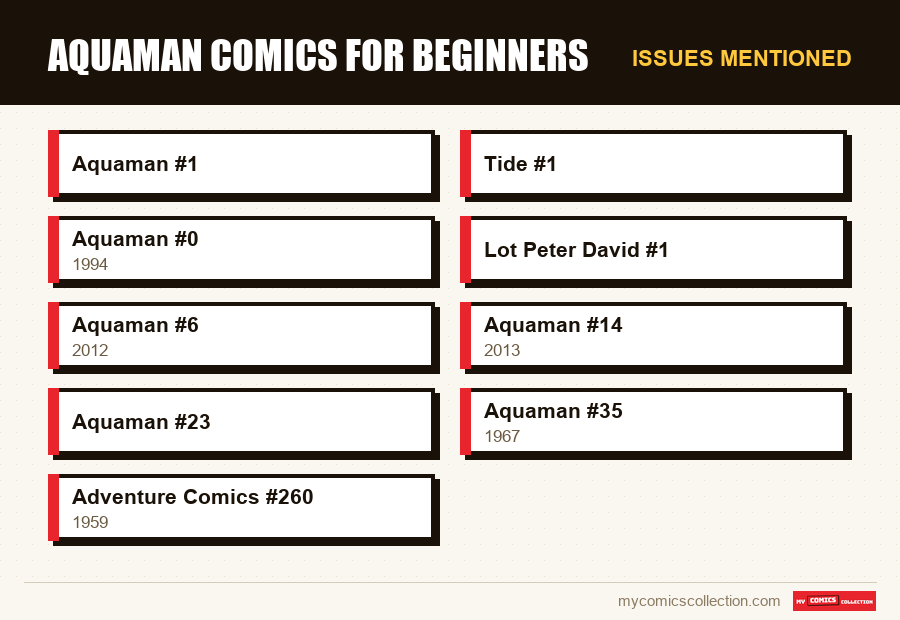
- Aquaman #1 (2011, New 52): your starting centerpiece. $15-25 in NM raw. This is the number every Aquaman collector has.
- Aquaman #1 (2016, Rebirth): $5-8 in NM. Excellent supplement.
- Aquaman: Time and Tide #1-4 (1993): full lot $10-15. The definitive origin story.
- Aquaman #0 (1994): $3-5. Start of the Peter David run.
Step 2: Depth (budget $60-80)
- Lot Peter David #1-25: $20-30 on eBay. The best quality/price ratio on the market.
- Aquaman #6 (2012): first Trench. $5-8 raw.
- Aquaman #14 (2013): beginning of Throne of Atlantis. $5-10 raw.
- Aquaman #23.1 (2013): 3D Black Manta cover. $8-12.
Step 3: Ambition (budget $60-100)
- Aquaman #35 (1967) in low-grade (GD/VG): $30-50. Your first vintage key issue. Even in average condition, owning the first appearance of Black Manta is a major milestone.
- Adventure Comics #260 (1959) in Fair/Good condition: $30-50. First origin story.
Understanding Ranks: Visual Guide to Aquaman
Condition assessment (grading) is crucial. Here are the specific benchmarks for Aquaman comics:
- NM (9.2-9.4): glossy cover, no visible folds, blank pages. Standard for moderns (post-2000).
- VF (8.0): slight minor defects: small stress on the edge, slight wear on the corners. Excellent condition for the Bronze Age.
- FN (6.0): moderate wear but attractive: slight creases, colors still bright. Good goal for the Silver Age.
- VG (4.0): notable wear: visible reading crease, rounded corners, but structurally intact. Acceptable for Silver Age key issues when budget is limited.
- GD (2.0): significant wear but complete: possible detached cover, stains, but all pages present. Often the only affordable grade for rarities.
Aquaman Silver Age specific note: the covers feature a lot of blue and green, colors that show fading easily. A copy with still bright colors commands a premium.
Where to buy: the best sources
Online
- eBay: the largest selection, but check seller ratings and ask for detailed photos.
- MyComicShop.com: reliable in-house grading, fair prices, excellent for Silver/Bronze Age.
- ComicConnect / Heritage Auctions: for premium CGC certified parts.
In physics
- Local comic shops: the sale bins often contain Aquaman from the 90s-2000s at $1-3 each.
- Agreements: negotiation possible, especially at the end of the day. DC sellers easily sell Aquaman over Batman.
- Estate sales and garage sales: rarely key issues, but sometimes complete runs at a ridiculous price.
Beginner mistakes to avoid
- Buy in CGC 9.8 without understanding why: for moderns at less than $20 in raw, the cost of grading ($50+) is rarely justified except for real key issues.
- Ignore provenance: a raw comic can hide restorations invisible to the untrained eye. Buy from reputable sellers.
- Scattering too quickly: focus on one run or period first before expanding. Consistency creates value.
- Neglecting storage: immediately invest in bags, boards and a storage box. A poorly stored comic loses value quickly.
- Paying the hype price: prices inflate after each film announcement. Patience: they always partially come back down in the following 6-12 months.
Collecting Goals: What type of collector are you?
The reader-collector: favor complete runs in reading state (VG-FN). Budget: $200-500 for a very satisfactory collection covering the best periods.
The investor: exclusively target key issues in high condition (NM+ for modern ones, VF+ for vintage ones). Initial budget: $500-2,000 for a portfolio of 5-10 strategic issues.
The completionist: aim for the complete collection of a series (New 52 in 52 issues is the most realistic). Budget: $300-500 for a complete run in NM.
Do you own Aquaman comics? Estimate the value of your collection for free to know their current rating.
Frequently asked questions
The catalogue is manageable: about 400 issues of main series, against more than 5,000 for Batman, so a complete collection is realistic. The great majority of issues remain affordable, and the community is described as passionate, supportive and less competitive.
With Aquaman #1 (2011, New 52), Geoff Johns's run (#1-25, 2011-2013), then Aquaman #1 (2016, Rebirth). Complete them with Aquaman: Time and Tide #1-4 (1993), the definitive origin story, and Aquaman #0 (1994), the start of Peter David's run.
Aquaman #35 (1967), the first appearance of Black Manta, even in low grade (GD/VG). Adventure Comics #260 (1959), the first origin story, is the other milestone to aim for in Fair/Good condition.
NM (9.2-9.4) is the standard for modern books, VF (8.0) is excellent condition for the Bronze Age, and FN (6.0) is a good target for the Silver Age. VG (4.0) remains acceptable for a Silver Age key on a limited budget, and GD (2.0) is often the only affordable grade for rarities.
Having a modern comic graded for no reason, ignoring provenance (a restoration can be invisible to an untrained eye), spreading too thin, neglecting storage and paying the "hype" price after a film announcement. Prices almost always fall back partly within the following 6 to 12 months.