
The best budget entries for Aquaman: Aquaman #1 (2011, New 52) around $15-25, Aquaman #1 (2016 Rebirth) under $10, and Peter David's runs from the 90s can be found in batches for a few dollars per issue.
Collecting Aquaman doesn't require an ocean budget. Long considered a secondary character, the King of Atlantis saw his popularity explode after the 2018 film, but many purchase windows remain accessible for the smart collector who knows where to look.
This guide gives you the keys to building a solid Aquaman collection without breaking the bank. From affordable key issues to underpriced runs, including tips for finding discounted copies, here is your budget roadmap.
Key issues Aquaman under $50
The truly old issues (Aquaman #1 from 1962) are out of reach for a tight budget, but several modern key issues remain very affordable:
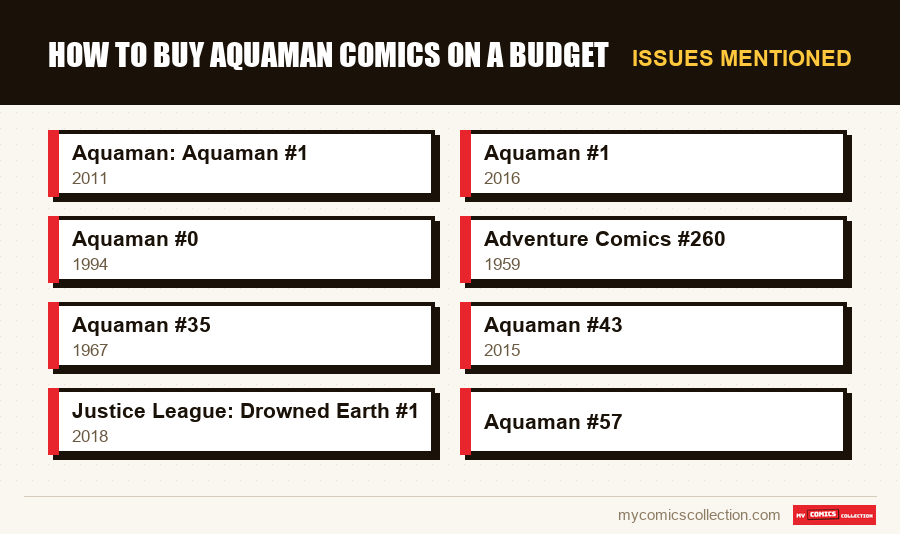
- Aquaman #1 (2011, New 52): relaunch by Geoff Johns and Ivan Reis, raw VF/NM copies between $15 and $25.
- Aquaman #1 (2016, Rebirth): excellent Dan Abnett series, available for under $10 in NM.
- Aquaman #0 (1994): beginning of the Peter David “hook hand” era, often under $5.
- Adventure Comics #260 (1959): first origin story of Aquaman, found in average condition (GD/VG) around $40-50.
- Aquaman #35 (1967): first appearance of Black Manta, copies in Fair/Good condition between $30 and $50.
Underrated Runs to Buy Now
The run of Peter David (1994-1998) remains absurdly cheap. This 75-issue series which redefined Aquaman as a bearded anti-hero is regularly found in complete sets for $30-50 on eBay. The quality of writing is exceptional and the rating can only go up.
Le run Geoff Johns/Ivan Reis (2011-2013, #1-25) is another underrated must-have. These issues are easily found under $5 each in raw, and the artistic quality is museum-worthy.
Where to find deals
$1 bins and eBay lots
Aquaman is a DC character often overlooked in comic shop sale bins. Runs from the 90s and 2000s are frequently found in dollar bins. On eBay, search for “Aquaman lot”: sellers regularly liquidate complete runs at ridiculous prices.
Conventions and estate sales
At the end of the convention, DC sellers willingly sell off their Aquaman stocks so as not to win them. The estate sales are also a mine: the character being less "glamorous" than Batman, the prices remain moderate even for Silver Age issues.
Raw vs slabbed: budget strategy
For Aquaman, raw is almost always the best budget choice. CGC grading fees ($30-50 minimum) are only justified for pre-1970 issues. An Aquaman #35 (1967) in CGC 4.0 costs $150+, but a raw copy in similar condition sells for around $40. Save your budget to buy more numbers.
Newsstand gems and variants
The editions newsstand of Aquaman from the 80s and 90s are rarer than the direct editions but do not yet command a significant premium. Now is the time to stockpile some. The New 52 run variant covers (notably the “Monsters” and “Bombshells” covers) are also interesting picks under $10.
Modern keys under $20
- Aquaman #43 (2015): highly sought-after variant cover, still available for under $15.
- Aquaman/Justice League: Drowned Earth #1 (2018): tie-in event, under $5.
- Aquaman #57-65 (2020): “Mera: Queen of Atlantis” bow, under $5 each.
2nd prints and reading copies
THE second printings of Aquaman #1 (2011) and #23.1 (villain month, 3D cover) are interesting budget alternatives to the first prints. For pure reading, the "Aquaman by Geoff Johns" TPBs can be found second-hand under $10 and cover the best arcs.
Reading copies vs investment copies
Create two levels of collection: reading copies (VG/FN, $1-3 each) for the pleasure of reading, and reserve your "investment" budget for the few key issues in NM which have real potential for added value: in particular everything related to Black Manta and Mera, whose cinema adaptations continue to support demand.
Organize your Aquaman collection and identify your missing numbers with our management application. Track the value of each number and spot the best buying opportunities.
Building a budget shopping list step by step
Buying smart does not mean buying at random. Before spending anything, put a three-tier list on paper. The first tier holds reading copies: the Peter David run, the start of the series by Geoff Johns and Ivan Reis, the Rebirth relaunch. The second holds issues of historical interest that you want to own in decent condition without chasing perfection, such as Adventure Comics #260 or Aquaman #35. The third is the wish list, those few copies in fine condition that you will only buy at the right moment.
Set a minimum condition for each tier
A simple rule avoids regrets: decide in advance the minimum acceptable condition for each tier. For reading, a clean copy with a solid spine is plenty. For older historical issues, accept visible flaws (small creases, yellowing) as long as the cover is complete, the staples hold and no pages are detached. For the wish list, insist on sharp photos of both sides and the edges.
Check before you buy
A few checks take a minute and prevent bad surprises:
- compare the exact title, year and number: Aquaman has several series with the same name, and a 2011 #1 is not a 2016 #1;
- find out whether it is a first print, a second printing or a variant cover, because the difference in demand is real;
- look for any mention of a 3D cover or special format, which changes handling and storage;
- ask for the details of defects when the description is limited to a vague adjective.
Buying lots: sort on arrival
A lot of 1990s issues is often the best deal, but it needs to be handled methodically. On arrival, separate the issues by series, check that no pages are missing, then tick off what you already own so you do not create duplicates. Surplus copies can serve as trading material at conventions. Put the important issues in bags with backing boards straight away, even if their value remains modest: protection costs little and preserves condition.
Knowing how to wait
A tight budget has one advantage: it forces patience. Adaptation announcements, relaunches and anniversary issues shift interest in a character. Outside those periods, copies are easier to negotiate. Track your target issues, note your reference prices and only buy when the offer fits your grid. This discipline matters more than the total amount spent.
One last habit: catalogue from the very first purchase
As soon as you have ten or twenty issues, keep an up-to-date inventory with the series, year, number, condition and print type. You will see at a glance what you are missing, what you have in duplicate and which copies deserve extra protection.
Frequently asked questions
Start with the modern reading issues: Aquaman #1 from 2011 (New 52) and Aquaman #1 from 2016 (Rebirth), plus the Peter David run from the 1990s. They offer excellent writing at a modest cost. Then add a few historical issues in average condition, such as Adventure Comics #260 or Aquaman #35.
Generally not. For Aquaman, raw is almost always the best budget choice, and grading is only justified for issues from before 1970. It is better to spend your budget on buying more issues.
Shop discount bins, online lots, the end of conventions and estate sales are the best leads. Since the character is less sought after than Batman, prices stay moderate even for Silver Age issues.
Reading copies are VG/FN copies bought for the pleasure of reading. Investment copies are a few key issues in NM, notably around Black Manta and Mera, whose film adaptations support demand. Separating the two tiers avoids overspending on issues meant to be read.
Newsstand editions from the 1980s and 90s are scarcer than direct editions, but they do not yet command a significant premium. This makes it a good time to accumulate a few without paying much.