In short
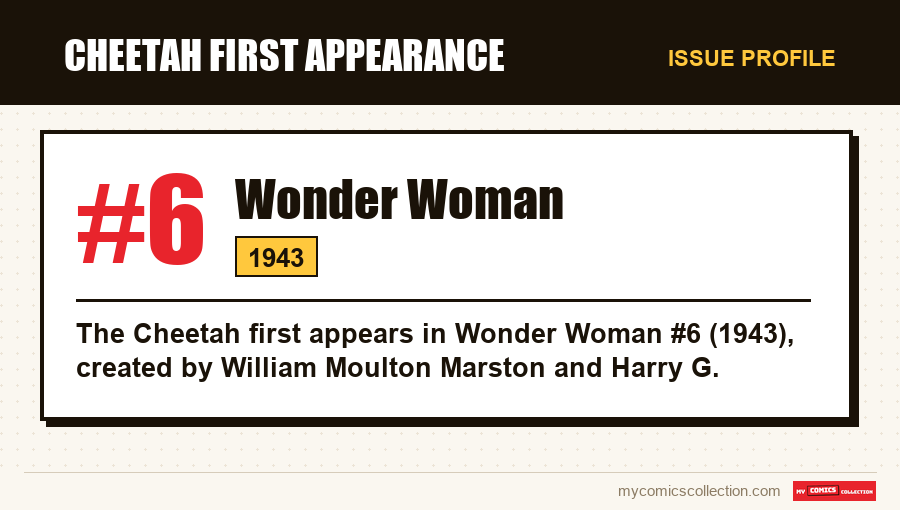
The Cheetah, in her original form as the socialite Priscilla Rich, first appears in Wonder Woman #6, an issue cover-dated 1943. Credit for the character goes to the team of William Moulton Marston, writing, and Harry G. Peter, art. In the story she is a wealthy woman with a divided personality who turns on Wonder Woman. The better-known Barbara Ann Minerva version debuts much later, in Wonder Woman vol. 2 #7 (1987).
Priscilla Rich, the first Cheetah, is simple to name yet routinely mistaken for her 1987 successor. Ask ten collectors which issue introduces her and several will answer with a number from 1987 rather than 1943. The two issues belong to two different women, two different creative teams and two very different kinds of back issue.
This guide stays on the single issue that matters, Wonder Woman #6. The credits, the cover year and the later issue numbers below were checked against published reference material, and the buying advice is our own method, built without any price figure and without reproducing a page or a line of dialogue from the book.
Identity of the issue: what you are holding
Wonder Woman #6 is the sixth number of the first Wonder Woman series, the one that began with an issue dated summer 1942. By the time #6 reached the stands the heroine was no longer a newcomer. The heroine's first story ran in All-Star Comics #8, her slot in Sensation Comics began in January 1942, and the summer 1942 issue #1 launched the title that holds our Cheetah. Issue #6 therefore sits early in a run that the publisher treated as an established property.
Begin with the cover date, since the listing errors start there. The issue is dated 1943. A seller who writes a specific month or season on the listing without showing the cover is adding information the buyer cannot check from the photograph. Use the year, and treat a month stated without a source as a guess.
On credits, the early run of the series is documented in ranges rather than issue by issue. William Moulton Marston is credited as the writer of issues 1 through 11, and Harry G. Peter as the penciler of issues 1 through 97. Marston wrote under the pen name Charles Moulton, so a catalog entry or a slab label may show either name.
How Priscilla Rich is introduced
The story presents Priscilla Rich as a woman of wealth and social standing in New York society, burdened by an inferiority complex and by a personality that splits in two. The trigger is a public humiliation. At a charity event she is outshone by Wonder Woman, and the resentment this produces drives her to attempt to harm the heroine during an escapology act she is involved in. The attempt fails.
What follows is the moment that defines the character. Alone at her makeup mirror, Priscilla collapses and sees a woman dressed as a cheetah. That figure directs her to make a costume out of a cheetah-skin rug. The Cheetah is thus born as the second self of a wealthy woman, a persona she adopts while being unable to control it.
Two features of this introduction are worth noting for anyone reading the issue as a historical object. First, the villain is a woman and her rival is the heroine herself, at a time when most superhero antagonists were men. Second, the character's logic is psychological before it is physical: the costume comes out of an inner division, not out of an animal power. The animal-themed identity that later writers would develop into something more literal begins here as a disguise and a state of mind.
Marston, Peter and the 1943 series behind her
The character is credited to William Moulton Marston and Harry G. Peter, the same pair who stand behind Wonder Woman herself. Marston was a psychologist by training and wrote the heroine's adventures under the Charles Moulton name; Peter's angular, tightly composed line gave the series its recognizable look. The Cheetah comes from that partnership at a stage when the series was still defining who could oppose its lead.
She came back within the Golden Age run. Wonder Woman #28, from 1948, is cited for her membership in Villainy Inc., a gathering of the heroine's foes. For a collector this is a useful reminder that the 1943 appearance launched a recurring antagonist and did not stand alone as a one-time curiosity.
If you want the broader editorial story of the Cheetah, including how the name passed from one woman to another, the companion piece on the Cheetah's history covers it. This page keeps to the single issue.
Why it is a key issue
Three things make Wonder Woman #6 a key. First, it launches a woman who grew into one of Diana's best-known adversaries. It comes from the first series, whose earliest issues are Golden Age books and are scarce in any condition. And the character kept returning, in several forms, across more than eight decades.
The continuity that followed is what turns a one-issue debut into a long-term reference point. After the 1985 Crisis on Infinite Earths relaunch of DC's universe, a new Cheetah was introduced: Barbara Ann Minerva, created by Len Wein and George Pérez and first seen in Wonder Woman vol. 2 #7 in 1987. Priscilla Rich remained part of the story, with her history reattributed to the period when Hippolyta served as Wonder Woman. In the modern timeline, Minerva eventually murders her at the urging of Zoom, a development covered in The Flash vol. 2 #219 in 2005.
The film connection adds visibility without changing the facts. The version portrayed on screen by Kristen Wiig in Wonder Woman 1984 is the Minerva incarnation. Anyone reading a news item about the movie and then searching for the character's first appearance will land on the question this page answers, and the answer is that the film's version and the 1943 version are different people.
Later volumes and look-alike numbers
The main trap in this corner of the market is the number 7. Wonder Woman vol. 2 #7, from 1987, introduces Barbara Ann Minerva, and sellers sometimes list it as the Cheetah's first appearance. It is the first appearance of that version, not of the character. Both issues are legitimate keys; they are different keys.
A second trap is the volume itself. The title was relaunched with new numbering more than once, so a bare reference to a sixth issue without a series year or a volume can point to a very different book. When you search a marketplace or enter a catalog number, include the year, 1943, and confirm the cover date on the photograph.
A third trap is the family of related appearances in other 1940s DC titles. The heroine appeared in Sensation Comics in the same period, and All-Star Comics #8 is the issue that carries her very first story. Neither of those is the Cheetah's debut. If a listing mixes the three, ask for the cover photograph and the issue number in the title of the listing.
If you are comparing an original with a later printing, treat the printing information and the publisher's marks as the authority, and be wary of any reproduction sold under a title that implies it is the original.
Do you collect this series?
Track what you own, what you are missing and what your collection is worth. 7-day trial.
Start my trial →
What to check before you buy
Golden Age books from the early 1940s were printed on inexpensive paper, and they were handled hard by their first readers. A copy that has survived in good shape is the exception. Start with the structure of the book: check the spine, the staples, and the point at which the cover is attached. Then work outward to the edges and corners.
Pre-1950 comics are frequently restored, and work done on a copy changes what it should be measured against. Color touch, spine reinforcement, tear sealing and piece replacement may all be present in a copy that looks attractive in a photograph. Ask directly whether any work has been done, and look for an explicit statement in the grading notes of a certified copy. A restored copy of #6 can still be worth owning, yet it belongs in its own comparison group.
For a certified copy, read the label before the grade. Confirm that the label reads Wonder Woman, issue 6, 1943, with the Cheetah debut noted. Check that the label's notes mention any restoration, and compare the slab's cover to the photograph the seller provides. A mismatched cover or a label that names a different issue is a reason to stop and ask questions.
For an uncertified copy of #6, ask the seller for photographs of both covers, the spine, the centerfold and several inside pages. Page quality matters for a book printed on paper of this kind, so look for descriptions such as brittleness or tanning in the listing and check the photographs for them.
Finally, compare like with like. Measure your Wonder Woman #6 only against other 1943 copies of #6 that share its grade and restoration status. The free valuation tool below works from current listings rather than from a printed guide.
Condition, grading labels and how to read a sale listing
When a listing says only "Golden Age" or "rare," it has told you nothing about the book. Look for four facts: the series and number, the cover date, the grade or a plain description of the condition, and whether the copy is restored. If any of the four is missing, the listing is incomplete.
The appearances that follow and are worth knowing
Five later issues give the character's history a spine. They are not a shopping list so much as a reading map, because each one marks a change in who wears the costume or how she is treated.
Wonder Woman #28 (1948) places Priscilla Rich in Villainy Inc., which shows how quickly the Golden Age series folded her into a rogues' gallery.
Wonder Woman #274 (1980) is cited for the story in which Deborah Domaine takes up the role and for the retirement and death of Priscilla Rich in that era's continuity. Justice League of America #195 (1981) places Domaine in a larger conflict with the Secret Society.
Wonder Woman vol. 2 #7 (1987), by Len Wein and George Pérez, introduces Barbara Ann Minerva after the Crisis reset. It is the issue that most casual readers associate with the name.
The Flash vol. 2 #219 (2005) shows Minerva murdering an elderly Priscilla Rich at Zoom's urging in the present-day timeline, closing the loop on the original character.
The Cheetah history follows these stages in more detail, and the Wonder Woman hub collects the issues around them.
Placing the issue in a Wonder Woman collection
A collector building a Golden Age Wonder Woman set usually works in the order of the character's own life. All-Star Comics #8 carries her first story, Sensation Comics #1 gives her a regular home, and Wonder Woman #1 begins her own title. Issue #6 comes only a few numbers into that series and offers something the first issues do not: a recurring villain with a visual identity.
If your budget does not stretch to every one of these books, the decision depends on what you want the set to show. A collector interested in the character's origin will put All-Star Comics #8 first. A collector interested in her rogues' gallery will put Wonder Woman #6 first. Neither choice is wrong, and both can be built over time. The guide to All-Star Comics #8 and the Wonder Woman #1 guide cover the other two.

Frequently asked questions
Her debut is Wonder Woman #6, a 1943 number of the original Wonder Woman title. The character in that issue is Priscilla Rich, a wealthy socialite. William Moulton Marston and Harry G. Peter are credited as her creators. Later versions of the character appear in other issues.
No. Wonder Woman vol. 2 #7, from 1987, introduces Barbara Ann Minerva, a different woman who took the Cheetah identity after the Crisis on Infinite Earths reboot. It was created by Len Wein and George Pérez. It is the first appearance of that version, not of the Cheetah as a character.
William Moulton Marston is credited as writer of the first eleven issues of the series, and Harry G. Peter as penciler of issues 1 through 97, which includes #6. Marston wrote under the name Charles Moulton, so either name can appear on a label or in a catalog entry for this issue.
The Cheetah played by Kristen Wiig in Wonder Woman 1984 follows the Barbara Ann Minerva version, introduced in 1987, not the Priscilla Rich version from 1943. A reader who comes to the comics through the film will want Wonder Woman vol. 2 #7 for the Minerva debut and #6 for the original character.
Read the label first: confirm the series, the issue number, the 1943 cover date and any note about restoration. Then compare the slab with the seller's photographs, checking the spine, staples, corners and paper quality. A mismatch between the label and the cover is a reason to ask for more information before buying.
Have a copy of Wonder Woman #6 or another early Cheetah appearance? Enter the series, number and condition to see how it compares with current listings.
Estimate my comic