The central character of this work is defined by a refusal: he has been assigned a role that he does not want to play. The entire series stems from this position: he works against what he was made to do, without the narrative ever guaranteeing that he will succeed. It is the opposite of the hero who discovers his destiny, the dominant formula of the genre. Here, destiny is known from the beginning and the character spends thirty years evading it.
This inversion explains both the tone of the work and the fact that it can last without a plot of discovery.
This article describes the device, what it allows, what it costs the story, and why it is so little used elsewhere.
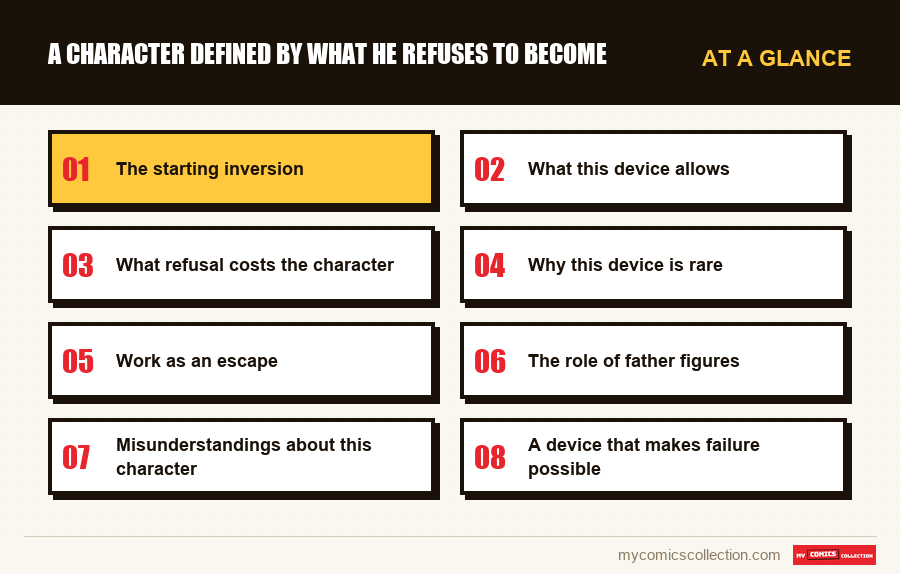
The starting inversion
To understand what is happening, we must first establish the common formula from which this character departs.
The dominant pattern is that of discovery. An ordinary character gradually learns that he is destined for something greater, accepts this role after hesitation, and assumes it. The plot is the journey from ignorance to acceptance.
Here, everything is known straight away. The character knows what is expected of him, has never ignored it, and refuses from the start. There is nothing to discover, only something not to do: and this for decades.
This shift changes the nature of the suspense. We don't wonder what he will learn but whether he will hold on, which is a question of a completely different order: it is never definitively resolved.
What this device allows
Permanent tension without intrigue
The refusal must be repeated at each episode. This provides a constant stake without requiring a continuous narrative arc, making the self-contained short story possible.
This is the structural key to the entire work.
A never heroic character
He acts out of professional duty rather than vocation, which avoids any grandiloquence and allows a dry, often funny tone.
An internal threat
The main danger is not the opponent of the day but what he could become. It therefore moves with him, constantly.
A possible ending
A question that really arises can be answered. This is what allowed the cycle to conclude, unlike series with indefinite discovery.
What refusal costs the character
The story does not present this position as comfortable, and that is what makes it credible.
He doesn't belong anywhere. Refused by what he is intended for and never quite accepted by those he protects, he occupies a position of permanent stranger that the work does not resolve.
He can't explain himself. His situation is too long to tell and too incredible to be believed. He therefore remains silent, which explains his constant laconicism: a trait that we take for a style and which is a consequence.
He is never even. A refusal cannot be resolved once and for all; it must be repeated, and each new occasion begins the ordeal again.
These three costs are presented without emphasis, generally in a box or silence. The work never feels sorry for its character, which is probably why the reader does it for him.
The illuminating comparison is not with the heroes of the genre but with the figures of stories. Many traditional stories feature someone who has been assigned a fate and who tries to escape it.
In these tales, the answer is almost always the same: one cannot escape one's fate, and efforts to avoid it make it possible. The work knows this pattern perfectly, it is its material, and this is what makes the character's refusal both vain and admirable.
Why this device is rare
There are three reasons why few series use it, and they are all commercial.
It prohibits the progression of power. A character who refuses what he could be cannot become stronger over the episodes, the central spring of the serial character narrative.
It makes the protagonist seemingly passive. Not doing something is less spectacular than doing it, and it sells less well than an upward trajectory.
It calls for a conclusion. A question that can be answered ends up requiring one, which threatens the indefinite renewal that profitable series thrive on.
This third point is decisive and is consistent with what we observe elsewhere. Narrative devices that call for an ending are systematically avoided by editors, and only an author who owns his series can afford to use one.
Work as an escape
A concrete aspect of the device deserves to be isolated, because it provides the story with its daily mechanics.
Refusing a role is not enough to fill a life. You have to do something else, and what the character does is a job: investigating supernatural affairs, for an organization, with colleagues and reports to submit.
This choice is smarter than it seems. A salaried job is the exact opposite of a destiny: it is ordinary, subordinate, subject to schedules and a hierarchy. By occupying this place, the character materializes his refusal every day without having to formulate it.
This also produces an important part of the humor of the work: a creature promised to take on considerable functions complains about a long journey or a poorly completed file.
The contrast is never emphasized by the text, which makes it effective. It functions like the black masses of the drawing: placed, and left to the reader.
The role of father figures
A relationship structures this system and it is worth naming it, because it is its pivot.
The character has two origins: the one assigned to him and the one he received from those who raised him. The whole story lies in the gap between these two filiations, and in the fact that the second never cancels the first.
Choosing nurture over nature is precisely what refusal means, and this is what prevents the work from being a simple story of rebellion. It's not about saying no to an authority, but about preferring one story to another.
This framing also explains why the strongest scenes in the cycle are rarely confrontations. These are moments when someone reminds him of one or the other of his two origins, and we see which one he chooses that day.
This is very old material, tales are full of it, treated without the story needing to theorize it even once.
Collecting this series?
Track what you own, what you are missing and what your collection is worth. 7 day trial.
Start my trial →Misunderstandings about this character
Mistaken for an action hero
His build and his activity place him in a category where he does not function. He does not progress or triumph.
His laconicism taken for coldness
He stays silent because he can't explain, not because he doesn't feel anything.
An expected arc that doesn't exist
The reader seeks progression and finds renewal. It's the device, not a stomp.
Humor taken for lightness
The dry tone is the consequence of a refusal of grandiloquence, not a softening of the words.
A device that makes failure possible
A property follows from all of the above and it clearly distinguishes this work from the genre to which it is attached.
In a progression story, failure is temporary by construction: the character must get back up for the series to continue. Defeat is an episode, never a state.
Here, the possible failure is not to lose a fight but to give in, and this defeat would be definitive. The story therefore maintains a threat that renewal does not cancel, which is extremely rare in a long series.
This gives weight to scenes which, elsewhere, would be innocuous. A moment of fatigue, a temptation, an accepted ease counts because they go in a direction from which we cannot return.
What duration does to this refusal
Thirty years of renewal produce an effect that no short story would achieve, and this is the best argument for reading the whole thing.
At the beginning, refusal is a position of principle: the character says no because he doesn't want to. It's simple and a little abstract.
After hundreds of episodes, this refusal became an accumulation of facts: everything he didn't do, all the times he could have given in, everything it cost him. The abstract position has become a biography.
This is an effect that only duration produces, and it explains why the conclusion of the cycle has the weight it does. The same final scene, written after three years, would weigh nothing; after thirty, it brings together all of the above.
For a reader, this means that the investment of time is not just a cost: it is the condition for the desired effect.
What to record
On this character, the useful field follows an evolution that nothing in the objects materializes.
The moments when refusal is put to the test, noted throughout the readings. They are scattered over hundreds of issues, sometimes separated by years of publication, and none of them refers to the previous ones. Noting them is the only way to perceive the accumulation which makes all the meaning of the system.
A reader who does not keep this trace reads a succession of episodes; the one holding it is reading a biography. They are the same pages.
What exactly the character refuses every time: the wording varies, and following these variations shows how the issue becomes clearer over the decades, which no quick rereading reveals.
These two fields involve careful reading more than inventory, and this is precisely what a work of this duration makes impossible without written support.
Questions fréquentes
A refusal. He has been assigned a role that he does not want to play, and he knows it from the start: contrary to the dominant pattern where a hero gradually discovers his destiny and accepts it. There is nothing to discover, only something not to do, for decades.
Because his situation is too long to tell and too incredible to be believed. His laconicism is not a posture or coldness: it is the direct consequence of a position that he cannot explain, and which is often taken for a simple stylistic trait.
Because a character who refuses what he could become cannot gain power: that would be giving in. The reader who seeks progression finds a renewal, and it is the device itself, not a trampling. This is also why so few series use it.
The material of the work, traditional tales, almost always responds that one cannot escape one's fate and that efforts to avoid it make it possible. The author knows this pattern perfectly, what makes refusal both futile and admirable, and what allowed the cycle to conclude.
Duration is the condition of the effect, not just its cost. At the beginning, refusal is a position of principle; after hundreds of episodes, it's become an accumulation of facts: everything he didn't do and what it cost him. The same final scene written after three years would mean nothing.
How many times has he said no?
These moments are scattered over hundreds of issues and none refer to the previous ones.