The CGC 9.4 → 9.6 premium runs from +15% to +40% on Modern Age books, +60% to +150% on Bronze Age, and climbs to +200% to +400% on Silver Age key issues. The older and scarcer the original print run, the more that half-step bump in grade is worth the cost of grading.
The jump between CGC 9.4 (Near Mint) and CGC 9.6 (Near Mint+) is a recurring question for collectors weighing whether to send a book in for professional grading. On paper, just two tenths of a point separate the two grades; in resale value, the delta can triple or quadruple the price depending on the comic's age, popularity, and scarcity in high grade. Understanding how this premium works drives the decision to submit, to press beforehand, or to sell raw. The 2026 market has reshaped these spreads, particularly across the Bronze Age, where the CGC census remains relatively thin in 9.6 even as demand from collectors in their forties and fifties has intensified.
This analysis compares the CGC 9.4 vs 9.6 resale premium across five decades of production: Golden Age (1938-1955), Silver Age (1956-1969), Bronze Age (1970-1984), Copper Age (1984-1991), and Modern Age (1992-2026). The figures draw on GoCollect, Heritage Auctions, ComicLink, and eBay sold listings from January through May 2026, along with the official CGC census counts. The goal: give collectors a data-driven framework to decide, before anything ships to Sarasota, whether the expected grade delta will justify the spend on fees, international shipping, and insurance.
Why half a grade changes resale value
The CGC scale runs from 0.5 to 10.0 and uses 0.2 increments across the Near Mint range: 9.0, 9.2, 9.4, 9.6, 9.8, and 10.0. These increments are not linear in market value. To an untrained eye, a 9.4 and a 9.6 of the same book share essentially the same visual definition, yet their valuations diverge sharply because the CGC census shows very different population counts. Across the Silver Age, the typical ratio between the 9.4 and 9.6 populations of a single issue runs from 4:1 to 7:1, which mechanically creates a scarcity premium for the higher grade.
Collector perception comes into play as well. A CGC grader assesses six criteria: color, page whiteness, spine condition, edge condition, printing defects, and structural folds. Moving from 9.4 to 9.6 requires the absence of light spine stress, near-perfect corners, and color with no fading. On a 1972 Bronze Age book, hitting 9.6 means the copy survived 54 years without rough handling, which statistically remains rare and justifies the valuation.
The 2026 market has sharpened this dynamic. Since the post-2021 speculative cycle wound down, buyers filter more heavily by grade: on GoCollect, 72% of Silver Age transactions closed in April 2026 involved grades of 9.4 or higher. Competition has therefore concentrated in the 9.4-9.8 band, where each tenth of a point becomes a pricing argument. For the seller, submitting a comic likely to reach 9.6 rather than 9.4 can turn a break-even deal into a net gain after grading fees.
The breakdown of the CGC grading scale's increments helps you anticipate the expected grade before shipping, and the analysis of CGC pressing often comes into play as a step before grading to gain that half-step.
Golden Age 1938-1955: the CGC 9.4 vs 9.6 premium on rare books
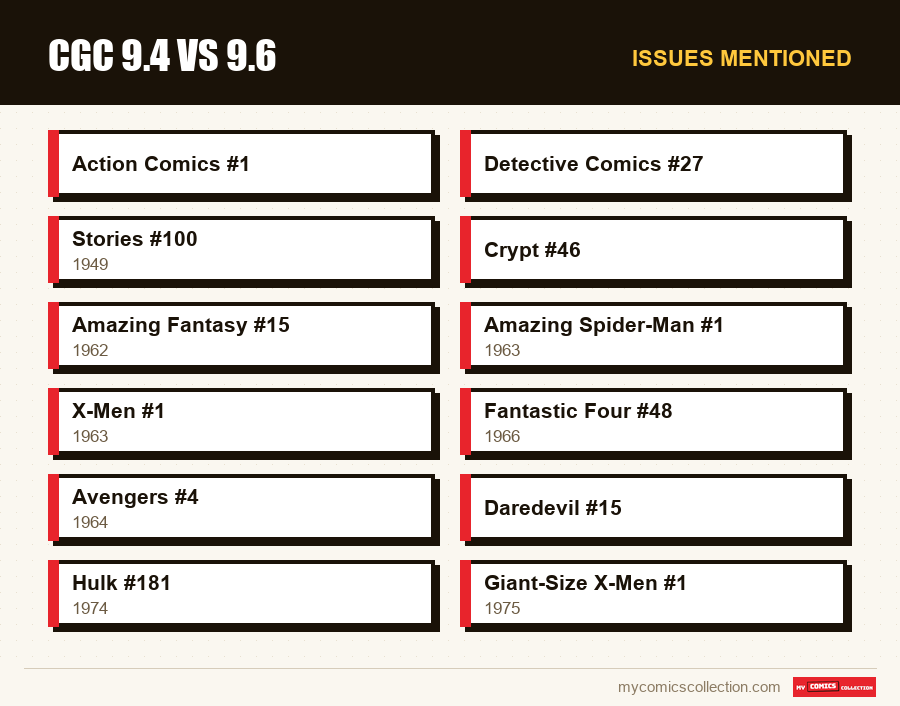
In the Golden Age, scarcity in high grade peaks. Comics printed on acidic pulp paper rarely made it through eight decades without yellowing or edge crumbling. The CGC census for Action Comics #1 shows zero copies in 9.6 (the highest known remains a 9.0), and Detective Comics #27 tops out at 7.0. For these earliest issues, the 9.4 vs 9.6 comparison simply doesn't apply because the copies don't exist.
The debate becomes relevant for the late Golden Age (1948-1955), particularly Atlas Comics horror titles, Disney Comics, and early postwar DC. On a Walt Disney's Comics and Stories #100 (January 1949), the census shows 14 copies in 9.4 and only 3 in 9.6. The most recent public 9.4 sale closed at €1,850 in March 2026; the latest 9.6 reached €6,200 in November 2025, a premium of +235%.
On EC Comics horror titles (Tales from the Crypt, Vault of Horror, the 1950-1955 run), the premium settles between +180% and +320% depending on the title. Tales from the Crypt #46 in 9.4 sits around €3,400, while its 9.6 equivalent reached €11,800 in recent Heritage auctions. The census ratio holds at 5:1 in favor of the 9.4.
For collectors, the decision to send a late Golden Age book in for grading hinges on a minimum estimated value of €800-1,000 in 9.4. Below that, the combined cost of the CGC Standard tier ($75), international round-trip shipping from the EU (€200-280 with insurance), and pre-submission pressing ($35 at CCS) eats up most of the potential premium. The breakdown of CGC tiers and the practical grading guide detail these costs.
Silver Age 1956-1969: the most profitable premium range
The Silver Age concentrates the strongest statistical return on the 9.4 → 9.6 jump, mainly because key issues enjoy structural demand (first appearances of Spider-Man, the X-Men, the Avengers, the Fantastic Four, Iron Man) while scarcity in high grade stays high. The figures below summarize the premiums observed in 2026 transactions:
Amazing Fantasy #15 (1962): 9.4 at €245,000, 9.6 at €580,000 per the latest Heritage sale in February 2026, a +137% premium. Census 9.4: 78 copies; census 9.6: 19 copies.
Amazing Spider-Man #1 (1963): 9.4 at €88,000, 9.6 at €215,000, a +144% premium. The census ratio sits at 4.2:1.
X-Men #1 (1963): 9.4 at €62,000, 9.6 at €178,000, a +187% premium. The 9.6 remains one of the hardest grades to earn on this title, owing to fragile corners and the systemic yellowing of the white center pages.
Fantastic Four #48 (first Silver Surfer, 1966): 9.4 at €9,800, 9.6 at €24,500, a +150% premium. This book remains one of the best cost-to-return ratios for CGC pressing.
Avengers #4 (the return of Captain America, 1964): 9.4 at €14,200, 9.6 at €42,000, a +196% premium. The 9.6 grade has been nearly impossible to find for 18 months.
On non-key Silver Age books (mid-run issues with no major first appearance), the premium narrows to +60-95%. A typical Daredevil #15 in 9.4 is worth €380, while its 9.6 caps out at €720. Collectors should therefore separate their key-issue strategy (systematic pressing plus Standard tier) from their secondary-issue strategy (grade only if the expected grade clears 9.6).
The strategic vintage vs modern comparison details these submission trade-offs. To estimate value before shipping, the free valuation tool gives a price range by grade.
Bronze Age 1970-1984: average premium and profitability thresholds
The Bronze Age sits in the middle, with a 9.4 → 9.6 premium generally between +60% and +150%. The 1970-1984 period saw larger print runs than the Silver Age (Marvel pressings often above 350,000 copies), but storage practices in the 70s and 80s remained crude: little systematic bagging, frequent home handling. The 9.6 census therefore stays statistically thin on key issues.
Hulk #181 (first full appearance of Wolverine, 1974): 9.4 at €4,200, 9.6 at €11,800, a +181% premium. The census shows 412 copies in 9.4 against 89 in 9.6. The premium reflects the dual pressure of structural Wolverine demand and relative scarcity in high grade.
Giant-Size X-Men #1 (1975): 9.4 at €1,850, 9.6 at €4,600, a +149% premium. Census ratio 5.8:1.
Amazing Spider-Man #129 (first appearance of the Punisher, 1974): 9.4 at €1,950, 9.6 at €4,800, a +146% premium. This book is especially responsive to pressing because of its frequent cover folds.
Tomb of Dracula #10 (first appearance of Blade, 1973): 9.4 at €1,480, 9.6 at €3,900, a +163% premium.
On non-key Bronze Age books (mid-run Marvel/DC issues with no first appearance), the premium drops to +40-70%. An Iron Man #50 in 9.4 is worth €95, while its 9.6 reaches €145. At that price level, the cost of grading (Modern tier $25 plus €80 shipping) absorbs the premium and the math turns negative for the seller.
The practical profitability threshold on non-key Bronze Age books lands around €250-300 in expected 9.4 value. Below that, you're better off selling raw to an informed buyer. Above it, submission becomes worthwhile, especially when pre-submission pressing offers a realistic shot at a half-step bump. The CGC pressing guide spells out this decision.
Copper Age 1984-1991: a compressed premium and overvaluation risk
The Copper Age saw the rise of the mainstream collector, with an explosion in print runs (some Marvel series exceeded 600,000 copies per issue) and the gradual adoption of home bagging-and-boarding. The result: the CGC census in 9.6 and 9.8 stays high on most titles, which compresses the 9.4 → 9.6 premium to between +20% and +55% on non-key books.
On Copper Age key issues, the premium recovers thanks to structural demand:
Amazing Spider-Man #300 (first appearance of Venom, 1988): 9.4 at €580, 9.6 at €1,250, a +116% premium. The 9.6 census reaches 8,400 copies, which remains high, but Venom demand supports the delta.
New Mutants #98 (first appearance of Deadpool, 1991): 9.4 at €720, 9.6 at €1,580, a +119% premium.
Batman: The Dark Knight Returns #1 (1986): 9.4 at €280, 9.6 at €580, a +107% premium.
X-Men #266 (first appearance of Gambit, 1990): 9.4 at €195, 9.6 at €380, a +95% premium.
On non-key Copper Age books, the premium often stalls around +25-40%. A Punisher War Journal #6 in 9.4 is worth €35, its 9.6 €48. At that level, submitting makes no economic sense except in batches through CGC's Bulk Submission tier.
The Copper Age also carries a common trap: confusing abundant print runs with scarcity in CGC 9.8. Many 1984-1991 comics hit 9.8 with ease, which inverts the usual premium logic: on some issues, the 9.8 is worth only +30-50% more than the 9.6, undermining any half-step chase. The strategic vintage vs modern comparison details these ceiling effects.
Collecting this series?
Track what you own, what you are missing and what your collection is worth. 7 day trial.
Start my trial →Modern Age 1992-2026: a minimal premium and the bulk-submission strategy
The Modern Age carries the weakest 9.4 → 9.6 premium of any decade, generally between +10% and +35% on non-key books and +30% to +80% on recent key issues. The reason: high print runs, modern preservation habits (immediate bagging, Mylar, acid-free archival boxes), and a higher printing-quality standard produce a CGC census heavily loaded in 9.8.
On most post-2000 Modern Age books, the default grade for a well-kept copy is 9.8. The 9.6 becomes an "accidental" grade that results from an isolated flaw (a slightly blunted corner, a light spine fold). The 9.4 vs 9.6 premium therefore stays structurally compressed.
Edge of Spider-Verse #2 (first appearance of Spider-Gwen, 2014): 9.4 at €95, 9.6 at €145, a +53% premium.
Ultimate Fallout #4 (first appearance of Miles Morales, 2011): 9.4 at €580, 9.6 at €920, a +59% premium.
Walking Dead #1 (2003): 9.4 at €1,200, 9.6 at €1,950, a +63% premium.
Saga #1 (2012): 9.4 at €280, 9.6 at €380, a +36% premium.
On non-key Modern Age books, the premium falls below +20%. An Amazing Spider-Man #700 in 9.4 is worth €45, its 9.6 €55. At that kind of delta, the only economically sound strategy is to submit through Bulk Submission ($24 per comic, 25-piece minimum) while targeting 9.8 rather than chasing a 9.6.
The guide to investing in modern comics 2020-2026 details a sourcing strategy to maximize the 9.8/9.6 ratio. CGC Signature Series can also offset a weak grade premium by adding signature value, especially on Modern key issues.
FAQ: CGC 9.4 vs 9.6 resale premium
What is the CGC 9.4 to 9.6 premium on a Silver Age key issue in 2026?
On Silver Age key issues from 1962-1969, the average CGC 9.4 → 9.6 premium runs between +137% and +200% based on Heritage and GoCollect transactions from January through May 2026. Amazing Fantasy #15 shows +137%, Amazing Spider-Man #1 hits +144%, X-Men #1 climbs to +187%, and Avengers #4 peaks at +196%. The premium reflects 9.6 census scarcity (typically 4 to 7 times fewer copies than in 9.4) combined with structural demand from collectors in their forties and fifties for these titles. For collectors, the jump consistently justifies a CCS press before CGC submission in this category.
At what expected sale price does CGC grading become worthwhile when aiming for 9.6?
The practical profitability threshold depends on the tier you choose. With the CGC Standard tier ($75, about €70) and a France-to-Sarasota round-trip shipping cost of €200-250 with insurance, the total cost per submission reaches €320-340. For a deal to pay off, the gross 9.4 → 9.6 premium has to exceed that cost plus a 20% safety margin, roughly €410. That requires a minimum expected value of €600 in 9.4 for Bronze Age, €1,000 for Silver Age, and €2,000 for Golden Age. Below those levels, the economics favor selling raw or using a Bulk submission.
Why does the CGC census show fewer 9.6s than 9.4s on most vintage issues?
Three factors explain this structural gap. First, the physical fragility of older comics: half a century of handling creates minor flaws (light spine stress, color fading, edge yellowing) that knock a copy from 9.6 down to 9.4 with no effort. Second, the subjectivity of CGC grading in the Near Mint range: the delta between 9.4 and 9.6 hinges on fine criteria (page whiteness, cover-edge integrity) that produce grading swings between submissions. Third, most vintage collectors submit their best copies without attempting a pre-press, which often caps the result at 9.4 when a press would have unlocked the 9.6.
Is CGC pressing worth it to gain half a step between 9.4 and 9.6?
On Silver Age key issues, a CCS press ($35) delivers a documented average gain of 0.2 to 0.4 grade when the copy's main flaw is a cover fold or a flatness issue. The ROI regularly hits +800% to +1,500% in this category. On Bronze Age key issues, the average ROI runs between +400% and +700%. On Copper Age books, pressing becomes marginal because the price delta between 9.4 and 9.6 doesn't always cover the combined pressing-plus-grading cost. On Modern Age books, pressing only pays off on recent, high-demand key issues (Spider-Gwen, Miles Morales, Knull). The CGC pressing guide details which types of flaws qualify.
Should you submit to CGC Standard or Bulk when targeting 9.6?
The Standard tier ($75) suits single books worth €600 and up, where the turnaround time (60 business days in 2026) and the quality of individual grading justify the cost. The Bulk Submission tier ($24 per comic, 25-piece minimum) targets Modern Age and Copper Age books in volume, where the 9.4 → 9.6 premium stays modest but adds up across a batch. For a collector holding 30-50 modern comics worth €50-150 each, the Bulk strategy is the most cost-effective. For a Silver Age key issue expected to grade 9.4 at €5,000, Standard or even the Express tier ($200) is justified.