A significant part of the distribution of Cerebus is composed of unapologetic parodies of figures from outside comics. A political leader modeled on a famous actor from American cinema, a barbarian who speaks like a cartoon character, a vigilante who changes his identity at each phase of the story to ape the fashionable superhero. These characters are not decorative winks: they structure the story, and understanding their function completely changes the reading.
This is the most confusing aspect for a contemporary reader, because several of these references have clearly aged, they belong to a popular culture that no longer circulates, and nothing in the book takes the trouble to explain them.
This article describes these characters, shows what purpose they serve, explains what is lost if we do not identify them, and why the parody did not prevent the work from being taken seriously.
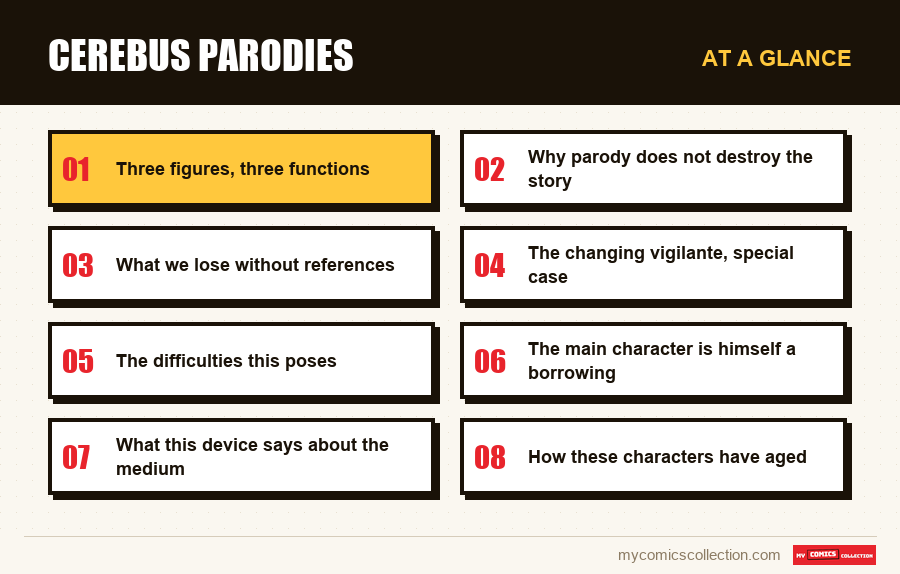
Three figures, three functions
The political leader
Modeled on an American actor famous for his rapid delivery and circular reasoning, he governs an entire city through absurdity.
Its function is not comical: it is to show that a power can function without any decision being rational.
The albino barbarian
A heroic fantasy warrior with cartoon character speech. The gap between his tragic appearance and his way of speaking is permanent.
It serves as a counterpoint: its presence permanently recalls the genre from which the work is taken.
The changing vigilante
A character who adopts a new superhero identity each period, aping the one that then dominates the market.
It is the work's most direct commentary on the industry surrounding it, and it was renewed for twenty years.
What they have in common
None know they are parodic. They act with the utmost seriousness in a world that takes them seriously, which prevents the story from making fun of them from the outside.
Why parody does not destroy the story
This is the central question, because a story populated by pastiches should collapse under the weight of its winks. Three choices prevent him from doing so.
The characters are treated seriously by the world. No one in the story notices that a leader speaks like a movie actor. He is simply the authority in place, with the consequences that entails. The pastiche is in the form, never in the situation.
They have real consequences. The absurd leader ruins people, dooms projects, destroys careers. A parody character whose decisions destroy lives quickly ceases to be funny.
They evolve. These figures are not repeated gags: they age, change position, lose power. Over twenty-six years, a pastiche that transforms becomes a character.
It is this last point that most distinguishes this work. Parody is a starting point, not an identity: and several of these characters end up producing scenes that can no longer be read as comical at all.
What we lose without references
We have to be honest: a reader who doesn't recognize any of the sources is losing something. The question is what, exactly.
He loses a layer of immediate pleasure: that of spotting a loan and measuring its accuracy. It's real but superficial, and it only concerns the first appearances.
He does not, however, lose no element of understanding. The functions described above operate independently of recognition: a leader who reasons in circles is absurd whether or not his source is identified, and his power over the city is exercised in the same way.
He finally loses the dating. These references placed the work in its time, for a readership who shared these points of reference. A reader today therefore reads a slightly more abstract text: which, paradoxically, may have helped him age.
Practical advice. Don't look up the references before reading. A reader who interrupts his reading to identify each borrowing turns a story into an exercise, and the rhythm of the dialogues, which is what makes these characters work, does not survive.
If a figure intrigues you, write it down and check it afterwards. Retrospective recognition gives the same pleasure without interrupting the reading.
The changing vigilante, special case
This character deserves separate treatment, because he does something that no other character does in the work.
With each major period, he abandons his identity to adopt a new one, modeled on the superhero who then dominates sales. It is therefore not a question of a fixed parody but of a continuous commentary device, updated for two decades.
The effect is twofold. At the time, each new identity was an immediate statement on what the industry was doing. Today, the succession of these identities forms a chronicle: we read, through this single character, the history of the medium's fashions over twenty years.
This is probably the element of the work that has aged the best, and for a counter-intuitive reason: what was news has become a document. The references that were the most dated are those that acquired the most value over time.
A reader today does not laugh at the same things as a reader of the time when faced with this character. He sees something else, and it's no less interesting.
The difficulties this poses
Dated references
Several sources belong to popular culture from the 1970s and 1980s which no longer circulates. Nothing in the book explains them.
Voices difficult to render
The comedy of these characters is based on language tics. In translation, these tics lose their anchor and appear arbitrary.
An intrusive place at times
Some sequences give them a lot of space for little comedic performance. This is the most frequently reported defect.
Un mélange de registres
Crossing a pastiche and a seriously written character in the same scene requires an adjustment that not all readers make.
Collecting this series?
Track what you own, what you are missing and what your collection is worth. 7 day trial.
Start my trial →The main character is himself a borrowing
One point often goes unnoticed and illuminates the entire system: the protagonist is also originally a parody.
An anthropomorphic animal armed with a sword in a world of heroic fantasy: the formula directly targets a genre that dominated independent comics in the late 1970s. The character therefore does not begin as an original creation but as another joke.
What distinguishes his journey from that of others is that he survives its parodic function. After a few dozen issues, we stop reading him as a joke on a genre and read him as someone: petty, calculating, capable of a cruelty that no longer has anything comical about it.
This transformation is probably the most difficult achievement of the work. Making a gag into a character involves gradually giving up what made you laugh, without the reader noticing the shift or feeling cheated.
It also explains why other parodies can fit into the same story. None are treated as inferior to the protagonist, since it exactly shares their original status. The world is populated by pastiches who take themselves seriously, and no one occupies an overarching position.
What this device says about the medium
A broader observation is worth asking, because it explains why this practice was possible here and less so elsewhere.
Borrowing so openly from existing figures presupposes a particular position: that of an author who does not depend on any editorial structure and therefore does not risk being asked by a legal service to remove a character.
A traditional publisher's publication would undoubtedly have discarded several of these creations, not for lack of humor but out of caution. Parody is an expensive exercise when you have something to lose.
It is therefore still a consequence of the independence model: in the same way as the duration, the freedom to change register, or the absence of contradiction in recent years. The same device produces singularities and excesses.
For a reader, this suggests one way to approach self-produced works: their most unusual features almost always arise from the fact that no one was there to prevent them.
How these characters have aged
Unevenly, and sorting is worth doing before you begin.
The political leader has aged very well. Its source matters little: a power that functions through circular reasoning and arbitrary decisions remains immediately legible, and probably more so today than at the time.
The barbarian has aged moderately. The gap between his appearance and his speech still works, but the two sources are less familiar, which makes the process more abstract: funny without knowing precisely why.
The vigilante has aged well otherwise. As said above, it moved from current commentary to historical document, which made it gain in interest what it lost in immediacy.
This inequality is normal for a work that has been running for twenty-six years. It simply means that a reader today will not laugh in the same places as the original readership, without the book being diminished.
What to note while reading
Two notes, specific to a story that works by references.
Characters whose source you have not identified. Write them down as you read rather than interrupting to search. This is the only way to reconcile the pleasure of rhythm and that of recognition.
The moment a pastiche stops making you laugh. This is the most interesting indicator of this work: several of these characters switch, at a specific point in the story, from a comic register to something significantly harsher. Spotting this shift says a lot about the construction of the whole.
These two notes answer a question that few stories ask: at what point did I stop reading a parody to read a character?
Frequently asked questions
No, no understanding depends on their identification. We lose a layer of immediate pleasure, that of spotting a borrowing, but the narrative functions operate independently: a leader who reasons in circles is absurd whether or not we identify his source.
Because these characters are treated seriously by the world around them, because their decisions have real consequences, a pastiche whose choices ruin lives quickly ceases to be funny, and above all because they evolve over twenty-six years. Parody is a starting point, not an identity.
Better not to do it. Interrupting your reading to identify each borrowing turns a story into an exercise, and the rhythm of the dialogues, which is precisely what makes these characters work, does not survive. Write down what intrigues you and check it afterwards.
More than back then, in a way. Each new identity then constituted a position on the current affairs of the medium; their succession today forms a chronicle of fashions over twenty years. What was news has become a document.
Probably not all, and not for lack of humor: openly borrowing from existing figures exposes you legally, and parody is expensive when you have something to lose. This is one more consequence of the model of independence: the same device that produces the singularities of this work also produces its excesses.
When does a pastiche become a character?
Noting this shift says more about the construction of the work than any summary.