Read the first two collections of Cerebus, and then decide: this is the only honest advice that can be given about this work. Three hundred issues published over twenty-six years by an author who published himself, with decorations drawn by a second artist from the middle. The beginning is a fantasy parody; what follows becomes a remarkable political satire, then goes off in directions that scared away a good portion of its readership. No one recommends reading everything, and it must be said straight away.
It's quite possibly the hardest work to recommend in all of American independent comics: considerable in places, frankly indefensible in others, and impossible to summarize in a single sentence without lying by omission one way or the other. Those who defend it and those who reject it each have good reasons, and they generally do not speak at the same volumes.
This article describes what it really is, offers a route that avoids dead ends, and speaks frankly about where most readers stop.
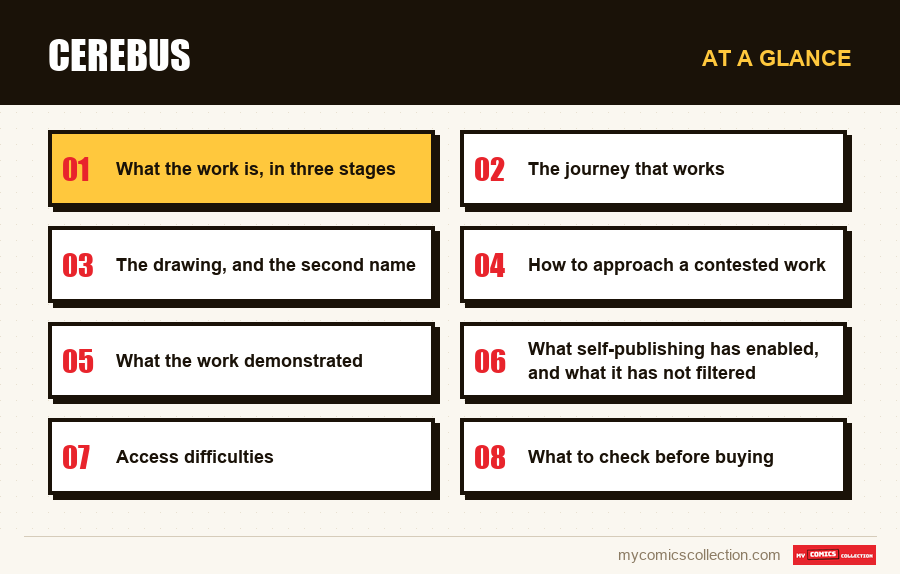
What the work is, in three stages
We cannot talk about Cerebus like a block. Three periods stand out clearly, and they do not appeal to the same readers.
The beginning is a parody. A brawling aardvark in a heroic fantasy setting, with pastiche gags and adventure plots. It's fun, dated, and quite far from what will make the work important. Many readers find this introduction disappointing.
The central part is a political and social satire of rare ambition in this medium. The character becomes prime minister, then something else; the story is interested in power, religious institutions, ambition. This is where we find what we cite when we cite this work.
The last part diverges sharply. The story deviates from fiction to develop the personal positions of its author, in long and discursive passages. This development has divided the readership in a lasting way, and it explains why almost no one recommends the entirety.
The journey that works
Step 1: the first collection
The parody period. You have to go through it to understand where the character is coming from, but you shouldn't judge the work there.
If you don't like the drawing or the humor, stop there: the sequel will not change these two aspects.
Step 2: the second collection
This is where the work becomes what it is cited for: a satire on power and institutions, constructed and funny.
This is the real decision point. If it takes you, keep going; otherwise, you will have read the right thing.
Step 3: what happens next
The story gains in scope and the design changes in nature with the arrival of a second artist on the sets. It is the formal summit of the whole.
Step 4: to stop, or not
Beyond that, the reader must make an informed decision. This is where opinions differ most violently, and there is no consensus.
The drawing, and the second name
One aspect sets this work apart from all others in the segment, and it is worth explaining.
From the middle of the publication, a second artist takes charge of all the decorations. It is not an assistant: it is a declared collaboration, and its contribution visually transforms the whole.
Before, the backgrounds are functional. Afterwards, the work acquires an architectural depth and a density of textures which place it among the most impressive in the medium: interiors, perspectives, materials worked page after page for more than a decade.
For a reader, this has a practical consequence: the work is visually much more beautiful after this change than before. A reader put off by the early drawing can legitimately jump forward, which is rarely recommended but perfectly defensible here.
What you need to know before committing. The last part of the work contains long developments where the author exposes personal positions on relations between the sexes, widely rejected and considered by many readers as misogynistic.
This is neither a detail nor a rumor: it is a substantial part of the text. A reader has the right to know this before buying, and he has just as much right to stop first: which the majority do.
Why does the beginning deceive so much?
The question deserves to be explored further, because it is the primary cause of abandonment and it is based on a reparable misunderstanding.
The first few issues were intended as a joke. A beginner author parodies a genre then dominant, with the means at hand and without a long-term plan: nothing, in these pages, announces twenty-six years of publication nor an ambitious political satire.
What changes next is therefore not a deepening of the initial idea: it is a change of project. The author discovers along the way what he can do with his character, and the work becomes something other than what it was.
A reader who judges on the first collection is therefore doubly wrong. If he doesn't like it, he condemns a work he hasn't read. If he likes the parody, he may be disappointed when it disappears.
Hence the counter-intuitive but solid advice: go through the first collection without judging it, as one goes through a preface. This is the only moment in this bibliography where you have to read without deciding.
How to approach a contested work
The question goes beyond this title and arises regularly: what to do with a work of which part is indefensible?
Three positions exist, and none is absurd. Don't read at all, which is a legitimate choice that no one has to justify. Read the relevant part, stopping before, which is what most of the readership does. Read all, to judge on evidence, which requires time and a certain endurance.
What is not tenable, however, is to recommend the whole thing without warning. A reader who discovers in the twelfth volume what awaits him has good reason to be angry with the person who advised him.
The position of this article is therefore simple: say what the work contains, indicate where it shifts, and let it be decided. A work of three hundred issues cannot be evaluated with a single verdict, and pretending otherwise does no one a favor.
What the work demonstrated
Regardless of its content, this publication produced a fact that matters for the history of the medium.
Three hundred monthly issues, published continuously for twenty-six years, by an author who financed its printing and distribution himself. There is practically no equivalent, all publishers combined.
This demonstration counted for an entire generation of independent authors. It proved that a long and personal work could exist outside of structures, and that an author could go the distance without ever ceding his rights.
This is what makes the overall judgment so uncomfortable: the historical importance is real and the late content is indefensible, and both observations are true at the same time. An honest review must cover both.
Collecting this series?
Track what you own, what you are missing and what your collection is worth. 7 day trial.
Start my trial →What self-publishing has enabled, and what it has not filtered
There is a direct link between the publication model and what the work became, and it sheds light on the two previous observations.
Total independence allowed the remarkable part: no one would have let an author carry out a political satire over three hundred issues in a classic editorial structure, and no one would have accepted that a story changed its nature along the way.
But the absence of an editor also means the absence of contradiction. No outside gaze intervened when the work shifted towards developments that made it indefensible: no collection director to discuss, no possible refusal, not even someone to point out that the story was being lost.
This is a lesson that we rarely learn from this case, and it is twofold. Independence protects a work from bad business decisions; it does not protect it from any of its author's bad decisions. Both effects come from the same cause, and one cannot be maintained without the other.
For a reader, this suggests a way of approaching any entirely self-produced work: what is most singular and what is most problematic often arise from the same device.
Access difficulties
A considerable volume
Three hundred issues grouped into large collections. Even the reduced course proposed here represents several hundred pages.
A very partial translation
Little of this work exists in French, and in a scattered manner. A French-speaking reader must largely rely on the original version.
Thick and austere collections
The collection volumes are massive, in black and white, without an accompanying device. These are not welcoming objects.
A cumbersome reputation
Discussions of this work often focus more on its author than on the book, which makes it difficult to know what one will read.
What to check before buying
Three points, specific to this publication and its mode of publishing.
What collection, and what numbers. The collection volumes are thick and cover large sections. As everywhere in this segment, it is the original number range that identifies an object, not its rank in the collection.
Editing and printing. In a self-published publication spread over twenty-six years, the collections have seen numerous reprints. Two copies of the same volume can belong to very distant editions.
The state, in detail. These volumes are heavy, which puts a strain on your backs. On copies that are thirty years old for the oldest, the binding is the first point to examine: ahead of the corners and the paper.
Certification is practically absent here, as in the entire independent black and white segment. Everything therefore relies on the seller's description, which makes the photographs decisive, and makes it particularly useful to ask for a photo of the spine and the edge, the only places where the wear of such a heavy volume can really be seen.
Frequently asked questions
No, and almost no one recommends it. The useful route lies in the first collections, where we find the political satire for which the work is renowned. Beyond that, reading becomes a personal choice that must be made with full knowledge of the facts.
Not at all, and that's what deceives the most readers. The first few issues are a fantasy parody with pastiche gags; what makes the work important only appears later. Judging on the first collection therefore leads to a false conclusion, in one sense or the other.
It contains long developments where the author exposes personal positions on relations between the sexes, widely rejected and considered by many as misogynistic. This is not a marginal detail but a substantial part of the text, and a reader deserves to know this before purchasing.
Because a second artist takes care of all the decorations from the middle of the publication. It's not an assistant but a declared collaboration, and it transforms the work visually: the backgrounds go from functional to an architectural density rare in the medium.
We can recommend part of it, provided we say where it stops and why. What is not tenable is to recommend the whole without warning: a reader who discovers in the twelfth volume what awaits him has good reason to be angry with the one who recommended it to him.
Massive collections, multiple editions
The number range and mintage identify an item; the volume rank is not enough.