High Society is the part of Cerebus which justifies the existence of everything else, and it is the one to read if you only have to read one. The main character, until then a parody barbarian, finds himself caught up in the politics of a city-state: campaigns, financing, alliances, promises. About twenty-five issues, a single volume, and a satire of power with rare precision in this medium. Asking prices observed on August 29, 2026: the collection wonders $3.98: less expensive than just one of the booklets it contains.
This is the moment when a fantasy joke becomes something else, and where we understand why this work is cited forty years later.
This article explains what this arc says, what makes it effective, its limitations, and why it constitutes the only truly defensible entry point into this bibliography.
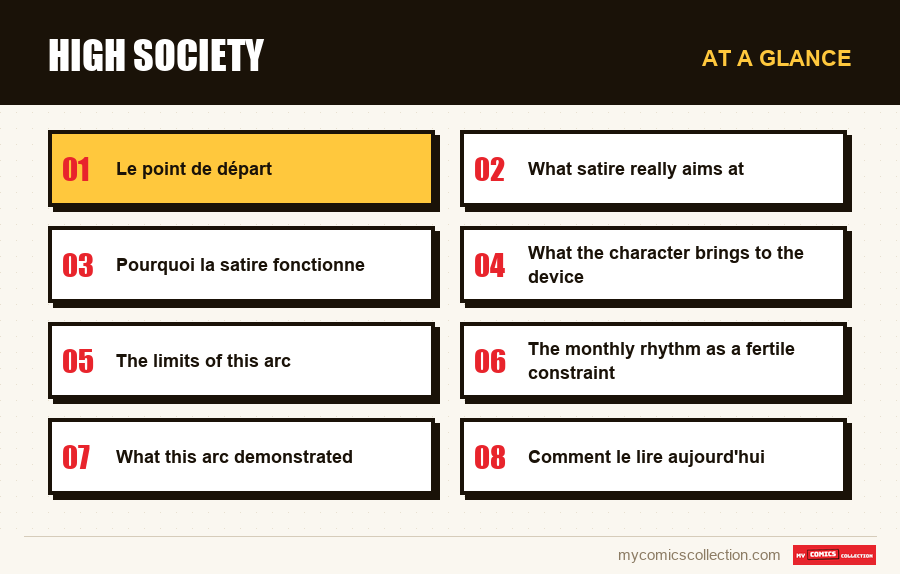
Le point de départ
The character arrives in a city-state with no other plan than to find money. He has neither conviction, nor program, nor the slightest idea of what a government is.
People notice it. Not for its qualities, but because it is unclassifiable, unpredictable, and therefore usable. He is offered a place, then another, then an application: each step presented as a service being rendered to him.
What follows is a complete political rise, told from the inside, by someone who never fully understands what is happening to him. It is this incomprehension that makes the story readable.: the reader discovers the system at the same time as the character, and without the shortcuts that knowledge would allow.
What satire really aims at
Le financement
A considerable part of the narrative is about money: who pays for a campaign, what they expect in return, and how that expectation is never explicitly stated.
It is handled with mechanical precision, without ever stating a thesis.
Les conseillers
The character is constantly surrounded by people who know better than him what he wants. Their real competence is to make their own presence indispensable.
Le vocabulaire
Part of the comedy comes from the words themselves: empty formulas, administrative circumlocutions, commitments written to commit to nothing.
The inertia of institutions
Power never resides where we believe. Those who really decide do not appear in official scenes, and the story shows them working elsewhere.
Pourquoi la satire fonctionne
Many political stories fail by overloading their message. This one avoids three pitfalls, and it's worth naming them.
It does not designate any side. The city has no identifiable real equivalent, and the factions have no legible political correspondence. The story therefore describes a mechanism rather than a situation, which makes it transposable and prevents it from becoming stale.
He doesn't judge his characters. The advisors, the financiers, the opponents all have consistent reasons. No one is presented as corrupt by nature: everyone optimizes their position, and the collective result is absurd without any individual decision being absurd.
Il reste drôle. This is probably the decisive point. A seriously written satire of power becomes a pamphlet; it is crossed by situation gags, absurd dialogues and a main character who understands everything wrong. The comic does not weaken the subject, it makes it bearable over several hundred pages.
What the character brings to the device
The choice of the protagonist is not trivial, and it explains a large part of the effectiveness of the whole.
A character competent in politics would have produced a story of strategy-interesting, but one that requires the reader to follow the calculations. A naive character would have produced a moral fable, with an innocent person corrupted by the system.
This one is neither. He is rusé mais ignorant: capable of maneuvering in the short term, unable to see the structure in which he finds himself. He wins battles that he had not identified and loses positions that he thought he had acquired.
This configuration allows the story to be readable without being didactic. The reader gradually understands things that the character will never understand, which produces a constant discrepancy, and this discrepancy is both the comic engine and the political content of the book.
Why start here, despite the order. This arc follows a first period of fantasy parody which has almost nothing to do with it: neither in tone, nor in ambition, nor in design.
A reader can legitimately begin directly with this volume. He will be missing some references to the character's past, with no impact on understanding. The gain is considerable: we enter through what is valuable, instead of first going through what is not worth much.
The limits of this arc
Des longueurs assumées
Some negotiation sequences stretch over dozens of pages. It's consistent with the subject matter, politics is slow, and sometimes painful to read.
A distribution that is expanding quickly
The number of characters increases rapidly, with similar names and shifting allegiances. A split reading gets lost.
A still sketchy drawing
The second cartoonist has not yet joined the publication. The settings remain functional, which contrasts with the ambition of the text.
Beaucoup de dialogue
It is a story of conversations. A reader who comes looking for action will find very little of it, and it's better to know that beforehand.
The monthly rhythm as a fertile constraint
One aspect of the construction deserves to be highlighted, because it explains a quality that is usually attributed to talent alone.
This arc was written and published at the rate of one chapter per month, for more than two years, without a detailed plan decided in advance. The author discovered where he was going as he went there.
This method produces predictable flaws: abandoned leads, characters disappearing for no reason, lengths. But it also achieves something that a fully planned story rarely achieves: a political intrigue that advances as real political intrigues advance, by accumulation of opportunities seized rather than by execution of a plan.
The best moments of this arc are precisely that. An alliance formed for a local reason becomes decisive thirty issues later; a promise made lightly comes back to demand its due. These effects are not designed, they are récoltés: the author exploiting what he had posed without knowing that he would pose it.
This is an argument in favor of publishing in episodes, at a time when we are increasingly writing entire series before publishing them. The monthly format imposes real constraints, and it also allows things that no other method allows.
Collecting this series?
Track what you own, what you are missing and what your collection is worth. 7 day trial.
Start my trial →What this arc demonstrated
Beyond its own quality, this period produced an effect that counts in the history of the medium.
By the early 1980s, American comics were largely associated with the costumed action narrative. For an independent monthly publication to devote twenty-five issues to an electoral campaign, without combat or external threat, was an absurd bet.
That the bet held up, with a readership that followed and a series that continued, constituted a demonstration. It proved that an audience existed for a long, adult, political story, without the codes of the dominant genre.
This demonstration counted for an entire generation of independent authors. She withdrew the argument that this type of project does not find its readers, and this argument, once dead, does not reappear.
Comment le lire aujourd'hui
Three practical recommendations, which arise from all of the above.
By volume, never by booklet. The market statement is clear: the collection costs less than just one of the issues it contains. There is no reason to reconstruct this arc individually.
Sans trop espacer. Allegiances shift, secondary characters return after long absences, and negotiations involve remembering what was promised. Reading spread over months loses part of the benefit.
Without reading the above, if one hesitates. This is the most useful and counterintuitive advice. The earlier period discourages many readers, and it is not necessary.
And after?
The question arises immediately, and it calls for an honest answer rather than automatic encouragement.
The following arc extends the same vein and benefits from the arrival of the second designer, who transforms the appearance of the work. It is the formal culmination of the whole, and the natural extension for those who loved political satire.
Beyond that, the work gradually moves away from this register to develop other concerns, some of which, widely rejected and considered by many as misogynistic, have lastingly divided its readership.
Stopping after this arc is therefore perfectly defensible, and this is what a significant portion of readers do. We will have read a complete, coherent story, with a beginning and an end, and the best in an otherwise very uneven work.
What to check before purchasing this volume
Three points specific to this collection, which have nothing to do with its market value.
The print and its printing. This volume has been reprinted for decades. On a story that relies largely on faces and dialogue, a impasto print makes expressions less readable: which is more important than one might think on such a talkative text.
The condition of the back. Like all collections of this work, this one is thick and its binding is its weak point. An already folded spine indicates a copy that will come apart when read.
The numbers contained. Check the range, as with any long work collected in sections. This is the only way to know if you have the entire arc and not a portion.
These three checks are requested by message before purchasing, and they separate a copy that will last from a copy that will disappoint: for a price difference that is generally insignificant in this segment.
Frequently asked questions
Yes, and it’s even recommended if you’re hesitant. The earlier period is a parody of fantasy that has almost nothing to do with tone, ambition or design. Some references to the character's past will be missing, with no impact on understanding, and the advantage is to enter directly through what is worthwhile.
Not particularly. The story assumes no prior knowledge and does not name any real side: it describes a mechanism (funding, advisors, promises) rather than an identifiable situation. This is also what prevents it from becoming outdated.
Not really, and that's not the point. He is cunning but ignorant, capable of short-term maneuvering without ever seeing the structure in which he finds himself. This gap between what he understands and what the reader understands constitutes both the comic driving force and the political content of the book.
Very little, and it is better to know this before opening the volume. It is a story of conversations, negotiations and maneuvers, some sequences of which stretch over dozens of pages. The slowness is consistent with the subject, but it puts off readers who come looking for something else.
Without reservation, and a significant portion of readers do so. We will have read a complete story with a beginning and an end, and the best that is in an otherwise very uneven work. The following arc is justified for those who have loved; beyond this, the work moves away from this register towards developments which have lastingly divided its readership.
A volume, a complete arc, a few dollars
Noting the range of numbers contained avoids buying a portion thinking you have the whole thing.