
The collections of Cerebus are nicknamed “telephone directories” by its readers, and that is not an image. Three hundred issues grouped into around fifteen volumes produce bricks of several hundred pages each, in black and white, without any accompanying device. This format has three direct consequences: binding is the weak point of any second-hand copy, the qualité d'impression varie fortement from one edition to another, and a volume cannot be bought without knowing what issues it contains.
This is the only segment of independent comics where the physical format determines the purchase to this extent. An informed reader checks things here that he or she does not check anywhere else.
This article explains where this format comes from, what it actually involves, and how to buy second-hand without unpleasant surprises.
Where does this format come from?
It does not result from an aesthetic choice but from an economic constraint, and that explains everything else.
An author who finances his own printing seeks the lowest unit cost. However, on a bound work, a significant part of the cost is fixed: the adjustments, the start-up, the binding itself. Grouping many pages in the same volume dilutes these fixed costs on more content.
Added to this is a stock logic. Fewer references to manage means fewer different palettes, less follow-up, less risk of ending up with an out-of-print volume and its unsold neighbor. For an author who is also his own warehouse, the simplicity of the catalog has real value.
Finally, a thick volume is justified editorially on a work whose arcs are long. Cutting a hundred-issue political satire into eight thin volumes would produce sections without autonomy; grouping them together gives sets that hold together.
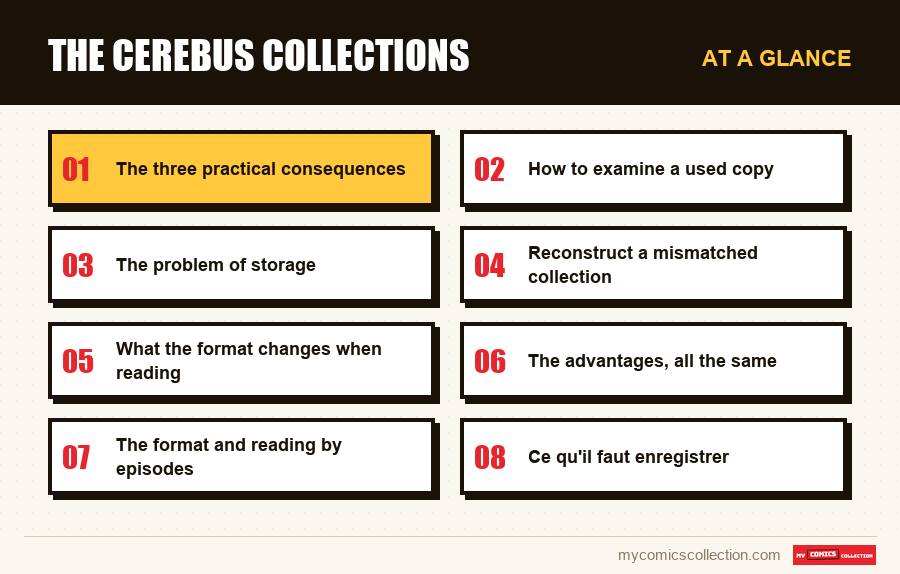
The three practical consequences
The binding works
Several hundred pages in a glued spine are under permanent stress. A volume opened flat, read several times or stored lying down will eventually give way.
This is the first point to examine on a used copy, before the corners and the paper.
Print varies
These volumes have seen numerous reprints over decades. The fineness of the line does not support economical prints: entire textures can disappear.
The content is not obvious
A volume has a title, not a rank. Knowing which numbers it groups requires checking it, as with any long work collected in sections.
Weight discourages
These are not objects that we take away. Reading is done seated, at a table, which concretely changes the relationship we have with the book.
How to examine a used copy
Four checks, in that order, and they all ask each other via message before purchasing.
The back, first. Ask for a photograph of the volume seen from the side, closed, and a second of the back seen from above. Wrinkles, bleaching and peeling are immediately visible. On these bricks, a tired back announces a copy that will come apart with use.
An interior double page then. This is the verification that no one does and that matters most here. It reveals the printing quality: if the hatching of the decorations can be read, the print is good; if dark surfaces form gray masses, it is not.
The credits page. It gives the numbers contained and often the drawing mention. These two pieces of information decide what you actually buy.
Paper, finally. On old black and white volumes, marked yellowing modifies the relationship between values and makes reading less comfortable: an invisible defect on a cover.
The request that saves the most.“Can you send me a photo of a double page inside? » This is an unusual question, and that's precisely why it's useful: it addresses the one aspect that no announcement documents.
On a work whose graphic value relies on the finesse of the line, two copies of the same volume can offer very different reading experiences.
The problem of storage
A material aspect deserves to be noted, because it produces damage that is noticed too late.
Volumes of this thickness cannot withstand being stored lying down in a pile. The weight of the upper ones compresses the lower ones, deforms the backs and ends up marking the covers. This is the primary cause of wear on this type of object, even before reading.
Stored upright, however, they require solid shelving and sufficient tightening: a thick volume left free tilts under its own weight, which tires the binding on the opposite side.
These constraints seem trivial. On a series of fifteen volumes kept for twenty years, they make the difference between a collection in good condition and a collection in which each spine is marked. This is the only case in this segment where storage is a real issue, and it's worth thinking about it before you buy rather than after.
Reconstruct a mismatched collection
The most frequent situation with this work is not the purchase new but the repurchase of an incomplete set: two or three volumes found separately, often in different editions.
It calls for a decision that we rarely make consciously: aim for homogeneity, or aim for content?
Homogeneity requires searching for volumes of the same print run, which is time-consuming and costly for a work reprinted for decades. The result is pleasing to the eye and consistent in print quality, but the build-up can take years.
The content is to take what presents itself, regardless of the print and appearance. The collection is mismatched but complete in a few months, and for a fraction of the price.
On this specific work, the second approach is almost always the right one: with one reservation, and it is important. A volume whose printing has crushed the decorations is not only less beautiful: it cuts off a real part of what we are supposed to read. It is therefore better to mix the prints while refusing copies whose interior is visibly damaged.
It's a trade-off that requires looking at the interior before buying, and that's exactly what most buyers don't do.
What the format changes when reading
A seated reading, at a table
The weight prohibits reading in bed or on transport. This seems anecdotal and really changes the pace at which we move forward.
Difficult to find your way
Without division into short volumes, finding a passage in several hundred pages requires patience. The lack of an accompanying device doesn't help.
Awkward breaks
A thick volume does not lend itself well to split readings. Resumption after several weeks involves finding where we left off in a block without reference points.
A high entry ticket
A volume represents several dozen issues, therefore a higher unit price than a thin volume. We do not test this work for a few euros.
Collecting this series?
Track what you own, what you are missing and what your collection is worth. 7 day trial.
Start my trial →The advantages, all the same
It would be unfair to only present the disadvantages, because this format has merits that collections in thin volumes do not have.
The cost per chapter is very low. A thick volume is much cheaper, for equal content, than the same material divided into five volumes. In a work of three hundred issues, the difference is considerable.
Longbows breathe. A satire that extends over dozens of issues is better read in one piece than arbitrarily cut up. The format here serves the story rather than constraining it.
La collection reste compacte. Fifteen volumes for three hundred issues take up less space than one might imagine, and are more easily located on a shelf than a long series of identical spines.
These advantages are real and they explain why the format was retained until the end, despite its material defects well known to readers.
The format and reading by episodes
A practical consequence arises from all of the above and concerns the very way in which we advance in the work.
A story of three hundred issues cannot be read in one go. It extends over months, often years, with interruptions. However, this format makes repeats uncomfortable: without division into short volumes, without detailed summary, finding your stopping point in several hundred pages requires leafing through.
The parade comes down to a simple habit: note the original number of the last chapter read, not the page or the volume. The numbers are indicated in the collections, they constitute the stable unity of all this work, and they allow us to pick up exactly where we left off even after a year of interruption.
It is also the data that allows us to know, years later, whether we had completed a volume or just started it. On a work where one willingly stops along the way, the distinction is not anecdotal: picking up a half-read volume and starting a new one do not require the same effort.
Ce qu'il faut enregistrer
On these volumes, the current inventory is insufficient, and three fields make it useful.
Les numéros contenus. It is the stable unity, here as in any long work collected in sections. The title of the volume does not say where it begins or where it stops.
The print, and its printing state. This second point is specific to this work: note if the textures read correctly on your copy. It's information you never find afterwards without reopening the book, and it decides whether it's worth looking for a better one.
The condition of the back, described in words. Not an overall rating but a description: soft or stiff back, marked crease or not, detachment initiated or not. On such heavy objects, this is what determines their survival and resale.
These three fields answer a question that this format poses more than any other: is my copy capable of lasting, and does it do justice to what it contains?
Questions fréquentes
Above all, for cost reasons. On a bound work, a significant part of the costs are fixed (adjustments, start-up, binding) and grouping together many pages dilutes these costs. For an author who finances his printing and manages his own stock, the simplicity of the catalog also has concrete value.
The back, without hesitation. Several hundred pages in a glued binding undergo permanent stress, and a folded or bleached spine indicates a copy that will come apart with use. This should be examined before the corners and before the paper.
Yes, and this is the verification that no one does. It reveals the printing quality: if the hatching of the decorations can be read, the print is good; if the dark surfaces form gray masses, part of the graphic work has disappeared. Two copies of the same volume may differ markedly on this point.
Upright, on sturdy shelving and tight enough so they don't tilt. Never lying in a pile: the weight of the upper volumes compresses the lower ones and deforms the spines, which constitutes the primary cause of wear on this type of object, even before reading.
Several, and they explain that it was preserved until the end. The cost per chapter is much lower than that of a collection in thin volumes, the long arcs are better read in one piece than cut up arbitrarily, and around fifteen volumes take up less space than a long series of identical spines.
The condition of the back decides the survival of the volume
On blocks of several hundred pages, this is the field to be described in words rather than noted.