Comics from the 1970s and 1980s include a quantity of text that current production has almost entirely abandoned: narration cartridges, explicit thoughts, comments from an external narrator. It was not clumsiness but a response to specific constraints: poor printing, changing readership, issues purchased at random. These cartridges did a job that nothing does anymore, and their disappearance has consequences that we rarely measure.
This is the trait that most disconcerts a contemporary reader discovering these series, and it deserves to be explained before being judged.
Here's what this text accomplished, why it disappeared, what we gained and lost in the process, and how to read these pages today.
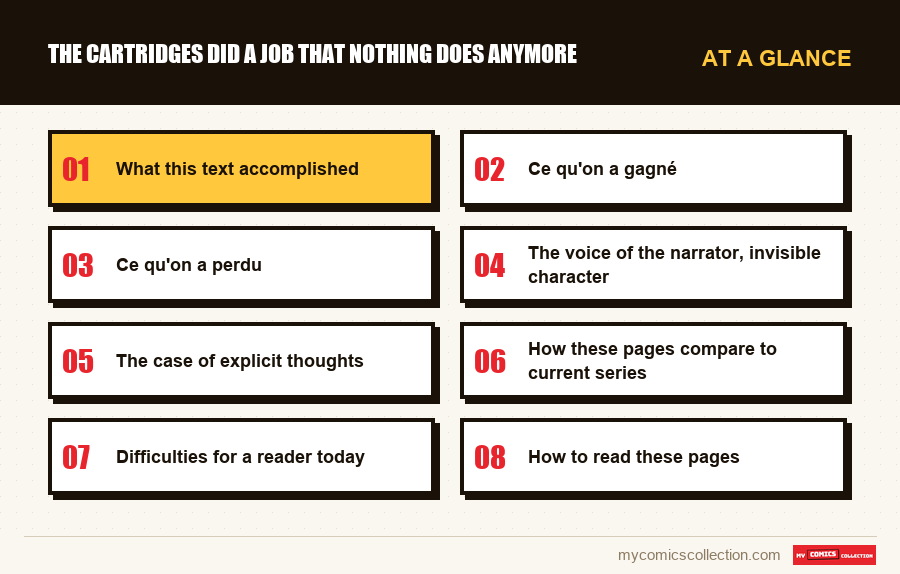
What this text accomplished
Four functions, none of which were decorative.
Locate a drive that arrives at any time. A number bought at random had to be understandable. The cartridges reminded us who was who and what was happening, in a few lines and without interrupting the action.
Compensate for poor printing. On absorbent paper and an approximate reproduction, certain visual details were missed. The text assured what the image did not guarantee.
Donner accès à l'intériorité. Explicit thoughts made it possible to know what a character was hiding from others: information that a drawing alone conveys only imperfectly.
Maintain pending threads. A cartridge line was enough to remind us that an absent character was in difficulty, which cost much less than a scene.
These four functions responded to real problems. Removing text without replacing these functions leaves gaps, and that's exactly what happened.
Why did the text disappear?
Printing has improved
Paper, inking and reproduction today allow details that the image alone transmits. The fallback text has become redundant.
This is the most legitimate cause of his abandonment.
The purchasing method has changed
We no longer buy an issue at random from a newsagent. The reader follows a series, so systematic recall no longer has any purpose.
Cinema provided a model
The external narration comes across as an admission of weakness, and this norm has been transmitted to the neighboring medium.
Volumes have replaced numbers
In continuous reading, a reminder every twenty pages becomes an unbearable repetition which did not exist at the monthly rate.
Ce qu'on a gagné
This must be said clearly, because evolution is not a net loss.
More breathable pages. Less text allows the drawing to be seen, which is particularly noticeable on the atmospheric plates where the cartridges occupied the place of the shadows.
Trust placed in the reader. Not explaining what the image shows is a form of respect, and it produces more active reading.
An elimination of redundancy. Many of the title blocks literally described what was seen, which was unnecessary even at the time.
These three gains are real and they explain why the evolution has been general. Nobody regrets the cartridges which said “he leaps” under a drawing of a leap, and their disappearance has sanitized the medium.
The problem is that we deleted the tool without addressing the functions. Three of the four uses described above disappeared with the cartridges, without replacement.
This is why current series are difficult to read in isolated issues, require continued continuity, and struggle to maintain secondary threads in suspense. These difficulties are presented as evolutions of taste; these are partly the consequences of a removed tool.
Ce qu'on a perdu
Three abilities that the medium commonly exercised and that he practices today with difficulty.
Entrance along the way. A reader today who opens a series at number thirty is lost, whereas a reader in 1980 could follow. It's not that the stories have become more complex, it's that they have stopped explaining themselves.
Maintaining low cost. A cartridge line kept a character present for almost nothing. Today you need a scene, which costs pages and forces you to reduce distribution.
Direct access to what a character is keeping quiet. Explicit thoughts allowed a gap between what we say and what we think, a powerful dramatic force that has become difficult to obtain.
This last loss is the least compensated. A medium without access to interiority must pass everything through behavior, which is more elegant and considerably longer.
The voice of the narrator, invisible character
One aspect deserves to be developed, because it distinguishes the good series of the period from the others.
The narrator of the cartridges is not neutral. Depending on the series, he comments with irony, worries, takes sides, sometimes addresses the reader directly. It is a presence, and it has a character.
This voice does a job that nothing can replace: it sets a tone for the whole, regardless of what the characters say. The same scene commented on soberly or emphatically does not produce the same effect.
On horror series, this narrator often adopts a cold distance which increases the unease. On group series, he becomes warmer and serves as a link between opposing points of view.
This is probably what we lost the most and noticed the least. A current series has no voice of its own apart from those of its characters, and must obtain through editing what a cartridge gave in one line.
The case of explicit thoughts
One particular form of this text has disappeared more completely than the others and deserves separate examination.
Thought bubbles gave direct access to what a character is not saying. They have almost disappeared from current production, replaced by first person cartridges or by nothing at all.
What they allowed was a constant gap between what was said and what was thought., a dramatic spring of formidable effectiveness: a character who reassures someone while thinking the opposite produces immediate and gratuitous tension.
Without them, this shift must be suggested by an expression, a posture, or a reaction plan: what works, costs spaces, and remains ambiguous.
The abandonment is justified by real aesthetic reasons: the thought bubbles age poorly and appear naive. But their function has never been replaced at equivalent cost, and current series achieve this effect less often.
How these pages compare to current series
A direct comparison illuminates the gap and is easy to conduct.
Take one issue from the period reviewed here and one recent issue, and count the words. The difference generally ranges from three to three, sometimes more.
Then count the events recounted. The difference is of the same order, and in the same direction: these issues contain more things, not just more text.
This is an important and often missed point. The text density of old series is not filler: it corresponds to a real narrative density. A twenty-page issue tells what a current series spreads over three.
Modern rhythm has its merits: readability, breathing, space left for drawing. But we have to accept that three issues tell what only one told in the past., and this difference weighs on the price per story much more than on the price per issue.
Collecting this series?
Track what you own, what you are missing and what your collection is worth. 7 day trial.
Start my trial →Difficulties for a reader today
A confusing density
The volume of text per page is surprising and gives the impression of a chatty story before you get used to it.
Repetitive reminders in volume
What was useful every month becomes boring when you string together the numbers in one go.
A dated tone
The narrator's voice uses period expressions which appear grandiloquent today.
A hidden drawing
The cartridges take up part of the space, which penalizes the atmospheric designers.
How to read these pages
Three adjustments that make these series significantly more comfortable.
Read at the original pace. A few issues per session rather than an entire volume. The reminders then stop being repetitive and become useful again.
Treat cartridges like service, not style. They are not looking for literary effect, they are doing work. Judging them as prose produces an unfair assessment.
Spot those who are doing something else. Some go beyond function and create an atmosphere or irony. These are the best and are easily distinguished once you look.
This last habit really changes reading. A title block that explains and a title block that comments are not the same work., and confusing them makes it seem talkative which is sometimes very controlled.
A tool that could come back
A forward-looking remark, since the conditions which caused the abandonment are in turn evolving.
Digital reading fragments again: we read a chapter between two activities, on a medium that does not help us remember, often weeks after the previous one. This is a situation close to that of the monthly magazine.
The problems that the cartridges solved therefore rest, and some recent series reintroduce forms of callback: often shameful, slipped into dialogue, but functionally identical.
It is not certain that the process will return in its old form, as aesthetic standards are against it. But the functions reappear.
This is a useful reminder: a narrative tool is almost never abandoned because it is bad, but because the problem it solved has changed: and it comes back when the problem returns.
Ce qu'il faut enregistrer
On series with explicit narration, the sheet benefits from noting what the text provided and which the memory does not retain.
The information given only by the cartridges, when it does not appear anywhere else. Certain elements of continuity are only there (a reminder of injury, a motivation, a waiting thread) and a reader who skims over these blocks loses data that the story subsequently takes for granted.
This is a common flaw: we read the title blocks quickly because they seem redundant, and we miss the small percentage that is not.
The pace at which you read each block, because the appreciation of these series depends directly on it: the same issues read twice a week or twenty in a row do not produce the same judgment, and remembering this allows you to put your own opinion into perspective before giving it.
These two notes deal with an obstacle which is not in the works but in the gap between their conditions of publication and our conditions of reading.
Questions fréquentes
For four practical reasons: to locate a reader who was buying at random, to compensate for a mediocre impression where certain details were missed, to provide access to what a character was hiding, and to keep threads waiting for the cost of a line. None of these functions were decorative.
Printing has improved, the method of purchasing has changed: we follow a series instead of buying at random -, cinema has imposed a standard against external narration, and reading in volumes makes reminders repetitive. The first three causes are legitimate.
The tool was deleted without its functions being addressed. Hence three current difficulties: we can no longer enter during a series, maintaining a secondary character now costs an entire scene, and access to what a character is silent must go through behavior: more elegant and much longer.
At the original pace, a few numbers per session rather than a single volume: the reminders then become useful again instead of being repetitive. And by distinguishing the cartridges which explain from those which comment: they are not the same work, and confusing them makes what is mastered appear talkative.
The functions are already coming back. Digital reading fragments again, in conditions close to the monthly, and certain recent series reintroduce reminders: often disguised as dialogue but functionally identical. A tool is almost never abandoned because it is bad, but because its problem has changed.
Did this information come from the cartridge?
A small percentage is not redundant, and that's the one we skim over.