This catalog is one of the easiest to browse in full on a low budget, because its structure is flat with two identified exceptions. As of August 29, 2026, the entries are between $0.99 and $2.99 depending on the series, for medians between $6.99 and $15.99. A hundred dollars covers several hundred numbers provided that we exclude the first two appearances, which are not useful for reading and cost in themselves more than all the rest.
Rare are the catalogs where the separation between reading and collecting is so clear and so easy to apply.
On the program: where the entries are located segment by segment, what to buy depending on the amount available, the errors specific to this catalog, and the minimum trace to keep when the packages follow one another.
Where are the entrances located?
Everything that follows comes from the same survey dated August 29, 2026: fixed price announcements, copies in shell counted separately from the others. These amounts are displayed, not cashed.
L'événement de 1985
Entrées à 0,99 et 1,99 $, median $10.00 across 124 listings. It is the most cited work in the catalog and the most accessible.
Twelve issues are enough to read it in full.
The solo antagonist series
Entries to 1,00 et 1,99 $, median $6.99 across 169 listings. The cheapest segment, with a plethora of options.
The group series
Entrées à $1.87 and $2.49, median $10.00 across 134 listings. This is the best content-price ratio in the catalog.
The horror series
Entries to 2,99 et 3,95 $, median $15.99 on 169 listings. The most expensive of the common segments, and by far the oldest.
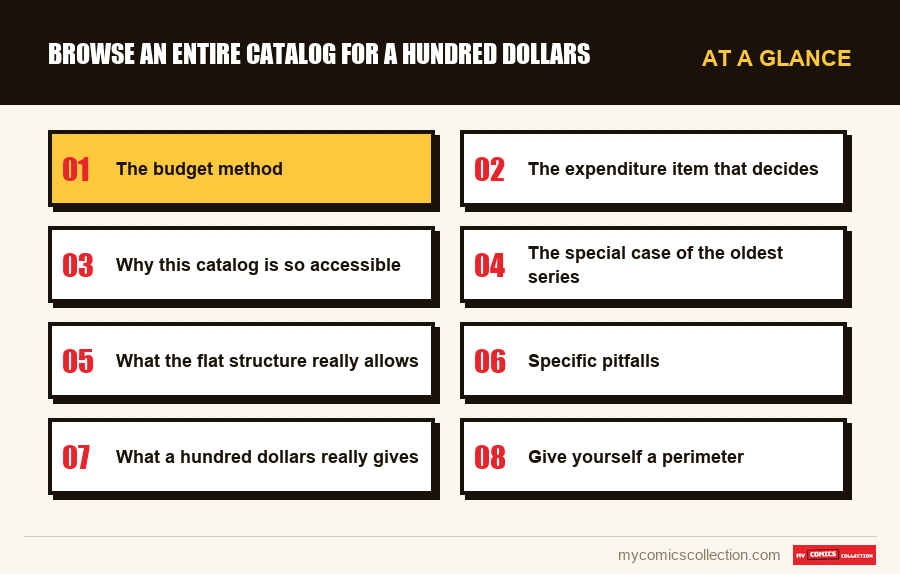
The budget method
Three levels, each giving a coherent whole rather than a fragment.
Twenty Dollars: The entire 1985 event. Twelve issues at $0.99 and $1.99 each, purchased as a set. It is the most cited work in the catalog, it concludes, and it fits within this budget.
Fifty Dollars: An extended installment of the group series. Count between $1.87 and $2.49 each and aim for thirty episodes following one another: this is the minimum volume for the continuity to produce its effect, the only reason to read this series.
One hundred dollars: the three series sampled. One block of each, allowing you to compare the three registers and decide which one to pursue.
The advantage of these three levels is that they do not pile up in quantity: each elucidates a distinct question: what this author has produced that has been most commented on, his way of conducting a long story, and which of his registers speak to you.
The two expensive references are outside this reasoning. They alone cost several times the budget needed to read the entire catalog, and they add nothing to the reading.
These are part purchases, motivated by the desire to own a point of origin. This is legitimate and unrelated to the above, but mixing the two projects leads to indefinitely postponing a reading that costs twenty dollars.
The expenditure item that decides
As with all the cheap catalogs noted in this campaign, it is the shipping and not the unit price.
A booklet posted for one dollar and mailed alone costs you five or six dollars. The correct comparison is therefore never between two unit prices but between two complete baskets, costs included, and a seller who costs more per unit wins as soon as he ships around twenty pieces together.
Optimizing the displayed price therefore amounts to optimizing the wrong variable, and the error is paid for here more than elsewhere: these series have dozens of issues, therefore dozens of opportunities to repeat it.
The abundance of the offer, from 124 to 169 advertisements depending on the segment, also makes the lots easy to find. Three or four bulk orders are enough to cover most of this catalog.
This is the only parameter over which a buyer really has control, the unit prices being more or less fixed and without negotiation possible at these levels.
Why this catalog is so accessible
The observed flatness is not accidental and is based on three cumulative production facts.
All these series have been published by major houses. National distribution, substantial print runs, frequent reprints: nothing has been confidential, unlike with self-published authors where the first printing is always rare.
Two of them date from a period of overproduction. The 1980s and early 1990s printed well in excess of actual demand, and these stocks still fuel the market.
Conservation had already become part of the customs. There are therefore numerous copies in good condition, which prohibits any state premium on current issues.
These three factors reinforce each other and produce a stable situation. There is no indication that these prices are changing: the causes that keep them low are structural and will not disappear.
For a buyer, this means that patience costs nothing in current segments: you can build this collection over three years or over three months, at the same price.
The special case of the oldest series
One segment requires a different approach, and this is the only one.
The 1970s series partially escapes the above: its paper has aged poorly, the copies in good condition are actually fewer in number, and attrition has done its work over fifty years.
This explains its higher median: $15.99 compared to $6.99 to $10.00 elsewhere: despite much lower awareness. It's not demand that's driving it, it's scarcity.
The practical consequence reverses the general advice: in this segment, a copy in good condition at a reasonable price deserves a decision, the offer is not renewed in the same way.
This is also the segment where you should be most wary of advertising photographs: yellowed paper is difficult to see in the thumbnail, and the gap between two similarly described copies can be considerable.
What the flat structure really allows
It is worth naming what a market without a high point allows and a tight market prohibits.
Try without commitment. At one or two dollars an issue, you can buy a series without knowing if it will be popular. In an expensive catalog, this freedom does not exist and we fall back on recommendations.
Make a mistake without consequences. A lot that disappoints represents a few dollars lost, which allows curiosity rather than caution.
Lire dans l'ordre. Series with strong continuity require consecutive blocks, which is inaccessible as soon as the unit price rises, and that is exactly what these series need to perform well.
This third point is the most important. A cheap catalog is the material condition for orderly reading, and on an author whose signature is the maintenance of continuity, this ceases to be a budgetary detail to become a question of method.
Collecting this series?
Track what you own, what you are missing and what your collection is worth. 7 day trial.
Start my trial →Specific pitfalls
Des séries homonymes
Several similar titles coexist, including later revivals written by others. The title alone is not enough.
Numbers written by others
On long series, not all the numbers are his. Buying by title brings off-topic episodes.
Paper from the 1970s
The horror series is on a support that yellows and breaks. Correct states are rarer there than elsewhere.
Purchasing individually
On dollar numbers, the postage far exceeds the item. This is the only real cost of this catalog.
What a hundred dollars really gives
The order of magnitude deserves to be asked, because it is surprising for an author of this notoriety.
Divided into grouped lots at the prices noted, one hundred dollars covers the entire 1985 event, a lengthy block of the group series, and a substantial sampling of the other two series: which is more than enough to judge this catalog and decide what to explore further.
The same amount buys, on the two tense references, a fraction of a single certified copy.
This comparison does not disqualify the purchase of a collection, which meets a different need. It locates: reading this author costs what a meal costs, owning your two points of origin costs several thousand dollars.
Many readers realize late that only reading interested them, after having believed that a serious collection required the other path. The clarity of this catalog makes this misunderstanding particularly easy to dispel.
Give yourself a perimeter
Abundance combined with low prices creates a danger that we do not see coming.
At a dollar per issue, you buy quickly and a lot. Without scope, we find ourselves with fragments of four series, issues written by others, and duplicates from successive batches.
The parade involves a prior decision: one series at a time, in order. On series with significant continuity, this is the only way to read them usefully.
Grabbing a package from another series in passing remains possible, there being no shortage of opportunities; We must still have in mind the one we are carrying out, otherwise none of them succeeds.
No arbitration of this file requires so little and changes so much: a minute of thought saves dozens of unnecessary commands.
What to record
When the packages arrive quickly and each piece is worth a dollar, the card has two functions and two only: to prevent repurchase, and to track progress.
The contents of each lot received, entered upon arrival. We buy here in packs of ten or twenty issues, often overlapping from one seller to another, and an unseized lot becomes in a few weeks a pile of which we do not know what it contains. This is the first source of duplicates for this type of catalog.
The entry must remain minimal (series, numbers, total price) otherwise it will not be made, and an entry not made does not protect you from anything.
Your progress point in each series, which has nothing to do with the extent of what you hold: buying in packs always makes possession run well ahead of reading, and finding the right page after a break determines whether you continue or not.
These two mentions respond to a situation that only a flat and abundant market produces: acquisition goes quickly, reading does not, and the gap quickly becomes impossible to keep track of.
Frequently asked questions
Twenty dollars is enough to read his most cited work in its entirety: twelve issues at $0.99 and $1.99 each, purchased in a single bundle. It is a complete whole that is concluded, not a fragment: which is rare at this budget level.
They add nothing to the reading and cost alone several times the budget necessary to browse the entire catalog. These are piece purchases, legitimate in themselves, but mixing the two projects leads to indefinitely postponing a reading that costs twenty dollars.
He dominates him completely. Compare complete baskets including fees, never two price tags: an order of around twenty pieces from a slightly more expensive seller systematically beats an isolated purchase from the least expensive. In this catalog, it is the only variable that a buyer controls.
By deciding on one series at a time, in order. At one dollar per issue we buy quickly and a lot, and without perimeter we obtain fragments of four series, issues written by others and duplicates from successive batches. The decision is made in a minute.
No, and it's a trap with long series: buying by title brings back episodes written by others. You have to check the title or trust the mentions in the advertisements, several sellers specifying the screenwriter: useful mention which is not systematic.
What exactly did this batch contain?
A packet of twenty numbers not entered becomes in a few weeks a pile whose contents we do not know.