
On this work, the question is not knowing where to stop but not stopping in the wrong place. The story is a closed epic whose quality does not decline: there is therefore no exit point dictated by a drop in speed. On the other hand, it has a hollow, located in the first third, where most of those who give up abandon. This dip is a settling in, not a shortness of breath, and that's exactly where you shouldn't stop.
This configuration is the opposite of that of long series, where the risk is to continue too long.
This article locates the trough, explains why it exists, gives the real exit points if any, and says what exactly is lost by stopping at each step.
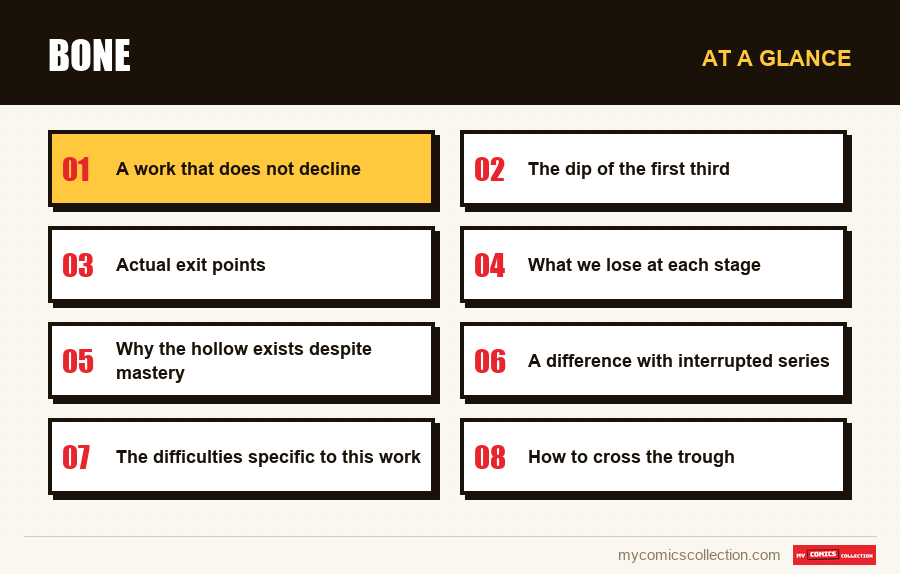
A work that does not decline
This point must be established first, for it entirely changes the nature of the question.
On an ordinary long series, the question of the stopping point arises because the quality varies: an author runs out of steam, a team changes, a formula wears out. The reader then searches for where the decline begins.
Ici, rien de tel. The work was conceived as a single story, led by the same person, and concluded at the expected time. There is no relaunch, no team change, no commercial extension.
The consequence is direct: no stopping point is recommended due to a drop in speed, since there is none. If we stop, it is for reasons that have to do with the reader, not the work.
This shifts the question entirely, and makes it more interesting, because it then concerns what we accept to miss.
The dip of the first third
Where it is located
After the initial installation, once the novelty has passed and before the main issue appears. The story then moves forward without visible direction.
This is where the majority of dropouts occur.
What's really happening there
Characters, places and objects are put in place, without any being yet connected to the others. The work is invisible because it is preparatory.
Why is it necessary
The subsequent rocker assumes a plinth installed. Without these volumes, the darkening would have nothing to rely on and would appear arbitrary.
What we think afterwards
This is the part that finished readers most often cite as the one they prefer to reread.
Actual exit points
If we have to stop, three places leave a more or less coherent whole, and a fourth should absolutely be avoided.
After the first volume. It forms an almost autonomous whole and gives a fair idea of the initial tone. We will not have read the work, but we will have read something.
At the middle turn. A movement concludes at this point, and one can stop with the feeling of having seen a complete story, even knowing that it continues.
Never in the depths of the first third. It's the worst place: we keep the memory of a story that doesn't move forward, even though we stopped exactly during the installation of everything that will follow.
Or we finish. This is obviously the recommended option, and the conclusion justifies the commitment, but it represents several thousand pages.
Practical advice that is better than a stopping point. If the story seems stagnant, don't stop: jump.
Skidding quickly through a hundred pages costs less than giving up, and the resumption of interest is clear enough to be noticed. You will have missed installations, about which you will know nothing, but you will have read the work rather than its first third.
What we lose at each stage
It pays to be precise, because losses are not proportional to what is left behind.
Stop after the first volume: we lose everything, but we don't know it. We keep the memory of a nice comedy and we are unaware that the work becomes something else. It is the greatest and least felt loss.
Stop in the middle: we lose the resolution but we have seen the transformation. This is the most defensible decision, because what makes the work original, the shift, has taken place.
Stopping before the last volumes: We especially lose explanations. The narrative material is in place and the ending brings less than the rise which precedes it.
This gradation has a counterintuitive consequence. The further we go, the less expensive it is to stop: the opposite of what we suppose about a work with a final revelation.
Why the hollow exists despite mastery
The question legitimately arises: if the author knew where he was going, why didn't he make the first third more concise?
Three reasons combine, and none of them are clumsy.
An installation cannot announce itself. Signaling that an item will be used later destroys the effect of its return. The price of the subsequent surprise is the apparent gratuity of the present moment.
The monthly publication imposed its rhythm. The original readers received these volumes months apart, spreading the installation over years and making it invisible. Read in a row, the same material concentrates and weighs.
The initial register did not allow tension. A comedy that sets up a serious issue from its beginning is no longer a comedy, and the entire seesaw device would collapse.
The hollowness is therefore a direct consequence of the choices that make the whole thing successful. We can't remove him without removing what he's up to., and this is what distinguishes it from an ordinary defect.
A difference with interrupted series
It is worth comparing this situation to that of works that are abandoned for other reasons, because the two cases are opposed.
On a never-ending series, stopping is almost always reasonable: nothing guarantees a conclusion, the quality fluctuates, and the reader who continues does so without perspective. The stopping point is a time management decision.
Here, stopping is a renunciation of an existing conclusion. It is written, available, attainable, and the only thing that separates the reader from it is a number of pages.
This difference changes the nature of the advice. On an open series, we help someone to stop at the right moment; here, we help him not to stop at all, which is an unusual position and which must be accepted as such.
It also explains why opinions on this work differ so much from one reader to another. Those who have finished it and those who stopped at the first third are simply not talking about the same book, and neither is wrong about what they actually read-this is the most common disagreement about it.
Collecting this series?
Track what you own, what you are missing and what your collection is worth. 7 day trial.
Start my trial →The difficulties specific to this work
A long commitment
Several thousand pages are discouraging before you even begin, regardless of quality.
A poorly reported hollow
Nothing warns that this is an installation, and the reader naturally concludes that it is running out of steam.
Cuttings in variable volumes
The exit points do not coincide with the ends of the volumes depending on the collection line chosen.
A difficult recovery
A reader who interrupts himself for a long time in the hollow rarely resumes, for lack of an issue that reminds him.
How to cross the trough
Three methods, from the simplest to the most effective.
Know that it exists. This is already the main thing: a reader informed that an installation phase awaits him does not take it for a fault, and his judgment is adjusted without effort.
Set a goal of pages rather than pleasure. Deciding to go to a specific point before evaluating avoids making a decision at the least favorable moment.
Read in series rather than individually. The trough is much better crossed in a row than in spaced volumes, where each recovery is without momentum.
These three methods aim for the same result: postpone the judgment beyond the area where it would be distorted. This is not complacency towards the work, it is a reading precaution applicable to any story with a long installation.
The special case of the reader in a hurry
One situation deserves a separate answer, because it is frequent and poorly addressed by the usual recommendations.
A reader who wants to know what this work is worth without spending weeks on it is generally recommended the first volume. This is the worst possible sample: it shows the initial register and nothing that makes the whole thing unique.
A better sample is to read the first volume then a volume from the last third, accepting that you will understand nothing of the second. We then see the two ends of the tilt, which no isolated volume gives.
This is unusual advice and better answers the question asked. A reader in a hurry does not want to start the work, he wants to know if it is worth starting: two needs that we systematically confuse.
If the gap between the two volumes intrigues him, he will have his answer. If he leaves him indifferent, he will have saved several weeks.
Ce qu'il faut enregistrer
On a long work whose environment is discouraging, the sheet should be used to resume rather than to list.
The reason for each interruption, noted at the time. Boredom, lack of time, unavailable volume, temporary weariness: these causes have nothing to do with each other and do not call for the same decision. Without this note, we resume months later believing we remember a problem when we had simply been interrupted.
This is what distinguishes an abandonment from a pause, a distinction that memory does not preserve and which nevertheless decides the resumption.
The exact point you arrived at, with volume and scene: on a story without a summary or reminder, restarting at the right place avoids having to go through fifty pages again to find your bearings: a restart which is, in practice, what makes you give up.
These two mentions address the only real risk of this work, which is neither the price nor the disappointment but the interruption which is never resumed.
Questions fréquentes
No. The work was conceived as a single story, led by the same person and concluded at the planned time, without relaunch or commercial extension. No stopping point is therefore recommended because of decline: if we stop, it is for reasons that lie with the reader.
Because characters, places and objects are put in place without yet being linked together. The work is invisible because it is preparatory, and without these volumes, subsequent obscuration would have nothing to rely on and would appear arbitrary.
At the middle turn, the most defensible stop: what makes the work original, the shift, has taken place. Never in the hollow of the first third, where we keep the memory of a story which does not advance even though we have stopped during the installation of everything that follows.
Not the first volume alone, which is the worst possible sample. Better to read the first volume then a volume from the last third, accepting not to understand anything about the second: we see the two ends of the shift. A reader in a hurry does not want to start the work, he wants to know if it is worth starting.
Jump rather than give up. Going quickly through a hundred pages costs less than stopping, and the resumption of interest is clear enough to be noticed. You will have missed installations about which you will know nothing, but you will have read the work rather than its first third.
Why did you stop?
Boredom or simple interruption: memory confuses the two, and this is what decides the resumption.