
This work is constructed for two readings, and the second does not show the same thing as the first. Elements laid out in the first volumes only take on meaning after thousands of pages, without any reminder pointing them out in passing. By rereading, we do not discover hidden details:we discover that scenes we thought were innocuous were installations, and the first volume completely changes its nature.
It is one of the rare long works where rereading brings more than the comfort of finding what you liked.
We will see here what the second reading reveals precisely, why the author could allow it, what changes in each part, and when to reread.
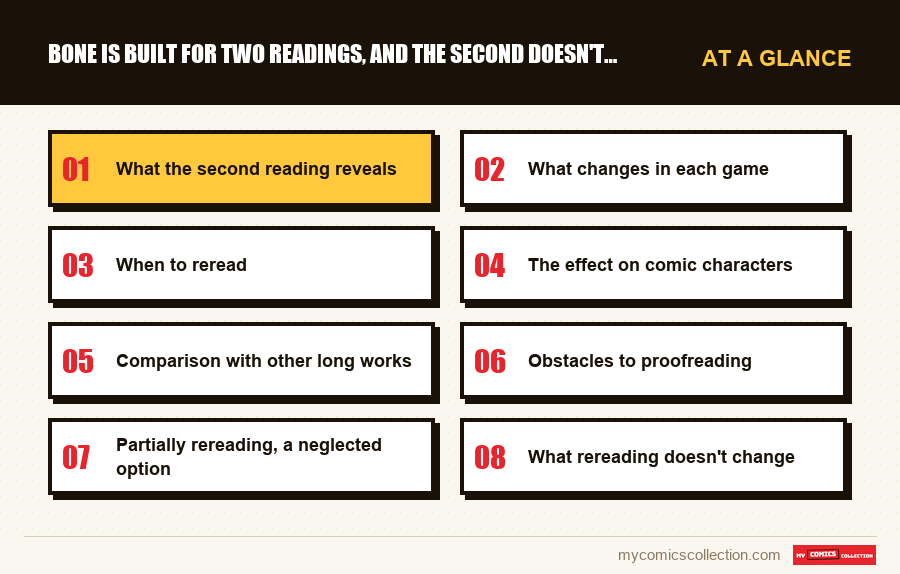
What the second reading reveals
Four categories of items change status, and they require no special attention to be seen once you know.
Objects that have become significant. Things shown in passing in the first volumes (an accessory, a place crossed, a map) return much later with an importance that nothing announced. On rereading, their first appearance is no longer neutral.
Sentences that said more. Some lines take on another meaning when you know who is really speaking. They were perfectly readable on the first pass, simply incomplete.
Des comportements expliqués. A character whose attitude seemed gruff or evasive acted based on knowledge that we did not have. Proofreading turns character traits into decisions.
The tone itself. The first volumes read like a comedy; reread, they carry warning signs which were all visible and which could be read differently.
None of these categories are hidden details. Everything was shown and nothing was emphasized, which is the definition of a work that trusts its reader.
What changes in each game
Le premier tiers
This is where proofreading adds the most. What passed for a series of gags becomes a methodical installation of characters, places and objects that will all serve a purpose.
Many readers find it slow on the first pass and prefer it to the second.
Le milieu
It gains in coherence: the threads which seemed to go in several directions appear as an organized convergence.
Le dernier tiers
It changes the least. The revelations are explicit and a second reading does not add much, other than the satisfaction of recognition.
The comic scenes
They remain funny but also become informative: many contain elements that the comic register would have gone unnoticed.
Why could the author afford it?
Sowing elements over thousands of pages presupposes two conditions that few authors meet.
Know where we are going. An improvised story cannot be established knowingly: it is necessary to reinterpret after the fact, what is always seen. Here, the installations are too precise to be retrospective.
Control publication. Self-publishing ensures that no outside decision will cut a series before the threads close. An author who fears cancellation does not sow ten years before the deadline.
These two conditions rarely combine. The first relates to temperament, the second to the mode of publication: and this is probably why this type of construction remains exceptional.
This says something more general about long works: their quality of construction depends less on talent than on the security available to their author.
An honest nuance on this type of analysis. Spotting an installation after the fact does not prove that it was planned. An attentive reader finds announcements everywhere, including where the author has not planned anything.
What argues for premeditation here is the precision of certain reminders: an object shown once, without comment, which returns exactly where it should. Chance produces vague coincidences, not adjustments of this finesse.
When to reread
The question has a more precise answer than one might imagine, and it does not consist of waiting.
Pas immédiatement. A rereading that follows the first too closely reveals nothing: we still remember everything, so nothing surprises. The effect requires having forgotten.
Not too late either. After several years, we have forgotten even the revelations themselves, and rereading becomes a first reading again: pleasant, but without the desired benefit.
The useful window is between the two, when we remember the broad outlines and the outcome without remembering the details. This is the moment when we recognize an installation without having anticipated the scene.
This requires knowing when you read, information that no one keeps, and this is precisely what an inventory can provide.
The effect on comic characters
One shift deserves to be isolated, because it is the one that readers most often report after a second reading.
At first glance, the three main figures are funny and a little interchangeable: we distinguish them by their temperament without attaching much importance to it, since they do not seem intended to carry an issue.
On rereading, we know what will happen to them, and their initial carelessness ceases to be neutral. Seeing them argue over trifles when we know what happens next produces an effect that the first passage could not achieve.
This is not dramatic irony in the classic sense: the story does not blink, does not prepare anything visible. It's just that the reader has changed his position and the same scenes find him different.
This is probably the best argument in favor of even partial rereading: a few pages from the beginning are enough to experience this shift, without having to go through the whole thing again.
Comparison with other long works
Locating this construction helps to understand why it is infrequent, even among stories of this magnitude.
Many long series reward rereading with recognition: we find favorite scenes, we better appreciate a drawing detail. It's nice and doesn't require any special construction.
Few reward rereading with a change in meaning. This requires having included elements whose meaning is deferred, therefore accepting that the first passage leaves certain scenes apparently unnecessary.
It's a costly gamble: a reader who gives up in the first third will only have seen scenes without a stake, and he will never know that they had one. The author loses this reader without gaining anything.
Accepting this risk implies aiming for a complete reading rather than a judgment by sample: a decision consistent with everything we observe elsewhere in this work, which is poorly recommended in extracts and poorly read diagonally.
Collecting this series?
Track what you own, what you are missing and what your collection is worth. 7 day trial.
Start my trial →Obstacles to proofreading
La longueur
Several thousand pages represent a commitment that few readers renew, even if satisfied.
A first third deemed slow
The memory of a quiet start dissuades you from starting again, even though it is the part that wins the most.
Deux versions disponibles
Rereading in the other version blurs the comparison, as the two do not show exactly the same thing.
A difficult moment to place
Without a record of the date of first reading, we reread too early or too late without knowing it.
Partially rereading, a neglected option
There's no need to redo everything, and targeted proofreading provides most of the benefit for a fraction of the effort.
The first volume alone is enough to measure the difference. This is where the transformation of meaning is strongest, and it can be reread in an evening.
The installation scenes identified are then sufficient. If you noticed where things appeared, you can go back to them directly rather than going through everything again.
The silent sequences deserve a separate visit. They carry a lot of information and can be read quickly on first reading; looking at them in isolation is instructive.
This piecemeal approach is often more effective than a full proofreading. It targets what changes instead of going over what doesn't change, and it requires two hours rather than two weeks.
Let us add that rereading also benefits from an often neglected material advantage: we then read in better conditions. The first reading of a work of this length generally takes place over months, with volumes borrowed, lent or read out of order. The second is done on a collection assembled, in the chosen order and at the desired pace: which is enough to explain part of the gain in coherence that we spontaneously attribute to knowledge of the plot.
What rereading doesn't change
We must also state the limits, otherwise we risk overselling the exercise.
The rhythm remains the same. The passages that seemed long to you will still seem so. Knowing their usefulness does not shorten them.
Weaknesses remain weaknesses. The dense explanations of the last volumes do not become elegant because we expected them.
The emotion of the first time does not return. We gain in understanding what we lose in surprise, and the exchange is not neutral for everyone.
These three limits are worth knowing before starting again. A reread is not an improvement on the first reading: it is a different reading, with its own advantages and its renunciations.
Ce qu'il faut enregistrer
On a work constructed for two readings, the sheet must prepare the second while the first is done.
The end date of the first reading, and the elements that intrigued you without being explained. The date determines the useful window for rereading (too early we remember everything, too late we forget everything) and no one remembers it. The intriguing elements are exactly those that will make sense on the second pass.
This list made during the first reading becomes a targeted rereading itinerary, which transforms a two-week commitment into a two-hour visit.
Your impression of the first hot third, noted before knowing the rest: this is the part whose judgment changes the most, and comparing the two impressions is the most direct measure of what the work has constructed.
These two mentions are only used once, months or years later, and they are impossible to reconstruct after the fact.
Frequently asked questions
Not hidden details, but the fact that scenes that we thought were innocuous were installations. Objects shown in passing, perfectly readable but incomplete replicas, behaviors that can be explained by knowledge that we did not have. Everything was shown, nothing was emphasized.
The first third, by far. What passed for a series of gags becomes a methodical installation of characters, places and objects that will all serve a purpose. Many readers find it slow on the first pass and prefer it to the second. The last third, conversely, changes little.
Neither immediately (we still remember everything, so nothing surprises) nor after several years, when we have forgotten even the revelations. The useful window is when we remember the broad outlines without the details, which requires knowing when we have read.
No, and targeted rereading is often more effective: the first volume alone is enough to measure the difference and can be read in one evening. If you noticed where items appeared, you can go back to them directly. Two hours rather than two weeks, for most of the benefit.
Spotting an installation after the fact doesn't prove it: an attentive reader finds ads everywhere. What argues for premeditation here is the precision of certain reminders: an object shown once without comment, which returns exactly where it is needed. Chance produces vague coincidences, not adjustments of this finesse.
When did you finish the first reading?
This date determines the useful window for rereading, and no one remembers it.