Lisez la série principale Black Hammer first, in full, before any derivative series. The universe created by Jeff Lemire and Dean Ormston at Dark Horse has around ten intersecting titles, and it is the only body of his work where order really matters. The derivatives are then read in the order of publication, each shedding light on a specific character.
Read the main series first, in its entirety, before any spin-off series. This is the only body of Lemire's work where order really matters.
Everywhere else at home, the series are independent: you can open Descender ou Gideon Falls without knowing anything about the rest. Black Hammer is an exception, because it is a shared universe conceived as such: with the entry defects that this supposes. This article gives the order, explains what each title brings, and points out the two pitfalls that lead to giving up.
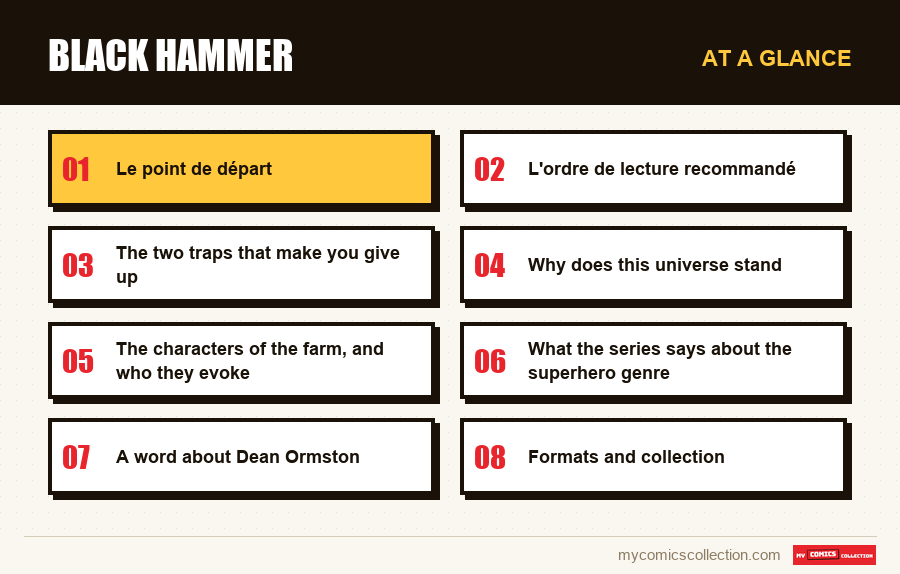
Le point de départ
A team of superheroes saved Spiral City from a cosmic threat. Since then, they wake up every morning in a farm lost in the countryside, from which they cannot escape: crossing the boundary of the land kills them. They have been there for ten years. No one in the village knows who they are, and they don't know how they got there.
The device is that of a rural camera, applied to archetypes of the genre: an extraterrestrial colossus disguised as a farmer, a heroine stuck in a child's body, an exiled Martian adventurer, an old alcoholic magician. Each refers to a recognizable figure from the silver age of comics, without ever being a parody.
It is this dual nature that explains the success of the series: it functions as a mystery: why are they there? and as a melancholic rereading of a whole section of superhero history.
L'ordre de lecture recommandé
1. Black Hammer: la série principale
Designed by Dean Ormston, with colors by Dave Stewart. It is the base: it establishes the farm, the characters and the mystery. No derivative is understandable without it, and several reveal its resolution.
Non négociable en premier.
2. Sherlock Frankenstein & the Legion of Evil
Four issues drawn by David Rubín. Black Hammer's daughter investigates her father's disappearance by questioning the team's former enemies. This is the best gateway to derivatives: it expands the universe without requiring anything more than the main series.
3. Doctor Star & the Kingdom of Lost Tomorrows
With Max Fiumara. An intimate tale about a scientist-hero and his son, closer to Essex County than superheroic. Often cited as the best title of the entire set.
4. The Quantum Age
With Wilfredo Torres. A jump into the future of the universe, around a team that succeeds the original heroes. It is the most detached derivative from the rest: pleasant, but the least necessary.
5. Skulldigger & Skeleton Boy
With Tonci Zonjic. The darkest variation, centered on a violent urban vigilante and the child he takes in. Reads in isolation, but resonates much better after the main series.
6. The sequels:Age of Doom et au-delà
The main series continues under successive titles. They require reading everything above and closing the questions asked at the beginning.
The two traps that make you give up
Start with a derivative
This is the most common error, and it is almost always accidental: derivatives are shorter, therefore less expensive, therefore easier to buy second-hand. However, many reveal in a few pages what the main series takes dozens of issues to install.
Trust the title on the cover
The main series changes its name throughout its seasons. A reader searching for “Black Hammer volume 4” may come across a volume with a different title and believe it is a different series. It’s the same story that continues.
Attendre l'action
The main series is slow and talkative in its first issues: the heroes wash the dishes, argue, go to the village bar. This is the subject, not a setup. Whoever expects fights gives up before the mystery opens.
Chercher les références
Each hero evokes a known figure of the genre. Identifying the connections is an insider's pleasure, but it's never necessary: the series can be read entirely without knowing a single superhero comic.
Why does this universe stand
Shared universes created by a single author often fail, because they expand faster than they deepen. Black Hammer avoids this fate for a specific reason: each derivative is entrusted to a designer with a radically different style, and deals with a different genre.
David Rubín brings a graphic energy close to the cartoon on Sherlock Frankenstein, which is an investigation. Max Fiumara gives Doctor Star a melancholy sweetness which makes it a family drama. Tonci Zonjic installs on Skulldigger an elegance of black polar. These are not variations of tone on the same product: they are four different books that share a setting.
This diversity has a practical consequence for the reader: if one derivative displeases you, the next one will not displease you for the same reasons. They don't look alike.
The characters of the farm, and who they evoke
Knowing the correspondences is not necessary, but they shed light on the project. Each inhabitant of the farm condenses a figure of the genre, and their treatment says what Lemire thinks of it.
Abraham Slam is the hero without power, the one who only held on by his fist and courage, and who, alone of all, adapts best to life on the farm. It is finally useful for something concrete.
Golden Gail is an adult woman locked in the body of the little girl she became by pronouncing a magic word. On the farm, the transformation is no longer reversed: she must return to the village primary school. He is the most cruelly treated character, and the funniest.
Barbalien, a shapeshifting Martian warrior, experiences a double dissimulation: that of his species and that of his homosexuality. Lemire draws from this superposition the most political thread of the series, without ever emphasizing it.
Colonel Weird has traveled too much in a dimension which has disordered his perception of time: he lives his existence in disorder and knows things that he cannot explain. It is through him that the mystery advances.
Madam Dragonfly, a witch linked to a haunted cabin, is the most opaque of the five, and the one whose revelation weighs heaviest on the entire story.
The strength of the device lies in the fact that none of these characters is a wink. They're written like people, not like quotes, and that's what allows the series to last sixty issues where a pastiche would run out in ten.
Collecting this series?
Track what you own, what you are missing and what your collection is worth. 7 day trial.
Start my trial →What the series says about the superhero genre
The question posed Black Hammer is not “what happens when heroes get old”, which has already been covered a hundred times. It is: what remains of a hero deprived of his function?
The characters on the farm are neither retired nor fallen. They retained their powers, their past and their memory. What they have lost is use: a world that needs them. The series observes them in this uselessness, and this is where it joins the rest of Lemire's work: his characters are always people whose lives have been defined by something they can no longer do.
The hockey player Essex County after the injury, the father of Sweet Tooth after the pandemic, the robot Descender after the genocide of the machines: it's the same figure. Black Hammer dresses him as a superhero, and it is precisely this disguise that makes the subject readable by a readership who would never have opened Essex County.
A word about Dean Ormston
The designer of the main series deserves to be named, because the series owes him a lot and he is regularly forgotten in favor of Lemire. Ormston comes from British comics, that of 2000 AD and Judge Dredd: a hard, angular, very inked line, the antithesis of Lemire's fragile drawing.
This choice is what prevents Black Hammer to slip into soft nostalgia. Where Lemire drawing himself would have made the farm touching, Ormston makes it disturbing: the faces are hollow, the shadows are heavy, and the neighboring village looks like a place from which you never return. Dave Stewart's colorism, warm on the farm scenes and cold on the memories of Spiral City, completes the separation of the two worlds.
Formats and collection
The universe poses a particular cataloging problem: around ten distinct titles, each with its soft issues and collections, plus library editions which bring together several derivative series in the same volume.
Concretely, the same story can be found in a collection in its name ou in an omnibus which brings together three. Without a register, it quickly becomes impossible to know whether Doctor Star is already in the library under another cover, and it is the most common duplicate in this universe.
The case of library editions is the most tricky: they have a generic title which does not always mention the series they contain, and two successive volumes can partially overlap. Always check the list of numbers on the cover pages before buying: it's the only information that doesn't lie.
The rule that works: record each derivative series by name, never “Black Hammer” as a single block. A catalog that distinguishes Sherlock Frankenstein de Skulldigger answers a question in one second that otherwise involves clearing a shelf.
Frequently asked questions
Technically yes, each one tells a complete story. But several reveal elements that the main series takes a long time to reveal, and the emotion of several scenes depends entirely on what we already know about the farm. To start with a derivative is to deprive yourself of the mystery which makes the whole thing so interesting.
No. Each character evokes a classic figure of the genre, and spotting these echoes adds extra pleasure, but the series never relies on them. It is also aimed a lot at readers coming from independent comics, without a superheroic past.
Doctor Star & the Kingdom of Lost Tomorrows. It's a short story about a father and his son, autonomous, which condenses everything that Lemire does best, and the only one of the set that we can recommend to someone who doesn't like the genre.
The central intrigue posed in the first issue finds its resolution, but the universe continued to expand with new series. We can therefore stop after the conclusion of the main story with a real feeling of completion, or continue: both defend themselves.
This is the real practical problem of this set: the stories circulate both in individual collections and in volumes which bring together several of them. Registering each spinoff series by its proper name, rather than the universe as a whole, is the only method that avoids purchasing the same title twice under two different covers.
A universe of ten series, a single catalog
Save each spin-off series by name and immediately see what's missing from your Black Hammer shelf.