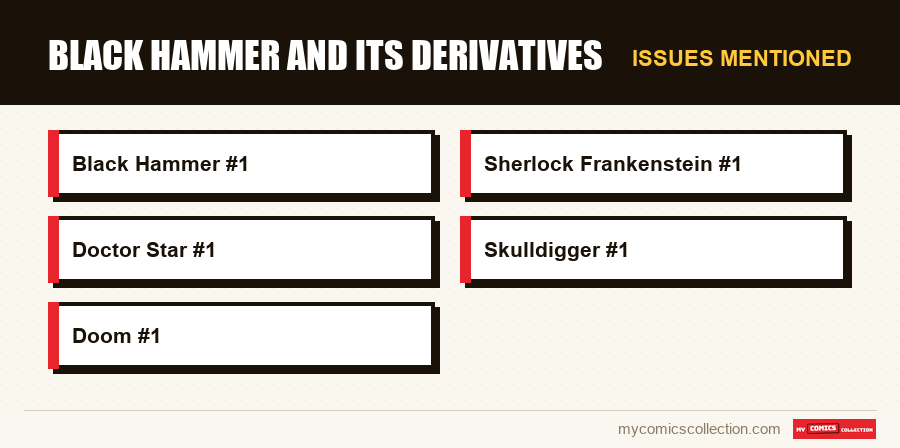
In the universe Black Hammer, the main series and its derivatives belong to two incommensurable markets. Asking prices observed on August 28, 2026 on the American market: Black Hammer #1 asks around $16 gross and $105 graded; the first numbers of the derivatives are around $8 to $10 gross, and some have no certified listing at all. The difference isn't about quality: it's about the first number.
Two markets, one universe. This is what the survey shows, and it is counter-intuitive for those who have read the derivatives and consider them, often rightly, to be better than the parent series.
The figures below are prix demandés, noted on August 28, 2026 on current announcements on the American market, isolated copies only: lots, reissues and collections excluded. These are not sales made, and this distinction is developed below.
Le relevé
Sherlock Frankenstein #1
Brut : median $7.79 across 83 listings, from $1.99 to $300.
Gradé : aucune annonce.
The most abundantly offered title in the survey, and the least expensive. Eighty-three copies available simultaneously for a first issue: there is no tension on this market.
Doctor Star #1
Brut : median $7.99 across 46 listings, from $1.49 to $81.54.
Gradé : aucune annonce.
Often cited as the best story in the entire universe. This is nowhere to be seen in its price: critical quality and marketability are two separate things.
Skulldigger #1
Brut : median $9.99 across 73 listings, from $0.99 to $120.
Gradé : median $99 across 7 listings.
The only derivative where a certified market begins to exist, with seven announcements. This is too little for the median to be reliable, but enough to signal the beginnings of interest.
Age of Doom #1
Brut : median $9.99 across 78 listings, from $0.99 to $119.99.
Gradé : deux annonces seulement.
The direct continuation of the main series, and yet aligned with the derivatives. The title change was enough to take it out of the « premier numéro » segment.
The comparison that explains everything
Compared to the same reading on the parent series, the difference is clear. Black Hammer #1 asks around $16 gross and $105 graded, with 17 certified listings. Its derivatives are around $8 to $10 gross, with zero to seven certified listings.
A factor of two on the crude, and a difference in nature on the grade: on one side an established certification market, on the other a market which practically does not exist.
This gap has nothing to do with the quality of the stories. Doctor Star is regularly presented as the top of the universe, and it is the least expensive of the survey. What the market values here is not what it reads, it is a position: be the first issue of the founding series.
Why the « #1 » concentrates the value
It is the universal benchmark
A buyer who wants to "own Black Hammer" purchases the first issue of the main series. It's the only object that everyone identifies without knowing the content.
The circulation follows the notoriety
A derivative launched after the success of the parent series benefits from much higher orders than a first issue launched to indifference. More copies in circulation, less rarity.
Certification follows price
Getting certified costs more than a copy is worth at $8. The graded market therefore does not exist on derivatives: not through lack of interest, but through arithmetic.
Changing titles is expensive
Age of Doom directly continues the main series, but under a different name. It mechanically leaves the desired segment, even though its content is part of it.
What these numbers allow, and what they don't allow
You must be precise about the nature of the data. eBay's public interface exposes listings en cours, not the history of completed sales. These are therefore prices hoped for by sellers, not prices paid by buyers.
Two consequences. First, the median is a floor of intention: the price actually obtained is structurally lower, because an overpriced ad remains online for a long time and weighs even more in the statistics. Second, reliability depends entirely on sample size: seven graded ads don't describe a market, they describe seven sellers.
Fair use of these figures is comparatif. They firmly establish that the parent series is an order of magnitude higher than its derivatives, and that the certification market only exists on it. They don't say what the copy sitting on your shelf is worth.
The number of ads is a piece of data in its own right. Quatre-vingt-trois exemplaires de Sherlock Frankenstein #1 available at the same time means no collector ever needs to rush into this title. Conversely, a seven-advertisement market requires you to take what is available.
Always look at the headcount before giving credit to a range. This is the data that rating articles systematically omit, and it is often the most informative.
What this changes for a collector
Three practical consequences arise from this statement, and they go against the grain of intuition.
Compléter l'univers coûte peu. Derivatives can be found around $8-10 the first issue, with ample supply. A collector who wants the set has no reason to wait or pay a premium.
The parent series is the only real expense item. If your budget is constrained, this is where you should concentrate it, and this is also the only title where the question of certification seriously arises.
Literary quality does not guide the purchase of a collection. Doctor Star is excellent and worth $8. This is good news for the reader, neutral information for the collector, and a useful reminder: these two activities do not obey the same criteria.
Collecting this series?
Track what you own, what you are missing and what your collection is worth. 7 day trial.
Start my trial →What the one dollar minimum says
Three of the four titles in the statement fall below the dollar: $0.99 for Skulldigger #1 et Age of Doom #1, $1.49 for Doctor Star. This floor deserves an explanation, because it is misleading.
A first issue offered for one dollar is not a damaged copy in the majority of cases. This is the classic call price for a volume seller: the comic is priced at one dollar, shipping costs cover most of the transaction, and the ad moves up in the sorting order by increasing price. This is an SEO technique, not a review.
Practical consequence: the minimum of a range says nothing about the state of the market, and a buyer who filters by the lowest price will often pay, including shipping, more than by purchasing an ad displayed at $6 or $7 with costs shared across several numbers.
This is the exact counterpart of the maximum problem. Both ends of a range are shaped by seller behaviors, not the value of the item. Only the center describes something real, and even then, provided we have ruled out the lots, which is what the above statement does.
The case of variants
The statement ranges go up to $300 on Sherlock Frankenstein #1, whose median is $7.79. A ratio of almost forty between the maximum and the median.
It is not an irrational market: it is the sign that “Sherlock Frankenstein #1” designates multiple objects. Independent publishers commonly publish the same issue under several covers (main cover, artist variants, boutique exclusives) whose print runs are nothing comparable.
In these series, the maximum of a range therefore almost always designates a rare variant, and the minimum a damaged copy. Only the median describes the current number, the one that most readers have.
A rule that goes beyond Black Hammer
The pattern observed here is repeated on almost all extended universes created by an independent author: the founding series concentrates the value, the derivatives remain accessible indefinitely.
The mechanics are still the same. The first title was launched without notoriety, with a cautious print run, and therefore only exists in limited quantities. Each subsequent success increases orders from booksellers for subsequent titles, which come out in abundance. Three years later, the first issue is rare and derivatives are everywhere.
For the collector, this suggests a simple strategy. In an emerging universe from a recognized author, it is the first issue of the first series that must be acquired early: the derivatives will always be available, at a price that will hardly change. The opposite is expensive: catching up with a seminal series after the fact comes at the price of its rarity.
What to note in your catalog
This statement makes concrete a rule valid beyond this universe: the title and number are never enough to locate a copy.
«Skulldigger #1” can mean a raw copy for $1 or a certified copy for $120. Without the cover variant, the condition or note, and the edition, no estimate is possible, and these three pieces of information cannot be reconstructed after the fact, because they appear nowhere on the object once it is stored.
It's the difference between an inventory, which tells you what you own, and a catalog, which lets you know what it's worth.
Questions fréquentes
Because they were launched after the success of the parent series, therefore with much higher orders from booksellers: more copies printed, more copies in circulation, less rarity fifteen years later. It is a purely quantitative mechanism, and it operates independently of content. Doctor Star, often cited as the best story in the entire universe, is the least expensive of the four titles noted: critical quality and market value simply don't measure the same thing. therefore with much higher orders from booksellers. More copies in circulation means less scarcity. Their quality is not taken into account: Doctor Star, often cited as the best story of the universe, is also the least expensive on the list.
That certification does not make economic sense on these securities. The operation costs more than an $8 copy is worth. This is therefore not a signal of disinterest from collectors, but a simple arithmetic consequence of the price level.
No, these are prices asked for advertisements in progress as of August 28, 2026. The price actually paid is structurally lower, because an overpriced advertisement remains online for a long time and weighs even more in the statistics. For a realized price, you must consult the history of sales concluded.
There is no rush: with 46 to 83 simultaneous announcements depending on the titles, the supply is abundant and there is no tension on this market. It's precisely the opposite of a title with seven announcements, where you have to take what comes.
Because a title change is enough to take a series out of the “first issue” segment, even when it directly continues the main story. The market values an identifiable position, not narrative continuity: it's a trap that we find on several Jeff Lemire series.
The number alone says nothing about the value
Variant, condition and print run are the three pieces of information that identify a copy, and the three that can no longer be found once the comic is put away.